How did a regime that claimed to have solved Germany’s economic crisis end up driving Europe to the brink of war within six years — and why did Britain, France and the wider world let it happen? This bundle pairs two complementary Year 12 / A-Level resources that build a connected narrative across the period, from domestic propaganda to international diplomacy.
Appeasement 1936–1939: A Crisis Simulation — A six-group, 90-minute simulation in which students take on the roles of Britain, France, Italy, the USSR and the USA, working through five real decision points between 1936 and 1939. Includes full teacher guidance, role cards, situation briefs, a comparison-table research worksheet, and an essay task.
How did a regime that claimed to have solved Germany’s economic crisis end up driving Europe to the brink of war within six years — and why did Britain, France and the wider world let it happen? This bundle pairs two complementary Year 12 / A-Level resources that build a connected narrative across the period, from domestic propaganda to international diplomacy.
Nazi Economic Policy: Mystery Method — Students use the Mystery method to investigate the question “Economic miracle or deception?”, working through 15 information cards covering statistical manipulation, rearmament, concealed debt and forced labour. Includes three discussion charts, a full teacher cluster solution, and a homework essay task.
“Was the Weimar Republic doomed to fail?” — a five-week analytical essay project, paired with an alternative presentation project on everyday life in the 1920s.
This pack gives Year 12 / A-Level History students (bilingual-ready) a structured route through Germany’s first democracy — from its founding in the chaos of 1918 to its collapse in 1933 — culminating in either a substantial analytical essay or a researched presentation, depending on which track fits your group.
Main Project: Was the Weimar Republic Doomed to Fail? (5 weeks) — A scaffolded route to a 400–600 word analytical essay. Students build an annotated timeline of all 21 key events (1918–1933), choose one additional source-analysis or stability-assessment task, and prepare for two individual oral discussions with the teacher (the Weimar Constitution, and Gustav Stresemann as “a good German or a good European?”). Includes a full lesson-by-lesson overview, an essay-writing-tips table, oral task prompts, and a curated list of online research resources (no fixed textbook required).
Alternative Project: Life in the 1920s (5 weeks, 14 lessons) — For groups better suited to research and presentation work. Students choose one topic — Medicine, Fashion, Entertainment, Sports, or School & Youth — and research it both globally and within Weimar Germany, ending in an 8–12 minute presentation plus a one-page handout. Each topic comes with a ready-made double-column overview (global developments vs. Germany/Weimar), key terms with definitions, and curated resource links. Includes a full phase-by-phase project plan and assessment criteria with weighting.
Why this pack works: both projects address the same guiding question from different angles — one through sustained argumentative writing, the other through research and presentation — so you can differentiate by group, or run them as alternatives across two classes. Both are fully online-research-based, with no dependency on a specific textbook.
Includes: 2 complete project briefs (essay project + alternative project), full lesson/phase plans, oral task prompts, assessment criteria, research resource lists, and a project-pack cover. Available in English and German, editable Word + PDF.
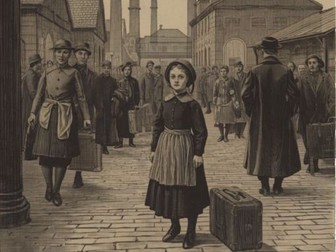
A twelve-year-old girl’s first sight of an industrial city — and everything her family left behind to get there.
Minna’s family has just arrived in Essen, drawn by the promise of steady factory wages after losing their farm. The Train to Essen follows her first hour in a world of smoke, noise and brick terraces — entirely unlike anything she has known.
Includes:
✔ Historical Context (1 page): rural-to-urban migration, the growth of Ruhr Valley cities, company housing
✔ Atmospheric illustration
✔ Short story (~430 words, B1–B2 reading level)
✔ 3 structured tasks: (1) Describe the child’s situation, (2) Make historical connections, (3) Creative writing — diary entry or letter
✔ Further reading: BBC, Victorian Web, Ruhr Museum, German Historical Museum
Curriculum fit: England KS3 History/English · USA Grade 7–9 Social Studies/ELA · Australia Year 8–10 · any secondary curriculum covering industrialisation and urban growth
No prep needed. Print and use, or assign digitally.
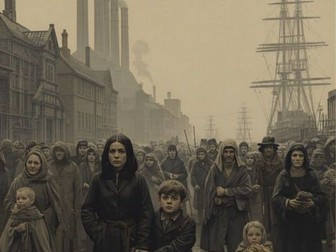
An eight-year-old boy’s first morning in Liverpool — after fleeing the Irish Famine.
Luke and his mother have just crossed from famine-stricken Ireland to the docks of Liverpool, 1847. Luke’s First Morning captures his disorientation in an enormous, noisy, indifferent city — and the loss that brought him there.
Includes:
✔ Historical Context (1 page): the Great Famine, Irish emigration to Liverpool, conditions on arrival
✔ Atmospheric illustration
✔ Short story (~430 words, B1–B2 reading level)
✔ 3 structured tasks: (1) Describe the child’s situation, (2) Make historical connections, (3) Creative writing — diary entry or letter
✔ Further reading: BBC History, National Museum of Ireland, Liverpool Irish Festival, Victorian Web
Curriculum fit: England KS3 History/English · USA Grade 7–9 Social Studies/ELA · Australia Year 8–10 · any secondary curriculum covering migration and the Victorian era
No prep needed. Print and use, or assign digitally.
Take your class from the British suffrage story out into a global, comparative view of women’s rights. In this ready-to-teach unit, students work in four groups to research the origins and development of women’s rights in Germany, the USA, India and Japan, then present their findings and compare the four national stories.
Everything is planned and print-ready:
A full teacher’s guide with a minute-by-minute plan for all three lessons (3 × 45 min: two for preparation, one for presentations and a comparison round)
Four group task cards (one country each) with the assignment, four shared guiding questions and curated, checked starter links for online research
A comparison worksheet (4 countries × 4 questions) plus synthesis questions for the closing discussion
Teacher background notes with concise, researched key facts per country, so you can steer the discussion with confidence
Skills: online research, source evaluation, structuring information, presenting, and historical comparison.
Works brilliantly as a follow-up to the “Suffragette Convention” debate role-play, but stands alone too. No textbook required.
Format: print-ready PDF plus a fully editable Word version. Suitable for Year 11+ (also ideal for bilingual history teaching).
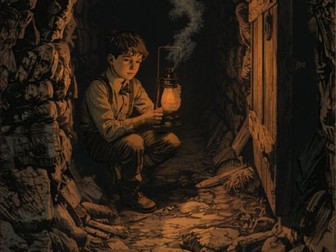
History through human eyes — a ten-year-old boy’s first day in a Victorian coal mine.
Emil is ten. His job is simple: sit in the dark beside a ventilation door and open it when the coal carts come. This is his first day underground. Coal Dust and Dawn is an original historical short story written by a History teacher, designed to make the Industrial Revolution immediate and personal for secondary students.
What’s included:
✔ Historical Context (1 page): child labour in Victorian coal mines, the Mines Act of 1842, the pace of reform — factually accurate, age-appropriate
✔ Atmospheric illustration
✔ Short story (~430 words): B1–B2 reading level, accessible to most secondary students
✔ 3 structured tasks:
— Task 1: Describe the child’s situation (comprehension)
— Task 2: Make historical connections (analytical paragraph)
— Task 3: Creative writing — diary entry or letter (differentiated choice)
✔ Further reading: 4 English-language resources (BBC, Victorian Web, Parliament Archives, National Coal Mining Museum)
Curriculum fit:
England: KS3 History (Industrial Revolution) / KS3–KS4 English (historical fiction, creative writing)
USA: Grade 7–9 Social Studies / ELA
Australia: Year 8–10 History / English
International: any secondary curriculum covering the Industrial Revolution
No prep needed. Print and use, or assign digitally.
Part of the Young Witnesses to History series by TN Teaching — original classroom fiction from children’s perspectives on pivotal moments in history.
Format: PDF, 6 pages, A4
A reassuring, jargon-free guide that schools can share with families to help parents support their child’s learning with AI – even if they’ve never used it themselves.
A perfect home-school link for newsletters, parents’ evenings or onboarding packs. It covers:
What AI tools are, in plain language, and how children realistically use them
Practical do’s and don’ts for healthy, balanced use at home
Conversation starters to talk with your child about AI, honesty and effort
Privacy and safety guidance, including what personal information should never be shared
Encouraging, non-alarmist advice focused on learning, not fear
Written by a practising teacher, with empathy for busy parents and no technical background required.
Format: print-ready PDF, A4. Easy to email, print or attach to a newsletter.
Part of the “AI in the Classroom” series – works alongside the teacher and student guides, or save with the complete bundle.
A ready-to-share handout that teaches students how to use AI to learn properly – not to cut corners. Hand it out in class, upload it to your VLE, or send it home.
Written in clear, student-friendly language, it covers:
How AI can actually help with studying, revision and understanding tricky topics
The difference between using AI to learn and using it to cheat
Simple, copy-and-paste prompts for explaining, quizzing and summarising
A 7-day “getting started” plan to build good habits
Key privacy and safety tips, including never entering classmates’ names or personal data
Ideal for secondary students (roughly KS3–KS5) and easy to use in tutor time, study-skills lessons or a digital-literacy unit.
Format: print-ready PDF, A4. No login or special software required.
Part of the “AI in the Classroom” series – pairs well with the teacher and parent guides, or save with the complete bundle.
Save hours of planning time without sacrificing quality. This practical guide shows you exactly how to use AI tools (such as ChatGPT, Claude or Copilot) to plan lessons that actually work in a real classroom – not generic AI filler.
Instead of vague advice, you get a clear, repeatable workflow:
A ready-to-use base prompt for planning any lesson, in any subject
How to critically check an AI’s output (timings, methods, subject accuracy)
Targeted “refining” prompts to differentiate, boost engagement, and trim a lesson to fit your time
How to generate matching worksheets and materials once the plan is solid
A clear note on data protection / GDPR when uploading pupil or textbook material
Written by a practising secondary teacher, with realistic time estimates and honest guidance on where AI helps – and where it doesn’t.
Format: print-ready PDF, A4. No login or special software required; works with any common AI chatbot.
Part of the “AI in the Classroom” series – see also the student and parent guides, or save with the complete bundle.
Immerse yourself in the fascinating world of the British women’s suffrage movement! Through this role-play activity, your students will experience first-hand how two important organisations – the constitutional NUWSS (“Suffragists”) and the militant WSPU (“Suffragettes”) – fought for women’s right to vote. They all pursued the same goal, but their methods were fundamentally different. Your class will take on the roles of speakers and audience members in a fictional convention to debate a crucial question: Which strategy truly leads to success – peaceful persuasion or militant pressure?
Roles: Five speaking roles (one chairperson, two NUWSS representatives, and two WSPU representatives), plus an active role for everyone else as members of the audience and the press. This ensures that every student is involved!
Materials: A comprehensive booklet containing an organiser’s guide and four detailed role cards for the speakers. Everything you need is included.
Content: The materials explore the crucial phase of the British women’s suffrage movement between 1907 and 1913. They provide an in-depth examination of the different strategies and ideologies that shaped the struggle for women’s right to vote.
 Quick View

 Quick View
 Quick View
 Quick View
 Quick View
 Quick View
 Quick View
 Quick View
 Quick View
 Quick View
 Quick View
 Quick View