Help students develop essential scientific skills through this engaging and interactive lesson on measurement and data collection. Students learn how scientists use measuring tools, standard units, and organized data to conduct reliable investigations and draw evidence-based conclusions.
File Type: PowerPoint Presentation
Grade 7 Science, Measurement, Scientific Investigation, Measuring Tools, Standard Units, Data Collection, Accuracy and Precision, STEM, Science Lesson, PowerPoint, Science Process Skills, Scientific Inquiry, Data Analysis, Laboratory Skills
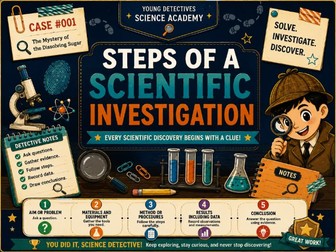
Transform students into science detectives as they learn the five steps of a scientific investigation through interactive activities, practice tasks, and assessment challenges.
Add What’s Included
Teachers love knowing exactly what they’re getting.
What’s Included:
Lesson introduction
Learning objectives
Interactive pre-assessment activity
Step-by-step instruction on scientific investigation
Guided practice
Investigation scenario
Science Detective Test
Answer key
Closing reflection activity
Add Keywords
Include:
Scientific Investigation
Scientific Method
Inquiry-Based Learning
Science Lesson
Middle School Science
Grade 7 Science
STEM
Investigation Skills
Critical Thinking
Assessment
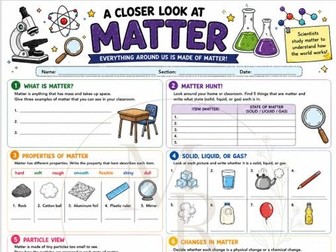
Help students explore the fascinating world of matter through this engaging and student-friendly science worksheet! This printable activity introduces key concepts about matter, including its properties, states, particle arrangement, physical and chemical changes, and mixtures and pure substances.
Students complete a variety of hands-on thinking tasks, observation activities, classification exercises, and reflection questions that encourage scientific inquiry and critical thinking. This resource is perfect for introducing a unit on matter, assessing prior knowledge, or reinforcing classroom learning.
What’s Included:
1 printable worksheet
What Is Matter? activity
Matter Hunt investigation
Properties of Matter practice
Solid, Liquid, or Gas classification
Particle View activity
Changes in Matter exercise
Mixtures or Pure Substances activity
Think Like a Scientist reflection
Exit Ticket assessment
Learning Objectives:
Define matter and identify examples of matter.
Describe common properties of matter.
Distinguish among solids, liquids, and gases.
Explain the arrangement of particles in different states of matter.
Differentiate physical and chemical changes.
Classify substances as mixtures or pure substances.
Perfect For:
Middle School Science
Introduction to Matter
Chemistry Lessons
Pre-Assessment Activities
Independent Practice
Homework
Science Centers
STEM Activities
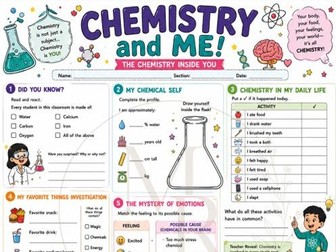
Help students discover that chemistry is all around them and inside them! This engaging one-page worksheet introduces key chemistry concepts through personal reflection, real-life connections, and interactive activities.
Students explore how chemistry relates to their bodies, emotions, daily routines, favorite foods, and the world around them. Through guided questions, checklists, and reflection tasks, learners develop curiosity about chemistry while making meaningful connections to their own lives.
What’s Included:
1 printable chemistry worksheet
Personal chemistry reflection activities
Chemistry in everyday life checklist
Chemical self-profile activity
Chemistry of emotions exploration
Human chemistry challenge
Reflection questions
Learning Objectives:
Recognize that chemistry is part of everyday life.
Identify examples of chemistry in the human body and the environment.
Connect chemistry concepts to personal experiences.
Develop curiosity and appreciation for the role of chemistry in daily living.
Perfect For:
Introduction to Chemistry
Grade 7 Science
Middle School Chemistry
Back-to-School Science Activities
STEM Lessons
Bell Work
Independent Practice
Science Enrichment Activities
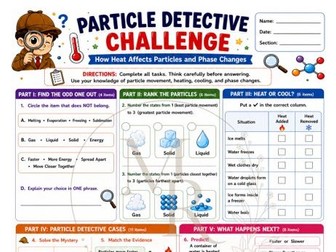
Turn your students into science detectives with this engaging worksheet on how heat affects particles and phase changes! Learners apply their understanding of particle movement, heating, cooling, and changes of state through a variety of interactive challenges, prediction tasks, matching activities, and critical thinking questions.
This detective-themed worksheet encourages students to analyze evidence, identify patterns, and explain how particles behave when heat is added or removed. It is perfect for reinforcing lessons on the Particle Model of Matter and phase changes while making learning fun and meaningful.
What’s Included:
1 printable worksheet
Odd One Out activity
Particle ranking challenges
Heat or Cool? classification task
Phase change matching activity
Particle behavior analysis
Prediction questions
Flowchart completion activity
Critical thinking challenge
Student self-assessment opportunities
Learning Objectives:
Describe how heat affects particle movement.
Explain the relationship between temperature and particle energy.
Identify phase changes and their causes.
Compare particle behavior during heating and cooling.
Apply the Particle Model of Matter to real-world situations.
Develop scientific reasoning and problem-solving skills.
Perfect For:
Grade 7 Science
Particle Model of Matter
States of Matter
Phase Changes
Chemistry Review
Independent Practice
Homework
Assessment Activities
STEM Learning Centers
Help students understand how heat affects particle movement and how these changes lead to phase changes of matter. This engaging, detective-themed lesson uses interactive activities, visual explanations, real-life examples, and mystery scenarios to help learners explore the relationship between heat, particle behavior, and changes of state.
Students investigate how heating and cooling affect particle movement, compare solids, liquids, and gases, and explain melting, freezing, evaporation, condensation, sublimation, and deposition using the Particle Model of Matter. The lesson concludes with problem-solving challenges that encourage scientific reasoning and discussion.
What’s Included:
30-slide PowerPoint lesson
Learning objectives
Interactive pre-assessment activity
Heating and cooling of particles
Particle movement and energy changes
Phase changes of matter
Melting, freezing, evaporation, condensation, sublimation, and deposition
Mystery scenario challenges
Discussion and reflection activities
Lesson summary and review
Learning Objectives:
Describe how heat affects particle movement.
Compare the effects of heating and cooling on matter.
Explain phase changes using the Particle Model of Matter.
Analyze real-life examples of changes of state.
Apply scientific reasoning to particle behavior and energy changes.
Perfect For:
Grade 7 Science
Particle Model of Matter
States of Matter
Phase Changes
Chemistry Lessons
Middle School Science
STEM Education
Inquiry-Based Learning
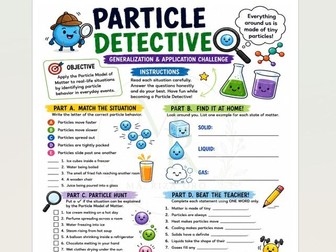
Help students apply their understanding of the Particle Model of Matter through this fun and engaging detective-themed worksheet. Learners become “Particle Detectives” as they analyze everyday situations, identify particle behavior, classify examples of matter, and demonstrate their understanding of solids, liquids, gases, and particle movement. The activity encourages critical thinking, observation, and real-world application of science concepts.
Students complete a variety of challenges including matching activities, home investigations, concept application tasks, fill-in-the-blank questions, and a bonus challenge. This worksheet is ideal as a lesson generalization activity, independent practice task, review exercise, homework assignment, or formative assessment. The detective theme keeps students motivated while reinforcing key scientific concepts.
What’s Included:
1 printable worksheet
Real-life particle behavior scenarios
States of matter identification activity
Particle Model application questions
Concept review and recall tasks
Fill-in-the-blank challenge
Bonus critical thinking activity
Student scoring section
Learning Objectives:
Apply the Particle Model of Matter to everyday situations.
Identify examples of solids, liquids, and gases.
Explain particle movement and behavior.
Relate particle arrangement to the properties of matter.
Demonstrate understanding of key Particle Model concepts.
Perfect For:
Grade 7 Science
Particle Model of Matter
States of Matter
Independent Practice
Homework
Review Activities
Science Centers
Formative Assessment
STEM Learning
Bring the invisible world of particles to life with this engaging and visually rich Science lesson on the Particle Model of Matter. Through real-life examples, interactive discussions, colorful diagrams, and inquiry-based activities, students learn how particles explain the behavior and properties of matter.
The lesson begins with a fun Mystery Scent Challenge that encourages students to think like scientists before exploring the Particle Model of Matter, the five key rules of the model, particle behavior, forces of attraction, and the differences among solids, liquids, and gases. Students discover how particle movement and arrangement explain changes in matter and everyday phenomena.
What’s Included:
20-slide PowerPoint lesson
Mystery Scent Challenge engagement activity
Learning objectives
Introduction to the Particle Model of Matter
The 5 Rules of the Particle Model
Structure and behavior of particles
Forces of attraction
Solids, liquids, and gases
Particle diagrams and visual explanations
Summary and review slide
Reflection questions and discussion prompts
Learning Objectives:
Describe the Particle Model of Matter.
Explain that matter is made of tiny particles that are constantly moving.
Compare the arrangement and movement of particles in solids, liquids, and gases.
Explain how forces of attraction affect particle behavior.
Describe how temperature affects particle movement.
Use the Particle Model to explain the properties of matter and changes of state.
Perfect For:
Grade 7 Science
Particle Theory of Matter
States of Matter
Chemistry Lessons
Middle School Science
Inquiry-Based Learning
STEM Education
Classroom Presentations
Science Review Lessons
Help students explore how scientists study things that cannot be directly observed with this engaging and interactive lesson presentation! This ready-to-use resource introduces scientific models and their role in understanding invisible, distant, complex, and microscopic phenomena.
What’s Included?
✔ 20 visually engaging presentation slides
✔ Interactive “Can You Draw It?” mystery activity
✔ Introduction to scientific models
✔ Importance and uses of models in science
✔ Physical Models
✔ Conceptual Models
✔ Computer Models
✔ Mathematical Models
✔ Real-world scientific examples
✔ Interactive “Model Masters Challenge” (5 examples)
✔ Review and assessment activities
✔ Conclusion and reinforcement slide
Learning Objectives
Students will be able to:
• Define a scientific model
• Explain why scientists use models
• Differentiate the four major types of scientific models
• Identify scientific models from real-world examples


 Quick View