 Quick View
Mountain Weather: Surface Pressure Charts & Synoptic Weather Analysis
Ideal for Outdoor Education, Mountain Leader Training, Duke of Edinburgh, Expedition Skills and Adventure Education
Help learners develop one of the most valuable mountain leadership skills: understanding what the weather is likely to do before setting foot on the hill.
This engaging and practical lesson introduces students to the interpretation of surface pressure (synoptic) weather charts, enabling them to identify pressure systems, predict wind strength and direction, recognise approaching weather fronts, and understand how forecast conditions will affect mountain environments.
The resource also includes a range of practical weather-chart reading exercises designed to build confidence through real-world application.
What’s Included?
Fully editable PowerPoint presentation
Introduction to atmospheric pressure and weather systems
High and low pressure systems explained
Understanding isobars and wind speed prediction
Clockwise and anti-clockwise air circulation patterns
Surface pressure chart interpretation activities
Weather front recognition exercises
Mountain weather implications and hazard awareness
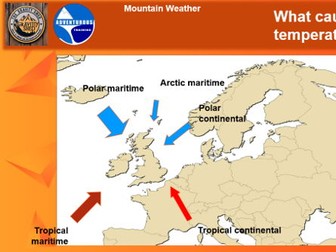
Air masses affecting the UK
Orographic rainfall and rain shadow effects
Temperature changes with altitude
Wind chill and mountain safety considerations
Practical synoptic chart reading tasks and discussion activities
Learning Outcomes
By the end of the session learners will be able to:
Interpret surface pressure charts with confidence.
Identify areas of high and low pressure.
Estimate likely wind strength using isobar spacing.
Determine wind direction around pressure systems.
Recognise weather fronts and associated weather conditions.
Explain how pressure systems influence mountain weather.
Apply weather forecasts to outdoor activity planning and risk management.
Suitable For
Mountain Leader Training
Lowland Leader Training
Hill and Moorland Leader Training
Outdoor Education Programmes
Duke of Edinburgh Award Groups
Adventure Activities
Expedition Training
Geography and Environmental Studies
Scout and Cadet Leadership Training
Teaching Approach
The lesson combines clear explanations with practical exercises, allowing learners to apply weather theory directly to authentic synoptic charts. The emphasis is on building real-world decision-making skills rather than simply memorising meteorological terminology.
Developed and delivered in outdoor education settings, this resource has been refined to help learners quickly gain confidence in weather interpretation and understand the practical implications for safe travel in mountainous environments.
A ready-to-teach resource that bridges the gap between weather theory and practical mountain leadership decision-making.