The Curated Self – Visual Arts Unit | Year 9 & 10 | Full Term UnitQuick View
artsmarter

The Curated Self – Visual Arts Unit | Year 9 & 10 | Full Term Unit

(0)
The capstone: an 8-week Years 9–10 unit where students make one independent work AND curate a real end-of-year exhibition – labels, roles, opening event, artist talks. Unit plans for both year levels, 8 PowerPoints, assessments and exams included. Making the work is half the art. Choosing, naming, placing and presenting it is the other half. The Curated Self is the capstone of the year: a complete, ready-to-teach term of Visual Arts for Year 9 AND Year 10, aligned to the Australian Curriculum: The Arts – Visual Arts (Version 9.0), with Presenting and performing (AC9AVA10P01) as the major focus – the strand most programs never quite get to. Each student develops one independent work in the medium where their year’s practice is strongest, from signed proposal through documented development to resolution. In parallel, the class mounts a formal end-of-year exhibition they curate and produce themselves. Two studies anchor the term: Brook Andrew’s NIRIN – curation itself as a creative and political act led by First Nations perspectives – and Yayoi Kusama’s Obliteration Room – the exhibition as an experience the audience completes. WHAT’S INCLUDED View a preview here: The Curated Self - Unit Preview Two complete unit plans (Year 9 and Year 10): 8 weeks × 3 lessons, every lesson outlined with learning intentions mapped to ACARA v9.0 codes Eight editable PowerPoint presentations: Unit introductions for each year level Anchor studies: Brook Andrew (NIRIN), Yayoi Kusama The Curator’s Craft – selection, sequence, placement, labels and didactics Exhibition Production – roles, run sheets, install day, the opening event Documentation & the Folio – photographing work to folio standard Year 10 Researching Exhibitions masterclass Assessment, fully marked out (per year level): Task 1: Visual Diary / Process Journal (30%) with A–E rubric Task 2: The Curated Self (Y9) / The Solo Show (Y10) (40%) with A–E rubric Exam 1: Reading the Exhibition (Week 4) – unseen installation analysis Exam 2: The Year on the Wall (Week 8) – the year’s summative paper, with marking guide and exemplars Student resources: Visual Diary Workbook scaffolding the capstone week by week Whole-year revision booklet matched to the summative exam Self-marking interactive revision quiz THE YEAR 10 DIFFERENCE The Year 10 capstone, “The Solo Show”, hands each student the curator’s job for their own retrospective: a thesis about their practice, existing works selected to prove it, ONE new work that extends it, a solo show within the shared space with full museum apparatus, a one-page catalogue entry and a three-minute artist talk. Exam 2 is an essay on curation as authorship plus a critical appraisal of their own practice – the written bridge to senior Visual Art.
Art as Voice – Complete Visual Arts Unit | Year 9 & 10Quick View
artsmarter

Art as Voice – Complete Visual Arts Unit | Year 9 & 10

(0)
A complete 8-week sculpture and digital media unit for Years 9–10: conceptual art and social commentary through Ai Weiwei, Piccinini, JR and Yhonnie Scarce. Unit plans for both year levels, 8 PowerPoints, assessments, exams and a student workbook. Artists change minds where arguments fail. What do YOUR students want to change someone’s mind about? Art as Voice is a complete, ready-to-teach term of Visual Arts for Year 9 AND Year 10, aligned to the Australian Curriculum: The Arts – Visual Arts (Version 9.0). Students investigate how artists respond to social, political and environmental influences to make artworks that carry a viewpoint – then build one of their own. Four artist studies model four persuasive strategies students can borrow: Ai Weiwei confronts – scale, multiplication and loaded materials Patricia Piccinini disarms – empathy and the believable impossible JR amplifies – unheard communities through monumental public photography Yhonnie Scarce haunts – hard Australian history made approachable through devastating beauty The ethics of persuasion are explicit from Week 1: argue issues, never target individuals; check facts; punch up, not down. Cultural protocols (ideas, never imagery – ICIP) carry forward. WHAT’S INCLUDED Art as Voice - Preview Two complete unit plans (Year 9 and Year 10): 8 weeks × 3 lessons, every lesson outlined with learning intentions mapped to ACARA v9.0 codes Eight editable PowerPoint presentations: Unit introductions for each year level Artist studies: Ai Weiwei, Patricia Piccinini, JR, Yhonnie Scarce Makers’ Toolkit: assemblage, construction, maquettes, staged photography, compositing Year 10 Researching Persuasive Practice masterclass Assessment, fully marked out (per year level): Task 1: Visual Diary / Process Journal (30%) with A–E rubric Task 2: The Voice Project (Y9) / The Campaign (Y10) (40%) with A–E rubric Exam 1: Reading the Message (Week 4) and Exam 2 (Week 8) with marking guides and exemplars Student resources: 15-page Visual Diary Workbook scaffolding every diary task Revision booklet matched to both exams Self-marking interactive revision quiz (any browser, no logins) THE YEAR 10 DIFFERENCE The Year 10 version, “The Campaign”, adds the audience requirement: one issue, one NAMED audience, and a body of work of 2-3 pieces built to change that audience’s mind. It culminates in a student-designed installation with curatorial rationale, plus comparative-analysis and essay exams that mirror senior assessment. PART OF A FULL-YEAR PROGRAM Term 3 of four connected units: Identity & Self → Country, Culture & Perspective → Art as Voice → The Curated Self. The persuasive and installation thinking built here feeds straight into Term 4’s real exhibition. Grab the Full Year Art Program bundle to save.
Full Year Art Program — 4 Complete Visual Arts Units | Year 9 & 10Quick View
artsmarter

Full Year Art Program — 4 Complete Visual Arts Units | Year 9 & 10

4 Resources
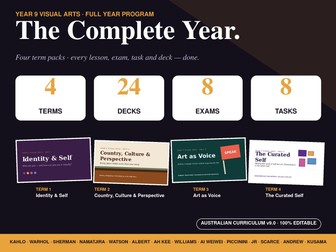
A whole year of Visual Arts for Years 9–10: four connected 8-week units, both year levels, 32 PowerPoints, 32 assessments and exams with rubrics and marking guides, student workbooks – ending in a real student-curated exhibition, kit included. One coherent year of Visual Arts – planned, resourced, assessed, and ending on a real gallery wall. The Full Year Art Program bundles four connected terms of Years 9–10 Visual Arts, aligned to the Australian Curriculum: The Arts – Visual Arts (Version 9.0). Every unit ships in a Year 9 AND a differentiated Year 10 version: 32 weeks of teaching per year level, every lesson outlined. THE ARC Term 1 – Identity & Self (drawing and mixed media): who am I, and how can I say it visually? Kahlo, Warhol, Sherman, Namatjira. Major work: a mixed-media self-portrait series. Term 2 – Country, Culture & Perspective (painting and printmaking): every place holds more than one story. First Nations art as the major focus – Watson, Albert, Ah Kee – taught with explicit cultural protocols (ICIP), plus Fred Williams. Major work: a Place & Perspective series with an editioned print. Term 3 – Art as Voice (sculpture and digital media): artists change minds where arguments fail. Ai Weiwei, Piccinini, JR, Scarce – four persuasive strategies. Major work: The Voice Project. Term 4 – The Curated Self (student-chosen media): the capstone. One independent work plus a formal, student-curated exhibition with real production roles, an opening event and artist talks. Brook Andrew’s NIRIN and Kusama anchor the term. Students learn to speak about themselves, about place, to an audience – then take responsibility for the whole conversation. WHAT’S IN THE BUNDLE View more details here: Full Year Art Program - Preview 8 complete unit plans (4 units × 2 year levels) – every lesson mapped to ACARA v9.0 32 editable PowerPoints – 14 artist studies from Kahlo to Kusama, technique toolkits for every medium, curation masterclasses, Year 10 research decks 16 assessment tasks and 16 exams with A–E rubrics, marking guides and exemplar answers – ending in a summative paper 4 term-by-term visual diary workbooks and revision booklets 4 self-marking interactive revision quizzes The complete Exhibition Kit: registrar log (Excel), museum-standard label sheets, catalogue template, photography consent letter, floor plan template, poster and invitation templates – reusable for every show your department runs CURRICULUM Complete coverage of all six Years 9–10 content descriptions (AC9AVA10E01, E02, D01, D02, C01, P01), rubrics written against the achievement standard, and First Nations Australian artists anchoring every term. Codes sit in clearly-marked tables – easy to swap for non-Australian frameworks.
Country, Culture & Perspective – Complete Visual Arts Unit | Year 9 & 10Quick View
artsmarter

Country, Culture & Perspective – Complete Visual Arts Unit | Year 9 & 10

(0)
A complete 8-week painting and printmaking unit for Years 9–10 with First Nations Australian art as the major focus – taught with explicit cultural protocols. Unit plans for both year levels, 8 PowerPoints, assessments, exams and a student workbook. Every place holds more than one story. Country, Culture & Perspective is a complete, ready-to-teach term of Visual Arts for Year 9 AND Year 10, aligned to the Australian Curriculum: The Arts – Visual Arts (Version 9.0). Students investigate how artists represent, celebrate and challenge perspectives of Australian places – with the practices of three leading First Nations Australian artists (Judy Watson, Tony Albert, Vernon Ah Kee) as the major focus, and Fred Williams as a comparative study in reinventing how land is seen. Cultural protocols come first. Week 1 explicitly teaches why First Nations imagery, symbols and styles are owned cultural knowledge (ICIP), and that respectful response means engaging with ideas and strategies while making work from your own place and experience. WHAT’S INCLUDED View preview of content here: [Country, Culture and PErspective - Preview(https://1drv.ms/b/c/cf531e57342e6492/IQC1d7nu0dgPQ40ofLFyLM3BAV9knz2qWo8ScqGEnWS3NYk?e=neNATZ) Two complete unit plans (Year 9 and Year 10): 8 weeks × 3 lessons, every lesson outlined with learning intentions mapped to ACARA v9.0 codes A dedicated protocols week before any making begins Eight editable PowerPoint presentations: Unit introductions for each year level Artist studies: Judy Watson, Tony Albert, Vernon Ah Kee, Fred Williams Print & Paint Toolkit: washes, layering, relief carving, proofing, editioning, monoprint Year 10 Researching Place-Based Practice masterclass Assessment, fully marked out (per year level): Task 1: Visual Diary / Process Journal (30%) with A–E rubric Task 2: Place & Perspective Series (Y9) / Body of Work: Contested Places (Y10) (40%) – including at least one editioned print and one painted work Exam 1: Reading Country (Week 4) and Exam 2 (Week 8) with marking guides and exemplars Student resources: 15-page Visual Diary Workbook scaffolding every diary task Revision booklet matched to both exams Self-marking interactive revision quiz THE YEAR 10 DIFFERENCE The Year 10 version, “Contested Places”, sends each student into a self-directed inquiry on a place where perspectives genuinely collide – the developed site versus the remembered one, the celebrated view versus the hidden history. Students independently research two artists, produce a body of work including a numbered relief edition, and curate their display with a written rationale. PART OF A FULL-YEAR PROGRAM Term 2 of four connected units: Identity & Self → Country, Culture & Perspective → Art as Voice → The Curated Self. The protocols taught here carry through the rest of the year. Grab the Full Year Art Program bundle to save.
Identity & Self - Complete Visual Arts Unit | Year 9 & 10 | Full TermQuick View
artsmarter

Identity & Self - Complete Visual Arts Unit | Year 9 & 10 | Full Term

(0)
A complete 8-week Visual Arts unit for Years 9–10: unit plans for both year levels, 8 editable PowerPoints, 4 artist studies, assessments with rubrics and marking guides, exams, and a student workbook. Print, teach, done. Who am I – and how can I say it visually? Identity & Self is a complete, ready-to-teach term of Visual Arts for Year 9 AND Year 10, aligned to the Australian Curriculum: The Arts – Visual Arts (Version 9.0), Years 9–10 band. Students investigate how artists construct, express and challenge identity through four artist studies – Frida Kahlo, Andy Warhol, Cindy Sherman and Vincent Namatjira – then answer the question themselves in a resolved mixed-media self-portrait series, presented with an artist statement in a classroom exhibition. Everything is written, sequenced and assessed for you. Both year-level versions are included, so you can run the same theme across your 9s and 10s with genuinely differentiated demands. WHAT’S INCLUDED Identity and Self - Unit Preview Two complete unit plans (Year 9 and Year 10): 8 weeks × 3 lessons, every lesson outlined with learning intentions mapped to ACARA v9.0 codes Weekly resources lists, studio routines and critique protocols Eight editable PowerPoint presentations: Unit introductions for each year level Artist studies: Frida Kahlo, Andy Warhol, Cindy Sherman, Vincent Namatjira Mixed-Media Toolkit techniques workshop Year 10 Independent Artist Research masterclass Assessment, fully marked out (per year level): Task 1: Visual Diary / Process Journal (30%) with A–E rubric Task 2: Mixed-Media Self-Portrait Series (Y9) / Body of Work (Y10) (40%) with A–E rubric Exam 1 (Week 4) and Exam 2 (Week 8) with marking guides and exemplar answers Student resources: 14-page Visual Diary Workbook scaffolding every diary task Revision booklet matched to both exams Self-marking interactive revision quiz (opens in any browser, no logins) A3 classroom posters, including the 4-step analysis frame used all year THE YEAR 10 DIFFERENCE The Year 10 version, “Facets of Identity”, keeps the term structure but shifts responsibility to the student: a self-framed inquiry question, two independently researched artists, an evaluative process journal with a Week 4 proposal gateway, a 3–4 piece body of work that must challenge an assumption, a student-curated display with curatorial rationale, and exams built around comparative analysis and essay argument. PART OF A FULL-YEAR PROGRAM Identity & Self is Term 1 of four connected units – Term 2: Country, Culture & Perspective; Term 3: Art as Voice; Term 4: The Curated Self, which ends in a real student-curated exhibition. The habits built in this unit (diary practice, the 4-step analysis frame, critique) are assessed in every later unit. Grab the Full Year Art Program bundle to save.
20 No-Prep Art Lessons for Relief/Substitute | Years 7-10Quick View
artsmarter

20 No-Prep Art Lessons for Relief/Substitute | Years 7-10

(0)
THE 8:47 AM PROBLEM, SOLVED. The art teacher calls in sick. The relief teacher hasn’t drawn since primary school. The class arrives in ten minutes. This bundle exists for exactly that morning. Every one of the 20 lessons is completely standalone – no sequence, no prior knowledge, no follow-up required. Grab any lesson by number, print the Word plan, project the PowerPoint, and the lesson runs itself. EVERY LESSON INCLUDES: A teacher plan (Word) with a timed 0–60 minute flow table, a word-for-word intro script, a 60-second art history background (so the relief teacher sounds like an expert), troubleshooting for the three most likely problems, early-finisher extensions, Year 7–10 differentiation notes, and an exit task. A student-facing PowerPoint (6–7 slides) with an example of the finished artwork, materials list, the hour at a glance, numbered step-by-step instructions, a success checklist, artist vocabulary, and three ‘finished early?’ challenges. WHAT’S IN THE BUNDLE: 20 editable Word lesson plans (.docx) 20 editable student PowerPoints (.pptx) A Start Here index with quick-pick guides (rowdy class? zero notice? no paint today?) A printable pack overview MATERIALS SPLIT: Lessons 1–10: paper, pencils, markers only – can run in ANY classroom, not just the art room. Zentangle patterns Blind contour One-point perspective Value shading Op Art Exquisite corpse Typography Scribble abstracts Positive/negative space Comics Lessons 11–20: standard art room supplies – paint, oil pastels, coloured paper, scissors, glue. Colour mixing lab Matisse cut-outs Sunset silhouettes Wax resist Painting to music Torn paper landscapes Monochromatic painting Klee shape cities Mandalas Warhol Pop Art Real artists and movements are woven through every lesson – Matisse, Kandinsky, Klee, Warhol, Bridget Riley, the Surrealists – so students learn genuine art content while the room stays calm and busy. 100% EDITABLE. All files are native Word and PowerPoint – adjust timings, translate, rebrand, or tweak for your school’s supplies. View a preview of the pack here: Relief Art Lesson Pack - Preview
Art Exhibition KitQuick View
artsmarter

Art Exhibition Kit

(0)
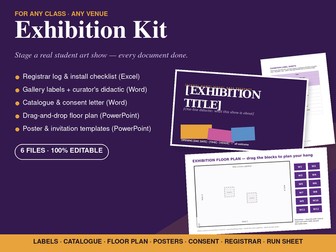
Class Art Exhibition Kit - Everything You Need to Stage a Real Student Show Turn your students’ work into a professional exhibition without reinventing the wheel. This editable kit hands you every document a class needs to plan, hang, promote and run an art show - from first floor plan to opening night. What’s inside (6 editable files): Registrar Log (Excel) - works register with auto-counts, install checklist, and opening-night run sheet Label & Didactic Sheets (Word) - print-ready gallery labels plus a curator’s panel template Catalogue Template (Word) - title page, artist entries and colophon, ready to fill and print Photography Consent Letter (Word) - parent/carer letter with a tear-off permission slip Floor Plan Template (PowerPoint) - drag-and-drop walls, plinths and work blocks to plan your hang Poster & Invitation Templates (PowerPoint) - bracketed placeholders, just swap in your details Why teachers love it: every file is 100% editable in Word, Excel and PowerPoint - no fonts to chase, no special software. Built around real gallery conventions (centreline heights, museum-standard labels, registrar practice) so students learn how professional exhibitions actually work. Print it, hand out the roles, and let your students run the show.