Hamlet: Examiner Language Practice Exercises (Grade 12 English Home Language)Quick View
kingarthsa

Hamlet: Examiner Language Practice Exercises (Grade 12 English Home Language)

(0)
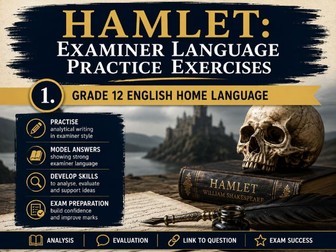
This resource builds on the skills introduced in “Writing in Examiner Language”. The model answer to the Ophelia practice task introduced in that resource is provided here, allowing learners to see how examiner-style analytical writing can be applied in practice. The resource also includes two further examiner-language exercises on Gertrude’s Complicity and the Role of Fortinbras, each accompanied by a teacher-model answer. Learners are given opportunities to identify and apply the analytical language required in Grade 12 English Home Language literature essays. An extension activity encourages learners to identify topic sentences, analytical verbs, literary present tense, links back to the essay question, and phrases that move beyond plot summary into analysis.
Grade 12 EHL — Hamlet Practice ResourceQuick View
kingarthsa

Grade 12 EHL — Hamlet Practice Resource

(0)
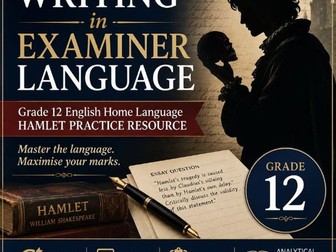
Writing in Examiner Language Grade Twelve English Home Language Hamlet Practice Resource. Why learners lose marks despite knowing the content. Examiner reports consistently flag the same issues, even in scripts that show good knowledge of the text: • Retelling instead of analysing — describing what happens rather than arguing why it matters. • Informal/conversational register — “I think”, “I feel”, “I reckon”, contractions, chatty tone. • Weak topic sentences — opening a paragraph with plot (“In this scene, Hamlet…”) instead of an argument. • Quotations left unintegrated — dropped in as a standalone sentence instead of woven into the learner’s own sentence. • Inconsistent tense — switching between past and present when discussing the text (should be present/“literary present” throughout). • Little analytical vocabulary — few verbs beyond “shows”; little use of literary terminology. The good news: this is a Register problem, not a knowledge problem — and register can be explicitly taught and drilled with a checklist, which is what this resource sets up. There is a Guide Question and a response, “Same Content, Two Registers”, One Weak, One Strong. “What changed?” (point this out explicitly to learners). This is followed by a Learner Self-Editing Checklist and a Word Bank and a Practice Task to conclude.