Dijkstra's Algorithm | AQA A Level Computer Science 7517 | 20 Worksheets + Answer KeysQuick View
CSResources

Dijkstra's Algorithm | AQA A Level Computer Science 7517 | 20 Worksheets + Answer Keys

(0)
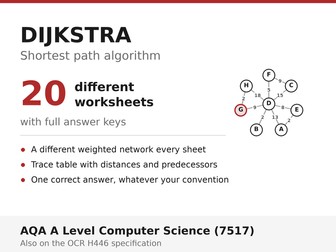
Dijkstra’s algorithm practice for AQA A Level Computer Science (7517): twenty different worksheets on the shortest path algorithm, each with a complete answer key. Every worksheet is built on a different weighted network. That is the point of the pack: you can set one sheet in class, a second for homework and a third for a resit without any two students ever holding the same questions, and without drawing new networks yourself at eleven o’clock at night. WHAT YOU GET 20 worksheets, 3 pages each, numbered 01 to 20 20 matching answer keys A contents table listing the number of vertices and the mark total of every sheet, so you can pick a six-vertex network for a ten-minute starter or a nine-vertex one for a full period WHAT IS ON EVERY SHEET Question 1 asks students to trace the algorithm: one row per vertex settled, recording every tentative distance and the vertex it was reached from, written as a subscript. Question 2 asks for the length of the shortest path and then for the path itself, read back off the completed table - the step most students never practise and most lose marks on. Question 3 asks why the distance to a settled vertex can never be improved by a later step, for a typical application of shortest path algorithms, and one further question that varies from sheet to sheet.
Graph Traversal BFS & DFS | AQA A Level Computer Science 7517 | 20 Worksheets + AnswersQuick View
CSResources

Graph Traversal BFS & DFS | AQA A Level Computer Science 7517 | 20 Worksheets + Answers

(0)
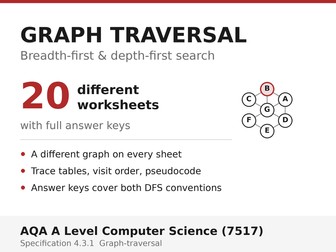
Graph traversal practice for AQA A Level Computer Science (7517): twenty different worksheets on breadth-first and depth-first search, each with a complete answer key. Every worksheet is built on a different graph. That is the point of the pack: you can set one sheet in class, a second for homework and a third for a resit without any two students ever holding the same questions, and without having to invent new graphs yourself at eleven o’clock at night. WHAT YOU GET 20 worksheets, 3 pages each, numbered 01 to 20 20 matching answer keys, 2 pages each A contents table listing the size and mark total of every sheet, so you can pick a short one for a cover lesson or a longer one for a full period WHAT IS ON EVERY SHEET Question 1 asks students to complete a trace table for a breadth-first traversal: the node removed from the queue, the state of the queue after each step, and the running visit order. Question 2 does the same for depth-first search, including the backtracking steps that most students forget. Question 3 shows a piece of pseudocode and asks which traversal it implements, and for a typical application of it. The first row of each trace table is completed for students, which removes any doubt about where the trace begins. Mark totals are printed at the top of each sheet and beside every question. WRITTEN FOR AQA, NOT ADAPTED FROM SOMEWHERE ELSE The pseudocode uses the conventions that appear in real 7517 question papers: the arrow assignment, SUBROUTINE and ENDSUBROUTINE, OUTPUT, FOR EACH … IN, and adjacency written as ConnectedNodes[N]. Helper subroutines are declared in prose before the code, exactly as AQA does. Question 3 asks for an application of the traversal rather than its time complexity, because that is what specification 4.3.1 actually requires. THE ANSWER KEYS DO SOMETHING UNUSUAL Textbooks disagree about how depth-first search is traced. These sheets use the alphabetically-first convention that mark schemes normally show, and state it plainly on the worksheet. But each answer key also lists the visit orders produced by the other two conventions in common use, with a note telling you to credit them in full. Whichever version your department teaches, you can mark with these keys without arguing with them. FORMAT PDF, A4, print-ready. You do not need to edit these: there are twenty genuinely different versions, so you already have a fresh sheet for every class, every resit and every homework. Licensed for the purchasing teacher and their own classes.
FREE Dijkstra's Algorithm Sample | AQA A Level Computer Science 7517 | 2 Worksheets + AnswersQuick View
CSResources

FREE Dijkstra's Algorithm Sample | AQA A Level Computer Science 7517 | 2 Worksheets + Answers

(0)
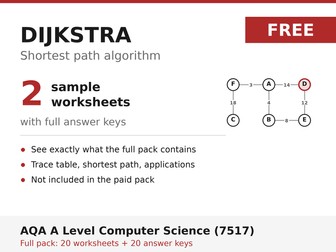
Two free sample worksheets on Dijkstra’s shortest path algorithm for AQA A Level Computer Science (7517), with full answer keys, so you can see exactly what the full pack contains before buying anything. Each sheet is built on its own weighted network. Question 1 is the trace table, one row per vertex settled, with tentative distances and the vertex each one was reached from. Question 2 asks for the length of the shortest path and for the path itself, read back off the completed table. Question 3 asks why a settled distance never changes, and for an application. These networks were generated so that the answer is never arguable: at every step exactly one unvisited vertex has the smallest tentative distance, and the shortest path to the target is unique. Whatever tie-breaking convention your department teaches, the answer key agrees with it. These two sheets are not in the paid pack - they are extra, so nothing is wasted if you buy it afterwards. The full pack contains 20 worksheets and 20 answer keys, every one built on a different network, which is what makes it usable for a whole class, a resit and a homework without any two students holding the same questions. Search Tes for “AQA A Level Computer Science Dijkstra shortest path” to find it.
FREE Graph Traversal BFS & DFS Sample | AQA A Level Computer Science 7517 | 2 Worksheets + AnswersQuick View
CSResources

FREE Graph Traversal BFS & DFS Sample | AQA A Level Computer Science 7517 | 2 Worksheets + Answers

(0)
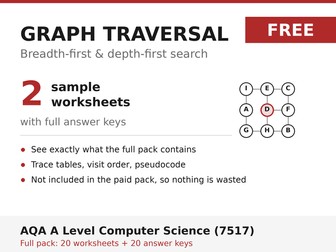
Two free sample worksheets on graph traversal for AQA A Level Computer Science (7517), with full answer keys, so you can see exactly what the full pack contains before buying anything. Each sheet is built on its own graph. Question 1 is a breadth-first trace table, question 2 a depth-first trace table including the backtracking steps, and question 3 asks students to identify a traversal from pseudocode written in the style of real 7517 papers. These two sheets are not in the paid pack : they are extra, so nothing is wasted if you buy it afterwards. The full pack contains 20 worksheets and 20 answer keys, every one built on a different graph, which is what makes it usable for a whole class, a resit and a homework without any two students holding the same questions. Search Tes for “AQA graph traversal worksheets” to find it.