Components of Blood- GCSE Circulatory SystemQuick View
Biosmash

Components of Blood- GCSE Circulatory System

(0)
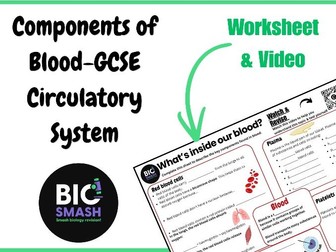
Help students to revise this GCSE level topic for their exams, or as a recap before studying Advanced-level biology. Students completing the worksheet gain an overview of the key components of blood and their functions. Covering blood cells, platelets and plasma. This resource enables students to produce a single page summary, which they can memorise and visualise in exams. Students fill in the gaps to summarise: The structure & function of red blood cells including the role of haemoglobin The roles of white blood cells- phagocytosis and production of antibodies & antitoxins The role of platelets in helping blood to clot and why this is important Subsbstances carried in plasma The document is a PDF so can be downloaded electronically or printed. The resource has an accompanying video which can be watched before or after students complete the worksheet, providing them with a deeper understanding of this topic. The video also includes a revision quiz. Use in class to introduce the topic, or set as a homework or revision exercise. The resource was developed to align with the AQA revision guide, but is also suitable for other GCSE courses. A PDF answer sheet is also provided, which could be projected onto the board to enable students to self or peer mark their answers. The resources could also be used as part of a cover lesson when a teacher is absent. For example, students could be set the task of using textbooks or revision guides to research the answers to the sheet. They could then be shown the video and be asked to check and correct/complete their answers as they watch.
Comparing the structure of DNA and RNA: A-levelQuick View
Biosmash

Comparing the structure of DNA and RNA: A-level

(0)
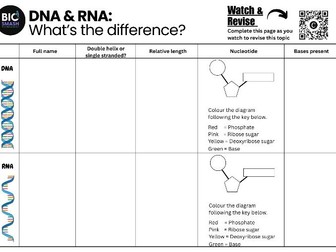
Help students to compare the structure of DNA and RNA and score top marks in this exam question. Download this resource to enable your students to produce a simple single page summary to memorise and visualise in exams. Students complete the table and colour the diagram to compare key features of DNA and RNA: Number of strands Sturcture of a nucleotide Sugars Bases Relative length Students complete the resource either by watching the associated video (accessed using the QR code provided on the worksheet) or using a textbook or revision guide. The document is a PDF so can be downloaded electronically or printed. Use in class to introduce the topic, or set as a homework or revision exercise. A PDF answer sheet is also provided, which could be projected onto the board to enable students to self or peer mark their answers. The resources could also be used as part of a cover lesson. For example, students could be set the task of using textbooks or revision guides to research the answers to the sheet. They could then be shown the video and be asked to check and correct/complete their answers as they watch.
An overview of why animals need  respiration (GCSE Level)Quick View
Biosmash

An overview of why animals need respiration (GCSE Level)

(0)
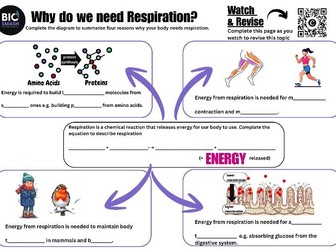
Help students to revise GCSE level respiration for their exams, or as a recap before studying Advanced-level metabolism. The resource enables differentiation by task as it includes two different versions of the worksheet: A gap fill activity for Foundation level student A version with boxes for free text for more able students This resource enables students to produce a single page summary, which they can memorise and visualise in exams. Students fill in the gaps to summarise the reaction for aerobic respiration and four reasons why animals need to respire: Release of energy for building molecules e.g. building proteins Release of energy for muscle contraction and movement Release of energy to maintain body temperature in mammals and birds Release of energy for active transport Students complete the resource either by watching the associated video (accessed using the QR code provided on the worksheet) or by using a textbook or revision guide. The document is a PDF so can be downloaded electronically or printed. Use in class to introduce the topic, or set as a homework or revision exercise. The resource was developed to align with the AQA revision guide, but is also suitable for other GCSE courses. A PDF answer sheet is also provided, which could be projected onto the board to enable students to self or peer mark their answers. The resources could also be used as part of a cover lesson when a teacher is absent. For example, students could be set the task of using textbooks or revision guides to research the answers to the sheet. They could then be shown the video and be asked to check and correct/complete their answers as they watch.
An introduction to the structure and function of the Nucleus. A level BiologyQuick View
Biosmash

An introduction to the structure and function of the Nucleus. A level Biology

(0)
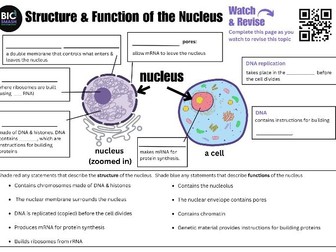
Help students to understand the structure and function of the nucleus as they study Eukaryotic cells and prepare for A level exam questions on this topic. This resource enables students to produce a single page summary that they can memorise and visualise in exams. They sort key sentences into two groups, helping them to understand the different between ‘structure’ and ‘function’ when answering exam questions, The worksheet includes descriptive sentences students can memorise to use in exam. These are packed with essential keywords to score higher marks. Students complete the resource either by watching the associated video (accessed using the QR code provided on the worksheet) or using a textbook or revision guide. The document is a PDF so can be downloaded electronically or printed. Use in class to introduce the topic, or set as a homework or revision exercise. The resource is suitable for a range of advanced level courses. A PDF answer sheet is also provided, which could be projected onto the board to enable students to self or peer mark their answers. The resources could also be used as part of a cover lesson. For example, students could be set the task of using textbooks or revision guides to research the answers to the sheet. They could then be shown the video and be asked to check and correct/complete their answers as they watch.
An overview of A-level cell structureQuick View
Biosmash

An overview of A-level cell structure

(0)
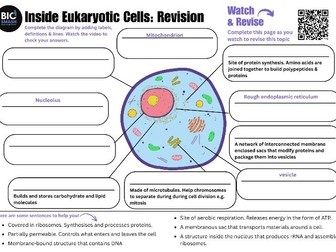
Help students to revise A-level cell structure for their exams, or as a recap before commencing modules that build upon this topic. This resource enables students to produce a single page summary, which they can memorise and visualise in exams. Students fill in the gaps to summarise the name and function of a range of components found in eukaryotic cells: nucleus nucleolus ribosomes rough endoplasmic reticulum smooth endoplasmic reticulum Golgi apparatus centrioles vesicles cell surface membrane The worksheet includes descriptive sentences students can memorise to use in exams, packed with essential keywords to score higher marks. Students complete the resource either by watching the associated video (accessed using the QR code provided on the worksheet) or using a textbook or revision guide. The document is a PDF so can be downloaded electronically or printed. Use in class to introduce the topic, or set as a homework or revision exercise. The resource is also suitable for a range of advanced level courses. A PDF answer sheet is also provided, which could be projected onto the board to enable students to self or peer mark their answers. The resources could also be used as part of a cover lesson. For example, students could be set the task of using textbooks or revision guides to research the answers to the sheet. They could then be shown the video and be asked to check and correct/complete their answers as they watch.
An overview of GCSE level metabolismQuick View
Biosmash

An overview of GCSE level metabolism

(0)
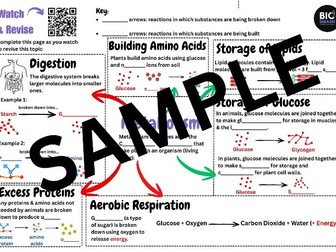
Help students to revise GCSE level metabolism for their exams, or as a recap before studying Advanced-level metabolism. This resource enables students to produce a single page summary, which they can memorise and visualise in exams. Students fill in the gaps to summarise a range of key metabolic reactions: digestion of starch digestion of protein amino acid synthesis by plants synthesis of lipid molecules storage of glucose as glycogen by animals storage of glucose as starch by plants aerobic respiration removal of excess proteins/amino acids in animals Students complete the resource either by watching the associated video (accessed using the. QR code provided on the worksheet) or by using a textbook or revision guide. The document is a PDF so can be downloaded electronically or printed. Use in class to introduce the topic of metabolism, or set as a homework or revision exercise. The resource was developed to align with the AQA revision guide, but is also suitable for other GCSE courses. A PDF answer sheet is also provided, which could be projected onto the board to enable students to self or peer mark their answers. The resources could also be used as part of a cover lesson when a teacher is absent. For example, students could be set the task of using textbooks or revision guides to research the answers to the sheet. They could then be shown the video and be asked to check and correct/complete their answers as they watch.