Spanish Numbers 1–15 & Age | Year 7 Spanish | 2-Hour LessonQuick View
The_Spanish_Teachers_Desk

Spanish Numbers 1–15 & Age | Year 7 Spanish | 2-Hour Lesson

(0)
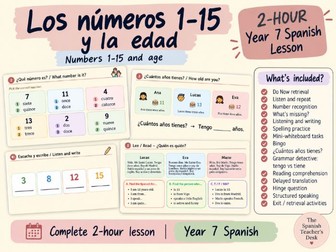
A ready-to-teach two-hour Spanish lesson for beginners, introducing and practising numbers 1–15 before using them in the context of asking and answering about age. The lesson moves from recognition and retrieval towards meaningful use of the language, while recycling previously taught language such as names, where students are from, languages and personality. Activities include: Do Now retrieval Listen and repeat Number recognition What’s missing? Listening and writing Missing-vowel spelling practice Mini-whiteboard retrieval Bingo ¿Cuántos años tienes? / Tengo ___ años Listening for age Grammar detective: tengo vs tiene Reading comprehension Delayed translation Hinge question Structured paired speaking Exit/retrieval activities Designed for Year 7 / beginner Spanish, with plenty of repetition and scaffolding before students are expected to speak independently. The resource can be taught as two consecutive one-hour lessons or one extended two-hour lesson.
GCSE Spanish – Social Problems | Los problemas sociales | 2-Hour LessonQuick View
The_Spanish_Teachers_Desk

GCSE Spanish – Social Problems | Los problemas sociales | 2-Hour Lesson

(0)
A complete 2-hour GCSE Spanish lesson on Los problemas sociales, designed for mixed-ability classes. Students learn how to talk about the social problems that concern them, explain why, and suggest possible solutions using se debería / no se debería + infinitive. The lesson gradually builds from accessible vocabulary and sentence structures towards more developed GCSE-style answers, including language such as: • El problema social que más me preocupa es… • Si tuviera que elegir, diría que… • Se debería / no se debería + infinitive • Si todos pusiéramos de nuestra parte, podríamos mejorar la situación. Activities include: • Retrieval Do Now • Vocabulary and pronunciation practice • Chat mat support • MWB recall and translation • Matching activities • Listening task + teacher script • Grammar detective • Hinge question • Delayed translation • Reading comprehension • Sentence Stealer • Trapdoor speaking practice • Exit ticket The lesson practises listening, reading, speaking, translation and grammar, with Foundation language alongside opportunities for Higher students to develop more sophisticated answers. Designed as a ready-to-teach GCSE Spanish lesson with plenty of structured repetition before independent production.
Year 7 Spanish – Greetings & ¿Qué tal? | Complete LessonQuick View
The_Spanish_Teachers_Desk

Year 7 Spanish – Greetings & ¿Qué tal? | Complete Lesson

(0)
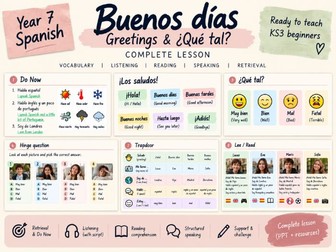
A complete Year 7 Spanish lesson introducing common greetings and how to say how you are. Ideal for beginner Spanish students in their first few weeks of learning. Students learn and practise greetings including ¡Hola!, Buenos días, Buenas tardes, Buenas noches, Hasta luego and ¡Adiós!, before learning how to respond to ¿Qué tal? using muy bien, bien, mal and fatal. Previously learnt language is deliberately recycled so students can begin combining new vocabulary with language they already know. The lesson includes: Retrieval Do Now Vocabulary presentation and pronunciation practice ¿Qué falta? / What’s missing? retrieval activity Greetings listening activity ¿Qué tal? listening and repetition Hinge question to check understanding Trapdoor speaking activity Reading comprehension with three levels of questioning Listening comprehension Support and challenge throughout Students move from comprehensible input and repetition towards retrieval, comprehension and structured production, while regularly revisiting previously learnt language. Suitable for Year 7 / KS3 Spanish beginners and designed to work with mixed-ability classes. Key language: ¡Hola! Buenos días. Buenas tardes. Buenas noches. Hasta luego. ¡Adiós! ¿Qué tal? Muy bien. Bien. Mal. Fatal.
Year 7 Spanish – Languages | ¿Qué idiomas hablas? | Complete LessonQuick View
The_Spanish_Teachers_Desk

Year 7 Spanish – Languages | ¿Qué idiomas hablas? | Complete Lesson

(0)
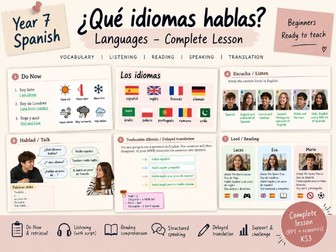
A complete Year 7 Spanish lesson on languages and saying which languages you speak. Ideal for beginner Spanish students in their first few weeks of learning. Students learn how to answer ¿Qué idiomas hablas?, using hablo, no hablo and un poco de to build increasingly detailed answers. The lesson includes: Retrieval Do Now Vocabulary presentation and pronunciation practice ¿Qué falta? / What’s missing? retrieval activity Listening activity with teacher script Phonics and pronunciation focus Delayed translation Hinge question to check understanding Reading comprehension Structured paired speaking Extension/challenge tasks throughout The lesson practises listening, reading, translation and speaking, with plenty of repetition before students are expected to produce the language independently. Suitable for Year 7 / KS3 Spanish beginners, with support and challenge built in for mixed-ability classes. Key language: ¿Qué idiomas hablas? Hablo español. Hablo inglés y un poco de español. No hablo…
GCSE Spanish – Actúa ya | Volunteering, Community & Social ActionQuick View
The_Spanish_Teachers_Desk

GCSE Spanish – Actúa ya | Volunteering, Community & Social Action

(0)
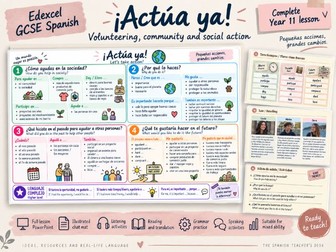
A complete GCSE Spanish lesson on volunteering, community and social action, designed for Year 11 Edexcel GCSE Spanish. The lesson is built around an illustrated Actúa ya Chat Mat, which students use as a scaffold to develop answers across present, past and future time frames, before moving towards more independent production. Students practise key language through a varied sequence of retrieval, listening, reading, translation, grammar and speaking activities, with regular opportunities to revisit and manipulate the same core language. Includes: Full illustrated Spanish-English Chat Mat Do Now retrieval and translation Listen & Repeat Bingo Faulty Echo ¿Te acuerdas? retrieval activity Jigsaw Translation Grammar Detective Hinge Question GCSE-style reading Three-time-frame practice Grammar and sentence-building activities Listening practice Independent Exit Ticket Higher-level language including si + imperfect subjunctive + conditional Suitable for a mixed-ability Year 11 class, with accessible core language alongside opportunities for students aiming for the higher grades to extend their answers. Ready to teach and designed to support students from scaffolded input towards confident, independent GCSE responses.
GCSE Spanish – Dónde prefieres vivir | Cities  | Edexcel | 2-Hour Lesson + Chat MatQuick View
The_Spanish_Teachers_Desk

GCSE Spanish – Dónde prefieres vivir | Cities | Edexcel | 2-Hour Lesson + Chat Mat

(0)
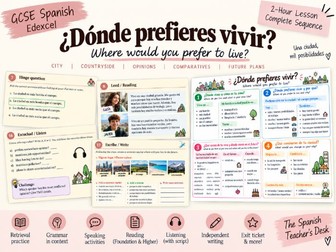
A complete 2-hour GCSE Spanish lesson on where you live, comparing the city and countryside, preferences and future plans. Designed for Edexcel GCSE Spanish, this resource develops students’ ability to move from supported comprehension to increasingly independent speaking and writing. Students practise: describing where they live and giving opinions comparing the city and countryside using más/menos… que saying where they prefer to live and explaining why talking about future living plans using higher-level chunks such as cuando sea mayor, si tuviera que dar mi opinión… and si tuviera la oportunidad… suggesting changes to their town/city using cambiaría, mejoraría and construiría The lesson includes retrieval practice, Listen & Repeat, Grammar Detective, Conti-style retrieval activities, MWB hinge questions, differentiated reading (Foundation/Core and Higher), listening with teacher script, structured speaking, independent writing and an exit ticket. Included: PowerPoint lesson + printable ¿Dónde prefieres vivir? chat mat. The sequence is designed to gradually remove scaffolding, with students moving from the chat mat and controlled practice towards independent GCSE-style language production. Suitable for a mixed-ability Year 10-11 class, with accessible support for Foundation students and extension opportunities for more confident learners. Topics: Local area, city vs countryside, opinions, comparatives, future plans, conditional language.
Year 7 Spanish – ¿Quién eres? | Introducing Yourself & Personality | 2-Hour LessonQuick View
The_Spanish_Teachers_Desk

Year 7 Spanish – ¿Quién eres? | Introducing Yourself & Personality | 2-Hour Lesson

(0)
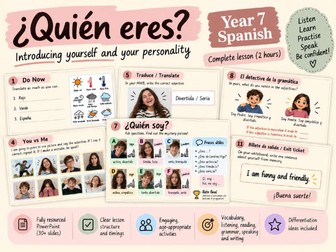
A fully resourced 2-hour Year 7 Spanish lesson introducing students to describing themselves and their personality. Designed for beginner learners, this lesson builds confidence gradually through listening and comprehensible input before moving into reading, grammar, retrieval, writing and structured speaking. Students learn to: introduce themselves using Soy… say where they are from using Soy de… describe their personality with adjectives such as divertido/a, simpático/a, tímido/a, activo/a, tranquilo/a, listo/a, serio/a and tonto/a use y, pero, bastante and un poco to extend their answers recognise and apply masculine/feminine adjective endings ask and answer ¿Cómo eres? Activities include retrieval practice, comprehensible input, You vs Me, What’s Missing?, MWB practice, Faulty Echo, Grammar Detective, listening, reading comprehension, delayed translation, structured pair speaking and a final Guess Who / Beat the Teacher game. Skills: Listening • Reading • Speaking • Writing • Grammar • Translation Level: Year 7 / beginner Spanish Length: Approximately 2 hours
GCSE Spanish – Medellín: Antes y Ahora | Town & City, Imperfect & Present Perfect | EdexcelQuick View
The_Spanish_Teachers_Desk

GCSE Spanish – Medellín: Antes y Ahora | Town & City, Imperfect & Present Perfect | Edexcel

(0)
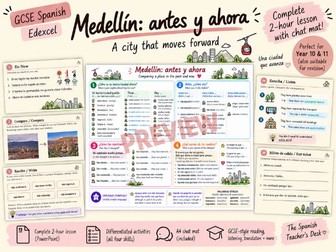
Medellín: antes y ahora is a complete 2-hour GCSE Spanish lesson designed to help students describe a town or city in the present, compare it with the past and explain how it has changed. Students practise: describing a town/city now and in the past era, había, estaba vs es, hay, está using the present perfect to explain changes (han construido, han mejorado, han renovado…) linking changes to logical consequences expressing and justifying opinions building more developed GCSE-style answers Designed with Edexcel GCSE Spanish in mind and suitable for Years 10–11, the lesson combines accessible scaffolding with opportunities for more confident students to develop complex language and independent responses. The resource includes an editable PowerPoint lesson and an A4 scaffolded chat mat, with vocabulary from Foundation and Higher combined into one accessible resource. Activities include retrieval practice, Grammar Detective, mini-whiteboard checks, hinge questions, listening, GCSE-style reading comprehension, speaking, translation, jigsaw translation and an independent exit ticket. Complex language is built into the chat mat to stretch higher-attaining students while keeping the core language accessible for students working towards the lower GCSE grades. Includes: PowerPoint lesson + printable A4 chat mat.
Year 7 Spanish | Countries, Colours & Flags | Phonics & Speaking LessonQuick View
The_Spanish_Teachers_Desk

Year 7 Spanish | Countries, Colours & Flags | Phonics & Speaking Lesson

(0)
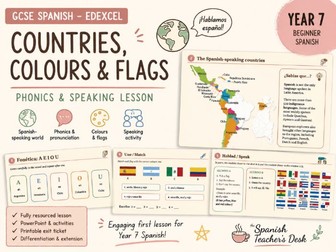
A ready-to-teach Year 7 Spanish lesson introducing Spanish-speaking countries, colours and key Spanish vowel sounds. The lesson includes: Spanish-speaking countries and cultural awareness Spanish vowel phonics: a, e, i, o, u Country-name pronunciation practice Short phonics dictation Key colours: rojo, amarillo, azul, verde, blanco, negro Flag and colour matching Structured paired speaking task Independent exit ticket Extension opportunities throughout Ideal for: Year 7 / beginner Spanish / first Spanish lessons / KS3 Spanish. Please note: The lesson includes a video activity that it can only be available in Onda 1 Pearson.
GCSE Spanish – ¡Un día fatal! | Preterite & Direct Object Pronouns | EdexcelQuick View
The_Spanish_Teachers_Desk

GCSE Spanish – ¡Un día fatal! | Preterite & Direct Object Pronouns | Edexcel

(0)
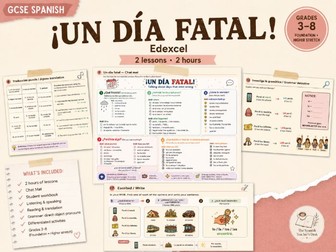
A ready-to-teach GCSE Spanish lesson pack on describing a day that went wrong, with a focus on the preterite tense and direct object pronouns (lo, la, los, las). Included: Full PowerPoint for 2 lessons Student workbook ¡Un día fatal! Chat Mat Listening and retrieval activities Jigsaw translation GCSE-style reading Speaking activities Direct object pronoun Grammar Detective + practice Scaffolded writing Foundation support and Higher stretch Designed for Edexcel GCSE Spanish, this resource includes two hours of lessons with a gradual progression from vocabulary recognition and comprehension to grammar, speaking and independent production.
GCSE Spanish Cinema Role Play | Edexcel Speaking Practice | En el cineQuick View
The_Spanish_Teachers_Desk

GCSE Spanish Cinema Role Play | Edexcel Speaking Practice | En el cine

(0)
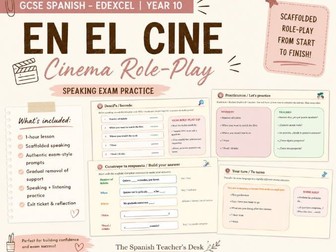
A complete GCSE Spanish speaking lesson designed to prepare students for an Edexcel-style cinema role play. The lesson includes: Retrieval Do Now linking to previous learning Key cinema vocabulary Listening and vocabulary recognition Explicit practice decoding GCSE role-play prompts Scaffolded response building Question formation practice Supported cinema role play Second role play to encourage transfer to a new situation Student and teacher role cards Exit ticket Students are gradually scaffolded from understanding key cinema vocabulary to decoding role-play prompts, building accurate responses and finally completing the speaking task with a partner. Suitable for Year 10 - 11 GCSE Spanish and designed with the Pearson Edexcel speaking assessment in mind. The lesson can also be adapted for other GCSE specifications or used as general transactional speaking practice. Skills: Speaking • Listening • Vocabulary • Exam skills
GCSE Spanish | El fin de semana pasado | Preterite TenseQuick View
The_Spanish_Teachers_Desk

GCSE Spanish | El fin de semana pasado | Preterite Tense

(0)
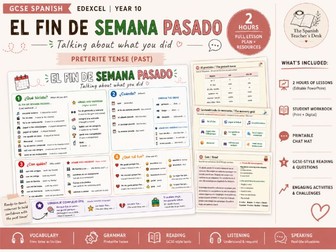
A complete 2-hour GCSE Spanish lesson on El fin de semana pasado, introducing and practising the preterite tense in the context of weekend activities. Includes: Editable PowerPoint for 2 hours of teaching Printable student workbook Printable El fin de semana pasado chat mat Vocabulary and retrieval activities Grammar Detective and explicit preterite practice Speaking activities including Trapdoor GCSE-style reading questions Delayed copying and dictation Exit ticket The resource is designed for mixed-attainment GCSE classes, with support for pupils who need more structure while providing opportunities for more confident learners to extend their answers and apply the preterite independently. Skills: vocabulary, grammar, speaking, reading, listening and writing.
GCSE Spanish 40–50 word Free Time |  Writing Lesson | EdexcelQuick View
The_Spanish_Teachers_Desk

GCSE Spanish 40–50 word Free Time | Writing Lesson | Edexcel

(0)
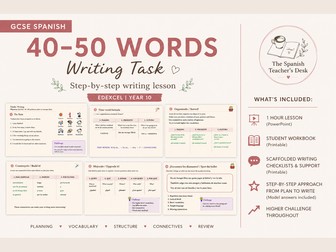
A complete step-by-step GCSE Spanish writing lesson designed to help students understand how to approach the Edexcel 40–50 word writing task. Students move from recognising and organising language → building sentences → upgrading ideas → analysing a model → planning → independent writing → self-assessment. Included: 1-hour teacher PowerPoint printable student workbook clear Describe – Opinion – Future writing formula Sort it! activity Build it! sentence scaffolding Upgrade it! activity model-answer analysis 60-second planning strategy GCSE-style 40–50 word task independent writing scaffold Be the examiner self-assessment Higher/stretch language throughout The lesson uses free time and future plans as its context, making it particularly useful alongside Edexcel GCSE Spanish Module 1, but the writing strategy can be transferred to other topics.
GCSE Spanish – Nos juntamos: Making Plans & Near Future Tense | Edexcel Year 10Quick View
The_Spanish_Teachers_Desk

GCSE Spanish – Nos juntamos: Making Plans & Near Future Tense | Edexcel Year 10

(0)
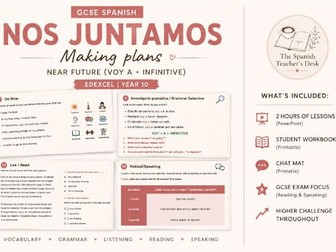
A complete 2-hour GCSE Spanish lesson sequence on making plans (Nos juntamos) and using the near future tense, designed for Edexcel Year 10. Students build vocabulary for making plans before learning and practising Near Future Tense. The lessons move from supported recognition and comprehension towards independent use of the language through listening, reading and speaking. The resource includes a teacher PowerPoint, student workbook and printable chat mat, with activities including: • Vocabulary introduction and retrieval • Bingo and categorisation • Grammar Detective • Explicit teaching and practice of the near future • Hinge Question • Broken Sentence activity • Listening task • GCSE-style reading comprehension • Scaffolded speaking practice • Exit ticket • Higher/stretch language throughout The resource is designed to support both Foundation students and students working towards Higher, with scaffolding that is gradually removed to encourage independent language production. Topic: Nos juntamos / Making plans Grammar: Near future – ir + a + infinitive Exam board: Pearson Edexcel GCSE Spanish Year group: Year 10
GCSE Spanish: El tiempo libre | Full Lesson + Workbook | Edexcel Module 1Quick View
The_Spanish_Teachers_Desk

GCSE Spanish: El tiempo libre | Full Lesson + Workbook | Edexcel Module 1

(0)
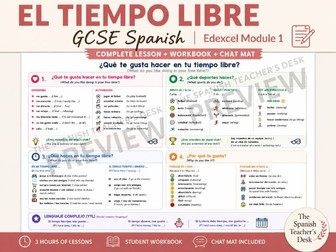
A complete GCSE Spanish lesson on El tiempo libre, designed for Edexcel GCSE Spanish and suitable for both Foundation and Higher students. The resource covers free-time activities, sports and opinions, with a focus on me gusta + infinitive, present-tense verbs and extending answers with reasons and more complex language. The pack includes a teacher PowerPoint, student workbook and chat mat, with a range of activities including listening, reading, speaking, grammar practice, retrieval activities and games. Activities include El eco mentiroso (Faulty Echo), Sentence Stealer, Jigsaw Translation, Grammar Detective, Sentence Auction, GCSE-style reading and listening, and speaking practice. Designed to cover approximately 3 hours of teaching (a two-hour lesson plus a separate one-hour lesson), with built-in scaffolding and challenge for mixed-attainment classes.
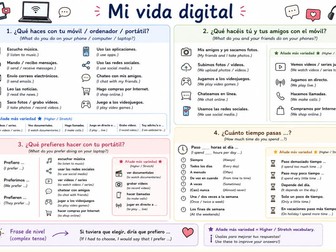
GCSE Spanish – Mi vida digitalQuick View
The_Spanish_Teachers_Desk

GCSE Spanish – Mi vida digital

(0)
A ready-to-teach GCSE Spanish resource pack for Edexcel Module 1, Lesson 1: Mi vida digital, with approximately 2 hours of classroom material. Students learn to talk about their digital lives while practising the present tense (I/We), preferir + infinitive, frequency expressions and extended answers. The pack includes: Teacher PowerPoint with answers Student workbook Mi vida digital vocabulary chat mat Foundation + Higher/Stretch vocabulary Listening and dictation Translation and GCSE-style reading Structured speaking and writing Grammar Detective and retrieval activities Hinge questions Sentence Stealer Classroom games Independent exit ticket Activities move from supported vocabulary practice to increasingly independent production, with the chat mat providing scaffolding that can gradually be removed. Designed for Edexcel GCSE Spanish, but easily adaptable for other GCSE specifications or confident KS3 classes.