Mixed Addition and Subtraction Within 20 WorksheetsQuick View
MathAndColoring

Mixed Addition and Subtraction Within 20 Worksheets

(0)
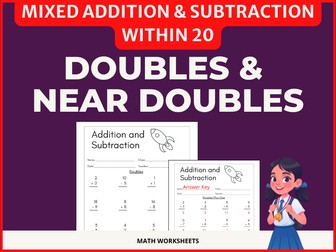
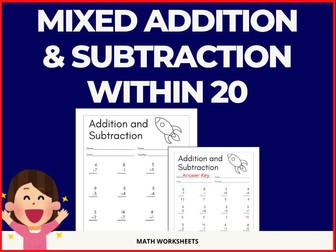
Mixed addition and subtraction through 20 math worksheets to help your students build confidence and fluency. Designed for Key Stage 1 (Year 1 and Year 2), the worksheets mix both operations in each practice sheet, encouraging children to think flexibly about numbers. Ideal for classwork, homework, exam preparation, or morning starters. What’s included: • 6 worksheets covering addition and subtraction facts within 20 • Mixed operation questions to develop number sense and operation recognition • Answer keys included for every worksheet • No prep, print-and-go format Perfect for: • Daily maths practice • Consolidating number bonds to 20 • Assessment preparation • Catch-up intervention groups • Early finishers and extension work Download now and give your class the mixed-operation practice they need to master addition and subtraction within 20!
Numberless Word Problems Addition and Subtraction Maths WorksheetsQuick View
MathAndColoring

Numberless Word Problems Addition and Subtraction Maths Worksheets

(0)
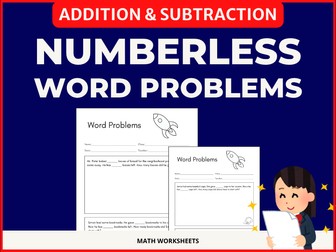
Numberless word problems build stronger problem solving skills and deepen pupils’ understanding of addition and subtraction. By removing numbers, pupils are encouraged to focus on the structure and context of each problem. They identify what’s happening and what operation is needed before working with actual values. This approach reduces the problem of pupils just guessing an operation without actually understanding what’s going on. Resource includes: • A set of word problems without numbers (within 20) • Problems covering a range of addition and subtraction structures (e.g. joining, separating, comparing, part-part-whole) • Space for pupils to record their thinking, strategy, and working out • Ready to print and use straight away You can add numbers yourself and use as traditional word problems or have the students add their own numbers to build their critical thinking skills. Because there are no numbers, the worskheets can be used across different years to teach addition and subtraction through 5, 10, 20, 100…etc Why use numberless word problems? Taking numbers out of the problem first shifts pupils’ attention to making sense of the story and the relationships between quantities. This builds stronger number sense, reasoning skills, and confidence tackling word problems independently. Maths skills covered: Addition and subtraction fluency within 20, reasoning, problem-solving, and comprehension skills as pupils interpret the context of the story problem and select the appropriate strategies and operations. Suitable for: • Reception–Year 4 (KS1) maths classes • Whole-class teaching, guided groups, or independent work • Number talks, morning work, and problem-solving sessions • Intervention and small-group support • Home education / homeschooling maths A resource that builds genuine mathematical thinkers!
Halloween Numberless Word Problems | Addition & SubtractionQuick View
MathAndColoring

Halloween Numberless Word Problems | Addition & Subtraction

(0)
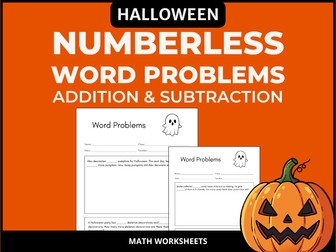
Fun Halloween themes numberless word problems maths worksheets! Numberless word problems are a research proven strategy that helps pupils build mathematical reasoning and comprehension of story problems. Pupils must read each scenario carefully, work out what’s happening, and decide whether to use addition or subtraction, and why. This approach helps pupils truly understand the structure of a problem instead of just guessing the operation and calling it a day. Resource includes: • 30 pages of numberless Halloween-themed word problems • Problems covering a range of addition and subtraction structures (e.g. joining, separating, comparing, part-part-whole) • Space for pupils to calculate • Fun Halloween contexts, like pumpkins, ghosts, trick-or-treating, spiders, etc., to boost engagement You have the option to either add numbers yourself or give the pupils an independent or group activity where they can write their own numbers. The worksheets can be used across a variety of years for addition and subtraction through 5, 10, 12, 20, 100 and so on. Why numberless word problems work: Removing numbers from a maths word problem forces pupils to slow down and make sense of the story before jumping to a calculation. It builds stronger number sense, deeper comprehension, and more confident, independent problem solvers. Suitable for: • Reception–Year 4 (KS1) maths classes • Whole-class teaching, guided maths groups, or independent work • Halloween-themed lessons and seasonal maths activities • Number talks and problem-solving discussions • Home education / homeschooling maths A resource that makes reasoning about addition and subtraction fun this Halloween!
Two Step  Numberless Word Problems HalloweenQuick View
MathAndColoring

Two Step Numberless Word Problems Halloween

(0)
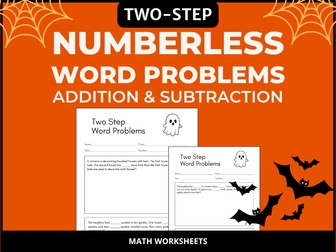
Challenge your students this Halloween with two-step numberless word problems for addition and subtraction! With no numbers in the story problem, pupils can’t just pick out numbers and guess an operation. Instead, they must carefully work through each spooky scenario, identify that two steps are needed, and reason through the sequence of operations required to solve it. Combining “numberless” and “two-step” pushes pupils to engage in much deeper mathematical reasoning than a standard word problem, helping them build genuine understanding of problem structure. Resource includes: • 30 pages of two-step Halloween-themed numberless word problems • Multiple types of addition and/or subtraction problems (comparison, part-whole, join, separate .etc) • Fun, seasonal contexts for Halloween, e.g pumpkins, trick-or-treating, ghosts, spiders, and more — to keep pupils engaged • Space for students to calculate You have the option to add numbers yourself or give your class the challenge of inserting their own numbers. The worksheets can be used across multiple years to teach multi step addition and subtraction. Why use numberless two-step problems? When a question does not feature any numbers, students have to understand: should the first number be bigger or smaller than the other one? Is the amount increasing or decreasing? They build stronger number sense, better comprehension of traditional word problems, and true problem-solving confidence, laying the groundwork for tackling multi-step problems independently once numbers are introduced. Maths skills covered: Pupils develop reasoning, critical thinking, and sequencing skills, learning to break a scenario into two connected steps and identify the correct operations. Suitable for: • Year 2–4 (KS1/Lower KS2) maths classes • Whole-class teaching, guided maths groups, or independent work • Halloween-themed lessons and seasonal maths activities • Number talks and problem-solving discussions • Home education / homeschooling maths Get it today!
Order of Operations with Decimals Worksheets | BODMAS, BIDMAS, GEMDAS, BEDMASQuick View
MathAndColoring

Order of Operations with Decimals Worksheets | BODMAS, BIDMAS, GEMDAS, BEDMAS

(0)
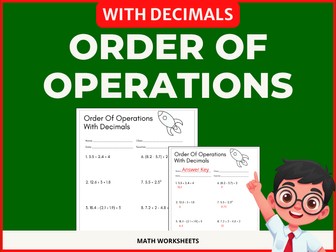
Maths worksheets covering order of operations with decimals. Can be used for Key Stage 2 (KS2) and Key Stage 3 (KS3) maths lessons, homework and revision particularly for Year 6 – 7 students. Students can practice applying BODMAS/BEDMAS/Order of calculations in multi-step equations involving decimals. Resource includes: • 5 printable worksheets, 10 questions each (50 questions total) • A BEDMAS reference sheet each pupil • Answer keys for every worksheet, making marking quick and easy • PDF, instant digital download. Ready to print and use straight away Maths skills covered: Pupils solve multi-step expressions involving addition, subtraction, multiplication, division, exponents/indices, and brackets. They apply the order of operations (BODMAS/BIDMAS/BEDMAS/GEMDAS/PEMDAS) to decimal number calculations. Suitable for: • Years 6–8 (Key Stage 2 and Key Stage 3) maths classes • Whole-class teaching, small groups, or independent work • Homework tasks and revision materials • Assessment and exam preparation • Home education / homeschooling maths A no-prep, print-and-go resource for reinforcing decimal calculation skills and order of operations rules in the classroom or at home.
Order of Operations with Exponents & Nested Brackets Worksheets | BEMDAS, BODMAS, BIDMAS, PEMDASQuick View
MathAndColoring

Order of Operations with Exponents & Nested Brackets Worksheets | BEMDAS, BODMAS, BIDMAS, PEMDAS

(0)
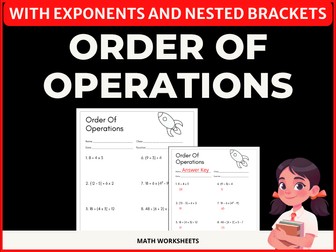
Challenging order of operations maths worksheets covering indices / exponents and nested brackets. Designed for Key Stage 2 (KS2) and Key Stage 3 (KS3) students, these worksheets are ideal for building confidence with more complex, multi-step calculations. Resource includes: • 5 printable worksheets, 10 questions each (50 questions total) • Each question combines 2–4 operations • A BEDMAS rule reference page included for each pupil • Answer keys included for every worksheet, to make your marking faster • Clean, black-and-white layout to keep printing costs down • PDF, instant digital download; ready to use immediately after printing Maths skills covered: Pupils apply the order of operations to multi-step expressions involving addition, subtraction, multiplication, division, exponents/indices, and grouping symbols, including nested brackets. They will practice using BODMAS/BIDMAS/BEDMAS/PEMDAS/GEMDAS rules accurately. Suitable for: • Years 6–9 (Key Stage 2 & 3) maths classes • Whole-class teaching, small groups, or independent/extension work • Homework tasks and revision materials • Assessment and exam preparation • Home education / homeschooling maths A no-prep, print-and-go worksheets that push pupils beyond the basics and builds confidence with complex order of operations problems.
BIDMAS Order of Operations with Integers, Fractions and Decimals Worksheets Bundle | BEMDAS, PEMDAS, GEMDAS, BODMASQuick View
MathAndColoring

BIDMAS Order of Operations with Integers, Fractions and Decimals Worksheets Bundle | BEMDAS, PEMDAS, GEMDAS, BODMAS

4 Resources
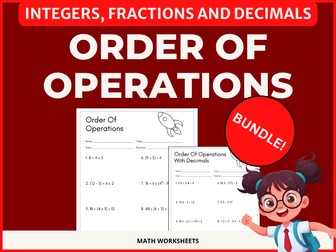
Everything you need to teach and consolidate order of operations, all in one money-saving bundle! This worksheets bundle brings together four resources, taking pupils from the basics right through to more advanced multi-step calculations with fractions, decimals, and exponents/indices. This bundle includes: 1. Order of Operations with No Exponents / indices The worksheets can be used as an introduction to the concept or as support for students who are behind. The focus is on addition, subtraction, multiplication, division, and brackets with whole numbers. Students can practice the order of operations rule without indices. Included: ** • 5 worksheets and answer keys • BEMDAS rule reference page 2. Order of Operations with Exponents & Nested Brackets A more challenging set of worksheets that require students to use exponents/indices and nested brackets in multi-step expressions. It can be an excellent way to assess pupil’s understanding of the material. **Included: ** • 5 worksheets and answer keys • BEMDAS rule reference page 3. Order of Operations with Decimals Applies BODMAS/BIDMAS/BEMDAS rules to calculations involving decimal numbers. You can tackle revision of multiple topics at once, allowing students to practice order of calculations and also practice adding, subtracting, multiplying and dividing decimals/ **Included: ** • 5 worksheets and answer keys • BEMDAS rule reference page 4. Order of Operations with Fractions Challenges pupils to apply the order of operations to fraction calculations. The worksheets are differentiated across three progressive difficulty levels. **Included: ** • 6 differentiated worksheets and answer keys Suitable for: • Years 6–9 (Key Stage 2 and Key Stage 3) maths classes • Whole-class teaching, small groups, or independent/differentiated work • Homework tasks, revision, and exam preparation • Home education / homeschooling maths A complete, no-prep bundle that supports pupils from their first introduction to order of operations all the way through to confident work with fractions, decimals, and exponents. At a better value than buying each resource separately.
Doubles and Near Doubles Maths Fact Fluency Addition Worksheets to Within 20Quick View
MathAndColoring

Doubles and Near Doubles Maths Fact Fluency Addition Worksheets to Within 20

(0)
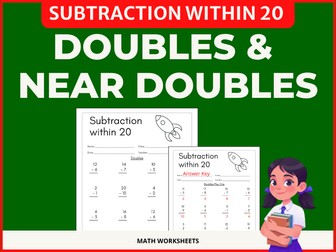
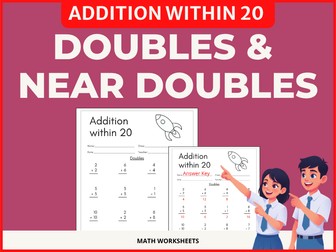
Doubles facts are often the first ones children commit to memory - 3+3, 6+6, 9+9 and so on. Near doubles build on that knowledge, teaching children to adjust a known double by one or two to work out a related fact. The worksheets work through each strategy step by step: doubles on their own first, then doubles plus one, doubles minus one, doubles plus two and doubles minus two as separate skills. Later worksheets mix these together challenge the students and build fluency Math Worksheets included: Doubles Doubles Plus One Doubles Minus One Doubles Plus Two Doubles Minus Two Mixed Doubles and Doubles Plus One Mixed Doubles and Doubles Minus One Mixed Doubles and Doubles Plus Two Mixed Doubles and Doubles Minus Two Mixed Doubles, Doubles Plus One, and Doubles Plus Two Mixed Doubles, Doubles Minus One, and Doubles Minus Two Suitable for Year 1 and Year 2 pupils working on addition fact fluency within 20. Useful for morning work, maths centres, homework, test preparation, assessment or independent practice. Answer keys included. Black and white, print-and-go format.
Order of Operations with Fractions Differentiated Maths WorksheetsQuick View
MathAndColoring

Order of Operations with Fractions Differentiated Maths Worksheets

(0)
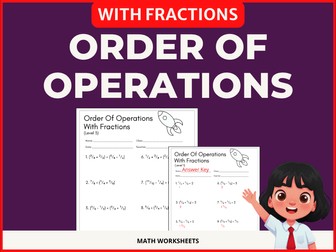
Take order of operations to the next level with fractions! This worksheet set challenges students to apply PEMDAS/BODMAS rules to multi-step problems involving fractions, strengthening both their fraction skills and their understanding of operation sequence. What’s included: 6 printable worksheets, 10 problems each (60 questions total) 3 progressive difficulty levels (2 worksheets per level) for easy differentiation Complete answer keys for every worksheet Simple, printer-friendly black-and-white design PDF, instant digital download What students practice: Adding, subtracting, multiplying, and dividing fractions within multi-step expressions that include parentheses/brackets. Reinforcing the PEMDAS/BODMAS/BEDMAS/GEMDAS order of operations (no exponents). Perfect for: Year 4–7 maths classrooms and small groups Students who’ve mastered basic order of operations and are ready for fractions Homework, warm-ups, and maths centers Exam preparation and review Homeschool lessons Download, print, and start practicing. No prep required!
Order of Operations With NO Exponents Math WorksheetsQuick View
MathAndColoring

Order of Operations With NO Exponents Math Worksheets

(0)
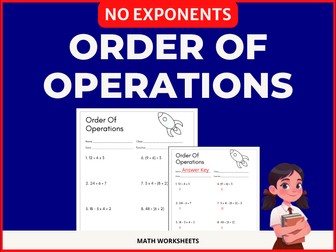
Build a rock-solid foundation in order of operations before adding exponents into the mix! These math worksheets are designed for students who are new to the concept so learners gain confidence before tackling harder problems. What’s included: 5 printable worksheets, 10 problems each (50 questions total) Mostly 2–3 step problems, with a handful of 4-step challenges to push stronger students A BEMDAS cheat sheet with an easy-to-remember mnemonic Complete answer keys for every worksheet Simple black-and-white printable design PDF, instant digital download What students practice: Multiplication, addition, subtraction, division, and grouping symbols (brackets/parentheses). Exponents are left out so students can master the core order-of-operations rule first. Perfect for: Grades 4–6 math classrooms First introduction to order of operations Homework, warm-ups, or math centers Test prep and skill checks Homeschool lessons Download, print, and you’re ready to teach. Zero prep needed! Depending on your location you may know the order of calculation rule as PEMDAS / GEMDAS / BEDMAS / BODMAS or BIDMAS. The questions are approproate regardless.