

 Quick View
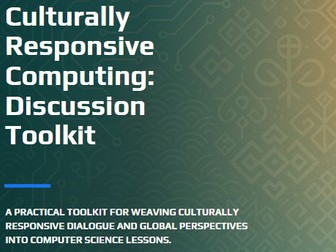
Culturally Responsive Computing Toolkit
Integrate culturally responsive computing into CS lessons with this ready-to-use discussion toolkit mapped to IB, AP, and Cambridge.
Overview
The Culturally Responsive Computing (CRC) Discussion Toolkit provides educators with classroom-ready slides that connect technical concepts to diverse cultural, historical, and global contexts. Designed to address time constraints, this toolkit offers drop-in discussion prompts, curated resources, and model responses mapped to major international specifications. See the resource on Google Slides here.
“A practical toolkit for weaving culturally responsive dialogue and global perspectives into computer science lessons.”
Pedagogical Background & Research
For a detailed look at the research, design methodology, and classroom implementation behind this toolkit, read the accompanying open-access article: ACM Inroads.
Community Contributions
This is an evolving living document. I invite you to contribute to keep it up to date. Educators can submit edit suggestions directly within the document to add new case studies, refine prompts, or contribute fresh perspectives. All suggested edits will be vetted and approved to ensure they align with the core purpose of the toolkit.
Suggest edits here.
Curriculum Mappings
Program
Syllabus Mapping
IB DP CS
Legacy (1–7) & updated modules (A1–B4, IA)
AP CS Principles
Units 1–5 (Data, Algorithms, etc.)
AP CS A
Units 1–4 (Using Objects, Selection, Classes, Data)
Cambridge IGCSE (0478)
Topics 1–10 (Data, Hardware, Software, etc.)
Cambridge A Level (9618)
Topics 1–20 (Architecture, Security, AI, etc.)
Topics & Case Studies
Historical & Social Computing Examples
Pioneers: NASA’s Human Computers, Ada Lovelace, Grace Hopper, Alan Turing, & Black Technologists.
Global Algorithms: Incan Quipu, Mesoamerican Calendars, Abacus, African Fractals, & al-Khwarizmi.
Cryptography: Navajo Code Talkers & Haitian Revolution Ciphers.
…
Contemporary & Global Perspectives Examples
Policy: Taiwan Tech, Europe’s GDPR, & Democratizing AI (NAIRR).
Culture & Access: South Korea Esports, Kenya M-Pesa, Sub-Saharan Digital Health, & Middle East Women in STEM.
Innovation: Latin America Open-Source, Balinese Subak System, & Indigenous-Led Tech.
…
What’s Included
Curated Media: Links to vetted articles, primary sources, short videos, and interactive simulations.
Discussion Prompts: Guided questions with model answers for Socratic discussions or reflections.
Flexible Design: Fully editable content to serve as short lesson starters or even unit capstone debates/discussions.