 Quick View
Rich and Poor Victorians Lesson KS2
Little Historians: The Victorians
Lesson 4 of 8
Rich or Poor?
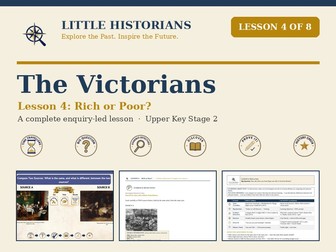
Pupils compare two Victorian paintings of two very different homes and ask what a house can tell you about a life.
This enquiry led lesson develops historical investigation, chronology, source analysis and evidence-based thinking. Rather than simply learning facts, pupils think like historians by investigating a real historical source and asking:
How did where you lived shape your life in Victorian Britain?
Every Little Historians lesson follows the same six-stage framework:
Time Travellers: retrieval and chronology
Big Question: historical enquiry
Evidence Detectives: source analysis
Discover: knowledge and vocabulary
Prove It!: evidence-based application
History Check: reflection and assessment
What’s Included?
Lesson 4 PowerPoint (plus a PDF copy for quick viewing on any device)
Historical Investigation activity booklet pages for Lesson 4
Teacher answer sheet for Lesson 4
Unit Overview and Lesson 4 plan, with effective questions to ask
The Little Historians Framework
The Source
Two paintings of two homes: Frith’s Many Happy Returns of the Day (1856), a comfortable family birthday, and Fildes’ The Doctor (1891), a sick child in a labourer’s cottage. In the Journal, pupils compare two of Doré’s London engravings from 1872.
In This Lesson
Pupils will:
Compare two sources showing rich and poor Victorian homes
Describe the key differences between wealthy and poor housing
Understand how overcrowding and dirty water spread disease, and how reform began
Ask whether two pictures by different artists can be compared fairly
Write a comparison of a rich and a poor Victorian childhood using both sources
Historical Skills Developed
Comparison
Observation
Inference
Historical vocabulary
Change and continuity
Evidence-based writing
Looking for the Full Unit?
Lesson 1 is FREE. The complete Victorian Unit contains all 8 enquiry led lessons, the full 62 page Historical Investigation Journal, a Knowledge Organiser, end-of-unit assessment with a supported version and mark schemes, teacher subject notes, a plan for every lesson, the Evidence Detective Question Bank and the Historian Competency Tracker – for less than the cost of the lessons bought separately.
Lessons include:
Who Were the Victorians?
Who Was Queen Victoria?
What Was It Like to Be a Victorian Child Worker?
How Did Where You Lived Shape Your Life?
What Was Victorian School Like?
How Did the Railways Change Britain?
How Big Was the British Empire, and at What Cost?
Are the Victorians Still With Us Today?
Viewing on a phone or tablet? Use the PDF copy – phone preview apps don’t display every PowerPoint design element.
Teach children to think like historians through evidence, enquiry and historical investigation.
Little Historians
Explore the Past. Inspire the Future.