French Lesson 4: Classroom ObjectsQuick View
Amine_Benembarek

French Lesson 4: Classroom Objects

(0)
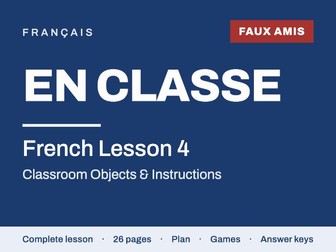
A complete, ready-to-teach French lesson on classroom objects, teacher instructions, and how to ask for help in French. Everything is planned, timed and answered, so you can print it and teach it with no preparation. WHAT’S INCLUDED (26 pages, one PDF) • A single 60-minute lesson plan, minute by minute, cross-referenced to page numbers • Two warm-up activities - a French-only “teacher robot” game and a real-object listening task • Ten classroom objects with illustrations, gender and pronunciation written for English speakers • Ten teacher instructions (Ecoutez, Levez-vous, Ouvrez votre livre) all sharing one pattern • Six essential survival phrases so learners can ask for help without switching to English • Picture-matching, sorting and comprehension activities • A pair speaking task built around the two classic false friends • A closing team game using real objects from the classroom, plus a quiet Mystery Bag variant • Object dictation, exit ticket and homework • Word search, letter scramble, odd-one-out and a crossword • Printable object cards • Full answer keys for everything WHAT MAKES THIS DIFFERENT Most beginner French resources teach vocabulary. This lesson also protects against the two classroom false friends that catch out English speakers every single year. Un crayon looks like it should be a wax crayon - it is an ordinary pencil. Une gomme looks like it should be chewing gum - it is an eraser. The warm-up springs both traps before they are explained, so learners remember the correction rather than just being told a fact. The lesson also splits vocabulary into two clear categories: what the teacher says to the class, and what the learner needs to say back. Most resources only teach the first half, which leaves learners able to follow instructions but unable to ask for help - so they default to English the moment they are stuck. Six survival phrases fix that gap directly. PRACTICAL DETAILS • No prep beyond printing and cutting the object cards • Suitable for KS2, KS3, Year 7 starters, adult beginners and one-to-one tuition • Follows Lessons 1-3 but works as a standalone classroom-language lesson • No prior French assumed (CEFR Pre-A1) • Teacher-only pages are clearly marked so you know what not to photocopy • Works as an emergency cover lesson Lesson 4 of a complete 30-lesson beginner French course.
French Unit 1 Assessment: Revision TestQuick View
Amine_Benembarek

French Unit 1 Assessment: Revision Test

(0)
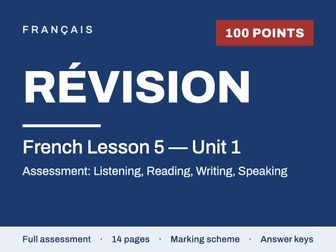
A complete, ready-to-use revision and assessment lesson covering Unit 1 of a beginner French course - greetings, the alphabet, numbers 0-20, and classroom language. Includes a 12-minute revision carousel followed by a full 100-point assessment across all four skills, with a marking scheme and answer key. WHAT’S INCLUDED (14 pages, one PDF) • A single 60-minute lesson plan, cross-referenced to page numbers • A four-station revision carousel, one station per topic, for use before the test • Part A - Listening (20 points): letter and number dictation, spoken instructions • Part B - Reading (25 points): a dialogue with comprehension questions, tu/vous judgement, gender and true/false items • Part C - Writing (30 points): numbers in words, spelling names aloud, a six-line dialogue • Part D - Speaking (25 points): a live one-to-one assessment grid with five prompts and a marking scale • A learner self-assessment checklist tied to each lesson in the unit • Printable revision station cards • A full marking scheme and answer key, including the listening script to read aloud WHAT MAKES THIS DIFFERENT Most revision resources are a pile of extra worksheets. This one is a structured test with a defined mark scheme, so it works as a genuine end-of-unit assessment rather than just more practice. Every item is tied to a specific error pattern from earlier in the unit. A teacher notes section explains what each question is really checking - for example, one reading question tests whether a learner reads dix-sept correctly rather than seeing sept, and one writing question checks whether register is held consistently across a full conversation rather than slipping into the wrong form partway through. That makes marking fast: the wrong answer usually tells you exactly what to reteach. PRACTICAL DETAILS • No prep beyond printing and cutting the revision station cards • Suitable for KS2, KS3, Year 7 starters, adult beginners and one-to-one tuition • Follows Lessons 1-4 of the same course • No prior French assumed (CEFR Pre-A1) • Teacher-only pages are clearly marked so you know what not to photocopy • The speaking assessment can be run alongside written work, so no lesson time is lost Lesson 5 of a complete 30-lesson beginner French course, and the final lesson of Unit 1.
French Lesson 3: Numbers 0-20Quick View
Amine_Benembarek

French Lesson 3: Numbers 0-20

(0)
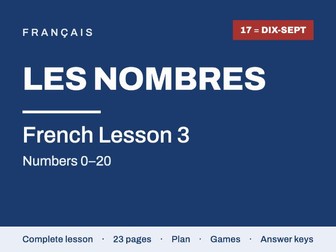
A complete, ready-to-teach French lesson on numbers 0-20 - counting, hearing numbers said aloud, and writing them correctly. Everything is planned, timed and answered, so you can print it and teach it with no preparation. WHAT’S INCLUDED (23 pages, one PDF) • A single 60-minute lesson plan, minute by minute, cross-referenced to page numbers • Two warm-up activities using fingers and a listening chain, no printing needed • All numbers 0-20 with French spelling and pronunciation written for English speakers • A dedicated page on why 17-19 are built differently from 11-16, with a side-by-side comparison table • Picture-matching, dice and sequencing activities • A pair speaking task in two rounds, pairing each confusable number with its counterpart • A closing number bingo game with four printable cards • Number dictation, exit ticket and homework • Word search, letter scramble, odd-one-out, logical sequences and an arithmetic crossword • Full answer keys for everything WHAT MAKES THIS DIFFERENT English invents a new word for every number up to twenty. French stops inventing at sixteen, then switches to a different system - seventeen becomes “ten-seven”, eighteen becomes “ten-eight”. Learners keep listening for a word that never comes, and miss the number when a French speaker says it. This lesson makes that switch the centre of the whole hour. The warm-up is built so learners feel the problem - most classes stumble counting backwards through 17 - before the grammar page explains it. The dictation, the pair task and the bingo game are all built around the numbers learners actually confuse: 7 and 17, 6 and 16, 2 and 12. PRACTICAL DETAILS • No prep beyond printing and cutting the bingo cards • Suitable for KS2, KS3, Year 7 starters, adult beginners and one-to-one tuition • Follows Lessons 1-2 but works as a standalone numbers lesson • No prior French assumed (CEFR Pre-A1) • Teacher-only pages are clearly marked so you know what not to photocopy • Works as an emergency cover lesson Lesson 3 of a complete 30-lesson beginner French course.
French Lesson 2: Alphabet & AccentsQuick View
Amine_Benembarek

French Lesson 2: Alphabet & Accents

(0)
A complete, ready-to-teach French lesson on the alphabet, the five accents, and spelling names aloud. Everything is planned, timed and answered, so you can print it and teach it with no preparation. WHAT’S INCLUDED (24 pages, one PDF) • A single 60-minute lesson plan, minute by minute, cross-referenced to page numbers • Two warm-up activities, including a listening dictation that exposes the E / I problem in the first ten minutes • All 26 letters with French names and pronunciation written for English speakers • The five accents - aigu, grave, circonflexe, trema, cedille - with examples and a naming exercise • Comment dit-on and Comment ca s’ecrit for spelling aloud • A pair speaking task in two rounds, with six names chosen to force every trap • A closing team spelling race • Letter dictation, exit ticket and homework • Word search, letter scramble, odd-one-out, crossword and a number-code puzzle • Printable letter tiles and accent cards • Full answer keys for everything WHAT MAKES THIS DIFFERENT The French alphabet looks identical to the English one, which is exactly the problem - learners assume they already know it and stop listening. Nine letters behave differently, and two pairs are actively misleading. French I is pronounced “ee”, which is the sound English speakers expect from the letter E - so they hear I and write E. French G is said “zhay”, which sounds like an English J, while French J is said “zhee”, which sounds like an English G. Learners reverse both pairs almost every time on first exposure. This lesson names those nine letters explicitly, prints them in red throughout, and builds the warm-up, the pair task and the closing game around them. PRACTICAL DETAILS • No prep beyond printing and cutting the letter cards • Suitable for KS2, KS3, Year 7 starters, adult beginners and one-to-one tuition • Follows Lesson 1 (greetings) but works as a standalone alphabet lesson • No prior French assumed (CEFR Pre-A1) • Teacher-only pages are clearly marked so you know what not to photocopy • Works as an emergency cover lesson Lesson 2 of a complete 30-lesson beginner French course.
French Lesson 1: Greetings & Tu or VousQuick View
Amine_Benembarek

French Lesson 1: Greetings & Tu or Vous

(0)
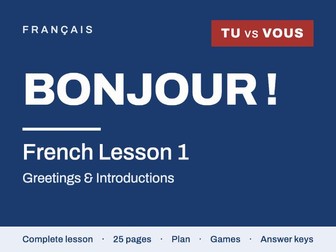
A complete, ready-to-teach first French lesson for absolute beginners - greetings, introductions, and the tu / vous distinction. Everything is planned, timed and answered, so you can print it and teach it with no preparation. WHAT’S INCLUDED (25 pages, one PDF) • A single 60-minute lesson plan, minute by minute, cross-referenced to page numbers • Two warm-up games - Debout / Assis and La Chaine des Prenoms • Three vocabulary sets with pronunciation guides written for English speakers • A dedicated tu / vous grammar page with a decision table and the safe-default rule • Two reading dialogues and picture-matching activities • Six written exercises, an exit ticket and a homework task • Bingo des Salutations speaking activity • A closing team game with printable cards • Word search, letter scramble, odd-one-out and crossword as extra practice • Full answer keys for everything WHAT MAKES THIS DIFFERENT Most beginner French resources teach the words. This one also teaches what English speakers get wrong about them. The teacher guide lists seven specific errors anglophone learners make in their very first French lesson - using bonne nuit as a greeting, saying salut to an adult, pronouncing the final t of salut, defaulting to tu because it looks like “you”, agreeing enchante with the wrong person - and exactly how to pre-empt each one. Every wrong answer in the exercises is a real mistake rather than a random distractor, so a wrong answer tells you which misconception to reteach. PRACTICAL DETAILS • No prep, no props, nothing to cut beyond the game cards • Suitable for KS2, KS3, Year 7 starters, adult beginners and one-to-one tuition • No prior French assumed (CEFR Pre-A1) • Teacher-only pages are clearly marked so you know what not to photocopy • Works as an emergency cover lesson Lesson 1 of a complete 30-lesson beginner French course.