Elements, Compounds & Mixtures | Grade 8Quick View
MaryamMikhak2026

Elements, Compounds & Mixtures | Grade 8

(0)
A complete Grade 8 Chemistry teacher pack covering elements, compounds and mixtures through clear explanations, activities and assessment. This ready-to-teach resource is designed to help students understand the differences between elements, compounds and mixtures using particle-level thinking and scientific reasoning. The pack includes: • Teacher overview and learning objectives • 45-minute lesson plan • Clear teacher explanations • Particle Detective classroom activity • Student worksheet • Scientific reasoning questions • 10-point formative assessment • Complete answer key • Detailed marking guide Suitable for Grade 8 / ages 11–14 and international science classrooms. It can be used for a complete lesson, revision, homework support or formative assessment. Part of the Grade 8 Chemistry Teacher Pack Series by Dr. Maryam Mikhak.
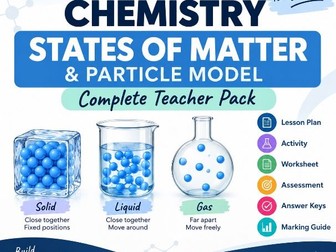
States of Matter | Grade 8 ChemistryQuick View
MaryamMikhak2026

States of Matter | Grade 8 Chemistry

(0)
A ready-to-teach Grade 8 Chemistry resource on states of matter and the particle model, including activities, worksheet, assessment and answer keys. This complete teacher pack introduces solids, liquids and gases through the particle model and helps students connect observable properties of matter with particle arrangement, movement and energy. Students move beyond memorising definitions by drawing and interpreting particle models, explaining scientific ideas and identifying common misconceptions about changes of state. What’s included: • Teacher Overview • 45-minute ready-to-teach Lesson Plan • Learning objectives and key vocabulary • Warm-up and guided practice • Particle Model Activity • Student Worksheet • Scientific reasoning and challenge questions • Teacher Answer Keys • 10-point formative assessment • Detailed Marking Guide Students will learn to: • Define matter • Compare solids, liquids and gases • Describe particle arrangement and movement • Draw and interpret particle models • Explain flow and compressibility using particle theory • Describe melting, freezing, evaporation/vaporization and condensation • Explain how heating affects particle motion • Recognise that particles do not disappear or become different particles during a physical change of state Suitable for: Grade 8 Chemistry, Middle School Science, KS3 Chemistry, classroom teaching, independent practice, homework, review and formative assessment. No previous formal chemistry knowledge is required. Prepared by Dr. Maryam Mikhak | Chemistry Teaching Resources