Percent Composition & Empirical FormulasQuick View
Opalchemy

Percent Composition & Empirical Formulas

(0)
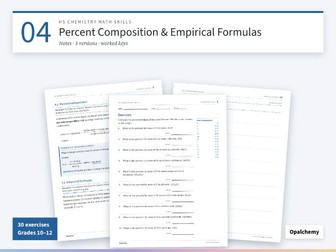
Textbook-style percent composition and empirical formula worksheets for high school chemistry: clear notes, 30 differentiated exercises and fully worked answer keys. What’s inside (14 pages) Textbook-style notes: percent composition, empirical formulas, molecular formulas and hydrates, with key points, worked examples and common mistakes Version A (10 exercises): percent composition Version B (10 exercises): empirical formula from % data Version C (10 exercises): molecular formulas, mass data, hydrates Fully worked answer keys for every exercise Teacher notes with guidance on which version suits which class Why teachers use it Quiet differentiation: student pages have no level labels, only a small A/B/C code in the footer Clean, textbook-quality layout that prints well in black and white Made by a chemist; every answer is calculated and checked for correct significant figures Works for homework, stations, sub plans or review Suitable for ages 14 to 18: high school chemistry (Grades 10–12 · Chemistry & Honors) and international schools. Printable PDF. Looking for more? A low-cost Challenge Pack with six real-world problems is available as an add-on to this set in the Opalchemy shop. Also for GCSE (UK) Covers the percentage-by-mass calculations in GCSE Chemistry (quantitative chemistry). Empirical and molecular formula questions also appear in some exam boards’ specifications, so check yours. Please note: the set follows US conventions in places (volumes in L and mL).
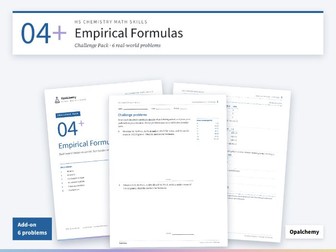
Empirical Formula Challenge ProblemsQuick View
Opalchemy

Empirical Formula Challenge Problems

(0)
Six real-world empirical formulas problems for high school chemistry, with fully worked solutions. A low-cost add-on for early finishers and honors classes. What’s inside (5 pages) Six applied problems: Nicotine; Vitamin C; Combustion analysis; An unknown hydrate; Choosing a fertilizer; Iron from ore Space to work on every page Fully worked answer key Great for Extension for early finishers Partner problem solving or warm-ups Honors or advanced chemistry homework Every problem uses only the skills from the main set; the challenge is in reading the situation and choosing the path, not in new mathematics. Printable PDF, black-and-white friendly. This pack is an add-on to the full “Percent Composition & Empirical Formulas” set (textbook-style notes, 30 differentiated exercises and worked keys) in the Opalchemy shop. Also for GCSE (UK) Builds on the percentage-by-mass calculations in GCSE Chemistry (quantitative chemistry). Empirical formula questions also appear in some exam boards’ specifications, so check yours. Please note: the problems follow US conventions in places (volumes in L and mL).
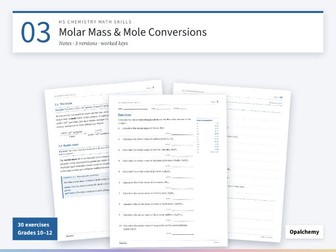
Molar Mass and Mole Conversion WorksheetsQuick View
Opalchemy

Molar Mass and Mole Conversion Worksheets

(0)
Textbook-style molar mass and mole conversion worksheets for high school chemistry: clear notes, 30 differentiated exercises and fully worked answer keys. What’s inside (12 pages) Textbook-style notes: the mole, molar mass, the mole map, with key points, worked examples and common mistakes Version A (10 exercises): molar mass Version B (10 exercises): one-step mole conversions Version C (10 exercises): multi-step: grams ↔ moles ↔ particles Fully worked answer keys for every exercise Teacher notes with guidance on which version suits which class Why teachers use it Quiet differentiation: student pages have no level labels, only a small A/B/C code in the footer Clean, textbook-quality layout that prints well in black and white Made by a chemist; every answer is calculated and checked for correct significant figures Works for homework, stations, sub plans or review Suitable for ages 14 to 18: high school chemistry (Grades 10–12 · Chemistry & Honors) and international schools. Printable PDF. Looking for more? A low-cost Challenge Pack with six real-world problems is available as an add-on to this set in the Opalchemy shop. Also for GCSE (UK) Covers the relative formula mass, moles and Avogadro constant calculations in GCSE Chemistry (quantitative chemistry, Higher tier). Please note: the set follows US conventions (volumes in L and mL, Avogadro constant 6.022 × 10²³ rather than 6.02 × 10²³); the method is the same.
Mole Conversions Practice: 60 ProblemsQuick View
Opalchemy

Mole Conversions Practice: 60 Problems

(0)
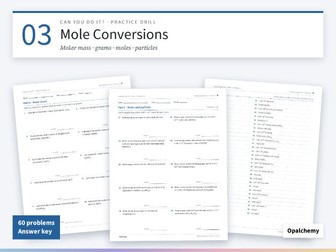
60 mole conversion practice problems for high school chemistry, with a one-page answer key. Pure practice: molar mass, grams, moles, particles and atoms inside compounds. What’s inside Part A (10): molar mass Part B (20): grams ↔ moles Part C (10): moles ↔ particles (Avogadro’s number) Part D (10): grams ↔ particles Part E (10): atoms inside a compound Reference page: mole map, atomic masses, which particle to count One-page answer key, rounded to the correct significant figures Student progress tracker Great for Homework and independent practice Review before a quiz or test Sub plans and early finishers No notes and no long solutions, just plenty of problems and the final answers so students can check themselves. Textbook-style layout that prints well in black and white. Made by a chemist; every answer is calculated and checked. Suitable for ages 14 to 18: high school chemistry (Grades 10–12) and international schools. Printable PDF. Pairs with the “Molar Mass and Mole Conversion Worksheets” set (textbook-style notes and fully worked keys) in the Opalchemy shop. Also for GCSE (UK) Practises the relative formula mass, moles and Avogadro constant calculations from GCSE Chemistry (quantitative chemistry, Higher tier). Please note: the problems follow US conventions (Avogadro constant 6.022 × 10²³ rather than 6.02 × 10²³); the method is the same.
Mole Conversions Challenge ProblemsQuick View
Opalchemy

Mole Conversions Challenge Problems

(0)
Six real-world molar mass & moles problems for high school chemistry, with fully worked solutions. A low-cost add-on for early finishers and honors classes. What’s inside (5 pages) Six applied problems: Aluminum or iron?; A sugar cube; A bottle of water; Zinc in a penny; Signing your name; A cup of coffee Space to work on every page Fully worked answer key Great for Extension for early finishers Partner problem solving or warm-ups Honors or advanced chemistry homework Every problem uses only the skills from the main set; the challenge is in reading the situation and choosing the path, not in new mathematics. Printable PDF, black-and-white friendly. This pack is an add-on to the full “Molar Mass and Mole Conversion Worksheets” set (textbook-style notes, 30 differentiated exercises and worked keys) in the Opalchemy shop. Also for GCSE (UK) Uses the relative formula mass, moles and Avogadro constant calculations from GCSE Chemistry (quantitative chemistry, Higher tier). Please note: the problems follow US conventions (volumes in L and mL, Avogadro constant 6.022 × 10²³ rather than 6.02 × 10²³); the method is the same.
Significant Figures & Scientific NotationQuick View
Opalchemy

Significant Figures & Scientific Notation

(0)
Textbook-style significant figures and scientific notation worksheets for high school chemistry: clear notes, 30 differentiated exercises and worked keys. What’s inside (11 pages) 2 pages of textbook-style notes: counting significant figures, scientific notation and rounding, and precision in calculations, with key points, worked examples, common mistakes and a quick check Version A (10 exercises): counting significant figures, including exact numbers Version B (10 exercises): scientific notation both ways and rounding Version C (10 exercises): calculations with the correct precision, using lab-style data Fully worked answer keys for every exercise Teacher notes with guidance on which version suits which class Why teachers use it Quiet differentiation: student pages have no level labels, only a small A/B/C code in the footer Clean, textbook-quality layout that prints well in black and white Made by a chemist, with every answer checked for correct significant figures Works for homework, stations, sub plans, review or a skills unit at the start of the year Suitable for ages 14 to 18: high school chemistry (grades 9-12), GCSE and A-level chemistry, and international schools. Printable PDF. Want to try before you buy? Download the free Significant Figures Challenge Problems from the Opalchemy shop. Also for GCSE (UK) Significant figures, standard form and rounding are maths skills assessed across GCSE Chemistry, Physics and Biology, so this set suits GCSE science classes too. Please note: some lab data use mL (1 mL = 1 cm³).
Dimensional Analysis Worksheets and NotesQuick View
Opalchemy

Dimensional Analysis Worksheets and Notes

(0)
Textbook-style dimensional analysis (factor-label) worksheets for high school chemistry: clear notes, 30 differentiated exercises and fully worked answer keys. What’s inside (12 pages) Textbook-style notes: conversion factors, chaining factors, squared and cubed units, with key points, worked examples and common mistakes Version A (10 exercises): one-step conversions Version B (10 exercises): multi-step conversions Version C (10 exercises): lab and chemistry applications Fully worked answer keys for every exercise Teacher notes with guidance on which version suits which class Why teachers use it Quiet differentiation: student pages have no level labels, only a small A/B/C code in the footer Clean, textbook-quality layout that prints well in black and white Made by a chemist; every answer is calculated and checked for correct significant figures Works for homework, stations, sub plans or review Suitable for ages 14 to 18: high school chemistry (Grades 9–12) and international schools. Printable PDF. Looking for more? A low-cost Challenge Pack with six real-world problems is available as an add-on to this set in the Opalchemy shop.
Dimensional Analysis Challenge ProblemsQuick View
Opalchemy

Dimensional Analysis Challenge Problems

(0)
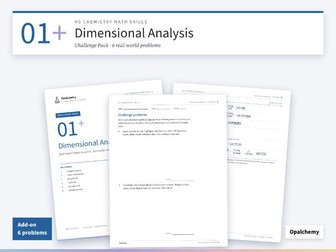
Six real-world dimensional analysis problems for high school chemistry, with fully worked solutions. A low-cost add-on for early finishers and honors classes. What’s inside (5 pages) Six applied problems: Sunlight’s journey; A year of heartbeats; Hospital drip; A gold bar; Painting a wall; A dripping faucet Space to work on every page Fully worked answer key Great for Extension for early finishers Partner problem solving or warm-ups Honors or advanced chemistry homework Every problem uses only the skills from the main set; the challenge is in reading the situation and choosing the path, not in new mathematics. Printable PDF, black-and-white friendly. This pack is an add-on to the full “Dimensional Analysis Worksheets and Notes” set (textbook-style notes, 30 differentiated exercises and worked keys) in the Opalchemy shop.
Mole Conversions Practice: Free SampleQuick View
Opalchemy

Mole Conversions Practice: Free Sample

(0)
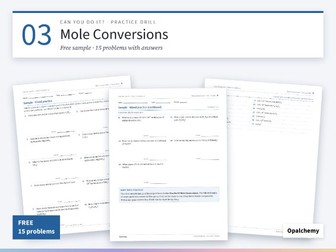
A free 15-problem sample of mole conversion practice for high school chemistry, with answers. Three problems from each part of the full 60-problem drill. What’s inside 15 mixed problems: molar mass, grams ↔ moles, moles ↔ particles, grams ↔ particles, atoms inside a compound Reference page: mole map, atomic masses, which particle to count Answer key Great for Homework and independent practice Review before a quiz or test Sub plans and early finishers No notes and no long solutions, just plenty of problems and the final answers so students can check themselves. Textbook-style layout that prints well in black and white. Made by a chemist; every answer is calculated and checked. Suitable for ages 14 to 18: high school chemistry (Grades 10–12) and international schools. Printable PDF. Like it? The full drill, “Mole Conversions Practice: 60 Problems”, is in the Opalchemy shop. Also for GCSE (UK) Practises the relative formula mass, moles and Avogadro constant calculations from GCSE Chemistry (quantitative chemistry, Higher tier). Please note: the problems follow US conventions (Avogadro constant 6.022 × 10²³ rather than 6.02 × 10²³); the method is the same.
Significant Figures Challenge ProblemsQuick View
Opalchemy

Significant Figures Challenge Problems

(0)
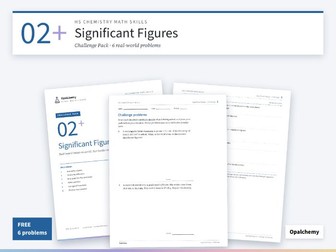
Six real-world significant figure problems for high school chemistry, with fully worked solutions. Free sample of Opalchemy’s textbook-style worksheets. What’s inside (5 pages) 6 applied problems where precision rules collide: mixed operations, subtraction that loses digits, percent error, exact counts and comparing measurements Space to work on every page Fully worked answer key Great for Extension for early finishers Partner problem solving or warm-ups Honors or advanced chemistry homework Every problem uses only standard significant-figure rules; the challenge is in reading the situation, not in new mathematics. Printable PDF, black-and-white friendly. This pack is an add-on to the full Significant Figures & Scientific Notation set (textbook-style notes, 30 differentiated exercises and worked keys) in the Opalchemy shop. Also for GCSE (UK) Significant figures, standard form and rounding are maths skills assessed across GCSE Chemistry, Physics and Biology, so these problems suit GCSE science classes too. Please note: some lab data use mL (1 mL = 1 cm³).