Year 1 Differentiated Addition Within 20Quick View
BetterFlow

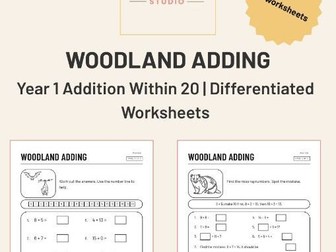
Year 1 Differentiated Addition Within 20

(0)
A differentiated Year 1 maths worksheet pack for practising addition within 20. This woodland-themed resource includes three levels of challenge, making it easy to support different levels of confidence within the same class. Included: ● Supported - pictorial addition using ten frames ●● Core - addition calculations within 20. ●●● Extending - missing numbers, reasoning and problem solving Teacher answer sheet The activities progress from visual representations to independent calculations and reasoning, allowing pupils to build fluency and confidence with addition. Curriculum link: Year 1 Number - Addition and Subtraction: add and subtract one-digit and two-digit numbers to 20, including zero. Suitable for: independent practice small-group work maths intervention homework assessment early finishers Format: Printable PDF. Answers included The final downloadable resource also includes an introductory teacher page explaining the pack, curriculum link and suggested uses.
Halves and Quarters Year 1 WorksheetsQuick View
BetterFlow

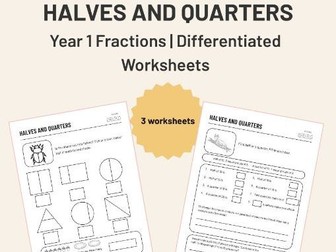
Halves and Quarters Year 1 Worksheets

(0)
Halves and quarters of shapes and quantities, kept in words just as Year 1 asks. Children check whether shapes are cut into equal halves, name shaded halves and quarters, then share numbers into equal groups. Weasel’s reasoning question tackles the most common fractions mistake: unequal pieces. The sheet comes in three differentiated tiers (Supported ●, Core ●●, Extending ●●●), all practising the same skill. You can hand out all three in one lesson and the whole class works on the same objective. What’s included (5 A4 pages, PDF): Teacher’s note: overview, curriculum link and suggested uses ● Supported: is the shape cut into halves? Tick or cross, colour half of each ticked shape, then share 6 acorns into 2 equal groups ●● Core: look at the shaded part and write half or quarter, then find half and a quarter of 8 acorns ●●● Extending: halves and quarters of numbers up to 20, two quarters make a half, four quarters make a whole, a sharing word problem, and Weasel’s reasoning question: ‘I cut my pie into 2 pieces, so each piece is a half.’ Is Weasel right? Answers page with the matching National Curriculum objectives Curriculum link: Year 1 Number (fractions): ‘recognise, find and name a half as one of two equal parts of an object, shape or quantity’ and ‘recognise, find and name a quarter as one of four equal parts of an object, shape or quantity’. Fractions are written in words throughout, since writing ½ and ¼ is Year 2. Also suits Year 2 consolidation. Great for independent practice, small groups, intervention, homework, assessment and early finishers. Print-ready A4, black-and-white friendly, no preparation needed. Woodland animal line art (beetle, jay and weasel) that children can colour in.
One More One Less to 100 Year 1 WorksheetsQuick View
BetterFlow

One More One Less to 100 Year 1 Worksheets

(0)
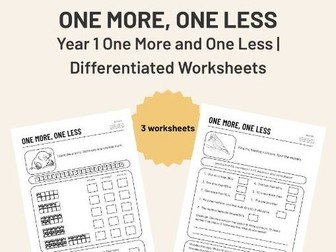
Find one more and one less, from acorns in ten-frames all the way up to 100. The Extending page targets the tricky crossing-a-ten numbers (39 → 40, 70 → 69) with a mistake to spot. The sheet comes in three differentiated tiers (Supported ●, Core ●●, Extending ●●●), all practising the same skill. You can hand out all three in one lesson and the whole class works on the same objective. What’s included (5 A4 pages, PDF): Teacher’s note: overview, curriculum link and suggested uses ● Supported: count the acorns, then write one less and one more, with a 0–20 number track for support, plus a word problem about Mole’s molehills ●● Core: one more and one less for numbers up to 80, using a number track, plus a word problem about Frog’s stepping stones ●●● Extending: missing numbers across tens and 100, a mistake to fix, an open challenge, and Woodpecker’s reasoning question: ‘When I find one more, only the last digit changes.’ Is Woodpecker right? Answers page with the matching National Curriculum objective Curriculum link: Year 1 Number and place value: ‘given a number, identify one more and one less’. Also suits Year 2 warm-ups. Great for independent practice, small groups, intervention, homework, assessment and early finishers. Print-ready A4, black-and-white friendly, no preparation needed. Woodland animal line art (mole, frog and woodpecker) that children can colour in.
Counting in 2s 5s 10s Year 1 DifferentiatedQuick View
BetterFlow

Counting in 2s 5s 10s Year 1 Differentiated

(0)
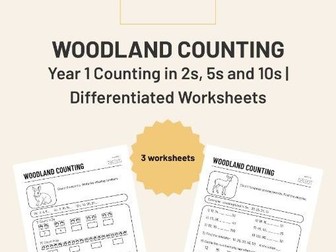
Count in 2s, 5s and 10s with acorns, number patterns and a find-the-mistake challenge. Supported pages count real groups; Extending pages count backwards and ask children to explain a pattern. The sheet comes in three differentiated tiers (Supported ●, Core ●●, Extending ●●●), all practising the same skill. You can hand out all three in one lesson and the whole class works on the same objective. What’s included (5 A4 pages, PDF): Teacher’s note: overview, curriculum link and suggested uses ● Supported: count groups of acorns in 2s, 5s and 10s and fill in the missing numbers, plus a word problem about rabbits’ ears ●● Core: continue number patterns forwards and backwards, plus a word problem about bundles of sticks ●●● Extending: patterns forwards and backwards, find the mistake, spot multiples of 5, a challenge on numbers you say in both 5s and 10s, and Deer’s reasoning question: ‘When I count in 10s from 0, every number ends in 0.’ Is Deer right? Answers page with the matching National Curriculum objective Curriculum link: Year 1 Number and place value: ‘count, read and write numbers to 100 in numerals; count in multiples of twos, fives and tens’. Ranges stay within the Year 1 guidance: 2s to 20, 5s to 50 and 10s to 100. Also suits Year 2 warm-ups. Great for independent practice, small groups, intervention, homework, assessment and early finishers. Print-ready A4, black-and-white friendly, no preparation needed. Woodland animal line art (rabbit, robin and roe deer) that children can colour in.
Comparing Numbers Year 1 WorksheetsQuick View
BetterFlow

Comparing Numbers Year 1 Worksheets

(0)
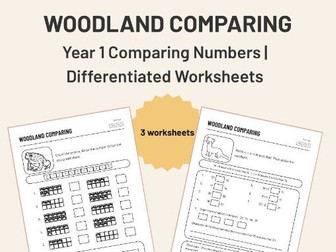
Compare numbers with acorns in ten-frames, then with the words more than, less than and equal to. The Extending page introduces the <, > and = signs as a first step towards Year 2, and Stoat’s reasoning question targets the classic mistake of thinking 19 is more than 21. The sheet comes in three differentiated tiers (Supported ●, Core ●●, Extending ●●●), all practising the same skill. You can hand out all three in one lesson and the whole class works on the same objective. What’s included (5 A4 pages, PDF): Teacher’s note: overview, curriculum link and suggested uses ● Supported: count acorns in ten-frames, write the numbers and circle the group with more, plus a word problem where both children have the same ●● Core: more than, less than or equal to, with numbers to 20 including zero, plus a ‘who has fewer?’ word problem about conkers ●●● Extending: compare numbers beyond 20 using <, > and =, order four numbers, an open challenge, and Stoat’s reasoning question: ‘19 is more than 21 because 9 is more than 1.’ Is Stoat right? Answers page with the matching National Curriculum objective Curriculum link: Year 1 Number and place value: ‘use the language of: equal to, more than, less than (fewer), most, least’. The ●●● page also gives a head start on the Year 2 objective ‘compare and order numbers from 0 up to 100; use <, > and = signs’. Great for independent practice, small groups, intervention, homework, assessment and early finishers. Print-ready A4, black-and-white friendly, no preparation needed. Woodland animal line art (toad, wren and stoat) that children can colour in.
Subtraction within 20 Year 1 WorksheetsQuick View
BetterFlow

Subtraction within 20 Year 1 Worksheets

(0)
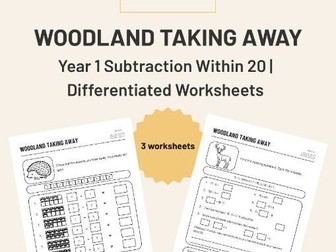
Subtraction within 20, from crossing out acorns to number-line work and missing-number problems. Stag’s reasoning question tackles a common misconception: does taking away always make a number smaller? The sheet comes in three differentiated tiers (Supported ●, Core ●●, Extending ●●●), all practising the same skill. You can hand out all three in one lesson and the whole class works on the same objective. What’s included (5 A4 pages, PDF): Teacher’s note: overview, curriculum link and suggested uses ● Supported: cross out acorns in ten-frames to take away within 10, including taking away zero, plus a word problem about Hedgehog’s beetles ●● Core: subtraction within 20 with a number line, including missing numbers, plus a ‘how many more’ word problem about bluebells and primroses ●●● Extending: missing-number problems (including the form 7 = □ − 9), a mistake to fix, an open challenge, and Stag’s reasoning question: ‘Taking away always makes the number smaller.’ Is Stag right? Answers page with the matching National Curriculum objective Curriculum link: Year 1 Number (addition and subtraction): ‘add and subtract one-digit and two-digit numbers to 20, including zero’. Also suits Year 2 consolidation. Great for independent practice, small groups, intervention, homework, assessment and early finishers. Print-ready A4, black-and-white friendly, no preparation needed. Woodland animal line art (hedgehog, hare and stag) that children can colour in.
Year 1 Number Bonds to 20: DifferentiatedQuick View
BetterFlow

Year 1 Number Bonds to 20: Differentiated

(0)
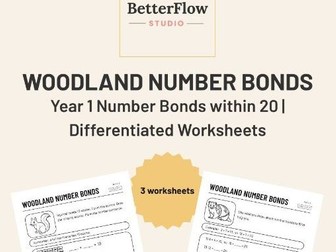
Number bonds three ways, with a woodland theme. Children make 10 with acorns in ten-frames, fill in missing numbers to 10, then move on to bonds to 20 and a reasoning question from Badger. The sheet comes in three differentiated tiers (Supported ●, Core ●●, Extending ●●●), all practising the same skill. You can hand out all three in one lesson and the whole class works on the same objective. What’s included (5 A4 pages, PDF): Teacher’s note: overview, curriculum link and suggested uses ● Supported: make 10 with acorns in ten-frames and complete the number sentence, plus a short word problem ●● Core: missing numbers to 10, a part-whole model and a word problem, with a number line for support ●●● Extending: bonds to 20 and related subtraction facts, an open challenge, and Badger’s reasoning question: ‘I know 4 + 6 = 10, so 14 + 6 = 20.’ Is Badger right? Answers page with the matching National Curriculum objective Curriculum link: Year 1 Number (addition and subtraction): ‘represent and use number bonds and related subtraction facts within 20’. Also suits Year 2 consolidation, since pupils should know bonds to 20 by the end of Year 2. Great for independent practice, small groups, intervention, homework, assessment and early finishers. Print-ready A4, black-and-white friendly, no preparation needed. Woodland animal line art (squirrel, fox and badger) that children can colour in. Upload fields Resource type: Worksheet/Activity Subject: Mathematics Age range: 5–7 Topics: Number bonds, Addition and subtraction
Naming 2D Shapes Year 1 WorksheetsQuick View
BetterFlow

Naming 2D Shapes Year 1 Worksheets

(0)
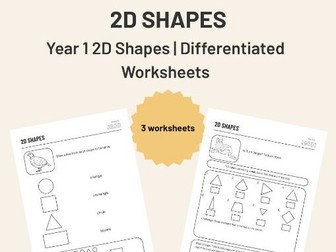
Name circles, triangles, squares and rectangles in all sorts of sizes and turns. The Extending page asks ‘Is it a triangle?’ with tricky non-examples, and Wildcat’s reasoning question tackles the ‘diamond’ that’s really a square. The sheet comes in three differentiated tiers (Supported ●, Core ●●, Extending ●●●), all practising the same skill. You can hand out all three in one lesson and the whole class works on the same objective. What’s included (5 A4 pages, PDF): Teacher’s note: overview, curriculum link and suggested uses ● Supported: match four shapes to their names, then count the circles in a row of shapes ●● Core: name shapes shown in different sizes and turns (including a square on its corner and an upside-down triangle), then draw a triangle that looks different ●●● Extending: is it a triangle? Tick or cross eight shapes, including open shapes, curved sides and four-sided shapes, draw a square on its corner, and Wildcat’s reasoning question: ‘This is not a square. It is a diamond.’ Is Wildcat right? Answers page with the matching National Curriculum objective Curriculum link: Year 1 Geometry (properties of shapes): ‘recognise and name common 2-D and 3-D shapes, including: 2-D shapes [for example, rectangles (including squares), circles and triangles]’. Pupils recognise and name only; counting sides is left for Year 2. Also suits Year 2 consolidation. Great for independent practice, small groups, intervention, homework, assessment and early finishers. Print-ready A4, black-and-white friendly, no preparation needed. Woodland animal line art (quail, moth and wildcat) that children can colour in.
Naming 3D Shapes Year 1 WorksheetsQuick View
BetterFlow

Naming 3D Shapes Year 1 Worksheets

(0)
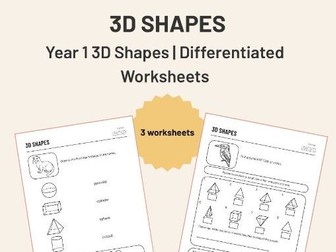
Name six common 3D shapes: cube, cuboid, sphere, cylinder, cone and pyramid. Shapes appear in different sizes and turns, the Extending page asks ‘Is it a pyramid?’ with tricky non-examples, and Kingfisher’s reasoning question asks whether a tall cuboid is still a cuboid. The sheet comes in three differentiated tiers (Supported ●, Core ●●, Extending ●●●), all practising the same skill. You can hand out all three in one lesson and the whole class works on the same objective. What’s included (5 A4 pages, PDF): Teacher’s note: overview, curriculum link and suggested uses ● Supported: match four shapes to their names, then count the spheres in a row of shapes ●● Core: name six shapes shown in different sizes and turns (including a cylinder on its side and an upside-down cone), then find a cuboid in the classroom ●●● Extending: is it a pyramid? Tick or cross eight shapes, including a cone, a tent-shaped prism and a flat triangle, name something shaped like a cone, and Kingfisher’s reasoning question: ‘This is not a cuboid. It is too tall.’ Is Kingfisher right? Answers page with the matching National Curriculum objective Curriculum link: Year 1 Geometry (properties of shapes): ‘recognise and name common 2-D and 3-D shapes, including: … 3-D shapes [for example, cuboids (including cubes), pyramids and spheres]’. Pupils recognise and name only; faces, edges and vertices are left for Year 2. Also suits Year 2 consolidation. Great for independent practice, small groups, intervention, homework, assessment and early finishers. Works well alongside real 3D shapes and everyday objects. Print-ready A4, black-and-white friendly, no preparation needed. Woodland animal line art (otter, pine marten and kingfisher) that children can colour in.
Measuring Length and Height Year 1Quick View
BetterFlow

Measuring Length and Height Year 1

(0)
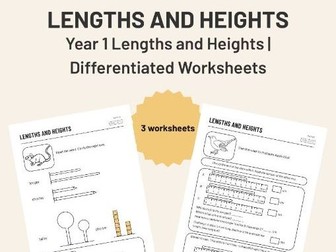
Compare lengths and heights, measure with cubes, then read a ruler in centimetres. Blackbird’s reasoning question catches the most common ruler mistake: starting at 1 instead of 0. The sheet comes in three differentiated tiers (Supported ●, Core ●●, Extending ●●●), all practising the same skill. You can hand out all three in one lesson and the whole class works on the same objective. What’s included (5 A4 pages, PDF): Teacher’s note: overview, curriculum link and suggested uses ● Supported: circle the longer, shorter or taller one, then count how many cubes long a stick is ●● Core: measure four objects with cubes, use longest, shortest and longer to compare them, then measure two trees in cubes ●●● Extending: measure sticks with a pictured ruler in centimetres, find the longest, shortest and the difference, a doubling challenge, and Blackbird’s reasoning question: ‘This stick is 7 cm long.’ Is Blackbird right? Answers page with the matching National Curriculum objectives Note for teachers: each ruler is printed beside its stick, so pupils read the length on the page. This keeps the answers correct even if your printer scales the page. Pupils shouldn’t measure the printed sticks with a real ruler. Curriculum link: Year 1 Measurement: ‘compare, describe and solve practical problems for: lengths and heights’ and ‘measure and begin to record the following: lengths and heights’. Also suits Year 2 warm-ups. Great for independent practice, small groups, intervention, homework, assessment and early finishers. Works well alongside real linking cubes and rulers. Print-ready A4, black-and-white friendly, no preparation needed. Woodland animal line art (wood mouse, nuthatch and blackbird) that children can colour in.