Christmas Science: How Do Arctic Animals Survive the Winter? KS2 Adaptation LessonQuick View
Biology_PhD

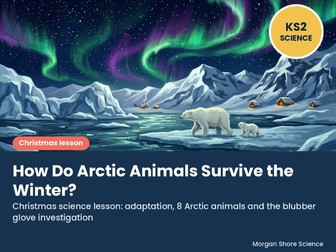
Christmas Science: How Do Arctic Animals Survive the Winter? KS2 Adaptation Lesson

(0)
A festive, fact-packed science lesson for the last weeks of the autumn term. “Santa lives at the North Pole… but who are his neighbours?” Pupils discover how real Arctic animals survive the freezing, dark winter. The lesson (18 editable PowerPoint slides with teacher notes): Christmas hook and think-pair-share What the Arctic is like in winter What an adaptation is Meet 8 Arctic animals, each with beautiful illustrations, three adaptations and a fun fact: polar bear, Arctic fox, reindeer, walrus, snowy owl, narwhal, Arctic hare and ringed seal Sorting activity: keep warm, find food or hide? Practical investigation: the “blubber glove” (method, safety notes and teacher set-up instructions) True or false quiz Plenary: design your own Arctic animal The worksheets (Word + PDF, 7 pages): Match the adaptation (support) Fill the gaps with a word bank (core) Explain it! (challenge) Cut-and-stick sorting activity Blubber glove investigation record sheet Design an Arctic animal Full answers Links to the KS2 programme of study: living things and their habitats and evolution and inheritance (adaptation). Written by a marine biologist. All facts checked.

The Hardy-Weinberg Principle - Complete Lesson (A-level Biology, AQA/OCR)Quick View
Biology_PhD

The Hardy-Weinberg Principle - Complete Lesson (A-level Biology, AQA/OCR)

(0)
A complete, ready-to-teach lesson on the Hardy-Weinberg principle, written by a marine biologist who works in population genetics. The lesson (17 editable PowerPoint slides with teacher notes): Starter: key-word matching (allele, genotype, phenotype, gene pool) What allele frequency means, with a visual gene pool Both equations, and where p² + 2pq + q² comes from (Punnett square of gametes) The five conditions for Hardy-Weinberg equilibrium A step-by-step method that works for every question Worked examples: banded grove snails and UK cystic fibrosis data Common mistakes to avoid “Your turn”: Arctic fox coat colours, with answers Observed vs expected: spotting a population NOT in equilibrium Exam-style question on PKU with a full mark scheme Exit ticket The worksheet (Word + PDF): Differentiated Bronze / Silver / Gold questions (10 questions, 26 marks) Real examples from Arctic foxes, grove snails and fish populations Stretch questions on equilibrium and genetic drift Full answer key with mark allocations Suitable for AQA and OCR A-level Biology (populations and evolution / patterns of inheritance). Free one-page revision sheet also available in my shop.
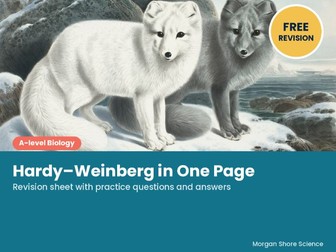
Hardy-Weinberg Principle: One-Page Revision Sheet + Practice Questions (A-level Biology)Quick View
Biology_PhD

Hardy-Weinberg Principle: One-Page Revision Sheet + Practice Questions (A-level Biology)

(0)
Everything students need on the Hardy-Weinberg principle on one page, plus a page of practice questions with full answers. Includes: Key symbols explained (p, q, p², 2pq, q²) Both equations and the five conditions A simple 5-step method for any Hardy-Weinberg question Worked example using real UK cystic fibrosis data The three most common mistakes 5 practice questions with a full answer key (including PKU and gene flow) Editable Word file and PDF. Suitable for AQA and OCR A-level Biology. Written by a marine biologist and population geneticist. Want the full lesson? The complete Hardy-Weinberg lesson (slides, worked examples, differentiated worksheet and exam-style question with mark scheme) is available in my shop.