KS3 Activate C2.1 Periodic Table: Groups and PeriodsQuick View
drt-tuition

KS3 Activate C2.1 Periodic Table: Groups and Periods

(0)
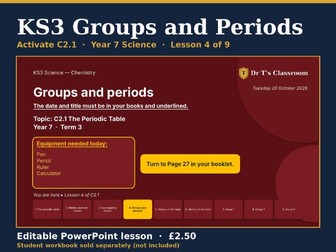
KS3 Science lesson on groups, periods and trends (Activate C2.1). Editable Year 7 PowerPoint with retrieval starter and answers. About this lesson Lesson 4 of 9 in the Year 7 Periodic Table unit (Activate C2.1). Pupils state the group and period of an element, describe a trend using data, and predict a missing value from a pattern. Built into every lesson Retrieval starter: five questions check the prior knowledge pupils need for the lesson (answers in the notes) A concrete, surprising hook to get pupils talking Learning objectives pupils can act on, each with a ‘Show it’ task Formative assessment throughout: checks, hinge question, plenary and exit ticket Common misconceptions targeted: a hidden teacher slide and hinge questions from documented KS3 misconceptions Command words always come with a sentence starter or writing frame Four Tier 3 key words, with pronunciation and warnings about everyday meanings Booklet task slides, each followed by an expected-answers slide, so all the answers are in this PowerPoint Written for KS3 reading levels: one short idea per bullet Fully editable PowerPoint (the lesson only: the printable workbook is a separate, paid resource) The full series This lesson is part of a complete KS3 Science series that follows Activate 1 and 2, covering Years 7 and 8. Lessons carry their Activate topic code. Not affiliated with or endorsed by Oxford University Press. What is free and what is paid Lesson 1 (The Periodic Table) is FREE. This lesson is £2.50. The Scheme of Work (SoW) that goes with these resources is FREE. The C2.1 Periodic Table student workbook is NOT free and is NOT included in this lesson. It holds the pages pupils write in when the slides say ‘Turn to Page…’, and is sold separately for £5.00 per topic. It is designed to cut down copying from the board, so lesson time goes on checking understanding. A KS3 Practical Requisition Spreadsheet is sold separately for £5.00. It makes requesting practicals and demos with your technicians seamless. Save on the whole topic: all 9 lesson PowerPoints plus the workbook are available together as a bundle for £16. Last updated: October 2026 (first release).
KS3 Activate C2.1 Periodic Table: Metals and Non-metalsQuick View
drt-tuition

KS3 Activate C2.1 Periodic Table: Metals and Non-metals

(0)
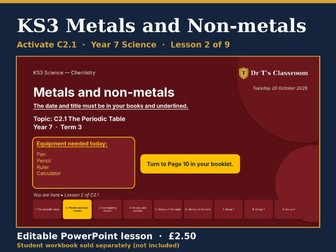
KS3 Science lesson on properties of metals and non-metals (Activate C2.1). Editable Year 7 PowerPoint with retrieval starter and answers. About this lesson Lesson 2 of 9 in the Year 7 Periodic Table unit (Activate C2.1). Pupils list the properties of metals, compare metals with non-metals, and write word equations for elements burning. Built into every lesson Retrieval starter: five questions check the prior knowledge pupils need for the lesson (answers in the notes) A concrete, surprising hook to get pupils talking Learning objectives pupils can act on, each with a ‘Show it’ task Formative assessment throughout: checks, hinge question, plenary and exit ticket Common misconceptions targeted: a hidden teacher slide and hinge questions from documented KS3 misconceptions Command words always come with a sentence starter or writing frame Four Tier 3 key words, with pronunciation and warnings about everyday meanings Booklet task slides, each followed by an expected-answers slide, so all the answers are in this PowerPoint Written for KS3 reading levels: one short idea per bullet Fully editable PowerPoint (the lesson only: the printable workbook is a separate, paid resource) The full series This lesson is part of a complete KS3 Science series that follows Activate 1 and 2, covering Years 7 and 8. Lessons carry their Activate topic code. Not affiliated with or endorsed by Oxford University Press. What is free and what is paid Lesson 1 (The Periodic Table) is FREE. This lesson is £2.50. The Scheme of Work (SoW) that goes with these resources is FREE. The C2.1 Periodic Table student workbook is NOT free and is NOT included in this lesson. It holds the pages pupils write in when the slides say ‘Turn to Page…’, and is sold separately for £5.00 per topic. It is designed to cut down copying from the board, so lesson time goes on checking understanding. A KS3 Practical Requisition Spreadsheet is sold separately for £5.00. It makes requesting practicals and demos with your technicians seamless. Save on the whole topic: all 9 lesson PowerPoints plus the workbook are available together as a bundle for £16. Last updated: October 2026 (first release).
KS3 Activate C2.1 Periodic Table: Investigating MetalsQuick View
drt-tuition

KS3 Activate C2.1 Periodic Table: Investigating Metals

(0)
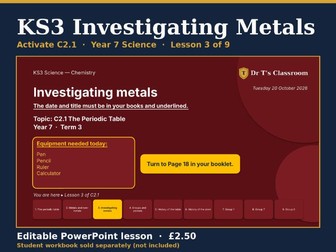
KS3 Science lesson on a classifying investigation into metals and non-metals (Activate C2.1). Year 7 PowerPoint with retrieval starter and answers. About this lesson Lesson 3 of 9 in the Year 7 Periodic Table unit (Activate C2.1). Pupils describe four tests for metal properties, record results in a clear table, and classify each material as metal or non-metal. Includes a classifying practical: metal or non-metal? Includes a ‘Career in focus’ slide on the Analytical Chemist, linked to Gatsby Benchmark 4 (linking curriculum learning to careers). Includes an Equipment Request slide for your technician. Built into every lesson Retrieval starter: five questions check the prior knowledge pupils need for the lesson (answers in the notes) A concrete, surprising hook to get pupils talking Learning objectives pupils can act on, each with a ‘Show it’ task Formative assessment throughout: checks, hinge question, plenary and exit ticket Common misconceptions targeted: a hidden teacher slide and hinge questions from documented KS3 misconceptions Command words always come with a sentence starter or writing frame Four Tier 3 key words, with pronunciation and warnings about everyday meanings Booklet task slides, each followed by an expected-answers slide, so all the answers are in this PowerPoint Written for KS3 reading levels: one short idea per bullet Fully editable PowerPoint (the lesson only: the printable workbook is a separate, paid resource) The full series This lesson is part of a complete KS3 Science series that follows Activate 1 and 2, covering Years 7 and 8. Lessons carry their Activate topic code. Not affiliated with or endorsed by Oxford University Press. What is free and what is paid Lesson 1 (The Periodic Table) is FREE. This lesson is £2.50. The Scheme of Work (SoW) that goes with these resources is FREE. The C2.1 Periodic Table student workbook is NOT free and is NOT included in this lesson. It holds the pages pupils write in when the slides say ‘Turn to Page…’, and is sold separately for £5.00 per topic. It is designed to cut down copying from the board, so lesson time goes on checking understanding. A KS3 Practical Requisition Spreadsheet is sold separately for £5.00. It makes requesting practicals and demos with your technicians seamless. Save on the whole topic: all 9 lesson PowerPoints plus the workbook are available together as a bundle for £16. Last updated: October 2026 (first release).
KS3 Activate C1.2 Elements, Atoms and Compounds Complete Topic BundleQuick View
drt-tuition

KS3 Activate C1.2 Elements, Atoms and Compounds Complete Topic Bundle

(0)
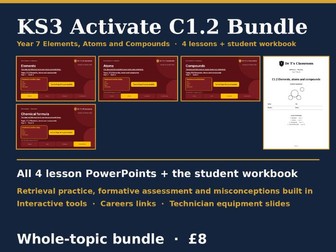
KS3 Activate C1.2 Elements, Atoms and Compounds complete topic bundle: 4 editable Year 7 lessons plus the student workbook. Retrieval, formative assessment and answers built in. About this bundle Everything for the Year 7 Elements, Atoms and Compounds unit (Activate C1.2) in one download: Elements, Atoms, Compounds, Chemical Formula, plus the 38-page student workbook that goes with the ‘Turn to Page…’ slides. Built into every lesson Retrieval starter: five questions check the prior knowledge pupils need for the lesson (answers in the notes) A concrete, surprising hook to get pupils talking Learning objectives pupils can act on, each with a ‘Show it’ task Formative assessment throughout: checks, hinge question, plenary and exit ticket Common misconceptions targeted: a hidden teacher slide and hinge questions from documented KS3 misconceptions Command words always come with a sentence starter or writing frame Four Tier 3 key words, with pronunciation and warnings about everyday meanings Booklet task slides, each followed by an expected-answers slide, so all the answers are in this PowerPoint Interactive tools made specifically for this lesson: the slides link to an ‘Explore’ tool and a ‘Check it’ tool that build and check understanding Written for KS3 reading levels: one short idea per bullet Fully editable PowerPoint (the lesson only: the printable workbook is a separate, paid resource) The full series This bundle is part of a complete KS3 Science series that follows Activate 1 and 2, covering Years 7 and 8. Lessons carry their Activate topic code. Not affiliated with or endorsed by Oxford University Press. Practical and demo lessons include an Equipment Request slide for your technician. Careers slides (with Gatsby benchmark links) appear in: Compounds, Chemical Formula. Why buy the bundle All 4 lessons and the workbook for £8, about a third off buying them separately (lesson 1 is free on its own; lessons 2 to 4 are £2.50 each; the workbook is £5.00). The Scheme of Work is free and sold separately. A KS3 Practical Requisition Spreadsheet is a separate £5.00 extra. Last updated: October 2026 (first release).
KS3 Activate C1.2 Elements, Atoms and Compounds Student WorkbookQuick View
drt-tuition

KS3 Activate C1.2 Elements, Atoms and Compounds Student Workbook

(0)
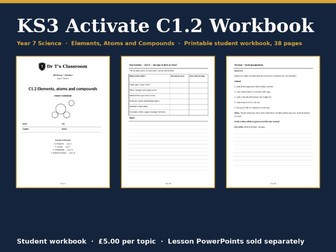
Printable Year 7 KS3 Science workbook for C1.2 Elements, Atoms and Compounds: 38 pages for all 4 lessons. Tasks pupils transform, not copy. Use with the lesson PowerPoints. About this workbook The student workbook for the Year 7 Elements, Atoms and Compounds unit (Activate C1.2), made to go with the KS3 Activate C1.2 Elements, Atoms and Compounds lesson PowerPoints. Every lesson has its own pages: match-it and sort tables, sequencing, Venn diagrams, faded worked examples and, in practical lessons, a Predict-Observe-Explain box, results table and conclusion frame. Why use it Pupils transform what the slides show instead of copying it from the board, so lesson time goes on checking understanding Page numbers match the ‘Turn to Page…’ prompts on the slides Command words come with sentence starters and writing frames All the answers are in the lesson PowerPoints: an Expected answers slide follows every booklet task Editable Word file, A4, ready to print What you are buying This is the workbook only. The lesson PowerPoints are sold separately: lesson 1 is free and lessons 2 to 4 are £2.50 each. The whole topic (all 4 lessons plus this workbook) is £8 as a bundle. This workbook is part of a complete KS3 Science series that follows Activate 1 and 2, covering Years 7 and 8. Resources carry their Activate topic code. Not affiliated with or endorsed by Oxford University Press. The Scheme of Work (SoW) that goes with these resources is FREE. A KS3 Practical Requisition Spreadsheet is sold separately for £5.00. It makes requesting practicals and demos with your technicians seamless. Last updated: October 2026 (first release).
KS3 Activate C1.2 Elements, Atoms and Compounds: Chemical FormulaQuick View
drt-tuition

KS3 Activate C1.2 Elements, Atoms and Compounds: Chemical Formula

(0)
KS3 Science lesson on chemical formulae, compounds and mixtures (Activate C1.2). Editable Year 7 PowerPoint with retrieval starter and answers. About this lesson Lesson 4 of 4 in the Year 7 Elements, Atoms and Compounds unit (Activate C1.2). Pupils identify an element, compound or mixture from a particle diagram, compare a mixture with a compound, and read a formula to say which elements and how many atoms. Includes a teacher demo: iron and sulfur. Includes a ‘Career in focus’ slide on the Analytical Chemist, linked to Gatsby Benchmark 4 (linking curriculum learning to careers). Includes an Equipment Request slide for your technician. Built into every lesson Retrieval starter: five questions check the prior knowledge pupils need for the lesson (answers in the notes) A concrete, surprising hook to get pupils talking Learning objectives pupils can act on, each with a ‘Show it’ task Formative assessment throughout: checks, hinge question, plenary and exit ticket Common misconceptions targeted: a hidden teacher slide and hinge questions from documented KS3 misconceptions Command words always come with a sentence starter or writing frame Four Tier 3 key words, with pronunciation and warnings about everyday meanings Booklet task slides, each followed by an expected-answers slide, so all the answers are in this PowerPoint Interactive tools made specifically for this lesson: the slides link to an ‘Explore’ tool and a ‘Check it’ tool that build and check understanding Written for KS3 reading levels: one short idea per bullet Fully editable PowerPoint (the lesson only: the printable workbook is a separate, paid resource) The full series This lesson is part of a complete KS3 Science series that follows Activate 1 and 2, covering Years 7 and 8. Lessons carry their Activate topic code. Not affiliated with or endorsed by Oxford University Press. What is free and what is paid Lesson 1 (Elements) is FREE. This lesson is £2.50. The Scheme of Work (SoW) that goes with these resources is FREE. The C1.2 Elements, Atoms and Compounds student workbook is NOT free and is NOT included in this lesson. It holds the pages pupils write in when the slides say ‘Turn to Page…’, and is sold separately for £5.00 per topic. It is designed to cut down copying from the board, so lesson time goes on checking understanding. A KS3 Practical Requisition Spreadsheet is sold separately for £5.00. It makes requesting practicals and demos with your technicians seamless. Save on the whole topic: all 4 lesson PowerPoints plus the workbook are available together as a bundle for £8. Last updated: October 2026 (first release).
KS3 Activate C1.2 Elements, Atoms and Compounds: CompoundsQuick View
drt-tuition

KS3 Activate C1.2 Elements, Atoms and Compounds: Compounds

(0)
KS3 Science lesson on compounds, naming (-ide and -ate) and new properties (Activate C1.2). Editable Year 7 PowerPoint with retrieval starter and answers. About this lesson Lesson 3 of 4 in the Year 7 Elements, Atoms and Compounds unit (Activate C1.2). Pupils name simple compounds using -ide and -ate, describe how magnesium changes when it burns, and explain why a compound has new properties. Includes a teacher demo: burning magnesium. Includes a ‘Career in focus’ slide on the Chemical Engineer, linked to Gatsby Benchmark 4 (linking curriculum learning to careers). Includes an Equipment Request slide for your technician. Built into every lesson Retrieval starter: five questions check the prior knowledge pupils need for the lesson (answers in the notes) A concrete, surprising hook to get pupils talking Learning objectives pupils can act on, each with a ‘Show it’ task Formative assessment throughout: checks, hinge question, plenary and exit ticket Common misconceptions targeted: a hidden teacher slide and hinge questions from documented KS3 misconceptions Command words always come with a sentence starter or writing frame Four Tier 3 key words, with pronunciation and warnings about everyday meanings Booklet task slides, each followed by an expected-answers slide, so all the answers are in this PowerPoint Interactive tools made specifically for this lesson: the slides link to an ‘Explore’ tool and a ‘Check it’ tool that build and check understanding Written for KS3 reading levels: one short idea per bullet Fully editable PowerPoint (the lesson only: the printable workbook is a separate, paid resource) The full series This lesson is part of a complete KS3 Science series that follows Activate 1 and 2, covering Years 7 and 8. Lessons carry their Activate topic code. Not affiliated with or endorsed by Oxford University Press. What is free and what is paid Lesson 1 (Elements) is FREE. This lesson is £2.50. The Scheme of Work (SoW) that goes with these resources is FREE. The C1.2 Elements, Atoms and Compounds student workbook is NOT free and is NOT included in this lesson. It holds the pages pupils write in when the slides say ‘Turn to Page…’, and is sold separately for £5.00 per topic. It is designed to cut down copying from the board, so lesson time goes on checking understanding. A KS3 Practical Requisition Spreadsheet is sold separately for £5.00. It makes requesting practicals and demos with your technicians seamless. Save on the whole topic: all 4 lesson PowerPoints plus the workbook are available together as a bundle for £8. Last updated: October 2026 (first release).
KS3 Activate C1.2 Elements, Atoms and Compounds: AtomsQuick View
drt-tuition

KS3 Activate C1.2 Elements, Atoms and Compounds: Atoms

(0)
KS3 Science lesson on atoms and their size (Activate C1.2). Editable Year 7 PowerPoint with retrieval starter and answers. About this lesson Lesson 2 of 4 in the Year 7 Elements, Atoms and Compounds unit (Activate C1.2). Pupils state what an atom is, compare the size of an atom with things they can see, and explain why one atom does not have the properties of the element. Built into every lesson Retrieval starter: five questions check the prior knowledge pupils need for the lesson (answers in the notes) A concrete, surprising hook to get pupils talking Learning objectives pupils can act on, each with a ‘Show it’ task Formative assessment throughout: checks, hinge question, plenary and exit ticket Common misconceptions targeted: a hidden teacher slide and hinge questions from documented KS3 misconceptions Command words always come with a sentence starter or writing frame Four Tier 3 key words, with pronunciation and warnings about everyday meanings Booklet task slides, each followed by an expected-answers slide, so all the answers are in this PowerPoint Written for KS3 reading levels: one short idea per bullet Fully editable PowerPoint (the lesson only: the printable workbook is a separate, paid resource) The full series This lesson is part of a complete KS3 Science series that follows Activate 1 and 2, covering Years 7 and 8. Lessons carry their Activate topic code. Not affiliated with or endorsed by Oxford University Press. What is free and what is paid Lesson 1 (Elements) is FREE. This lesson is £2.50. The Scheme of Work (SoW) that goes with these resources is FREE. The C1.2 Elements, Atoms and Compounds student workbook is NOT free and is NOT included in this lesson. It holds the pages pupils write in when the slides say ‘Turn to Page…’, and is sold separately for £5.00 per topic. It is designed to cut down copying from the board, so lesson time goes on checking understanding. A KS3 Practical Requisition Spreadsheet is sold separately for £5.00. It makes requesting practicals and demos with your technicians seamless. Save on the whole topic: all 4 lesson PowerPoints plus the workbook are available together as a bundle for £8. Last updated: October 2026 (first release).
KS3 Activate C2.2 Separating Mixtures: ChromatographyQuick View
drt-tuition

KS3 Activate C2.2 Separating Mixtures: Chromatography

(0)
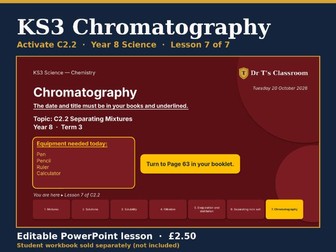
KS3 Science lesson on paper chromatography (Activate C2.2). Editable Year 8 PowerPoint with retrieval starter and answers. About this lesson Lesson 7 of 7 in the Year 8 Separating Mixtures unit (Activate C2.2). Pupils state what chromatography separates, describe how to set up paper chromatography, and identify the dyes in a mixture from a chromatogram. Includes an observing practical: who stole the money? Includes a ‘Career in focus’ slide on the Analytical Chemist, linked to Gatsby Benchmark 4 (linking curriculum learning to careers). Includes an Equipment Request slide for your technician. Built into every lesson Retrieval starter: five questions check the prior knowledge pupils need for the lesson (answers in the notes) A concrete, surprising hook to get pupils talking Learning objectives pupils can act on, each with a ‘Show it’ task Formative assessment throughout: checks, hinge question, plenary and exit ticket Common misconceptions targeted: a hidden teacher slide and hinge questions from documented KS3 misconceptions Command words always come with a sentence starter or writing frame Four Tier 3 key words, with pronunciation and warnings about everyday meanings Booklet task slides, each followed by an expected-answers slide, so all the answers are in this PowerPoint Interactive tools made specifically for this lesson: the slides link to an ‘Explore’ tool and a ‘Check it’ tool that build and check understanding Written for KS3 reading levels: one short idea per bullet Fully editable PowerPoint (the lesson only: the printable workbook is a separate, paid resource) The full series This lesson is part of a complete KS3 Science series that follows Activate 1 and 2, covering Years 7 and 8. Lessons carry their Activate topic code. Not affiliated with or endorsed by Oxford University Press. What is free and what is paid Lesson 1 (Mixtures) is FREE. This lesson is £2.50. The Scheme of Work (SoW) that goes with these resources is FREE. The C2.2 Separating Mixtures student workbook is NOT free and is NOT included in this lesson. It holds the pages pupils write in when the slides say ‘Turn to Page…’, and is sold separately for £5.00 per topic. It is designed to cut down copying from the board, so lesson time goes on checking understanding. A KS3 Practical Requisition Spreadsheet is sold separately for £5.00. It makes requesting practicals and demos with your technicians seamless. Save on the whole topic: all 7 lesson PowerPoints plus the workbook are available together as a bundle for £13. Last updated: October 2026 (first release).
KS3 Activate C2.2 Separating Mixtures Complete Topic BundleQuick View
drt-tuition

KS3 Activate C2.2 Separating Mixtures Complete Topic Bundle

(0)
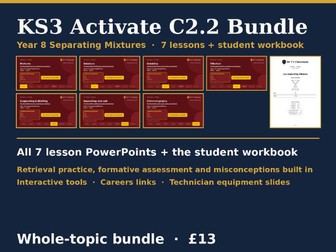
KS3 Activate C2.2 Separating Mixtures complete topic bundle: 7 editable Year 8 lessons plus the student workbook. Retrieval, formative assessment and answers built in. About this bundle Everything for the Year 8 Separating Mixtures unit (Activate C2.2) in one download: Mixtures, Solutions, Solubility, Filtration, Evaporation and Distillation, Separating Rock Salt, Chromatography, plus the 74-page student workbook that goes with the ‘Turn to Page…’ slides. Built into every lesson Retrieval starter: five questions check the prior knowledge pupils need for the lesson (answers in the notes) A concrete, surprising hook to get pupils talking Learning objectives pupils can act on, each with a ‘Show it’ task Formative assessment throughout: checks, hinge question, plenary and exit ticket Common misconceptions targeted: a hidden teacher slide and hinge questions from documented KS3 misconceptions Command words always come with a sentence starter or writing frame Four Tier 3 key words, with pronunciation and warnings about everyday meanings Booklet task slides, each followed by an expected-answers slide, so all the answers are in this PowerPoint Interactive tools made specifically for this lesson: the slides link to an ‘Explore’ tool and a ‘Check it’ tool that build and check understanding Written for KS3 reading levels: one short idea per bullet Fully editable PowerPoint (the lesson only: the printable workbook is a separate, paid resource) The full series This bundle is part of a complete KS3 Science series that follows Activate 1 and 2, covering Years 7 and 8. Lessons carry their Activate topic code. Not affiliated with or endorsed by Oxford University Press. Practical and demo lessons include an Equipment Request slide for your technician. Careers slides (with Gatsby benchmark links) appear in: Mixtures, Chromatography. Why buy the bundle All 7 lessons and the workbook for £13, about a third off buying them separately (lesson 1 is free on its own; lessons 2 to 7 are £2.50 each; the workbook is £5.00). The Scheme of Work is free and sold separately. A KS3 Practical Requisition Spreadsheet is a separate £5.00 extra. Last updated: October 2026 (first release).
KS3 Activate C2.2 Separating Mixtures Student WorkbookQuick View
drt-tuition

KS3 Activate C2.2 Separating Mixtures Student Workbook

(0)
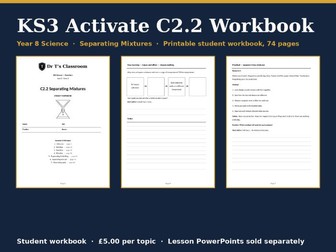
Printable Year 8 KS3 Science workbook for C2.2 Separating Mixtures: 74 pages for all 7 lessons. Tasks pupils transform, not copy. Use with the lesson PowerPoints. About this workbook The student workbook for the Year 8 Separating Mixtures unit (Activate C2.2), made to go with the KS3 Activate C2.2 Separating Mixtures lesson PowerPoints. Every lesson has its own pages: match-it and sort tables, sequencing, Venn diagrams, faded worked examples and, in practical lessons, a Predict-Observe-Explain box, results table and conclusion frame. Why use it Pupils transform what the slides show instead of copying it from the board, so lesson time goes on checking understanding Page numbers match the ‘Turn to Page…’ prompts on the slides Command words come with sentence starters and writing frames All the answers are in the lesson PowerPoints: an Expected answers slide follows every booklet task Editable Word file, A4, ready to print What you are buying This is the workbook only. The lesson PowerPoints are sold separately: lesson 1 is free and lessons 2 to 7 are £2.50 each. The whole topic (all 7 lessons plus this workbook) is £13 as a bundle. This workbook is part of a complete KS3 Science series that follows Activate 1 and 2, covering Years 7 and 8. Resources carry their Activate topic code. Not affiliated with or endorsed by Oxford University Press. The Scheme of Work (SoW) that goes with these resources is FREE. A KS3 Practical Requisition Spreadsheet is sold separately for £5.00. It makes requesting practicals and demos with your technicians seamless. Last updated: October 2026 (first release).
KS3 Activate C2.3 Metals and Non-metals: Investigating Plastic BagsQuick View
drt-tuition

KS3 Activate C2.3 Metals and Non-metals: Investigating Plastic Bags

(0)
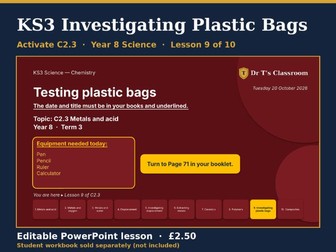
KS3 Science lesson on a fair test on plastic bag strength (Activate C2.3). Editable Year 8 PowerPoint with retrieval starter and answers. About this lesson Lesson 9 of 10 in the Year 8 Metals and Non-metals unit (Activate C2.3). Pupils identify the independent and dependent variables, measure the mass that tears each strip, and conclude the pattern in their results. Includes a fair-test practical: does a wider strip hold more? Includes an Equipment Request slide for your technician. Built into every lesson Retrieval starter: five questions check the prior knowledge pupils need for the lesson (answers in the notes) A concrete, surprising hook to get pupils talking Learning objectives pupils can act on, each with a ‘Show it’ task Formative assessment throughout: checks, hinge question, plenary and exit ticket Common misconceptions targeted: a hidden teacher slide and hinge questions from documented KS3 misconceptions Command words always come with a sentence starter or writing frame Four Tier 3 key words, with pronunciation and warnings about everyday meanings Booklet task slides, each followed by an expected-answers slide, so all the answers are in this PowerPoint Written for KS3 reading levels: one short idea per bullet Fully editable PowerPoint (the lesson only: the printable workbook is a separate, paid resource) The full series This lesson is part of a complete KS3 Science series that follows Activate 1 and 2, covering Years 7 and 8. Lessons carry their Activate topic code. Not affiliated with or endorsed by Oxford University Press. What is free and what is paid Lesson 1 (Metals and Acid) is FREE. This lesson is £2.50. The Scheme of Work (SoW) that goes with these resources is FREE. The C2.3 Metals and Non-metals student workbook is NOT free and is NOT included in this lesson. It holds the pages pupils write in when the slides say ‘Turn to Page…’, and is sold separately for £5.00 per topic. It is designed to cut down copying from the board, so lesson time goes on checking understanding. A KS3 Practical Requisition Spreadsheet is sold separately for £5.00. It makes requesting practicals and demos with your technicians seamless. Save on the whole topic: all 10 lesson PowerPoints plus the workbook are available together as a bundle for £18. Last updated: October 2026 (first release).
KS3 Activate C2.3 Metals and Non-metals: CeramicsQuick View
drt-tuition

KS3 Activate C2.3 Metals and Non-metals: Ceramics

(0)
KS3 Science lesson on ceramics and their properties (Activate C2.3). Editable Year 8 PowerPoint with retrieval starter and answers. About this lesson Lesson 7 of 10 in the Year 8 Metals and Non-metals unit (Activate C2.3). Pupils describe five properties of ceramics, link each use to a property, and explain why ceramics have high melting points. Includes a ‘Career in focus’ slide on the Materials Scientist, linked to Gatsby Benchmark 4 (linking curriculum learning to careers). Built into every lesson Retrieval starter: five questions check the prior knowledge pupils need for the lesson (answers in the notes) A concrete, surprising hook to get pupils talking Learning objectives pupils can act on, each with a ‘Show it’ task Formative assessment throughout: checks, hinge question, plenary and exit ticket Common misconceptions targeted: a hidden teacher slide and hinge questions from documented KS3 misconceptions Command words always come with a sentence starter or writing frame Four Tier 3 key words, with pronunciation and warnings about everyday meanings Booklet task slides, each followed by an expected-answers slide, so all the answers are in this PowerPoint Written for KS3 reading levels: one short idea per bullet Fully editable PowerPoint (the lesson only: the printable workbook is a separate, paid resource) The full series This lesson is part of a complete KS3 Science series that follows Activate 1 and 2, covering Years 7 and 8. Lessons carry their Activate topic code. Not affiliated with or endorsed by Oxford University Press. What is free and what is paid Lesson 1 (Metals and Acid) is FREE. This lesson is £2.50. The Scheme of Work (SoW) that goes with these resources is FREE. The C2.3 Metals and Non-metals student workbook is NOT free and is NOT included in this lesson. It holds the pages pupils write in when the slides say ‘Turn to Page…’, and is sold separately for £5.00 per topic. It is designed to cut down copying from the board, so lesson time goes on checking understanding. A KS3 Practical Requisition Spreadsheet is sold separately for £5.00. It makes requesting practicals and demos with your technicians seamless. Save on the whole topic: all 10 lesson PowerPoints plus the workbook are available together as a bundle for £18. Last updated: October 2026 (first release).
KS3 Activate C2.3 Metals and Non-metals: PolymersQuick View
drt-tuition

KS3 Activate C2.3 Metals and Non-metals: Polymers

(0)
KS3 Science lesson on polymers, monomers and their uses (Activate C2.3). Editable Year 8 PowerPoint with retrieval starter and answers. About this lesson Lesson 8 of 10 in the Year 8 Metals and Non-metals unit (Activate C2.3). Pupils draw monomers joining into a polymer, sort polymers into natural and synthetic, and explain why a polymer suits a use. Built into every lesson Retrieval starter: five questions check the prior knowledge pupils need for the lesson (answers in the notes) A concrete, surprising hook to get pupils talking Learning objectives pupils can act on, each with a ‘Show it’ task Formative assessment throughout: checks, hinge question, plenary and exit ticket Common misconceptions targeted: a hidden teacher slide and hinge questions from documented KS3 misconceptions Command words always come with a sentence starter or writing frame Four Tier 3 key words, with pronunciation and warnings about everyday meanings Booklet task slides, each followed by an expected-answers slide, so all the answers are in this PowerPoint Written for KS3 reading levels: one short idea per bullet Fully editable PowerPoint (the lesson only: the printable workbook is a separate, paid resource) The full series This lesson is part of a complete KS3 Science series that follows Activate 1 and 2, covering Years 7 and 8. Lessons carry their Activate topic code. Not affiliated with or endorsed by Oxford University Press. What is free and what is paid Lesson 1 (Metals and Acid) is FREE. This lesson is £2.50. The Scheme of Work (SoW) that goes with these resources is FREE. The C2.3 Metals and Non-metals student workbook is NOT free and is NOT included in this lesson. It holds the pages pupils write in when the slides say ‘Turn to Page…’, and is sold separately for £5.00 per topic. It is designed to cut down copying from the board, so lesson time goes on checking understanding. A KS3 Practical Requisition Spreadsheet is sold separately for £5.00. It makes requesting practicals and demos with your technicians seamless. Save on the whole topic: all 10 lesson PowerPoints plus the workbook are available together as a bundle for £18. Last updated: October 2026 (first release).
KS3 Activate C2.2 Separating Mixtures: Evaporation and DistillationQuick View
drt-tuition

KS3 Activate C2.2 Separating Mixtures: Evaporation and Distillation

(0)
KS3 Science lesson on evaporation and distillation (Activate C2.2). Editable Year 8 PowerPoint with retrieval starter and answers. About this lesson Lesson 5 of 7 in the Year 8 Separating Mixtures unit (Activate C2.2). Pupils choose the right method for a mixture, describe how distillation collects pure water, and compare evaporation with distillation. Includes two teacher demos: evaporating salt solution and distilling salt water. Includes an Equipment Request slide for your technician. Built into every lesson Retrieval starter: five questions check the prior knowledge pupils need for the lesson (answers in the notes) A concrete, surprising hook to get pupils talking Learning objectives pupils can act on, each with a ‘Show it’ task Formative assessment throughout: checks, hinge question, plenary and exit ticket Common misconceptions targeted: a hidden teacher slide and hinge questions from documented KS3 misconceptions Command words always come with a sentence starter or writing frame Four Tier 3 key words, with pronunciation and warnings about everyday meanings Booklet task slides, each followed by an expected-answers slide, so all the answers are in this PowerPoint Interactive tools made specifically for this lesson: the slides link to an ‘Explore’ tool and a ‘Check it’ tool that build and check understanding Written for KS3 reading levels: one short idea per bullet Fully editable PowerPoint (the lesson only: the printable workbook is a separate, paid resource) The full series This lesson is part of a complete KS3 Science series that follows Activate 1 and 2, covering Years 7 and 8. Lessons carry their Activate topic code. Not affiliated with or endorsed by Oxford University Press. What is free and what is paid Lesson 1 (Mixtures) is FREE. This lesson is £2.50. The Scheme of Work (SoW) that goes with these resources is FREE. The C2.2 Separating Mixtures student workbook is NOT free and is NOT included in this lesson. It holds the pages pupils write in when the slides say ‘Turn to Page…’, and is sold separately for £5.00 per topic. It is designed to cut down copying from the board, so lesson time goes on checking understanding. A KS3 Practical Requisition Spreadsheet is sold separately for £5.00. It makes requesting practicals and demos with your technicians seamless. Save on the whole topic: all 7 lesson PowerPoints plus the workbook are available together as a bundle for £13. Last updated: October 2026 (first release).
KS3 Activate C2.2 Separating Mixtures: FiltrationQuick View
drt-tuition

KS3 Activate C2.2 Separating Mixtures: Filtration

(0)
KS3 Science lesson on filtration (Activate C2.2). Editable Year 8 PowerPoint with retrieval starter and answers. About this lesson Lesson 4 of 7 in the Year 8 Separating Mixtures unit (Activate C2.2). Pupils choose mixtures that filtering can separate, describe how to filter sand from water, and explain why salt solution goes through filter paper. Includes an observing practical: separate sand from water. Includes an Equipment Request slide for your technician. Built into every lesson Retrieval starter: five questions check the prior knowledge pupils need for the lesson (answers in the notes) A concrete, surprising hook to get pupils talking Learning objectives pupils can act on, each with a ‘Show it’ task Formative assessment throughout: checks, hinge question, plenary and exit ticket Common misconceptions targeted: a hidden teacher slide and hinge questions from documented KS3 misconceptions Command words always come with a sentence starter or writing frame Four Tier 3 key words, with pronunciation and warnings about everyday meanings Booklet task slides, each followed by an expected-answers slide, so all the answers are in this PowerPoint Interactive tools made specifically for this lesson: the slides link to an ‘Explore’ tool and a ‘Check it’ tool that build and check understanding Written for KS3 reading levels: one short idea per bullet Fully editable PowerPoint (the lesson only: the printable workbook is a separate, paid resource) The full series This lesson is part of a complete KS3 Science series that follows Activate 1 and 2, covering Years 7 and 8. Lessons carry their Activate topic code. Not affiliated with or endorsed by Oxford University Press. What is free and what is paid Lesson 1 (Mixtures) is FREE. This lesson is £2.50. The Scheme of Work (SoW) that goes with these resources is FREE. The C2.2 Separating Mixtures student workbook is NOT free and is NOT included in this lesson. It holds the pages pupils write in when the slides say ‘Turn to Page…’, and is sold separately for £5.00 per topic. It is designed to cut down copying from the board, so lesson time goes on checking understanding. A KS3 Practical Requisition Spreadsheet is sold separately for £5.00. It makes requesting practicals and demos with your technicians seamless. Save on the whole topic: all 7 lesson PowerPoints plus the workbook are available together as a bundle for £13. Last updated: October 2026 (first release).
KS3 Activate C2.2 Separating Mixtures: Separating Rock SaltQuick View
drt-tuition

KS3 Activate C2.2 Separating Mixtures: Separating Rock Salt

(0)
KS3 Science lesson on separating pure salt from rock salt (Activate C2.2). Editable Year 8 PowerPoint with retrieval starter and answers. About this lesson Lesson 6 of 7 in the Year 8 Separating Mixtures unit (Activate C2.2). Pupils order the steps to get pure salt from rock salt, explain why each step works, and improve their method to get purer salt. Includes a separating practical: pure salt from rock salt. Includes an Equipment Request slide for your technician. Built into every lesson Retrieval starter: five questions check the prior knowledge pupils need for the lesson (answers in the notes) A concrete, surprising hook to get pupils talking Learning objectives pupils can act on, each with a ‘Show it’ task Formative assessment throughout: checks, hinge question, plenary and exit ticket Common misconceptions targeted: a hidden teacher slide and hinge questions from documented KS3 misconceptions Command words always come with a sentence starter or writing frame Four Tier 3 key words, with pronunciation and warnings about everyday meanings Booklet task slides, each followed by an expected-answers slide, so all the answers are in this PowerPoint Interactive tools made specifically for this lesson: the slides link to an ‘Explore’ tool and a ‘Check it’ tool that build and check understanding Written for KS3 reading levels: one short idea per bullet Fully editable PowerPoint (the lesson only: the printable workbook is a separate, paid resource) The full series This lesson is part of a complete KS3 Science series that follows Activate 1 and 2, covering Years 7 and 8. Lessons carry their Activate topic code. Not affiliated with or endorsed by Oxford University Press. What is free and what is paid Lesson 1 (Mixtures) is FREE. This lesson is £2.50. The Scheme of Work (SoW) that goes with these resources is FREE. The C2.2 Separating Mixtures student workbook is NOT free and is NOT included in this lesson. It holds the pages pupils write in when the slides say ‘Turn to Page…’, and is sold separately for £5.00 per topic. It is designed to cut down copying from the board, so lesson time goes on checking understanding. A KS3 Practical Requisition Spreadsheet is sold separately for £5.00. It makes requesting practicals and demos with your technicians seamless. Save on the whole topic: all 7 lesson PowerPoints plus the workbook are available together as a bundle for £13. Last updated: October 2026 (first release).
KS3 Activate C2.2 Separating Mixtures: SolubilityQuick View
drt-tuition

KS3 Activate C2.2 Separating Mixtures: Solubility

(0)
KS3 Science lesson on solubility and saturated solutions (Activate C2.2). Editable Year 8 PowerPoint with retrieval starter and answers. About this lesson Lesson 3 of 7 in the Year 8 Separating Mixtures unit (Activate C2.2). Pupils identify a saturated solution, read solubility from a bar chart or graph, and describe how temperature affects solubility. Built into every lesson Retrieval starter: five questions check the prior knowledge pupils need for the lesson (answers in the notes) A concrete, surprising hook to get pupils talking Learning objectives pupils can act on, each with a ‘Show it’ task Formative assessment throughout: checks, hinge question, plenary and exit ticket Common misconceptions targeted: a hidden teacher slide and hinge questions from documented KS3 misconceptions Command words always come with a sentence starter or writing frame Four Tier 3 key words, with pronunciation and warnings about everyday meanings Booklet task slides, each followed by an expected-answers slide, so all the answers are in this PowerPoint Interactive tools made specifically for this lesson: the slides link to an ‘Explore’ tool and a ‘Check it’ tool that build and check understanding Written for KS3 reading levels: one short idea per bullet Fully editable PowerPoint (the lesson only: the printable workbook is a separate, paid resource) The full series This lesson is part of a complete KS3 Science series that follows Activate 1 and 2, covering Years 7 and 8. Lessons carry their Activate topic code. Not affiliated with or endorsed by Oxford University Press. What is free and what is paid Lesson 1 (Mixtures) is FREE. This lesson is £2.50. The Scheme of Work (SoW) that goes with these resources is FREE. The C2.2 Separating Mixtures student workbook is NOT free and is NOT included in this lesson. It holds the pages pupils write in when the slides say ‘Turn to Page…’, and is sold separately for £5.00 per topic. It is designed to cut down copying from the board, so lesson time goes on checking understanding. A KS3 Practical Requisition Spreadsheet is sold separately for £5.00. It makes requesting practicals and demos with your technicians seamless. Save on the whole topic: all 7 lesson PowerPoints plus the workbook are available together as a bundle for £13. Last updated: October 2026 (first release).
KS3 Activate C2.3 Metals and Non-metals: CompositesQuick View
drt-tuition

KS3 Activate C2.3 Metals and Non-metals: Composites

(0)
KS3 Science lesson on composite materials (Activate C2.3). Editable Year 8 PowerPoint with retrieval starter and answers. About this lesson Lesson 10 of 10 in the Year 8 Metals and Non-metals unit (Activate C2.3). Pupils define a composite material, explain what each part of a composite does, and recommend materials for a bullet-proof vest. Includes a ‘Career in focus’ slide on the Materials Scientist, linked to Gatsby Benchmark 4 (linking curriculum learning to careers). Built into every lesson Retrieval starter: five questions check the prior knowledge pupils need for the lesson (answers in the notes) A concrete, surprising hook to get pupils talking Learning objectives pupils can act on, each with a ‘Show it’ task Formative assessment throughout: checks, hinge question, plenary and exit ticket Common misconceptions targeted: a hidden teacher slide and hinge questions from documented KS3 misconceptions Command words always come with a sentence starter or writing frame Four Tier 3 key words, with pronunciation and warnings about everyday meanings Booklet task slides, each followed by an expected-answers slide, so all the answers are in this PowerPoint Written for KS3 reading levels: one short idea per bullet Fully editable PowerPoint (the lesson only: the printable workbook is a separate, paid resource) The full series This lesson is part of a complete KS3 Science series that follows Activate 1 and 2, covering Years 7 and 8. Lessons carry their Activate topic code. Not affiliated with or endorsed by Oxford University Press. What is free and what is paid Lesson 1 (Metals and Acid) is FREE. This lesson is £2.50. The Scheme of Work (SoW) that goes with these resources is FREE. The C2.3 Metals and Non-metals student workbook is NOT free and is NOT included in this lesson. It holds the pages pupils write in when the slides say ‘Turn to Page…’, and is sold separately for £5.00 per topic. It is designed to cut down copying from the board, so lesson time goes on checking understanding. A KS3 Practical Requisition Spreadsheet is sold separately for £5.00. It makes requesting practicals and demos with your technicians seamless. Save on the whole topic: all 10 lesson PowerPoints plus the workbook are available together as a bundle for £18. Last updated: October 2026 (first release).
KS3 Activate C1.3 Reactions: Word EquationsQuick View
drt-tuition

KS3 Activate C1.3 Reactions: Word Equations

(0)
KS3 Science lesson on word equations, reactants and products (Activate C1.3). Editable Year 7 PowerPoint with retrieval starter and answers. About this lesson Lesson 2 of 7 in the Year 7 Reactions unit (Activate C1.3). Pupils identify the reactants and products in a word equation, write a word equation from a description, and explain what happens to atoms in a reaction. Includes a teacher demo: what is made? (three reactions). Includes an Equipment Request slide for your technician. Built into every lesson Retrieval starter: five questions check the prior knowledge pupils need for the lesson (answers in the notes) A concrete, surprising hook to get pupils talking Learning objectives pupils can act on, each with a ‘Show it’ task Formative assessment throughout: checks, hinge question, plenary and exit ticket Common misconceptions targeted: a hidden teacher slide and hinge questions from documented KS3 misconceptions Command words always come with a sentence starter or writing frame Four Tier 3 key words, with pronunciation and warnings about everyday meanings Booklet task slides, each followed by an expected-answers slide, so all the answers are in this PowerPoint Interactive tools made specifically for this lesson: the slides link to an ‘Explore’ tool and a ‘Check it’ tool that build and check understanding Written for KS3 reading levels: one short idea per bullet Fully editable PowerPoint (the lesson only: the printable workbook is a separate, paid resource) The full series This lesson is part of a complete KS3 Science series that follows Activate 1 and 2, covering Years 7 and 8. Lessons carry their Activate topic code. Not affiliated with or endorsed by Oxford University Press. What is free and what is paid Lesson 1 (Chemical Reactions) is FREE. This lesson is £2.50. The Scheme of Work (SoW) that goes with these resources is FREE. The C1.3 Reactions student workbook is NOT free and is NOT included in this lesson. It holds the pages pupils write in when the slides say ‘Turn to Page…’, and is sold separately for £5.00 per topic. It is designed to cut down copying from the board, so lesson time goes on checking understanding. A KS3 Practical Requisition Spreadsheet is sold separately for £5.00. It makes requesting practicals and demos with your technicians seamless. Save on the whole topic: all 7 lesson PowerPoints plus the workbook are available together as a bundle for £13. Last updated: October 2026 (first release).
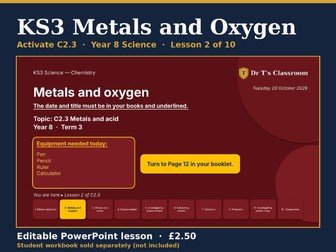
KS3 Activate C2.3 Metals and Non-metals: Metals and OxygenQuick View
drt-tuition

KS3 Activate C2.3 Metals and Non-metals: Metals and Oxygen

(0)
KS3 Science lesson on metals reacting with oxygen (Activate C2.3). Editable Year 8 PowerPoint with retrieval starter and answers. About this lesson Lesson 2 of 10 in the Year 8 Metals and Non-metals unit (Activate C2.3). Pupils name the product of a metal and oxygen, write word equations for metals burning, and compare how metals react with acid and oxygen. Includes a teacher demo and an observing practical on the colours of burning metals. Includes a ‘Career in focus’ slide on the Analytical Chemist, linked to Gatsby Benchmark 4 (linking curriculum learning to careers). Includes an Equipment Request slide for your technician. Built into every lesson Retrieval starter: five questions check the prior knowledge pupils need for the lesson (answers in the notes) A concrete, surprising hook to get pupils talking Learning objectives pupils can act on, each with a ‘Show it’ task Formative assessment throughout: checks, hinge question, plenary and exit ticket Common misconceptions targeted: a hidden teacher slide and hinge questions from documented KS3 misconceptions Command words always come with a sentence starter or writing frame Four Tier 3 key words, with pronunciation and warnings about everyday meanings Booklet task slides, each followed by an expected-answers slide, so all the answers are in this PowerPoint Interactive tools made specifically for this lesson: the slides link to an ‘Explore’ tool and a ‘Check it’ tool that build and check understanding Written for KS3 reading levels: one short idea per bullet Fully editable PowerPoint (the lesson only: the printable workbook is a separate, paid resource) The full series This lesson is part of a complete KS3 Science series that follows Activate 1 and 2, covering Years 7 and 8. Lessons carry their Activate topic code. Not affiliated with or endorsed by Oxford University Press. What is free and what is paid Lesson 1 (Metals and Acid) is FREE. This lesson is £2.50. The Scheme of Work (SoW) that goes with these resources is FREE. The C2.3 Metals and Non-metals student workbook is NOT free and is NOT included in this lesson. It holds the pages pupils write in when the slides say ‘Turn to Page…’, and is sold separately for £5.00 per topic. It is designed to cut down copying from the board, so lesson time goes on checking understanding. A KS3 Practical Requisition Spreadsheet is sold separately for £5.00. It makes requesting practicals and demos with your technicians seamless. Save on the whole topic: all 10 lesson PowerPoints plus the workbook are available together as a bundle for £18. Last updated: October 2026 (first release).