Edexcel IGCSE Chemistry Unit 3 – Physical Chemistry: Lesson 18, Whole-Unit RevisionQuick View
ChemWorks

Edexcel IGCSE Chemistry Unit 3 – Physical Chemistry: Lesson 18, Whole-Unit Revision

(0)
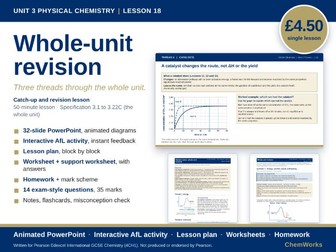
Edexcel IGCSE Chemistry (4CH1) Unit 3 Physical Chemistry, Lesson 18: Whole-Unit Revision. A complete, ready-to-teach lesson: animated PowerPoint, interactive AfL activity, a worksheet and a scaffolded worksheet (both with answers) and homework. The whole of Physical chemistry pulled into three threads: energy, collisions and catalysts. Pupils finally see how ΔH, rate, activation energy and yield connect. After the three threads and a “Which is bigger?” activity, pupils sit an 18-minute timed section in silence, then swap and mark a partner’s sheet with the answers. The plenary puts a full explanation in order, and the homework is final revision on two reactions the lesson never uses. Walk in and teach: the lesson is planned minute by minute, with the slides, two levels of worksheet, homework and every answer ready to go. Specification points: 3.1 to 3.22C revised, the whole unit. What you get 32-slide editable PowerPoint, with worked examples that build a click at a time, an interactive activity, and speaker notes giving the answers and timings Two-page lesson plan: the lesson at a glance, then the 50 minutes block by block Worksheet with answers (20 marks) Scaffolded support worksheet with answers: the same questions, with gap-fills and word banks Homework with mark scheme (15 marks, about 15 to 20 minutes): yours to set or not Student notes Flashcards to print and cut, plus a text file for Quizlet or Anki Misconception check with its key 14 exam-style questions worth 35 marks across the worksheet and homework 11 resources in all: the PowerPoint and 10 documents, each document as a PDF and an editable Word file (the Quizlet text file comes on top) Why teachers like it One idea at a time: every slide builds up a click at a time, so there is never a wall of text See straight away who has got it: a wrong answer brings up a cross, the reason and Try again; the right one brings up a tick and the reasoning Mixed classes covered: the scaffolded worksheet asks the same questions with more help, so everyone works on the same chemistry Every diagram and animation was drawn for this lesson: nothing is borrowed from a textbook or the web Save more on ChemWorks: this revision lesson is also in the complete Unit 3 Physical Chemistry pack (18 lessons, both unit tests with mark schemes and all the unit documents, £59.50). Lesson 1 of the unit is free, so you can try before you buy. Written for Pearson Edexcel International GCSE Chemistry (4CH1). Not produced or endorsed by Pearson.
Edexcel IGCSE Chemistry Unit 3 – Physical Chemistry: Lesson 17, Rates and Equilibria RevisionQuick View
ChemWorks

Edexcel IGCSE Chemistry Unit 3 – Physical Chemistry: Lesson 17, Rates and Equilibria Revision

(0)
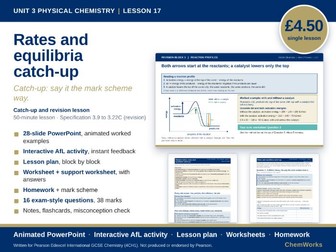
Edexcel IGCSE Chemistry (4CH1) Unit 3 Physical Chemistry, Lesson 17: Rates and Equilibria Revision. A complete, ready-to-teach lesson: animated PowerPoint, interactive AfL activity, a worksheet and a scaffolded worksheet (both with answers) and homework. Four short revision blocks, each followed straight away by its own exam-style question, so pupils practise every idea while it is fresh. Built for the lesson before the end-of-unit test, it covers collision theory the way the mark scheme wants it, both core practicals (with an anomalous result to spot), reaction profiles, and how one change can affect the rate and the yield differently. A “Spot the mistake” activity and a plenary where pupils mark a student’s answer finish it off, and the student notes work as a revision summary of rates and equilibria. Walk in and teach: the lesson is planned minute by minute, with the slides, two levels of worksheet, homework and every answer ready to go. Specification points: 3.9 to 3.22C revised (3.14C and 3.19C to 3.22C are Chemistry only). What you get 28-slide editable PowerPoint, with worked examples that build a click at a time, an interactive activity, and speaker notes giving the answers and timings Two-page lesson plan: the lesson at a glance, then the 50 minutes block by block Worksheet with answers (23 marks) Scaffolded support worksheet with answers: the same questions, with gap-fills and word banks Homework with mark scheme (15 marks, about 15 to 20 minutes): yours to set or not Student notes Flashcards to print and cut, plus a text file for Quizlet or Anki Misconception check with its key 16 exam-style questions worth 38 marks across the worksheet and homework 11 resources in all: the PowerPoint and 10 documents, each document as a PDF and an editable Word file (the Quizlet text file comes on top) Why teachers like it One idea at a time: every slide builds up a click at a time, so there is never a wall of text See straight away who has got it: a wrong answer brings up a cross, the reason and Try again; the right one brings up a tick and the reasoning Mixed classes covered: the scaffolded worksheet asks the same questions with more help, so everyone works on the same chemistry Every diagram and animation was drawn for this lesson: nothing is borrowed from a textbook or the web Save more on ChemWorks: this revision lesson is also in the complete Unit 3 Physical Chemistry pack (18 lessons, both unit tests with mark schemes and all the unit documents, £59.50). Lesson 1 of the unit is free, so you can try before you buy. Written for Pearson Edexcel International GCSE Chemistry (4CH1). Not produced or endorsed by Pearson.
Edexcel IGCSE Chemistry Unit 3 – Physical Chemistry: Lesson 16, Pressure and EquilibriumQuick View
ChemWorks

Edexcel IGCSE Chemistry Unit 3 – Physical Chemistry: Lesson 16, Pressure and Equilibrium

(0)
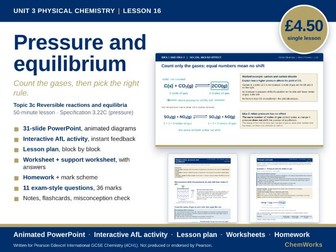
Edexcel IGCSE Chemistry (4CH1) Unit 3 Physical Chemistry, Lesson 16: Pressure and Equilibrium. A complete, ready-to-teach lesson: animated PowerPoint, interactive AfL activity, a worksheet and a scaffolded worksheet (both with answers) and homework. Cross out the solid, count the gas, then decide. Counting a solid as a gas is the trap in pressure questions, and this lesson catches it early. An animation of a piston pushing in shows the number of gas molecules falling as the position shifts. Pupils sort six changes into more product, less product or no change, then put temperature, pressure and a catalyst together to choose the best conditions for one reaction. The homework includes a full six-mark answer on the best conditions for making hydrogen. No practical is needed. Walk in and teach: the lesson is planned minute by minute, with the slides, two levels of worksheet, homework and every answer ready to go. Specification points: 3.22C the effect of pressure on the position of equilibrium (Chemistry only). What you get 31-slide editable PowerPoint, with worked examples that build a click at a time, an interactive activity, and speaker notes giving the answers and timings Two-page lesson plan: the lesson at a glance, then the 50 minutes block by block Worksheet with answers (20 marks) Scaffolded support worksheet with answers: the same questions, with gap-fills and word banks Homework with mark scheme (16 marks, about 15 to 20 minutes): yours to set or not Student notes Flashcards to print and cut, plus a text file for Quizlet or Anki Misconception check with its key 11 exam-style questions worth 36 marks across the worksheet and homework 11 resources in all: the PowerPoint and 10 documents, each document as a PDF and an editable Word file (the Quizlet text file comes on top) Why teachers like it One idea at a time: every slide builds up a click at a time, so there is never a wall of text See straight away who has got it: a wrong answer brings up a cross, the reason and Try again; the right one brings up a tick and the reasoning Mixed classes covered: the scaffolded worksheet asks the same questions with more help, so everyone works on the same chemistry Every diagram and animation was drawn for this lesson: nothing is borrowed from a textbook or the web Save more on ChemWorks: this lesson is also in the Topic 3c Reversible Reactions and Equilibria pack (4 lessons, £16) and the complete Unit 3 Physical Chemistry pack (18 lessons, both unit tests with mark schemes and all the unit documents, £59.50). Lesson 1 of the unit is free, so you can try before you buy. Written for Pearson Edexcel International GCSE Chemistry (4CH1). Not produced or endorsed by Pearson.
Edexcel IGCSE Chemistry Unit 3 – Physical Chemistry: Lesson 15, The Position of EquilibriumQuick View
ChemWorks

Edexcel IGCSE Chemistry Unit 3 – Physical Chemistry: Lesson 15, The Position of Equilibrium

(0)
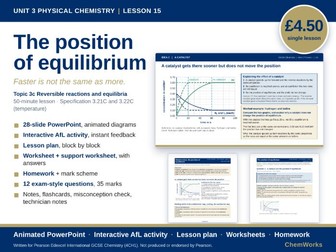
Edexcel IGCSE Chemistry (4CH1) Unit 3 Physical Chemistry, Lesson 15: The Position of Equilibrium. A complete, ready-to-teach lesson: animated PowerPoint, interactive AfL activity, a worksheet and a scaffolded worksheet (both with answers) and homework. Purple, blue or pink? The class predicts what colour a cobalt chloride tube will turn in ice before it goes in. That demonstration anchors what pupils need: heating shifts the position of equilibrium the endothermic way, cooling the exothermic way. They learn why a catalyst leaves the position where it is, practise reading the sign of ΔH in a “Which way does it shift?” activity, and meet the trap examiners love: faster does not mean more product. Walk in and teach: the lesson is planned minute by minute, with the slides, two levels of worksheet, homework and every answer ready to go. Specification points: 3.21C a catalyst and the position of equilibrium; 3.22C the effect of temperature (both Chemistry only). What you get 28-slide editable PowerPoint, with worked examples that build a click at a time, an interactive activity, and speaker notes giving the answers and timings Two-page lesson plan: the lesson at a glance, then the 50 minutes block by block Worksheet with answers (19 marks) Scaffolded support worksheet with answers: the same questions, with gap-fills and word banks Homework with mark scheme (16 marks, about 15 to 20 minutes): yours to set or not Student notes Flashcards to print and cut, plus a text file for Quizlet or Anki Misconception check with its key Technician notes with the kit and hazards 12 exam-style questions worth 35 marks across the worksheet and homework 12 resources in all: the PowerPoint and 11 documents, each document as a PDF and an editable Word file (the Quizlet text file comes on top) Why teachers like it One idea at a time: every slide builds up a click at a time, so there is never a wall of text See straight away who has got it: a wrong answer brings up a cross, the reason and Try again; the right one brings up a tick and the reasoning Mixed classes covered: the scaffolded worksheet asks the same questions with more help, so everyone works on the same chemistry Every diagram and animation was drawn for this lesson: nothing is borrowed from a textbook or the web Save more on ChemWorks: this lesson is also in the Topic 3c Reversible Reactions and Equilibria pack (4 lessons, £16) and the complete Unit 3 Physical Chemistry pack (18 lessons, both unit tests with mark schemes and all the unit documents, £59.50). Lesson 1 of the unit is free, so you can try before you buy. Written for Pearson Edexcel International GCSE Chemistry (4CH1). Not produced or endorsed by Pearson.
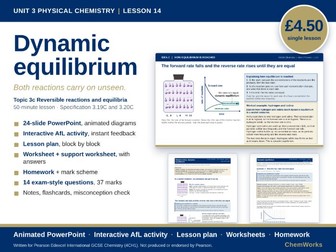
Edexcel IGCSE Chemistry Unit 3 – Physical Chemistry: Lesson 14, Dynamic EquilibriumQuick View
ChemWorks

Edexcel IGCSE Chemistry Unit 3 – Physical Chemistry: Lesson 14, Dynamic Equilibrium

(0)
Edexcel IGCSE Chemistry (4CH1) Unit 3 Physical Chemistry, Lesson 14: Dynamic Equilibrium. A complete, ready-to-teach lesson: animated PowerPoint, interactive AfL activity, a worksheet and a scaffolded worksheet (both with answers) and homework. The molecules never stop reacting. A looping animation of a sealed container shows the forward and reverse reactions carrying on at the same rate, and “dynamic” finally makes sense. Pupils learn why equilibrium needs a sealed container, why the two rates end up equal, and the two characteristics the mark scheme asks for. A “True or false” activity tackles the usual misunderstandings, including “constant” read as “equal”. The plenary has pupils mark a student who wrote that sealing the container stops heat escaping. No practical is needed. Walk in and teach: the lesson is planned minute by minute, with the slides, two levels of worksheet, homework and every answer ready to go. Specification points: 3.19C dynamic equilibrium in a sealed container; 3.20C its two characteristics (both Chemistry only). What you get 24-slide editable PowerPoint, with worked examples that build a click at a time, an interactive activity, and speaker notes giving the answers and timings Two-page lesson plan: the lesson at a glance, then the 50 minutes block by block Worksheet with answers (21 marks) Scaffolded support worksheet with answers: the same questions, with gap-fills and word banks Homework with mark scheme (16 marks, about 15 to 20 minutes): yours to set or not Student notes Flashcards to print and cut, plus a text file for Quizlet or Anki Misconception check with its key 14 exam-style questions worth 37 marks across the worksheet and homework 11 resources in all: the PowerPoint and 10 documents, each document as a PDF and an editable Word file (the Quizlet text file comes on top) Why teachers like it One idea at a time: every slide builds up a click at a time, so there is never a wall of text See straight away who has got it: a wrong answer brings up a cross, the reason and Try again; the right one brings up a tick and the reasoning Mixed classes covered: the scaffolded worksheet asks the same questions with more help, so everyone works on the same chemistry Every diagram and animation was drawn for this lesson: nothing is borrowed from a textbook or the web Save more on ChemWorks: this lesson is also in the Topic 3c Reversible Reactions and Equilibria pack (4 lessons, £16) and the complete Unit 3 Physical Chemistry pack (18 lessons, both unit tests with mark schemes and all the unit documents, £59.50). Lesson 1 of the unit is free, so you can try before you buy. Written for Pearson Edexcel International GCSE Chemistry (4CH1). Not produced or endorsed by Pearson.
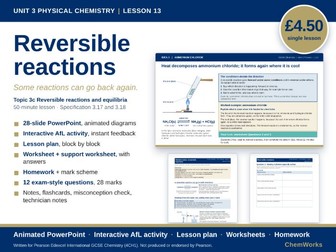
Edexcel IGCSE Chemistry Unit 3 – Physical Chemistry: Lesson 13, Reversible ReactionsQuick View
ChemWorks

Edexcel IGCSE Chemistry Unit 3 – Physical Chemistry: Lesson 13, Reversible Reactions

(0)
Edexcel IGCSE Chemistry (4CH1) Unit 3 Physical Chemistry, Lesson 13: Reversible Reactions. A complete, ready-to-teach lesson: animated PowerPoint, interactive AfL activity, a worksheet and a scaffolded worksheet (both with answers) and homework. Blue crystals turn white when they are heated. Add the water back and they turn blue again, and the test tube gets hot in pupils’ hands: a reversible reaction they can see and feel. Pairs heat hydrated copper(II) sulfate, collect the water in a cooled tube and add it back to the white solid, with burning magnesium as the contrast, a reaction that can’t go back. A “Predict then watch” activity with clips of ammonium chloride has pupils commit to what happens before they see it, and an odd-one-out plenary pulls the four changes together. Walk in and teach: the lesson is planned minute by minute, with the slides, two levels of worksheet, homework and every answer ready to go. Specification points: 3.17 reversible reactions and the reversible arrow; 3.18 hydrated copper(II) sulfate and ammonium chloride. What you get 28-slide editable PowerPoint, with worked examples that build a click at a time, an interactive activity, and speaker notes giving the answers and timings Two-page lesson plan: the lesson at a glance, then the 50 minutes block by block Worksheet with answers (14 marks) Scaffolded support worksheet with answers: the same questions, with gap-fills and word banks Homework with mark scheme (14 marks, about 15 to 20 minutes): yours to set or not Student notes Flashcards to print and cut, plus a text file for Quizlet or Anki Misconception check with its key Technician notes with the kit and hazards 12 exam-style questions worth 28 marks across the worksheet and homework 12 resources in all: the PowerPoint and 11 documents, each document as a PDF and an editable Word file (the Quizlet text file comes on top) Why teachers like it One idea at a time: every slide builds up a click at a time, so there is never a wall of text See straight away who has got it: a wrong answer brings up a cross, the reason and Try again; the right one brings up a tick and the reasoning Mixed classes covered: the scaffolded worksheet asks the same questions with more help, so everyone works on the same chemistry Every diagram and animation was drawn for this lesson: nothing is borrowed from a textbook or the web Save more on ChemWorks: this lesson is also in the Topic 3c Reversible Reactions and Equilibria pack (4 lessons, £16) and the complete Unit 3 Physical Chemistry pack (18 lessons, both unit tests with mark schemes and all the unit documents, £59.50). Lesson 1 of the unit is free, so you can try before you buy. Written for Pearson Edexcel International GCSE Chemistry (4CH1). Not produced or endorsed by Pearson.
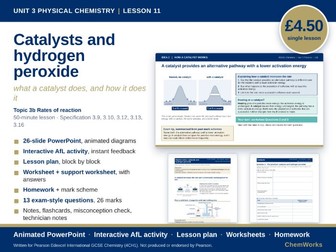
Edexcel IGCSE Chemistry Unit 3 – Physical Chemistry: Lesson 11, Catalysts and Hydrogen PeroxideQuick View
ChemWorks

Edexcel IGCSE Chemistry Unit 3 – Physical Chemistry: Lesson 11, Catalysts and Hydrogen Peroxide

(0)
Edexcel IGCSE Chemistry (4CH1) Unit 3 Physical Chemistry, Lesson 11: Catalysts and Hydrogen Peroxide. A complete, ready-to-teach lesson: animated PowerPoint, interactive AfL activity, a worksheet and a scaffolded worksheet (both with answers) and homework. Manganese(IV) oxide, iron(III) oxide or a slice of raw potato: which is the best catalyst for hydrogen peroxide? Pupils find out for themselves in the second rates core practical. Pairs collect oxygen over water for 60 seconds with each solid, while you run lead(IV) oxide, the no-solid control and the glowing splint test at the front. A “Predict then watch” activity tests what a catalyst does to the line and what it doesn’t, then two worked examples explain it with an alternative pathway of lower activation energy. Pupils also learn how to show that a catalyst is chemically unchanged. Walk in and teach: the lesson is planned minute by minute, with the slides, two levels of worksheet, homework and every answer ready to go. Specification points: 3.9 and 3.10 for catalysts; 3.12 and 3.13 what a catalyst is and how it works; 3.16 the hydrogen peroxide core practical. What you get 26-slide editable PowerPoint, with worked examples that build a click at a time, an interactive activity, and speaker notes giving the answers and timings Two-page lesson plan: the lesson at a glance, then the 50 minutes block by block Worksheet with answers (10 marks) Scaffolded support worksheet with answers: the same questions, with gap-fills and word banks Homework with mark scheme (16 marks, about 15 to 20 minutes): yours to set or not Student notes Flashcards to print and cut, plus a text file for Quizlet or Anki Misconception check with its key Technician notes with the kit and hazards 13 exam-style questions worth 26 marks across the worksheet and homework 12 resources in all: the PowerPoint and 11 documents, each document as a PDF and an editable Word file (the Quizlet text file comes on top) Why teachers like it One idea at a time: every slide builds up a click at a time, so there is never a wall of text See straight away who has got it: a wrong answer brings up a cross, the reason and Try again; the right one brings up a tick and the reasoning Mixed classes covered: the scaffolded worksheet asks the same questions with more help, so everyone works on the same chemistry Every diagram and animation was drawn for this lesson: nothing is borrowed from a textbook or the web Save more on ChemWorks: this lesson is also in the Topic 3b Rates of Reaction pack (6 lessons, £24) and the complete Unit 3 Physical Chemistry pack (18 lessons, both unit tests with mark schemes and all the unit documents, £59.50). Lesson 1 of the unit is free, so you can try before you buy. Written for Pearson Edexcel International GCSE Chemistry (4CH1). Not produced or endorsed by Pearson.
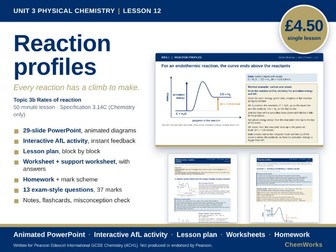
Edexcel IGCSE Chemistry Unit 3 – Physical Chemistry: Lesson 12, Reaction ProfilesQuick View
ChemWorks

Edexcel IGCSE Chemistry Unit 3 – Physical Chemistry: Lesson 12, Reaction Profiles

(0)
Edexcel IGCSE Chemistry (4CH1) Unit 3 Physical Chemistry, Lesson 12: Reaction Profiles. A complete, ready-to-teach lesson: animated PowerPoint, interactive AfL activity, a worksheet and a scaffolded worksheet (both with answers) and homework. Both arrows start at the reactants’ line. Get that right and most reaction profile marks follow. Pupils see why the curve rises even for an exothermic reaction, then draw profiles for both kinds, one part at a time. The “Label the profile” activity has them choose which arrow is the activation energy and which is ΔH, with and without a catalyst. They learn to read each value off a scale as the difference between two levels, and finish by finding three mistakes in a student’s catalysed curve. No practical is needed. Walk in and teach: the lesson is planned minute by minute, with the slides, two levels of worksheet, homework and every answer ready to go. Specification points: 3.14C reaction profiles with ΔH and the activation energy (Chemistry only). What you get 29-slide editable PowerPoint, with worked examples that build a click at a time, an interactive activity, and speaker notes giving the answers and timings Two-page lesson plan: the lesson at a glance, then the 50 minutes block by block Worksheet with answers (22 marks) Scaffolded support worksheet with answers: the same questions, with gap-fills and word banks Homework with mark scheme (15 marks, about 15 to 20 minutes): yours to set or not Student notes Flashcards to print and cut, plus a text file for Quizlet or Anki Misconception check with its key 13 exam-style questions worth 37 marks across the worksheet and homework 11 resources in all: the PowerPoint and 10 documents, each document as a PDF and an editable Word file (the Quizlet text file comes on top) Why teachers like it One idea at a time: every slide builds up a click at a time, so there is never a wall of text See straight away who has got it: a wrong answer brings up a cross, the reason and Try again; the right one brings up a tick and the reasoning Mixed classes covered: the scaffolded worksheet asks the same questions with more help, so everyone works on the same chemistry Every diagram and animation was drawn for this lesson: nothing is borrowed from a textbook or the web Save more on ChemWorks: this lesson is also in the Topic 3b Rates of Reaction pack (6 lessons, £24) and the complete Unit 3 Physical Chemistry pack (18 lessons, both unit tests with mark schemes and all the unit documents, £59.50). Lesson 1 of the unit is free, so you can try before you buy. Written for Pearson Edexcel International GCSE Chemistry (4CH1). Not produced or endorsed by Pearson.
Edexcel IGCSE Chemistry Unit 3 – Physical Chemistry: Lesson 10, Temperature and RateQuick View
ChemWorks

Edexcel IGCSE Chemistry Unit 3 – Physical Chemistry: Lesson 10, Temperature and Rate

(0)
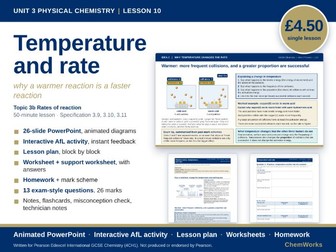
Edexcel IGCSE Chemistry (4CH1) Unit 3 Physical Chemistry, Lesson 10: Temperature and Rate. A complete, ready-to-teach lesson: animated PowerPoint, interactive AfL activity, a worksheet and a scaffolded worksheet (both with answers) and homework. Heating speeds a reaction up for two reasons, and the mark scheme wants both. Most pupils give one. Pairs run the disappearing cross with one flask from the bench and one from a warm bath, reading the temperature in the solution rather than the bath. Two worked examples build the explanation link by link, and an “Odd one out” activity checks that pupils are thinking about the proportion of successful collisions, not the total. The plenary puts right the classic “heating lowers the activation energy” mistake, and the homework ends with a glow stick in a freezer. Walk in and teach: the lesson is planned minute by minute, with the slides, two levels of worksheet, homework and every answer ready to go. Specification points: 3.9, 3.10 and 3.11 for temperature: the experiment, the effect and the explanation. What you get 26-slide editable PowerPoint, with worked examples that build a click at a time, an interactive activity, and speaker notes giving the answers and timings Two-page lesson plan: the lesson at a glance, then the 50 minutes block by block Worksheet with answers (10 marks) Scaffolded support worksheet with answers: the same questions, with gap-fills and word banks Homework with mark scheme (16 marks, about 15 to 20 minutes): yours to set or not Student notes Flashcards to print and cut, plus a text file for Quizlet or Anki Misconception check with its key Technician notes with the kit and hazards 13 exam-style questions worth 26 marks across the worksheet and homework 12 resources in all: the PowerPoint and 11 documents, each document as a PDF and an editable Word file (the Quizlet text file comes on top) Why teachers like it One idea at a time: every slide builds up a click at a time, so there is never a wall of text See straight away who has got it: a wrong answer brings up a cross, the reason and Try again; the right one brings up a tick and the reasoning Mixed classes covered: the scaffolded worksheet asks the same questions with more help, so everyone works on the same chemistry Every diagram and animation was drawn for this lesson: nothing is borrowed from a textbook or the web Save more on ChemWorks: this lesson is also in the Topic 3b Rates of Reaction pack (6 lessons, £24) and the complete Unit 3 Physical Chemistry pack (18 lessons, both unit tests with mark schemes and all the unit documents, £59.50). Lesson 1 of the unit is free, so you can try before you buy. Written for Pearson Edexcel International GCSE Chemistry (4CH1). Not produced or endorsed by Pearson.
Edexcel IGCSE Chemistry Unit 3 – Physical Chemistry: Lesson 9, Collision TheoryQuick View
ChemWorks

Edexcel IGCSE Chemistry Unit 3 – Physical Chemistry: Lesson 9, Collision Theory

(0)
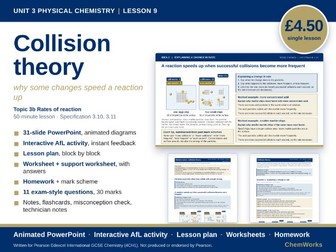
Edexcel IGCSE Chemistry (4CH1) Unit 3 Physical Chemistry, Lesson 9: Collision Theory. A complete, ready-to-teach lesson: animated PowerPoint, interactive AfL activity, a worksheet and a scaffolded worksheet (both with answers) and homework. Nine collisions on screen, three of them successful. The collision counters in this lesson give pupils a picture they can hang every rate explanation on. From there they build the full chain the mark scheme wants: more particles in the same space, more frequent collisions, more successful collisions each second, a faster rate. A disappearing-cross demonstration has the class predict which flask clears first, and a “Spot the mistake” activity hunts down the sentences an examiner won’t accept, starting with “more collisions” and no idea of time. The pressure of a gas is covered too. Walk in and teach: the lesson is planned minute by minute, with the slides, two levels of worksheet, homework and every answer ready to go. Specification points: 3.10 and 3.11 for surface area, concentration and gas pressure, explained with collision theory. What you get 31-slide editable PowerPoint, with worked examples that build a click at a time, an interactive activity, and speaker notes giving the answers and timings Two-page lesson plan: the lesson at a glance, then the 50 minutes block by block Worksheet with answers (16 marks) Scaffolded support worksheet with answers: the same questions, with gap-fills and word banks Homework with mark scheme (14 marks, about 15 to 20 minutes): yours to set or not Student notes Flashcards to print and cut, plus a text file for Quizlet or Anki Misconception check with its key Technician notes with the kit and hazards 11 exam-style questions worth 30 marks across the worksheet and homework 12 resources in all: the PowerPoint and 11 documents, each document as a PDF and an editable Word file (the Quizlet text file comes on top) Why teachers like it One idea at a time: every slide builds up a click at a time, so there is never a wall of text See straight away who has got it: a wrong answer brings up a cross, the reason and Try again; the right one brings up a tick and the reasoning Mixed classes covered: the scaffolded worksheet asks the same questions with more help, so everyone works on the same chemistry Every diagram and animation was drawn for this lesson: nothing is borrowed from a textbook or the web Save more on ChemWorks: this lesson is also in the Topic 3b Rates of Reaction pack (6 lessons, £24) and the complete Unit 3 Physical Chemistry pack (18 lessons, both unit tests with mark schemes and all the unit documents, £59.50). Lesson 1 of the unit is free, so you can try before you buy. Written for Pearson Edexcel International GCSE Chemistry (4CH1). Not produced or endorsed by Pearson.
Edexcel IGCSE Chemistry Unit 3 – Physical Chemistry: Lesson 8, Surface Area and ConcentrationQuick View
ChemWorks

Edexcel IGCSE Chemistry Unit 3 – Physical Chemistry: Lesson 8, Surface Area and Concentration

(0)
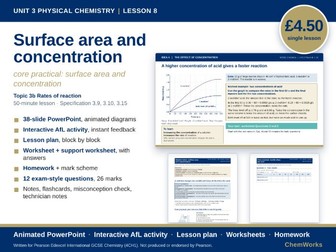
Edexcel IGCSE Chemistry (4CH1) Unit 3 Physical Chemistry, Lesson 8: Surface Area and Concentration. A complete, ready-to-teach lesson: animated PowerPoint, interactive AfL activity, a worksheet and a scaffolded worksheet (both with answers) and homework. The marble chips core practical, planned, run and written up in one lesson, with every pair getting a result in 15 minutes. Half the benches change the size of the chips, half change the concentration of the acid, and everyone follows the loss in mass on a balance. Before any kit is touched, a “Put the method in order” activity checks the plan, including three tempting steps that should never be used. Afterwards, pupils compare two runs on the same axes and explain why each line levels off where it does. Walk in and teach: the lesson is planned minute by minute, with the slides, two levels of worksheet, homework and every answer ready to go. Specification points: 3.9 and 3.10 for surface area and concentration; 3.15 the marble chips core practical. What you get 38-slide editable PowerPoint, with worked examples that build a click at a time, an interactive activity, and speaker notes giving the answers and timings Two-page lesson plan: the lesson at a glance, then the 50 minutes block by block Worksheet with answers (10 marks) Scaffolded support worksheet with answers: the same questions, with gap-fills and word banks Homework with mark scheme (16 marks, about 15 to 20 minutes): yours to set or not Student notes Flashcards to print and cut, plus a text file for Quizlet or Anki Misconception check with its key Technician notes with the kit and hazards 12 exam-style questions worth 26 marks across the worksheet and homework 12 resources in all: the PowerPoint and 11 documents, each document as a PDF and an editable Word file (the Quizlet text file comes on top) Why teachers like it One idea at a time: every slide builds up a click at a time, so there is never a wall of text See straight away who has got it: a wrong answer brings up a cross, the reason and Try again; the right one brings up a tick and the reasoning Mixed classes covered: the scaffolded worksheet asks the same questions with more help, so everyone works on the same chemistry Every diagram and animation was drawn for this lesson: nothing is borrowed from a textbook or the web Save more on ChemWorks: this lesson is also in the Topic 3b Rates of Reaction pack (6 lessons, £24) and the complete Unit 3 Physical Chemistry pack (18 lessons, both unit tests with mark schemes and all the unit documents, £59.50). Lesson 1 of the unit is free, so you can try before you buy. Written for Pearson Edexcel International GCSE Chemistry (4CH1). Not produced or endorsed by Pearson.
Edexcel IGCSE Chemistry Unit 3 – Physical Chemistry: Lesson 7, Measuring the Rate of a ReactionQuick View
ChemWorks

Edexcel IGCSE Chemistry Unit 3 – Physical Chemistry: Lesson 7, Measuring the Rate of a Reaction

(0)
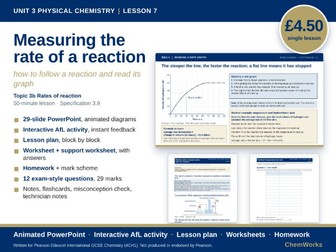
Edexcel IGCSE Chemistry (4CH1) Unit 3 Physical Chemistry, Lesson 7: Measuring the Rate of a Reaction. A complete, ready-to-teach lesson: animated PowerPoint, interactive AfL activity, a worksheet and a scaffolded worksheet (both with answers) and homework. Steepness is rate, height is amount. Pupils who get that one idea can read almost any rate graph, and this lesson drills it. It opens with a gas syringe demonstration on marble chips and the three ways to follow a rate. Pairs then collect hydrogen from magnesium ribbon and dilute acid over water, reading the volume every 10 seconds. Back at their desks they try the “Read the graph” activity, work out an average rate and sketch where a faster run would level off. The homework uses the class’s own results, with a printed set for anyone who missed the practical. Walk in and teach: the lesson is planned minute by minute, with the slides, two levels of worksheet, homework and every answer ready to go. Specification points: 3.9 following the rate of a reaction and reading the results from a graph. What you get 29-slide editable PowerPoint, with worked examples that build a click at a time, an interactive activity, and speaker notes giving the answers and timings Two-page lesson plan: the lesson at a glance, then the 50 minutes block by block Worksheet with answers (13 marks) Scaffolded support worksheet with answers: the same questions, with gap-fills and word banks Homework with mark scheme (16 marks, about 15 to 20 minutes): yours to set or not Student notes Flashcards to print and cut, plus a text file for Quizlet or Anki Misconception check with its key Technician notes with the kit and hazards 12 exam-style questions worth 29 marks across the worksheet and homework 12 resources in all: the PowerPoint and 11 documents, each document as a PDF and an editable Word file (the Quizlet text file comes on top) Why teachers like it One idea at a time: every slide builds up a click at a time, so there is never a wall of text See straight away who has got it: a wrong answer brings up a cross, the reason and Try again; the right one brings up a tick and the reasoning Mixed classes covered: the scaffolded worksheet asks the same questions with more help, so everyone works on the same chemistry Every diagram and animation was drawn for this lesson: nothing is borrowed from a textbook or the web Save more on ChemWorks: this lesson is also in the Topic 3b Rates of Reaction pack (6 lessons, £24) and the complete Unit 3 Physical Chemistry pack (18 lessons, both unit tests with mark schemes and all the unit documents, £59.50). Lesson 1 of the unit is free, so you can try before you buy. Written for Pearson Edexcel International GCSE Chemistry (4CH1). Not produced or endorsed by Pearson.
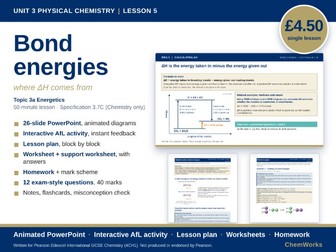
Edexcel IGCSE Chemistry Unit 3 – Physical Chemistry: Lesson 5, Bond EnergiesQuick View
ChemWorks

Edexcel IGCSE Chemistry Unit 3 – Physical Chemistry: Lesson 5, Bond Energies

(0)
Edexcel IGCSE Chemistry (4CH1) Unit 3 Physical Chemistry, Lesson 5: Bond Energies. A complete, ready-to-teach lesson: animated PowerPoint, interactive AfL activity, a worksheet and a scaffolded worksheet (both with answers) and homework. Bond energy questions go wrong in the counting, not the maths. This lesson makes pupils count every bond before they touch a calculator. The “Which total?” activity throws the classic traps at them: the number in front of a molecule, a double bond counted twice, a molecule with two kinds of bond. Each wrong answer goes straight to its reason. Then come the subtraction and the sign, energy in minus energy out, and to finish, pupils mark a student’s answer that falls into two of the traps. Walk in and teach: the lesson is planned minute by minute, with the slides, two levels of worksheet, homework and every answer ready to go. Specification points: 3.7C calculating ΔH from bond energies (Chemistry only). What you get 26-slide editable PowerPoint, with worked examples that build a click at a time, an interactive activity, and speaker notes giving the answers and timings Two-page lesson plan: the lesson at a glance, then the 50 minutes block by block Worksheet with answers (23 marks) Scaffolded support worksheet with answers: the same questions, with gap-fills and word banks Homework with mark scheme (17 marks, about 15 to 20 minutes): yours to set or not Student notes Flashcards to print and cut, plus a text file for Quizlet or Anki Misconception check with its key 12 exam-style questions worth 40 marks across the worksheet and homework 11 resources in all: the PowerPoint and 10 documents, each document as a PDF and an editable Word file (the Quizlet text file comes on top) Why teachers like it One idea at a time: every slide builds up a click at a time, so there is never a wall of text See straight away who has got it: a wrong answer brings up a cross, the reason and Try again; the right one brings up a tick and the reasoning Mixed classes covered: the scaffolded worksheet asks the same questions with more help, so everyone works on the same chemistry Every diagram and animation was drawn for this lesson: nothing is borrowed from a textbook or the web Save more on ChemWorks: this lesson is also in the Topic 3a Energetics pack (5 lessons, £16) and the complete Unit 3 Physical Chemistry pack (18 lessons, both unit tests with mark schemes and all the unit documents, £59.50). Lesson 1 of the unit is free, so you can try before you buy. Written for Pearson Edexcel International GCSE Chemistry (4CH1). Not produced or endorsed by Pearson.
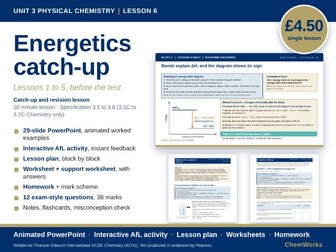
Edexcel IGCSE Chemistry Unit 3 – Physical Chemistry: Lesson 6, Energetics Catch-up and RevisionQuick View
ChemWorks

Edexcel IGCSE Chemistry Unit 3 – Physical Chemistry: Lesson 6, Energetics Catch-up and Revision

(0)
Edexcel IGCSE Chemistry (4CH1) Unit 3 Physical Chemistry, Lesson 6: Energetics Catch-up and Revision. A complete, ready-to-teach lesson: animated PowerPoint, interactive AfL activity, a worksheet and a scaffolded worksheet (both with answers) and homework. The lesson to teach just before the mid-unit test, when half the class has forgotten what m stands for in Q = mcΔT and the other half still thinks breaking bonds gives energy out. It re-teaches Energetics in two blocks, first a temperature change to ΔH, then energy level diagrams and bonds, with an “Odd one out” activity between them built from the five commonest mistakes. Pupils then get 21 minutes on fresh questions they haven’t seen before, and the student notes double as a revision sheet for the test. Walk in and teach: the lesson is planned minute by minute, with the slides, two levels of worksheet, homework and every answer ready to go. Specification points: 3.1 to 3.8 revised (3.5C to 3.7C are Chemistry only). What you get 29-slide editable PowerPoint, with worked examples that build a click at a time, an interactive activity, and speaker notes giving the answers and timings Two-page lesson plan: the lesson at a glance, then the 50 minutes block by block Worksheet with answers (21 marks) Scaffolded support worksheet with answers: the same questions, with gap-fills and word banks Homework with mark scheme (17 marks, about 15 to 20 minutes): yours to set or not Student notes Flashcards to print and cut, plus a text file for Quizlet or Anki Misconception check with its key 12 exam-style questions worth 38 marks across the worksheet and homework 11 resources in all: the PowerPoint and 10 documents, each document as a PDF and an editable Word file (the Quizlet text file comes on top) Why teachers like it One idea at a time: every slide builds up a click at a time, so there is never a wall of text See straight away who has got it: a wrong answer brings up a cross, the reason and Try again; the right one brings up a tick and the reasoning Mixed classes covered: the scaffolded worksheet asks the same questions with more help, so everyone works on the same chemistry Every diagram and animation was drawn for this lesson: nothing is borrowed from a textbook or the web Save more on ChemWorks: this revision lesson is also in the complete Unit 3 Physical Chemistry pack (18 lessons, both unit tests with mark schemes and all the unit documents, £59.50). Lesson 1 of the unit is free, so you can try before you buy. Written for Pearson Edexcel International GCSE Chemistry (4CH1). Not produced or endorsed by Pearson.
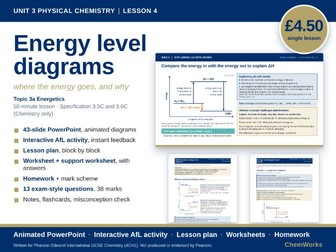
Edexcel IGCSE Chemistry Unit 3 – Physical Chemistry: Lesson 4, Energy Level DiagramsQuick View
ChemWorks

Edexcel IGCSE Chemistry Unit 3 – Physical Chemistry: Lesson 4, Energy Level Diagrams

(0)
Edexcel IGCSE Chemistry (4CH1) Unit 3 Physical Chemistry, Lesson 4: Energy Level Diagrams. A complete, ready-to-teach lesson: animated PowerPoint, interactive AfL activity, a worksheet and a scaffolded worksheet (both with answers) and homework. Six student diagrams, one mistake in each: an arrow pointing the wrong way, temperature on the axis, a label whose sign and words disagree. Spotting them is how pupils learn to draw an energy level diagram that earns every mark. Two worked examples build the diagram part by part, then the lesson moves on to bonds: breaking takes energy in, making gives it out, and whichever is bigger decides ΔH. A worked example on hydrogen and bromine shows the full explanation, and pupils get 18 minutes of worksheet time to practise it. No practical is needed. Walk in and teach: the lesson is planned minute by minute, with the slides, two levels of worksheet, homework and every answer ready to go. Specification points: 3.5C energy level diagrams; 3.6C bond breaking is endothermic and bond making is exothermic (both Chemistry only). What you get 43-slide editable PowerPoint, with worked examples that build a click at a time, an interactive activity, and speaker notes giving the answers and timings Two-page lesson plan: the lesson at a glance, then the 50 minutes block by block Worksheet with answers (23 marks) Scaffolded support worksheet with answers: the same questions, with gap-fills and word banks Homework with mark scheme (15 marks, about 15 to 20 minutes): yours to set or not Student notes Flashcards to print and cut, plus a text file for Quizlet or Anki Misconception check with its key 13 exam-style questions worth 38 marks across the worksheet and homework 11 resources in all: the PowerPoint and 10 documents, each document as a PDF and an editable Word file (the Quizlet text file comes on top) Why teachers like it One idea at a time: every slide builds up a click at a time, so there is never a wall of text See straight away who has got it: a wrong answer brings up a cross, the reason and Try again; the right one brings up a tick and the reasoning Mixed classes covered: the scaffolded worksheet asks the same questions with more help, so everyone works on the same chemistry Every diagram and animation was drawn for this lesson: nothing is borrowed from a textbook or the web Save more on ChemWorks: this lesson is also in the Topic 3a Energetics pack (5 lessons, £16) and the complete Unit 3 Physical Chemistry pack (18 lessons, both unit tests with mark schemes and all the unit documents, £59.50). Lesson 1 of the unit is free, so you can try before you buy. Written for Pearson Edexcel International GCSE Chemistry (4CH1). Not produced or endorsed by Pearson.
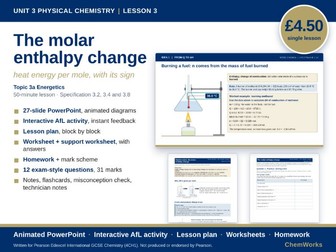
Edexcel IGCSE Chemistry Unit 3 – Physical Chemistry: Lesson 3, The Molar Enthalpy ChangeQuick View
ChemWorks

Edexcel IGCSE Chemistry Unit 3 – Physical Chemistry: Lesson 3, The Molar Enthalpy Change

(0)
Edexcel IGCSE Chemistry (4CH1) Unit 3 Physical Chemistry, Lesson 3: The Molar Enthalpy Change. A complete, ready-to-teach lesson: animated PowerPoint, interactive AfL activity, a worksheet and a scaffolded worksheet (both with answers) and homework. Q to ΔH is where the marks leak away: joules never turned into kilojoules, the wrong number of moles, a missing sign. This lesson plugs each gap with a five-step method pupils can follow every time. It starts with why ΔH is per mole at all (double the amounts and Q doubles, but Q ÷ n stays put). After a “Which ΔH?” activity, groups burn a fuel in a spirit burner, weigh the burner before and after, and calculate their own enthalpy of combustion. Their values go up beside the data-book ones, and the plenary asks why theirs come out less negative. Walk in and teach: the lesson is planned minute by minute, with the slides, two levels of worksheet, homework and every answer ready to go. Specification points: 3.2 calorimetry, here combustion; 3.4 the molar enthalpy change, ΔH, from Q; 3.8 the practical. What you get 27-slide editable PowerPoint, with worked examples that build a click at a time, an interactive activity, and speaker notes giving the answers and timings Two-page lesson plan: the lesson at a glance, then the 50 minutes block by block Worksheet with answers (16 marks) Scaffolded support worksheet with answers: the same questions, with gap-fills and word banks Homework with mark scheme (15 marks, about 15 to 20 minutes): yours to set or not Student notes Flashcards to print and cut, plus a text file for Quizlet or Anki Misconception check with its key Technician notes with the kit and hazards 12 exam-style questions worth 31 marks across the worksheet and homework 12 resources in all: the PowerPoint and 11 documents, each document as a PDF and an editable Word file (the Quizlet text file comes on top) Why teachers like it One idea at a time: every slide builds up a click at a time, so there is never a wall of text See straight away who has got it: a wrong answer brings up a cross, the reason and Try again; the right one brings up a tick and the reasoning Mixed classes covered: the scaffolded worksheet asks the same questions with more help, so everyone works on the same chemistry Every diagram and animation was drawn for this lesson: nothing is borrowed from a textbook or the web Save more on ChemWorks: this lesson is also in the Topic 3a Energetics pack (5 lessons, £16) and the complete Unit 3 Physical Chemistry pack (18 lessons, both unit tests with mark schemes and all the unit documents, £59.50). Lesson 1 of the unit is free, so you can try before you buy. Written for Pearson Edexcel International GCSE Chemistry (4CH1). Not produced or endorsed by Pearson.
Edexcel IGCSE Chemistry Unit 3 – Physical Chemistry: Lesson 2, Calorimetry and Q = mcΔTQuick View
ChemWorks

Edexcel IGCSE Chemistry Unit 3 – Physical Chemistry: Lesson 2, Calorimetry and Q = mcΔT

(0)
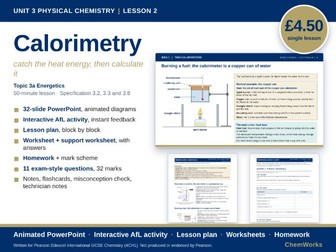
Edexcel IGCSE Chemistry (4CH1) Unit 3 Physical Chemistry, Lesson 2: Calorimetry and Q = mcΔT. A complete, ready-to-teach lesson: animated PowerPoint, interactive AfL activity, a worksheet and a scaffolded worksheet (both with answers) and homework. Plenty of pupils can recite Q = mcΔT and still put the mass of the zinc in for m. This lesson sorts out what m really is before it costs them marks. Pupils take the polystyrene cup and the copper can apart piece by piece in a “Which part does this job?” activity, and learn why heat loss always makes the measured change too small. Then each group adds a different mass of zinc powder to copper(II) sulfate solution, works out Q, and the class sees where Q stops rising. It finishes with three mistakes to find in a worked answer. Walk in and teach: the lesson is planned minute by minute, with the slides, two levels of worksheet, homework and every answer ready to go. Specification points: 3.2 calorimetry experiments; 3.3 Q = mcΔT; 3.8 the temperature-change practical. What you get 32-slide editable PowerPoint, with worked examples that build a click at a time, an interactive activity, and speaker notes giving the answers and timings Two-page lesson plan: the lesson at a glance, then the 50 minutes block by block Worksheet with answers (16 marks) Scaffolded support worksheet with answers: the same questions, with gap-fills and word banks Homework with mark scheme (16 marks, about 15 to 20 minutes): yours to set or not Student notes Flashcards to print and cut, plus a text file for Quizlet or Anki Misconception check with its key Technician notes with the kit and hazards 11 exam-style questions worth 32 marks across the worksheet and homework 12 resources in all: the PowerPoint and 11 documents, each document as a PDF and an editable Word file (the Quizlet text file comes on top) Why teachers like it One idea at a time: every slide builds up a click at a time, so there is never a wall of text See straight away who has got it: a wrong answer brings up a cross, the reason and Try again; the right one brings up a tick and the reasoning Mixed classes covered: the scaffolded worksheet asks the same questions with more help, so everyone works on the same chemistry Every diagram and animation was drawn for this lesson: nothing is borrowed from a textbook or the web Save more on ChemWorks: this lesson is also in the Topic 3a Energetics pack (5 lessons, £16) and the complete Unit 3 Physical Chemistry pack (18 lessons, both unit tests with mark schemes and all the unit documents, £59.50). Lesson 1 of the unit is free, so you can try before you buy. Written for Pearson Edexcel International GCSE Chemistry (4CH1). Not produced or endorsed by Pearson.
Edexcel IGCSE Chemistry Unit 3 – Physical Chemistry: Topic 3c Reversible Reactions and EquilibriaQuick View
ChemWorks

Edexcel IGCSE Chemistry Unit 3 – Physical Chemistry: Topic 3c Reversible Reactions and Equilibria

(0)
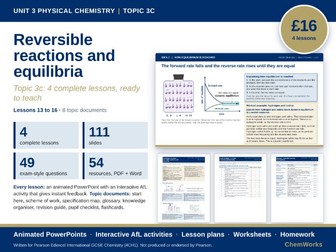
Edexcel IGCSE Chemistry (4CH1) Unit 3 Physical Chemistry, Topic 3c Reversible Reactions and Equilibria: 4 complete, ready-to-teach lessons with animated PowerPoints, interactive AfL activities, worksheets, homework and topic revision resources. Reversible reactions pupils can see happen, and equilibrium made visible. It starts with blue copper(II) sulfate turning white and back again, moves on to dynamic equilibrium with a looping animation of a sealed container, then covers how a catalyst, temperature and pressure affect the position of equilibrium, with a cobalt chloride colour-change demonstration. Walk in and teach. Every lesson is planned minute by minute and comes with its slides, two levels of worksheet, homework and every answer, so your planning is done before you open the file. The lessons Lesson 13: Reversible reactions (28 slides) Lesson 14: Dynamic equilibrium (24 slides) Lesson 15: The position of equilibrium (28 slides) Lesson 16: Pressure and equilibrium (31 slides) What you get Every lesson: an animated, editable PowerPoint with an interactive AfL activity, a two-page lesson plan, a worksheet and a scaffolded support worksheet, both with answers, homework with mark scheme, student notes, flashcards and a misconception check, plus technician notes for every practical Topic documents: Start here, scheme of work, spec coverage map, glossary, knowledge organiser, revision guide, pupil checklist and flashcard set In all: 111 slides, 49 exam-style questions worth 136 marks, and 54 resources, every document as PDF and editable Word. Specification points: 3.17–3.22C. Price: £16 for its 4 lessons, £4 a lesson; bought one by one its lessons cost £18, so you save £2. Better value still: the complete Unit 3 Physical Chemistry pack (18 lessons, both unit tests with mark schemes and all the unit documents) for £59.50. The unit tests come only with the complete unit. Written for Pearson Edexcel International GCSE Chemistry (4CH1). Not produced or endorsed by Pearson.
Edexcel IGCSE Chemistry Unit 3 – Physical Chemistry: Topic 3b Rates of Reaction (6 Lessons)Quick View
ChemWorks

Edexcel IGCSE Chemistry Unit 3 – Physical Chemistry: Topic 3b Rates of Reaction (6 Lessons)

(0)
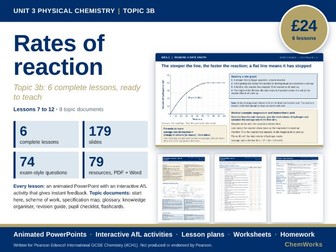
Edexcel IGCSE Chemistry (4CH1) Unit 3 Physical Chemistry, Topic 3b Rates of Reaction: 6 complete, ready-to-teach lessons with animated PowerPoints, interactive AfL activities, worksheets, homework and topic revision resources. Both rates core practicals, ready to run, with the collision theory pupils need to explain them. Pupils follow a rate by collecting gas, run the marble chips core practical on a balance, predict a disappearing-cross demonstration, time the cross themselves at two temperatures and test solids as catalysts for hydrogen peroxide. Five of the six lessons have a practical or a demonstration, and the topic ends with reaction profiles, with and without a catalyst. Walk in and teach. Every lesson is planned minute by minute and comes with its slides, two levels of worksheet, homework and every answer, so your planning is done before you open the file. The lessons Lesson 7: Measuring the rate of a reaction (29 slides) Lesson 8: Surface area and concentration (38 slides) Lesson 9: Collision theory (31 slides) Lesson 10: Temperature and rate (26 slides) Lesson 11: Catalysts and hydrogen peroxide (26 slides) Lesson 12: Reaction profiles (29 slides) What you get Every lesson: an animated, editable PowerPoint with an interactive AfL activity, a two-page lesson plan, a worksheet and a scaffolded support worksheet, both with answers, homework with mark scheme, student notes, flashcards and a misconception check, plus technician notes for every practical Topic documents: Start here, scheme of work, spec coverage map, glossary, knowledge organiser, revision guide, pupil checklist and flashcard set In all: 179 slides, 74 exam-style questions worth 174 marks, and 79 resources, every document as PDF and editable Word. Specification points: 3.9–3.16. Price: £24 for its 6 lessons, £4 a lesson; bought one by one its lessons cost £27, so you save £3. Better value still: the complete Unit 3 Physical Chemistry pack (18 lessons, both unit tests with mark schemes and all the unit documents) for £59.50. The unit tests come only with the complete unit. Written for Pearson Edexcel International GCSE Chemistry (4CH1). Not produced or endorsed by Pearson.
Edexcel IGCSE Chemistry Unit 3 – Physical Chemistry: Topic 3a Energetics (5 Lessons)Quick View
ChemWorks

Edexcel IGCSE Chemistry Unit 3 – Physical Chemistry: Topic 3a Energetics (5 Lessons)

(0)
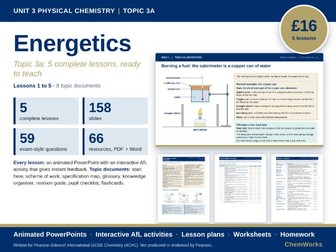
Edexcel IGCSE Chemistry (4CH1) Unit 3 Physical Chemistry, Topic 3a Energetics: 5 complete, ready-to-teach lessons with animated PowerPoints, interactive AfL activities, worksheets, homework and topic revision resources. Energetics from the first thermometer reading to bond-energy calculations, in five lessons that build on each other. Pupils measure temperature changes in polystyrene cups, use Q = mcΔT on their own zinc displacement results and burn fuels to find an enthalpy of combustion: three class practicals in the first three lessons. Then come energy level diagrams, bonds and bond energies. Walk in and teach. Every lesson is planned minute by minute and comes with its slides, two levels of worksheet, homework and every answer, so your planning is done before you open the file. The lessons Lesson 1: Exothermic and endothermic (30 slides) Lesson 2: Calorimetry (32 slides) Lesson 3: The molar enthalpy change (27 slides) Lesson 4: Energy level diagrams (43 slides) Lesson 5: Bond energies (26 slides) What you get Every lesson: an animated, editable PowerPoint with an interactive AfL activity, a two-page lesson plan, a worksheet and a scaffolded support worksheet, both with answers, homework with mark scheme, student notes, flashcards and a misconception check, plus technician notes for every practical Topic documents: Start here, scheme of work, spec coverage map, glossary, knowledge organiser, revision guide, pupil checklist and flashcard set In all: 158 slides, 59 exam-style questions worth 173 marks, and 66 resources, every document as PDF and editable Word. Specification points: 3.1–3.8. Price: £16 for its 5 lessons: £4 for each of the 4 paid lessons, as Lesson 1 is free; bought one by one its lessons cost £18, so you save £2. Better value still: the complete Unit 3 Physical Chemistry pack (18 lessons, both unit tests with mark schemes and all the unit documents) for £59.50. The unit tests come only with the complete unit. Written for Pearson Edexcel International GCSE Chemistry (4CH1). Not produced or endorsed by Pearson.
Edexcel IGCSE Chemistry Unit 3 – Physical Chemistry: Complete Unit, 18 Lessons + TestsQuick View
ChemWorks

Edexcel IGCSE Chemistry Unit 3 – Physical Chemistry: Complete Unit, 18 Lessons + Tests

(0)
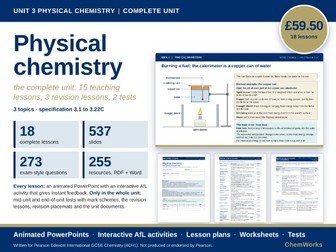
Edexcel IGCSE Chemistry (4CH1) Unit 3, Physical Chemistry, complete and ready to teach: 18 animated PowerPoint lessons, worksheets with answers, homework, two tests and every unit document. Teach the whole of Physical Chemistry from one download: every lesson planned minute by minute, every slide built and animated, every worksheet at two levels with answers, and both unit tests written and marked for you. It covers specification 3.1 to 3.22C: energetics, calorimetry and bond energies, rates and collision theory, catalysts, reaction profiles and equilibrium, with both core practicals and the Chemistry-only points. What you get 18 complete 50-minute lessons: 15 teaching lessons in 3 topics, plus 3 catch-up and revision lessons 537 slides, 273 exam-style questions and 255 resources (PDF and editable Word) Every lesson: animated PowerPoint with an interactive AfL activity, two-page lesson plan, worksheet and scaffolded support worksheet, both with answers, homework with mark scheme, student notes, flashcards and a misconception check Ten class practicals or demonstrations, including both core practicals, each with technician notes Mid-unit test on Energetics and end-of-unit test on Rates and Equilibria (50 minutes, 45 marks each) with mark schemes, common mistakes, flashcards and revision placemats: only in this pack Unit documents: Start here, teacher guide, scheme of work, spec coverage map, what the exam asks most, glossary, pupil checklist, equations and data sheet, practicals at a glance, misconception quiz and long-answer workshop Every topic folder: knowledge organiser, revision guide, glossary, pupil checklist and flashcards Why teachers like it Slides teach one idea at a time, a click at a time, with worked examples that show where the marks are earned The AfL activity gives instant feedback: a cross, the reason and Try again, or a tick and the reasoning Scaffolded support worksheets ask the same questions with more help, so a mixed class works on the same chemistry Original Edexcel-style questions throughout; no past-paper questions, nothing borrowed from a textbook or the web The topics 3a Energetics (Lessons 1–5) Catch-up and revision: Energetics (Lesson 6), before the mid-unit test 3b Rates of reaction (Lessons 7–12) 3c Reversible reactions and equilibria (Lessons 13–16) Catch-up and revision: Rates and equilibria (Lesson 17) and whole-unit revision (Lesson 18) Price: £59.50, just £3.50 a lesson, with both tests and all unit documents. The lessons bought singly come to £76.50, so you save £17; the three topic packs and three revision lessons come to £69.50, without the tests. Lesson 1 is free on ChemWorks: try it before you buy. Written for Pearson Edexcel International GCSE Chemistry (4CH1). Not produced or endorsed by Pearson.