OOP Mini Project in Python|Complete System Design & Implementation|OCR A Level H446|PPT|Mark SchemeQuick View
Siliconscholor

OOP Mini Project in Python|Complete System Design & Implementation|OCR A Level H446|PPT|Mark Scheme

(0)
OOP Mini Project in Python: Complete System Design & Implementation (OCR A Level Computer Science H446) Move students from isolated OOP exercises to building a complete system. This ready-to-use bundle guides them through a whole mini project: analysing a problem, designing classes, writing and testing the code, and evaluating the result. It brings together everything from your OOP sequence and mirrors the stages of the A Level programming project. Please note: this is a practice project to build skills ahead of the OCR H446 programming project (NEA). It is not an NEA task and should not be submitted as coursework. What’s included PowerPoint presentation: a stage-by-stage walkthrough of the project, with worked examples and class diagrams Project brief and student tasks: a clear scenario, requirements and structured steps, with scaffolding for weaker students and extension for stronger ones Hands-on build activity: students design and code a multi-class system, such as a library, shop, booking or game system Testing and evaluation tasks: test plans, test data and an evaluation against the requirements Full mark scheme: model solutions, a marking guide and examples of what good looks like Topics covered Analysing a problem and writing clear requirements Identifying classes, attributes and methods Drawing class diagrams and showing relationships between classes Applying encapsulation, inheritance, polymorphism and abstraction in one system Structuring a program across multiple classes Storing and managing collections of objects Input validation and error handling Testing: test plans, test data and iterative testing Evaluating a solution against the original requirements Commenting, naming and writing maintainable code Common mistakes, such as overly large classes and weak planning Why teachers like it Zero prep: download and teach Differentiated tasks that support all learners and stretch the more able Builds the planning, coding and evaluation habits that NEA success depends on Fully editable, so you can swap in your own scenario Works over a series of lessons, as a holiday task or as an assessment Suitable for Teachers of OCR A Level Computer Science (H446), and any A Level or advanced programming course that wants a capstone OOP project in Python. Please leave a review and follow my shop for more Computer Science resources!
Inheritance & Overriding in Python OOP|OCR A Level H446|PPT|Worksheet|Activity|MCQ|Mark SchemeQuick View
Siliconscholor

Inheritance & Overriding in Python OOP|OCR A Level H446|PPT|Worksheet|Activity|MCQ|Mark Scheme

(0)
Inheritance in Python OOP: Superclasses, Subclasses & Overriding (OCR A Level Computer Science H446) Teach students to build on existing code instead of repeating it. This ready-to-use bundle shows how a subclass inherits attributes and methods from a superclass, how to override and extend behaviour, and how to explain the benefits in exam answers. What’s included PowerPoint presentation: step-by-step explanations, worked examples and class diagrams showing inheritance hierarchies Worksheet: graded tasks from identifying superclasses and subclasses to writing your own class hierarchies Hands-on activity: a practical task where students refactor repeated code into an inheritance structure, such as vehicles, employees or game characters MCQ quiz: quick questions for starters, plenaries or assessment Full mark scheme: answers and explanations for every task, plus guidance on wording “explain” and “describe” answers Topics covered What inheritance is, and why programmers use it Superclass (parent) and subclass (child) relationships Inheriting attributes and methods Calling the parent constructor with super().init() Adding new attributes and methods to a subclass Method overriding, and extending behaviour with super() Reading and drawing inheritance diagrams “Is-a” relationships, and inheritance versus composition (“has-a”) Benefits: code reuse, easier maintenance and consistent structure Links to encapsulation and polymorphism Extension: multiple inheritance and method resolution order in Python Common mistakes, such as forgetting super().init() and overusing inheritance Why teachers like it Zero prep: download and teach Differentiated tasks that support all learners and stretch the more able Clear link between Python code and exam-style answers Fully editable Works for lessons, homework, revision and NEA preparation Suitable for Teachers of OCR A Level Computer Science (H446), and any A Level or advanced programming course teaching object-oriented design in Python. Please leave a review and follow my shop for more Computer Science resources!
Polymorphism & Abstraction in Python OOP|OCR A Level H446|PPT|Worksheet|Activity|MCQ|Mark SchemeQuick View
Siliconscholor

Polymorphism & Abstraction in Python OOP|OCR A Level H446|PPT|Worksheet|Activity|MCQ|Mark Scheme

(0)
Polymorphism & Abstraction in Python OOP: Complete Teaching Bundle (OCR A Level Computer Science H446) Complete your OOP sequence with two ideas students often find slippery. This ready-to-use bundle explains how different objects can respond to the same method call, and how abstraction lets programmers hide complexity and focus on what matters. It uses clear analogies, worked code and exam-style questions. What’s included PowerPoint presentation: step-by-step explanations, worked examples and class diagrams showing shared interfaces and different behaviours Worksheet: graded tasks from spotting polymorphism in code to designing your own class hierarchies Hands-on activity: a practical task such as building a shape, animal or payment system where one loop handles many object types MCQ quiz: quick questions for starters, plenaries or assessment Full mark scheme: answers and explanations for every task, plus guidance on wording “explain” and “describe” answers Topics covered What polymorphism is, and why programmers use it Method overriding as the main route to polymorphism Calling the same method on different objects in a list or loop Writing code that works with a superclass and any of its subclasses What abstraction is, and how it differs from encapsulation Abstraction in OOP: hiding implementation detail behind a simple interface Abstract classes and methods Links to inheritance and encapsulation, and class diagrams Benefits: flexibility, extensibility, reduced repetition and easier maintenance Extension: Python’s abc module and duck typing Common mistakes, such as confusing overriding with overloading, or abstraction with encapsulation Why teachers like it Zero prep: download and teach Differentiated tasks that support all learners and stretch the more able Clear link between Python code and exam-style answers Fully editable Works for lessons, homework, revision and NEA preparation Suitable for Teachers of OCR A Level Computer Science (H446), and any A Level or advanced programming course teaching object-oriented design in Python. Please leave a review and follow my shop for more Computer Science resources!
Encapsulation & Access Control in Python OOP|OCR A Level H446|PPT|Worksheet|Activity|MCQ|Mark SchemeQuick View
Siliconscholor

Encapsulation & Access Control in Python OOP|OCR A Level H446|PPT|Worksheet|Activity|MCQ|Mark Scheme

(0)
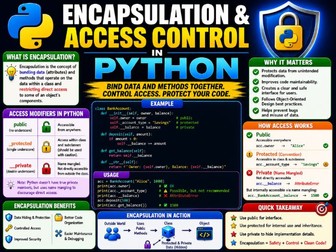
Encapsulation & Access Control in Python OOP: Complete Teaching Bundle (OCR A Level Computer Science H446) Teach one of the most examined OOP ideas with clarity. This ready-to-use bundle shows students how to protect an object’s data, control access through methods, and explain why it matters. It uses clear analogies, worked code and exam-style questions. What’s included PowerPoint presentation: step-by-step explanations, worked examples and diagrams showing what is hidden and what is exposed Worksheet: graded tasks from identifying public and private members to writing fully encapsulated classes Hands-on activity: a practical task where students fix an insecure class, such as a bank account whose balance can be changed directly MCQ quiz: quick questions for starters, plenaries or assessment Full mark scheme: answers and explanations for every task, plus guidance on how to word “explain” and “describe” answers Topics covered What encapsulation is, and why programmers use it Attributes and methods, and the idea of hiding internal data Public, private and protected access, and how they appear in exam-style pseudocode Getters and setters (accessor and mutator methods) Validating data inside setters to keep objects in a valid state How Python handles access: _single and __double underscore conventions, name mangling and the @property decorator Encapsulation versus abstraction and information hiding Benefits: security, maintainability, reduced errors and easier changes Common mistakes, such as accessing attributes directly and confusing Python conventions with true enforcement Why teachers like it Zero prep: download and teach Differentiated tasks that support all learners and stretch the more able Clear link between Python code and exam-style answers Fully editable Works for lessons, homework, revision and NEA preparation Suitable for Teachers of OCR A Level Computer Science (H446), and any A Level or advanced programming course teaching object-oriented design in Python. Please leave a review and follow my shop for more Computer Science resources!
Python Modules & Libraries|random, math, datetime|0478 / 9618 / OCR|PPT|Worksheet|MCQ|Mark SchemeQuick View
Siliconscholor

Python Modules & Libraries|random, math, datetime|0478 / 9618 / OCR|PPT|Worksheet|MCQ|Mark Scheme

(0)
Python Modules & Libraries: import, random, math & More (Cambridge IGCSE 0478, AS & A Level 9618, OCR GCSE & A Level) Show students how to use code someone else has already written. This ready-to-use bundle introduces Python modules and libraries through the ones students use most: random, math, time and datetime. It also covers how to read documentation and how to build a simple module of their own. Syllabus note: library routines and random number generation are part of the Cambridge 0478 and OCR GCSE content, and this pack links Python’s random and math modules to them. Wider module use, such as datetime, is extension content that supports practical programming and NEA work, and is not a required topic. What’s included PowerPoint presentation: step-by-step explanations with worked code examples and diagrams of how a program uses a module Worksheet: graded tasks from importing a module to combining several in one program Hands-on activity: a practical task such as building a dice game, quiz or simple simulation MCQ quiz: quick questions for starters, plenaries or assessment Full mark scheme: answers and explanations for every task, so marking is quick and consistent Topics covered What a module and a library are, and why programmers reuse code Import styles: import x, from x import y and import x as z The random module: randint(), choice(), random() and shuffle() The math module: sqrt(), pi, floor() and ceil() The time and datetime modules Linking Python modules to exam pseudocode library routines such as RANDOM, ROUND, MOD and DIV Finding and reading documentation with help() and dir() Writing and importing a simple module of your own Common errors, such as ModuleNotFoundError and name clashes Why teachers like it Zero prep: download and teach Differentiated tasks that support all learners and stretch the more able Fun, game-based examples that keep students engaged Fully editable Works for lessons, homework, revision and cover work Suitable for Teachers of Cambridge IGCSE Computer Science (0478), Cambridge AS & A Level (9618), OCR GCSE (J277) and OCR A Level (H446), and any beginner-to-intermediate Python course. Please leave a review and follow my shop for more Computer Science resources!
Exception Handling in Python|try / except|Cambridge A Level 9618, IGCSE & OCR|PPT|Worksheet|MCQ|MarkQuick View
Siliconscholor

Exception Handling in Python|try / except|Cambridge A Level 9618, IGCSE & OCR|PPT|Worksheet|MCQ|Mark

(0)
Exception Handling in Python: try, except, else & finally (Cambridge AS & A Level 9618, IGCSE 0478, OCR GCSE & A Level) Teach students to write programs that don’t crash. This ready-to-use bundle shows how to anticipate runtime errors, catch them with try and except, and respond sensibly. It uses realistic examples such as user input and file handling. Syllabus note: exception handling is part of the Cambridge 9618 A Level content. For Cambridge IGCSE 0478 and OCR it is best used as extension and robustness content. It builds on validation, error types and defensive design, and supports practical programming and NEA work. What’s included PowerPoint presentation: step-by-step explanations, worked code examples and diagrams of program flow with and without exception handling Worksheet: graded tasks from reading error messages to writing complete try/except blocks Hands-on activity: a practical task where students make a fragile program robust MCQ quiz: quick questions for starters, plenaries or assessment Full mark scheme: answers and explanations for every task, so marking is quick and consistent Topics covered What an exception is, and how it differs from a syntax or logic error Reading Python error messages and tracebacks The try and except structure Catching specific exceptions: ValueError, ZeroDivisionError, TypeError, IndexError, KeyError and FileNotFoundError Using else and finally Validating user input with a loop and try/except Combining exception handling with file handling Exception handling versus validation, and when to use each Common mistakes, such as bare except blocks that hide bugs Why teachers like it Zero prep: download and teach Differentiated tasks that support all learners and stretch the more able Realistic examples that link to file handling and input validation Fully editable Works for lessons, homework, revision and cover work Suitable for Teachers of Cambridge AS & A Level Computer Science (9618), Cambridge IGCSE (0478), OCR GCSE (J277) and OCR A Level (H446), and any beginner-to-intermediate Python course. Please leave a review and follow my shop for more Computer Science resources!
Python OOP: Classes & Objects|A Level 9618 & OCR H446|PPT|Worksheet|Activity|MCQ|Mark SchemeQuick View
Siliconscholor

Python OOP: Classes & Objects|A Level 9618 & OCR H446|PPT|Worksheet|Activity|MCQ|Mark Scheme

(0)
Classes & Objects in Python OOP: Complete Teaching Bundle (Cambridge AS & A Level 9618, OCR A Level H446) Teach object-oriented programming from the ground up. This ready-to-use bundle takes students from “what is a class?” to building programs made of interacting objects. It uses clear analogies, worked examples and exam-style questions. Syllabus note: object-oriented programming is part of the Cambridge 9618 and OCR H446 A Level content. This pack focuses on classes and objects, the foundation for later work on inheritance and polymorphism. For Cambridge IGCSE 0478 and OCR GCSE it works as extension content only, as OOP is not required at that level. What’s included PowerPoint presentation: step-by-step explanations, worked code examples and diagrams linking classes to objects Worksheet: graded tasks from reading a class definition to designing and writing your own Hands-on activity: a practical task where students model a real-world scenario, such as a library, shop or game, using classes MCQ quiz: quick questions for starters, plenaries or assessment Full mark scheme: answers and explanations for every task, so marking is quick and consistent Topics covered Why programmers use OOP, compared with procedural programming Classes as blueprints and objects as instances Attributes (properties) and methods The constructor: init and the role of self Creating and using multiple objects Encapsulation: public and private attributes, and getters and setters Objects stored in lists and passed to functions Class diagrams and linking Python code to exam-style pseudocode Common errors, such as forgetting self and mixing up classes and objects Why teachers like it Zero prep: download and teach Differentiated tasks that support all learners and stretch the more able Real-world examples that make abstract ideas concrete Fully editable Works for lessons, homework, revision and NEA preparation Suitable for Teachers of Cambridge AS & A Level Computer Science (9618) and OCR A Level Computer Science (H446), and any programming course introducing OOP in Python. It can also be used as an extension for strong Cambridge IGCSE (0478) and OCR GCSE (J277) students. Please leave a review and follow my shop for more Computer Science resources!
CSV File Handling in Python|Read & Write CSV Files|0478 / 9618 / OCR|PPT|Worksheet|MCQ|Mark SchemeQuick View
Siliconscholor

CSV File Handling in Python|Read & Write CSV Files|0478 / 9618 / OCR|PPT|Worksheet|MCQ|Mark Scheme

(0)
CSV File Handling in Python: Reading, Writing & Processing Data (Cambridge IGCSE 0478, AS & A Level 9618, OCR GCSE J277) Give students a realistic way to practise file handling. CSV files are how real programs store tables of data, such as names, scores, stock and results. This ready-to-use bundle takes students from reading a single line to loading, searching, updating and saving whole datasets. Syllabus note: the specifications require reading and writing text files. This pack applies those skills to CSV data, which is a common context for exam-style programming questions and practical tasks. It does not claim that CSV handling is a separate syllabus topic. What’s included PowerPoint presentation: step-by-step explanations with worked code examples and diagrams of how a CSV file maps to records and fields Worksheet: graded tasks from reading a simple file to processing and writing back data Hands-on activity: a practical task such as building a student marks or inventory system that saves to a CSV file MCQ quiz: quick questions for starters, plenaries or assessment Full mark scheme: answers and explanations for every task, so marking is quick and consistent Topics covered What a CSV file is, and records, fields and delimiters Opening, reading, writing and appending files, and closing safely with with Splitting lines with .split(",") and removing newlines with .strip() Converting data types when reading values from a file Storing file data in lists and 2D lists Searching, filtering and calculating totals and averages from file data Updating records and writing the data back to the file Using Python’s csv module (csv.reader and csv.writer) as an extension Handling errors, such as FileNotFoundError and missing or malformed data Common mistakes, such as overwriting data in write mode Why teachers like it Zero prep: download and teach Differentiated tasks that support all learners and stretch the more able Realistic data tasks that build on existing file-handling lessons Fully editable Works for lessons, homework, revision and cover work Suitable for Teachers of Cambridge IGCSE Computer Science (0478), Cambridge AS & A Level Computer Science (9618) and OCR GCSE Computer Science (J277), and any KS4/KS5 or beginner-to-intermediate Python course. OCR A Level students will find it useful for NEA data-handling projects. Please leave a review and follow my shop for more Computer Science resources!
File Handling in Python|Reading & Writing Files|0478 / 9618 / OCR|PPT|Worksheet|MCQ|Mark SchemeQuick View
Siliconscholor

File Handling in Python|Reading & Writing Files|0478 / 9618 / OCR|PPT|Worksheet|MCQ|Mark Scheme

(0)
File Handling in Python: Reading & Writing Files, Complete Teaching Bundle (Cambridge IGCSE 0478, AS & A Level 9618, OCR GCSE J277) Teach students how programs store and retrieve data beyond a single run. This ready-to-use bundle covers opening, reading, writing, appending and closing text files in Python. It links each idea to the pseudocode used in exam questions, so students can move between the two with confidence. What’s included PowerPoint presentation: clear, step-by-step explanations with worked code examples and Python-to-pseudocode comparisons Worksheet: graded tasks from basic read and write operations to short programs that process file data Hands-on activity: a practical task where students build a program that saves and loads real data MCQ quiz: quick questions for starters, plenaries or assessment Full mark scheme: answers and explanations for every task, so marking is quick and consistent Topics covered Why programs use files, and the difference between a file and a variable Opening files in read (“r”), write (“w”) and append (“a”) modes Reading with .read(), .readline() and .readlines(), and looping through a file line by line Writing and appending text with .write() Closing files, and using with to do it safely Processing file contents, such as splitting lines, converting data types and calculating totals Handling errors, including FileNotFoundError and checking that a file exists Linking Python file handling to exam pseudocode (OPENFILE, READFILE, WRITEFILE, CLOSEFILE) Common mistakes, such as overwriting data in write mode Why teachers like it Zero prep: download and teach Differentiated tasks that support all learners and stretch the more able Written in Python and linked to exam pseudocode Fully editable Works for lessons, homework, revision and cover work Suitable for Teachers of Cambridge IGCSE Computer Science (0478), Cambridge AS & A Level Computer Science (9618) and OCR GCSE Computer Science (J277). It also works for any KS4/KS5 or beginner Python course. OCR A Level students will find it useful for NEA programming projects. Please leave a review and follow my shop for more Computer Science resources!
List Comprehensions in Python|Extension for 0478, 9618, OCR|PPT|Worksheet|Activity|MCQ|Mark SchemeQuick View
Siliconscholor

List Comprehensions in Python|Extension for 0478, 9618, OCR|PPT|Worksheet|Activity|MCQ|Mark Scheme

(0)
List Comprehensions in Python: Programming Extension Bundle (Cambridge IGCSE 0478, AS & A Level 9618, OCR GCSE & A Level) Help your strongest programmers write shorter, cleaner Python. This ready-to-teach bundle shows students how to replace multi-line loops with a single readable line. It is ideal for stretch, enrichment and practical programming work. Please note: list comprehensions are not a required topic in the Cambridge 0478, Cambridge 9618 or OCR specifications. This is a programming-skills extension that supports Python coding tasks (for example Cambridge Paper 2 and Paper 4 practical work, and OCR Paper 2 and NEA programming). It is not a syllabus-coverage pack. What’s included PowerPoint presentation: step-by-step explanations, worked examples and comparisons of loop versus comprehension Worksheet: graded tasks from simple comprehensions to filtering and transforming data Hands-on activity: a practical challenge where students refactor loop-based code MCQ quiz: quick questions for starters, plenaries or checking understanding Full mark scheme: answers and explanations for every task Topics covered What a list comprehension is, and why it is useful Basic syntax: [expression for item in iterable] Using range() and existing lists as the source Adding conditions with if to filter items Transforming values, such as squaring, converting case and calculating totals Rewriting for loops as comprehensions, and the reverse When a loop is clearer than a comprehension Common errors and debugging Why teachers like it Zero prep: download and teach Differentiated tasks that stretch confident students Supports the Python skills students need for practical programming tasks Fully editable Works for enrichment, homework, clubs and cover lessons Suitable for Teachers of Cambridge IGCSE Computer Science (0478), Cambridge AS & A Level (9618), OCR GCSE (J277) and OCR A Level (H446), and any KS4/KS5 or beginner-to-intermediate Python course. Please leave a review and follow my shop for more Computer Science resources!
Dictionaries in Python|Cambridge IGCSE 0478 / AS/A 9618|PPT|Worksheet|Activity|MCQ|Mark SchemeQuick View
Siliconscholor

Dictionaries in Python|Cambridge IGCSE 0478 / AS/A 9618|PPT|Worksheet|Activity|MCQ|Mark Scheme

(0)
Python Dictionaries: Complete Teaching Bundle (Cambridge IGCSE 0478 / AS & A Level 9618) Teach key-value data structures with confidence. This ready-to-use bundle takes students from “what is a dictionary?” to using dictionaries in real programs, with everything you need for a full lesson or short sequence of lessons. What’s included PowerPoint presentation: a clear, step-by-step lesson with worked code examples, visual explanations of key-value pairs and built-in prompts for class discussion Worksheet: graded tasks from basic dictionary operations to short programming problems Hands-on activity: a practical task where students apply dictionaries to a realistic scenario MCQ quiz: quick-fire questions for starters, plenaries or assessment Full mark scheme: answers for the worksheet, activity and MCQs, so marking is quick and consistent Topics covered What a dictionary is, and how it differs from a list Creating dictionaries and understanding keys and values Accessing, adding, updating and deleting items Checking whether a key exists using in Looping through keys, values and items (.keys(), .values(), .items()) Nested dictionaries and lists of dictionaries Common errors and debugging (e.g. KeyError) Practical uses such as lookup tables, counting and simple records Why teachers love it Zero prep: download, print and teach Differentiated tasks that support all learners and stretch the more able Written in Python, the language students use in class Fully editable, so you can adapt it to your classroom Ideal for lessons, homework, cover work or revision Suitable for Cambridge IGCSE Computer Science (0478), Cambridge AS & A Level Computer Science (9618), and any KS4/KS5 or beginner programming course teaching Python data structures. Please leave a review and follow my shop for more Computer Science resources!
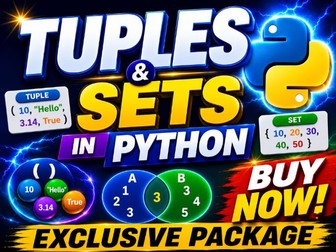
Tuples & Sets in Python|OCR A-Level H446 |PPT|Worksheet|Activity|MCQ|Mark SchemeQuick View
Siliconscholor

Tuples & Sets in Python|OCR A-Level H446 |PPT|Worksheet|Activity|MCQ|Mark Scheme

(0)
Teach tuples and sets with a complete lesson that’s ready to go. Students know lists. This pack shows them when a list is the wrong tool: a tuple for data that must never change, and a set for removing duplicates and comparing collections. It builds step by step, from creating each type to using set operations such as union and intersection. It is written for OCR A-Level Computer Science H446 and needs no prep. WHAT’S INCLUDED PowerPoint lesson ([X] slides): side-by-side comparisons, worked examples, live-code demos and built-in check-for-understanding questions Student worksheet ([X] pages): scaffolded tasks from recall, to predicting outputs, to exam-style problems Hands-on coding activity: students solve practical problems, such as removing duplicate entries, comparing two class registers and returning several values from a function MCQ quiz ([X] questions): quick-fire questions to check understanding and catch misconceptions Answers and full mark scheme: model answers with mark allocations, so marking takes minutes WHAT STUDENTS WILL LEARN Tuples What a tuple is, and what immutable means Creating tuples, including the single-item tuple (5,) Indexing and slicing a tuple Tuple unpacking: assigning several variables in one line Returning several values from a function as a tuple Tuple vs list: when to choose each, and why immutability helps Looping through a tuple Sets What a set is: unordered, with no duplicates Creating sets, and turning a list into a set to remove duplicates Adding and removing items with add(), remove() and discard() Checking membership with in Set operations: union, intersection, difference and symmetric difference Subsets and supersets Why sets can’t be indexed or sorted in place Comparing data structures Choosing between a list, tuple and set for a given scenario Tracing tuple and set code to predict the output Common errors: trying to change a tuple item, forgetting the comma in a one-item tuple, using {} and getting an empty dictionary instead of a set, expecting a set to keep its order, and trying to index a set WHY TEACHERS LOVE IT Exam-focused: questions use clear command words and mark-scheme style answers Targets real misconceptions: the mistakes students make every year Differentiated: support tasks plus stretch questions for top-grade students Non-specialist friendly: clear explanations and full answers included Flexible: works as a single lesson, homework, cover or revision Print-and-go: no editing needed (editable PPT included) PERFECT FOR OCR A-Level H446 teachers, heads of department, non-specialist and cover staff, and students learning independently. It suits ages 16-18 (Year 12-13). PART OF A FULL SERIES This pack belongs to my Python data structures collection. Check my shop for matching packs on lists, 2D lists and arrays, stacks, queues and trees. If this saved you time, a quick review really helps other teachers find it. Thank you!
Lists in Python Core Operations|Cambridge 0478 / 9618 |PPT|Worksheet|Activity|MCQ|Mark SchemeQuick View
Siliconscholor

Lists in Python Core Operations|Cambridge 0478 / 9618 |PPT|Worksheet|Activity|MCQ|Mark Scheme

(0)
Teach Python lists with a complete lesson that’s ready to go. Lists are how students store and process collections of data, and they sit behind most exam programming questions on searching, totals and data handling. This pack takes students from “why use a list?” to creating, changing, searching and looping through lists with confidence. It is aligned to Cambridge IGCSE AS/ A Level Computer Science 0478 / 9618 (Programming) and needs no prep. WHAT’S INCLUDED PowerPoint lesson ([X] slides): worked examples, live-code demos and built-in check-for-understanding questions Student worksheet ([X] pages): scaffolded tasks from recall, to predicting outputs, to exam-style problems Hands-on coding activity: students build programs such as a shopping list manager, a test-score analyser and a simple contact list MCQ quiz ([X] questions): quick-fire questions to check understanding and catch misconceptions Answers and full mark scheme: model answers with mark allocations, so marking takes minutes WHAT STUDENTS WILL LEARN What a list is, and why programs need one Creating lists and storing different data types Indexing: accessing items by position, starting at 0 Changing items by assigning to an index Adding items with append() and insert() Removing items with remove(), pop() and del Finding the length with len() and checking membership with in Slicing a list with [start:end] Sorting and reversing with sort() and reverse() Looping through a list, both by item and by index Totals, averages, largest and smallest values from list data Linear search using a list How Python lists relate to the arrays used in Cambridge pseudocode Common errors: index out of range, off-by-one mistakes, confusing remove() with pop(), thinking sort() returns a new list, and changing a list while looping through it WHY TEACHERS LOVE IT Exam-focused: questions follow Cambridge command words and mark-scheme style Targets real misconceptions: the mistakes students make every year, especially zero-based indexing Differentiated: support tasks plus stretch questions for top-grade students Non-specialist friendly: clear explanations and full answers included Flexible: works as a single lesson, homework, cover or revision Print-and-go: no editing needed (editable PPT included) PERFECT FOR Cambridge IGCSE 0478 teachers, heads of department, non-specialist and cover staff, and students learning independently. It suits ages 14-16 (Year 10-11 / Grade 9-10). PART OF A FULL SERIES This pack belongs to my Cambridge IGCSE 0478 / AS/A Level 9618 Python collection. Check my shop for matching packs on Introduction to Python, variables and data types, operators and expressions, string handling, selection, for loops and range(), while loops, nested loops, functions, parameters and scope, and file handling. If this saved you time, a quick review really helps other teachers find it. Thank you!
Recursion & Base Cases in Python|Cambridge A - Level 9618|PPT|Worksheet|Activity|MCQ|Mark SchemeQuick View
Siliconscholor

Recursion & Base Cases in Python|Cambridge A - Level 9618|PPT|Worksheet|Activity|MCQ|Mark Scheme

(0)
Make recursion click with a complete lesson that’s ready to go. Recursion is one of the topics students find hardest, because they have to follow code that calls itself. This pack builds the idea step by step, from a simple countdown to tracing the call stack, so students can write, trace and explain recursive functions with confidence. It is aligned to Cambridge A-Level Computer Science 9618 and needs no prep. WHAT’S INCLUDED PowerPoint lesson ([X] slides): animated call-stack diagrams, worked examples and built-in check-for-understanding questions Student worksheet ([X] pages): scaffolded tasks from recall, to tracing recursive calls, to exam-style problems Hands-on coding activity: students write recursive functions such as factorial, sum of a list, power and string reversal MCQ quiz ([X] questions): quick-fire questions to check understanding and catch misconceptions Answers and full mark scheme: model answers with mark allocations, so marking takes minutes WHAT STUDENTS WILL LEARN What recursion is, and how it differs from iteration The base case (stopping condition) and the recursive case How the call stack works: stack frames building up (winding) and returning (unwinding) Tracing recursive functions step by step to predict the output Classic examples: factorial, Fibonacci, sum of a list, power, and reversing a string Why the order of output changes depending on where the print statement sits Recursion vs iteration: advantages and disadvantages, including memory use and readability Converting a recursive solution to an iterative one, and the reverse Stack overflow and Python’s recursion limit Recursive functions in Cambridge pseudocode Common errors: a missing or unreachable base case, forgetting to return the recursive call, and mixing up the order of winding and unwinding WHY TEACHERS LOVE IT Exam-focused: questions follow Cambridge command words and mark-scheme style Targets real misconceptions: the mistakes students make every year, especially tracing the unwinding stage Differentiated: support tasks plus stretch questions for top-grade students Non-specialist friendly: clear explanations and full answers included Flexible: works as a single lesson, homework, cover or revision Print-and-go: no editing needed (editable PPT included) PERFECT FOR Cambridge A-Level 9618 teachers, heads of department, non-specialist and cover staff, and students learning independently. It suits ages 16-18 (Year 12-13 / Grade 11-12). PART OF A FULL SERIES This pack belongs to my Cambridge 9618 Python and Algorithms collection. Check my shop for matching packs on algorithms, data structures, OOP and the complete Python course. If this saved you time, a quick review really helps other teachers find it. Thank you!
2D Lists & Arrays in Python|Cambridge IGCSE 0478 / AS/A 9618|PPT|Worksheet|Activity|MCQ|Mark SchemeQuick View
Siliconscholor

2D Lists & Arrays in Python|Cambridge IGCSE 0478 / AS/A 9618|PPT|Worksheet|Activity|MCQ|Mark Scheme

(0)
Teach 2D lists and arrays with a complete lesson that’s ready to go. Once students can use a 1D list, the exam moves them to grids and tables: seating plans, game boards, timetables and score sheets. This pack takes students from “what is a 2D array?” to creating, reading, updating and looping through one with confidence. It is aligned to Cambridge IGCSE Computer Science 0478 / AS /A Level 9618 (Programming) and needs no prep. WHAT’S INCLUDED PowerPoint lesson ([X] slides): grid diagrams, worked examples, live-code demos and built-in check-for-understanding questions Student worksheet ([X] pages): scaffolded tasks from recall, to tracing nested loops, to exam-style problems Hands-on coding activity: students build programs such as a noughts-and-crosses board, a seating plan and a class marks table MCQ quiz ([X] questions): quick-fire questions to check understanding and catch misconceptions Answers and full mark scheme: model answers with mark allocations, so marking takes minutes WHAT STUDENTS WILL LEARN What a 2D list (2D array) is, and when a grid is better than a 1D list Rows and columns: how to picture the data as a table Creating a 2D list with nested brackets and filling it with starting values Accessing one element with two indexes: grid[row][column] Updating an element by assigning to a position Looping through a whole grid with nested for loops Row totals, column totals and overall totals Searching a grid for a value and reporting its position Finding the largest and smallest value in a table Printing a grid neatly as rows Tracing 2D array code with a trace table to predict the output How Python 2D lists relate to the 2D arrays in Cambridge pseudocode, including how the exam writes the two indexes Common errors: swapping row and column, index out of range, forgetting the second loop, off-by-one mistakes, and building a grid with [[0] * 3] * 3, which makes every row the same list WHY TEACHERS LOVE IT Exam-focused: questions follow Cambridge command words and mark-scheme style Targets real misconceptions: the mistakes students make every year, especially row and column order Differentiated: support tasks plus stretch questions for top-grade students Non-specialist friendly: clear explanations and full answers included Flexible: works as a single lesson, homework, cover or revision Print-and-go: no editing needed (editable PPT included) PERFECT FOR Cambridge IGCSE 0478, AS/ A Level 9618 teachers, heads of department, non-specialist and cover staff, and students learning independently. It suits ages 14-16 (Year 10-11 / Grade 9-10). PART OF A FULL SERIES This pack follows my Lists in Python Core Operations lesson and belongs to my Cambridge IGCSE 0478 , AS / A 9618 Python collection. Check my shop for matching packs on for loops and range(), nested loops, functions, parameters and scope, and file handling. If this saved you time, a quick review really helps other teachers find it. Thank you!
Defining & Calling Functions in Python|Cambridge 0478/ 9618 |PPT|Worksheet|Activity|MCQ|Mark SchemeQuick View
Siliconscholor

Defining & Calling Functions in Python|Cambridge 0478/ 9618 |PPT|Worksheet|Activity|MCQ|Mark Scheme

(0)
Teach functions with a complete lesson that’s ready to go. Functions are how students move from one long script to organised, reusable code, and subroutines appear in the programming paper every year. This pack takes students from “why split code into parts?” to defining, calling and tracing their own functions with confidence. It is aligned to Cambridge IGCSE / AS/ A Level Computer Science 0478/ 9618 (Programming) and needs no prep. WHAT’S INCLUDED PowerPoint lesson ([X] slides): worked examples, live-code demos and built-in check-for-understanding questions Student worksheet ([X] pages): scaffolded tasks from recall, to tracing function calls, to exam-style problems Hands-on coding activity: students build programs from small functions, such as a calculator, a grade checker and a menu system MCQ quiz ([X] questions): quick-fire questions to check understanding and catch misconceptions Answers and full mark scheme: model answers with mark allocations, so marking takes minutes WHAT STUDENTS WILL LEARN What a function (subroutine) is, and why programmers use them Defining a function with def: syntax, colon and indentation Calling a function and how control passes to it and back Parameters and arguments, and the difference between them Returning values with return, and storing the result in a variable Functions that return a value vs procedures that don’t Local and global variables, and why scope matters Calling a function from inside another function Tracing function calls with a trace table to predict the output Benefits of subroutines: reuse, readability and easier testing How Python functions map to PROCEDURE and FUNCTION in Cambridge pseudocode Common errors: forgetting the brackets when calling, using print instead of return, calling before defining, wrong number of arguments, and changing a local variable and expecting a global one to change WHY TEACHERS LOVE IT Exam-focused: questions follow Cambridge command words and mark-scheme style Targets real misconceptions: the mistakes students make every year, especially print vs return Differentiated: support tasks plus stretch questions for top-grade students Non-specialist friendly: clear explanations and full answers included Flexible: works as a single lesson, homework, cover or revision Print-and-go: no editing needed (editable PPT included) PERFECT FOR Cambridge IGCSE 0478/ AS/A level 9618 teachers, heads of department, non-specialist and cover staff, and students learning independently. It suits ages 14-16 (Year 10-11 / Grade 9-10). PART OF A FULL SERIES This pack belongs to my Cambridge 0478 / 9618 Python collection. Check my shop for matching packs on Introduction to Python, variables and data types, operators and expressions, string handling, selection, for loops and range(), while loops, nested loops, arrays and file handling. If this saved you time, a quick review really helps other teachers find it. Thank you!
Lambda & Higher-Order Functions in Python|OCR A-Level H446|PPT|Worksheet|Activity|MCQ|Mark SchemeQuick View
Siliconscholor

Lambda & Higher-Order Functions in Python|OCR A-Level H446|PPT|Worksheet|Activity|MCQ|Mark Scheme

(0)
Teach lambda functions and higher-order functions with a complete lesson that’s ready to go. Passing functions around like data is one of the ideas students find hardest to grasp, and it sits at the heart of functional programming. This pack builds it step by step, from a one-line lambda to using map(), filter() and sorted() on real data. It is written for OCR A-Level Computer Science H446 and needs no prep. The Python skills also transfer to other A-Level courses as enrichment. WHAT’S INCLUDED PowerPoint lesson ([X] slides): worked examples, live-code demos and built-in check-for-understanding questions Student worksheet ([X] pages): scaffolded tasks from recall, to predicting outputs, to exam-style problems -Hands-on coding activity: students process real data with lambda, map and filter, such as converting prices, filtering scores and sorting records MCQ quiz ([X] questions): quick-fire questions to check understanding and catch misconceptions Answers and full mark scheme: model answers with mark allocations, so marking takes minutes WHAT STUDENTS WILL LEARN What a lambda (anonymous) function is, and how it differs from a def function Lambda syntax: parameters, a single expression and an implicit return Functions as first-class objects: storing them in variables and passing them as arguments What makes a function “higher-order”: taking a function as input or returning one map(): applying a function to every item in a collection filter(): keeping only the items that meet a condition reduce(): combining a collection into a single value sorted() with a key function for custom ordering Functions that return functions Comparing map and filter with loops and list comprehensions Tracing lambda and map/filter code to predict the output Common errors: forgetting list() around map or filter, putting more than one statement in a lambda, confusing lambda parameters with outer variables, and misunderstanding what filter treats as true WHY TEACHERS LOVE IT Exam-focused: questions use clear command words and mark-scheme style answers Targets real misconceptions: the mistakes students make every year Differentiated: support tasks plus stretch questions for top-grade students Non-specialist friendly: clear explanations and full answers included Flexible: works as a single lesson, homework, cover or revision Print-and-go: no editing needed (editable PPT included) PERFECT FOR OCR A-Level H446 teachers, heads of department, non-specialist and cover staff, and students learning independently. It suits ages 16-18 (Year 12-13). PART OF A FULL SERIES This pack belongs to my A-Level Python and functional programming collection. Check my shop for matching packs on recursion, algorithms, data structures and OOP. If this saved you time, a quick review really helps other teachers find it. Thank you!
While Loops in Python|Cambridge 0478 / 9618 |PPT |Worksheet| Activity| MCQ |Mark SchemeQuick View
Siliconscholor

While Loops in Python|Cambridge 0478 / 9618 |PPT |Worksheet| Activity| MCQ |Mark Scheme

(0)
Teach while loops with a complete lesson that’s ready to go. The while loop is where students move from “repeat this 10 times” to “repeat until something happens”. It is also behind input validation, menus and games, and it appears in many exam programming questions. This pack takes students from “when do I use a while loop?” to writing and tracing them with confidence. It is aligned to Cambridge IGCSE/AS/A Level Computer Science 0478 / 9618 (Programming) and needs no prep. WHAT’S INCLUDED PowerPoint lesson ([X] slides): worked examples, live-code demos and built-in check-for-understanding questions Student worksheet ([X] pages): scaffolded tasks from recall, to predicting outputs, to exam-style problems Hands-on coding activity: students write programs that use while loops, such as a password check, a number-guessing game and a running total MCQ quiz ([X] questions): quick-fire questions to check understanding and catch misconceptions Answers and full mark scheme: model answers with mark allocations, so marking takes minutes WHAT STUDENTS WILL LEARN What condition-controlled iteration is, and how it differs from count-controlled loops The while loop structure: syntax, condition, colon and indentation Initialising, testing and updating the loop variable Input validation with a while loop, such as repeating until a valid value is entered Sentinel values: stopping a loop when the user enters a special value Running totals and counters inside a while loop Infinite loops: why they happen and how to avoid them Tracing while loops with a trace table to predict the output Choosing between a for loop and a while loop How Python’s while loop maps to WHILE…ENDWHILE and REPEAT…UNTIL in Cambridge pseudocode Common errors: forgetting to update the variable, using < instead of <=, testing the wrong condition, and not setting the starting value before the loop WHY TEACHERS LOVE IT Exam-focused: questions follow Cambridge command words and mark-scheme style Targets real misconceptions: the mistakes students make every year, especially infinite loops Differentiated: support tasks plus stretch questions for top-grade students Non-specialist friendly: clear explanations and full answers included Flexible: works as a single lesson, homework, cover or revision Print-and-go: no editing needed (editable PPT included) PERFECT FOR Cambridge IGCSE/AS/A Leve teachers, heads of department, non-specialist and cover staff, and students learning independently. It suits ages 14-16 (Year 10-11 / Grade 9-10). PART OF A FULL SERIES This pack belongs to my Cambridge IGCSE/AS/A Leve Python collection. Check my shop for matching packs on Introduction to Python, variables and data types, operators and expressions, string handling, selection, for loops and range(), arrays, subroutines and file handling. If this saved you time, a quick review really helps other teachers find it. Thank you!
Nested Loops & Applications in Python|Cambridge 0478 / 9618 |PPT|Worksheet|Activity|MCQ|Mark SchemeQuick View
Siliconscholor

Nested Loops & Applications in Python|Cambridge 0478 / 9618 |PPT|Worksheet|Activity|MCQ|Mark Scheme

(0)
Take students from basic loops to solving real problems with a complete lesson that’s ready to go. Once students can write a single loop, the exam asks them to combine loops and use them to solve problems. This pack covers nested loops and the most common loop applications: totals, counters, searching, validation and patterns. It is aligned to Cambridge IGCSE/ AS / A Level Computer Science 0478 / 9618 (Programming) and needs no prep. WHAT’S INCLUDED PowerPoint lesson ([X] slides): worked examples, live-code demos and built-in check-for-understanding questions Student worksheet ([X] pages): scaffolded tasks from recall, to tracing nested loops, to exam-style problems Hands-on coding activity: students build programs such as multiplication tables, pattern printers and a data-processing task MCQ quiz ([X] questions): quick-fire questions to check understanding and catch misconceptions Answers and full mark scheme: model answers with mark allocations, so marking takes minutes WHAT STUDENTS WILL LEARN What a nested loop is, and how the inner loop runs fully for each pass of the outer loop Counting iterations: working out how many times the inner code runs Tracing nested loops with a trace table to predict the output Pattern printing: rows, columns and shapes using nested for loops Multiplication tables and other grid-style output Running totals, counters and averages inside loops Finding the largest and smallest value in a set of data Searching: looping through data to find a match Input validation and menu-driven programs using loops Combining loops with selection inside the loop body How nested loops map to nested FOR…NEXT structures in Cambridge pseudocode Common errors: wrong indentation, reusing the same loop variable in both loops, resetting a total in the wrong place, and off-by-one mistakes WHY TEACHERS LOVE IT Exam-focused: questions follow Cambridge command words and mark-scheme style Targets real misconceptions: the mistakes students make every year, especially tracing nested loops Differentiated: support tasks plus stretch questions for top-grade students Non-specialist friendly: clear explanations and full answers included Flexible: works as a single lesson, homework, cover or revision Print-and-go: no editing needed (editable PPT included) PERFECT FOR Cambridge IGCSE 0478 / AS/ A 9618 teachers, heads of department, non-specialist and cover staff, and students learning independently. It suits ages 14-16 (Year 10-11 / Grade 9-10). PART OF A FULL SERIES This pack belongs to my Cambridge IGCSE 0478/ AS/ A 9618 Python collection. Check my shop for matching packs on Introduction to Python, variables and data types, operators and expressions, string handling, selection, for loops and range(), while loops, arrays, subroutines and file handling. If this saved you time, a quick review really helps other teachers find it. Thank you!
Variables & Data Types in Python|Cambridge 0478/9618|PPT|Worksheet|Activity|Quiz|Mark SchemeQuick View
Siliconscholor

Variables & Data Types in Python|Cambridge 0478/9618|PPT|Worksheet|Activity|Quiz|Mark Scheme

(0)
Teach Variables & Data Types in Python with confidence, with zero prep. This complete lesson pack takes students from “what is a variable?” to writing and tracing Python code that uses all five Cambridge data types. Everything is aligned to Cambridge IGCSE Computer Science 0478/ 9618 (Topic 8: Programming) and ready to teach today. WHAT’S INCLUDED PowerPoint lesson ([X] slides): clear explanations, worked examples, live-code demos and built-in check-for-understanding questions Student worksheet ([X] pages): scaffolded tasks that progress from recall to application to exam-style problems Hands-on coding activity: a practical Python task where students declare variables, choose the correct data type and fix common errors Quiz ([X] questions): quick-fire multiple choice and short answer to check understanding before moving on Full mark scheme: model answers with mark allocations, so marking takes minutes **WHAT STUDENTS WILL LEARN ** What variables and constants are, and why programs need them The five Cambridge data types: integer, real, char, string, Boolean How to declare, assign and update variables in Python Choosing the correct data type for a given scenario Type conversion: int(), float(), str() Common errors and misconceptions (for example, “5” vs 5) How Python maps to the pseudocode used in the Cambridge exam WHY TEACHERS LOVE IT Exam-focused: questions follow Cambridge command words and mark-scheme style Differentiated: supports mixed-ability groups, with stretch tasks for top-grade students Non-specialist friendly: clear explanations and answers included Flexible: works for a single lesson, homework, cover or revision Print-and-go: no editing needed (editable PPT included) PERFECT FOR Cambridge IGCSE 0478 teachers, heads of department, non-specialist staff and cover supervisors, and students revising independently. PART OF A FULL SERIES This pack belongs to my complete Cambridge IGCSE 0478/ 9618 Python and Programming collection. Check my shop for matching packs on selection, iteration, arrays, subroutines and file handling. *** If this saved you time, a quick review really helps other teachers find it. Thank you!**