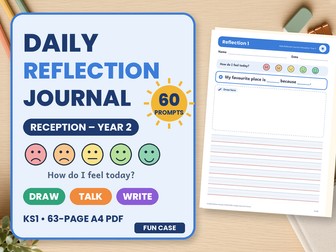
Give Reception to Year 2 pupils a calm daily reflection routine with 60 original prompts. Each page has a “How do I feel today?” face row, a large prompt in child-friendly type, a drawing box and six sets of primary handwriting lines, so children can draw and write, or talk while an adult scribes.
63 A4 pages in one PDF: cover, adult notes, 60 reflection pages and terms. Prompts include “My favourite place is ___ because ___.” and “If I built a den, it would have ___.” Ideal as a morning or end-of-day journal for KS1; pages can be kept in a folder or bound as a book for each child.
The adult notes give support ideas for Reception, Year 1 and Year 2, talk prompts to extend thinking and a quick five-step routine.
This is a reflective writing pack for KS1, not a complete English, PSHE or RSHE scheme and not a diagnostic assessment. Adult modelling, oral responses and extra paper are welcome, and children are never required to share sensitive personal information.
Print A4 at actual size. You receive one PDF, also supplied as a ZIP. Single-classroom licence.
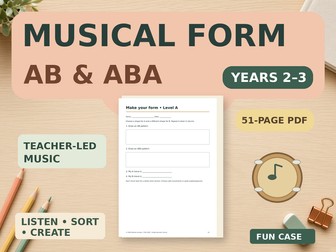
Help Years 2–3 explore musical form with AB and ABA listening and sorting activities. This teacher-led KS1 / lower KS2 pack focuses on hearing contrasting sections, showing their order and noticing when the first section returns—not a full music scheme or formal assessment.
51 A4 pages in one printable PDF: teaching guidance and a teacher-performed sound demonstration; vocabulary wall and two sets of cut-apart word cards; six complete shape-sequence cards and sorting mat; supported and independent AB/ABA identification, make-your-form and exit tasks; picture sort, draw-and-tell and four small exit tickets. Also includes adult answers and open-task models, classroom observation records, progress graph, pupil reflection, optional home practice, certificate, terms and 19 printable teaching panels adapted from the original slideshow.
The guided demonstration uses short eight-pulse sections so pupils hear whole musical sections, not just isolated beats. Shape patterns are visual models; adults provide the sounds. No audio recording or editable presentation is included. The original 29-page pack and 19-slide teaching sequence are adapted into this PDF; three added adult guidance pages explain models and checking criteria. These are not 51 pupil worksheets.
British English throughout, with clear pupil workspace and safe participation choices: quiet taps, seated gestures, pointing, drawing, listening or speaking. Adult-led teaching and supervised cutting where appropriate. Two practice levels offer different support, not fixed ability labels. Optional family activities do not require personal disclosure or a returned record.
Print pupil tasks separately from adult keys. Use for teacher-led lessons, small-group practice or revision. One buyer PDF, also available alone in a PDF-only ZIP; no Google Slides link, PowerPoint, audio or additional editable files. Single-educator licence. Public preview is limited to a cover and one unanswered pupil page.
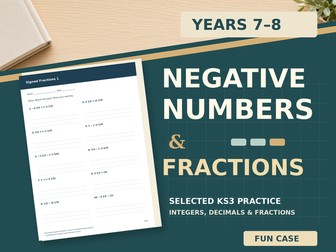
Practise negative numbers and directed-number skills with 19 KS3 maths worksheets and explained answers for Years 7–8. Use after signed-number methods have been taught; placement depends on readiness, not a statutory year-by-year match.
41 A4 PDF pages: cover, adult guide, 19 pupil pages, 19 explained key pages and terms. All 166 original items and their order are retained, including repeated practice. Numerical expressions are unchanged; necessary fraction-key corrections are documented in the release.
Includes two pages each of integer addition, subtraction, multiplication and division; two signed-decimal addition pages; two signed-fraction pages covering addition, subtraction and multiplication; three four-question word-problem pages; two mixed-operation integer pages; ten sign predictions with calculation checks; and a four-step dinner budget.
This is a selected practice pack, NOT complete coverage of rational-number operations: no decimal/fraction division, powers or roots. Not a full KS3 curriculum, GCSE course, SATs paper, standardised test or diagnostic assessment. No guaranteed speed, independence or attainment.
British English and imagined contexts use pounds, Celsius, metres and rugby phases. The light Thanksgiving theme remains in temperature, parade, food and budget questions; no celebration, cultural knowledge or historical claims are required. These are localised fictional scenarios, not currency or measurement conversions.
Every item has an answer and method/sign explanation; fraction keys show improper-fraction working and simplification. Accept equivalent exact fractions, mixed numbers or accurate decimal forms, with appropriate units. Negative mixed-number notation and adjacent-bracket multiplication are explained in the guide. Money balances carry forward sequentially.
Each numerical item has three writing lines; four-question context pages have full-width working areas. Show working in the spaces, or use a book or squared paper for more room. Adult modelling, number lines, reading support, oral/scribed answers, enlargement and extra paper may help; calculators can check work at teacher discretion.
Paper-only hypothetical tasks: no food, purchases, balloons, sport activity or outdoor exposure required. Do not request family finances, beliefs or diets.
Print A4 at actual size: pupil pages 3–21; keys 22–40. Buyer receives one non-editable PDF, also alone in its PDF-only ZIP. No cards, separate recording sheet or editable files. Public preview: cover and uncompleted pupil fraction page only, no keys. Single-classroom licence; do not share or post publicly.
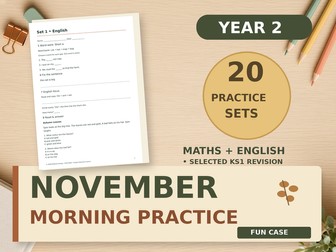
Year 2 morning work for November: 20 autumn-themed maths and English practice sets for teacher-selected KS1 revision. Each set has one maths page and one English page. Earlier KS1 skills are revisited alongside two-digit place value and comparison; this is not a full Year 2 curriculum, phonics scheme or formal assessment.
70 A4 pages: cover, two teacher-guide pages, two skills-guide pages, 40 pupil pages, 20 full-sized adult answer pages, two support/extension pages, two blank adult planning templates and terms. The original 30-page pack is expanded for clearer workspace and readable keys—not extra questions or 70 pupil worksheets.
Each set retains eight task areas: number of the day (tens, ones, one/ten more and less, number words); six addition/subtraction facts; rotating time, pence, comparison, shape or base-ten work; a word problem; phonics word work; sentence editing; word copying/finding, alphabetical order or syllables; and a short passage with two multiple-choice questions. 120 facts, 20 word problems and 40 reading questions, plus the other tasks. Later facts include missing numbers.
British English throughout, UK penny values and explained shape conventions. Coin-value labels are not realistic coin portraits or coin-recognition tests. O’clock and half-past revisit earlier learning. Phonics tasks should follow spellings already taught in your school’s sequence. Passages may be adult-read; listening comprehension is not evidence of independent decoding. Includes sentence models, reading answers, word-sort keys and accent-sensitive syllable guidance.
Fictional autumn, family and feast scenes require no personal disclosure or celebration. Set 18 sentence editing uses Bonfire Night in November as a UK autumn example for capitals and a question mark; it is not a requirement to celebrate. Select suitable sections, model first and use counters, oral responses or extra paper as needed. No fixed lesson time, no-prep or unaided-work guarantee.
One printable PDF, also alone in a PDF-only ZIP. No editable files, slideshow, audio or online activities. Blank templates require the adult to write and check their own tasks. Single-classroom licence. Public preview limited to a cover and one unanswered pupil page.
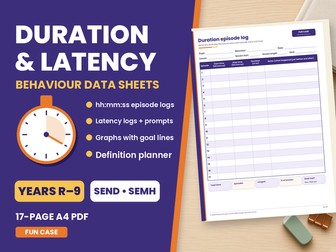
Find out how long a behaviour lasts and how quickly a pupil starts after an instruction, then graph progress against a clear goal. These printable duration recording and latency recording sheets help SEND, SEMH and pastoral teams in Years R–9 collect fair, comparable behaviour data.
17 A4 pages in one PDF:
• Cover and contents (p1–2)
• How to use in six steps (p3)
• Duration or latency? Timing guide, formulas, time formats and prompt codes (p4)
• Behaviour definition planner with definition, examples, non-examples, start and stop rules, measurement, replacement behaviour and goal – worked example and blank (p5–6)
• Duration episode log with hh:mm:ss start and stop times – worked example and blank (p7–8)
• Duration session summary with total time, longest episode and % of session – worked example and blank (p9–10)
• Latency log with prompt codes and a within-goal column – worked example and blank (p11–12)
• Behaviour observation graphs with numbered scales, axis labels and dashed goal lines – worked example (p13), blank duration graphs (p14) and blank latency graphs (p15)
• Team review planner (p16)
• Terms of use (p17)
The worked examples follow a Year 8 pupil (duration) and a Year 2 pupil (latency). Each example shows every step, from clock times and totals to the % of session, the goal decision and the graph, so staff can follow it straight away.
Use the behaviour observation sheets for SEMH tracking, SEND behaviour data and a clear behaviour data graph for reviews with your SENCo, parents and carers.
Print A4 at actual size. You receive one PDF; the ZIP download contains the identical PDF only. These recording and planning tools support professional judgement and your school’s policies; they do not diagnose or assess. Single-educator licence.
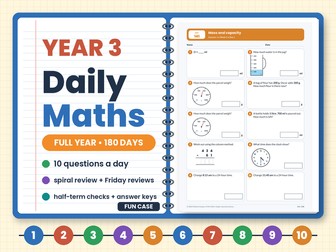
A whole year of ten-minute daily maths for Year 3, mapped statement by statement to the national curriculum in England. Each day has ten questions: six on the focus for the week and four spiral review questions that bring back earlier topics, so place value, column methods, times tables, fractions, measures, time, shape and statistics stay fresh all year. Use it as a morning starter, a maths meeting, an early work task or a homework sheet.
What is included (208 A4 pages):
• How to Use guide, Year at a Glance (six half-terms, five focus weeks and a review week each) and a two-page Curriculum Coverage map listing every Year 3 statement and the days that teach it.
• 180 daily pages with ten questions each (1,800 questions in all): place value to 1,000, 10 or 100 more or less, counting in 4s, 8s, 50s and 100s, mental and column addition and subtraction, estimating and inverse checks, the 3, 4 and 8 times tables, two-digit by one-digit multiplication and division, scaling and correspondence problems.
• Measures and geometry: rulers in cm and mm, perimeter, kitchen scales and jugs (g, kg, ml, l), money with £ and p and giving change, clocks with Roman numerals, 12-hour and 24-hour times, durations, days in each month, right angles and turns, parallel and perpendicular lines, 2-D and 3-D shapes.
• Fractions: tenths, fractions of a set, equivalent fractions with bar diagrams, comparing, adding and subtracting fractions with the same denominator.
• Statistics: scaled bar charts, pictograms and tables with one-step and two-step questions.
• A Friday review every week and a half-term check on Days 30, 60, 90, 120, 150 and 180.
• Answer keys for all 180 days, a class record sheet for the six checks and a pupil goal tracker.
Money follows the Year 3 guidance (£ and p written separately). All drawings, clocks, coins and charts are original. One non-editable PDF.
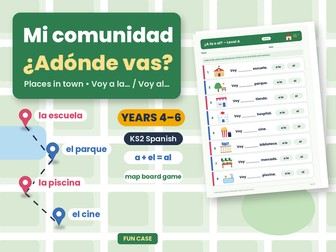
Teach places in town in Spanish with a clear grammar focus. Pupils learn 12 places with el or la, ask ¿Adónde vas? (Where are you going?) and answer Voy a la escuela or Voy al parque, using the rule a + el = al. They then describe a town with En mi pueblo hay… and No hay…, and read a short text about Pablo’s town. It suits KS2 Spanish in Years 4–6, and you do not need to be a fluent speaker.
What is included (27 A4 pages):
• Teacher guide with objectives, KS2 languages National Curriculum links and a vocabulary list.
• Grammar and pronunciation notes for teachers: a la and al, Voy a casa, no hay, a false friend (la librería) and a say-it-like guide for every place.
• Lesson at a glance (30 minutes) and a scripted lesson with hook, teach, model, practise and wrap-up, plus useful Spanish phrases for the lesson.
• ¿Adónde vas? grammar poster, Los lugares del pueblo poster and 12 picture cards, colour-coded pink for la and blue for el.
• Mapa del pueblo board game with 24 squares, and six games and activities.
• Sorting mat (Voy a la… / Voy al…) and sorting cards.
• Two-level worksheets: Name the Place and ¿A la o al? at Level A (pictures and choices to circle) and Level B (writing from memory), plus En mi pueblo hay….
• Reading: El pueblo de Pablo, with six comprehension questions.
• Exit tickets at two levels, four quick checks, answer key, class record sheet, I can tracker, family letter and certificate.
All Spanish uses standard spelling, accents and punctuation. One non-editable PDF.
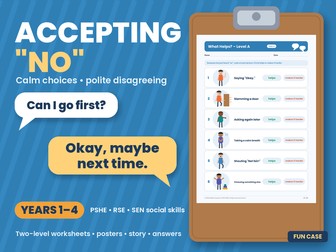
Help pupils cope when the answer is “no”. In one gentle, practical lesson, pupils learn that feeling disappointed is OK, practise calm-down choices (a balloon breath, counting to 5, squeezing their hands, a drink, a break), respond with words such as “Okay, maybe next time” and disagree politely with “I think… because…”. It suits KS1 and lower KS2 PSHE, Relationships Education, social skills groups and one-to-one SEN support.
What is included (28 A4 pages):
• Teacher guide with objectives, Relationships Education and Health Education links, success criteria and key vocabulary.
• Teacher notes on teaching this kindly: all feelings are OK, “accepting no is not accepting anything” (pupils always tell a trusted adult if something feels unsafe), regulation and communication needs, and a safeguarding reminder.
• Lesson at a glance (30 minutes) and a scripted lesson with hook, teach, model, practise and wrap-up, plus role-play ground rules.
• When I Hear “No” four-step poster and a My Calm-Down Choices poster.
• Word wall, 12 picture cards, 8 No Problem scenario cards and six games, including Pass the “Okay” and a polite disagree debate.
• Sorting mat and sorting pictures (Helps it go well or Makes it harder).
• Two-level worksheets: What Helps? and I Think… Because… at Level A (pictures and choices to circle) and Level B (written answers).
• My Plan for Hearing “No” and a four-picture story, Maya Hears No, with questions.
• Exit tickets at two levels, four quick checks, answer key, class record sheet, pupil goal tracker, family letter and certificate.
All people and scenes are original drawings; examples use characters, not real pupils. One non-editable PDF.
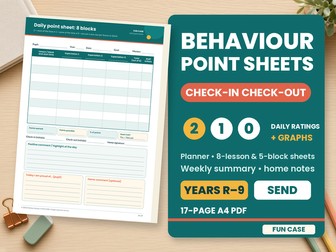
Run a calm, positive Check-In Check-Out (CICO) routine with printable daily behaviour point sheets for Years R–9. Each pupil starts and ends the day with a trusted adult, works towards three clear expectations and receives quick 0–1–2 ratings in every lesson or block.
17 A4 pages in one PDF:
• Cover and contents (p1–2)
• How to use, with roles for mentor, class teacher, pupil and home (p3)
• Setting up well: rating scale, strong expectation wording, goal setting and fading steps (p4)
• Expectation planner with looks like, sounds like, settings and replacement behaviour – worked example and blank (p5–6)
• Daily point sheet for 8 lessons or blocks (secondary) – worked example and blank (p7–8)
• Daily point sheet for 5 blocks (primary) with a feelings check – worked example and blank (p9–10)
• Weekly summary – worked example and blank (p11–12)
• Progress graphs with numbered scales, axis labels and dashed goal lines – worked example and blank (p13–14)
• Check-in and check-out conversation guide with two home–school note slips (p15)
• Two-week review and fading planner (p16)
• Terms of use (p17)
Worked examples show exactly how to total points, work out the percentage and decide whether the goal was met, then carry the numbers into the weekly summary and graph.
Use it as a daily behaviour chart or behaviour report card for SEND behaviour support and pastoral support. Ideal for SENCos, pastoral leads, mentors, teaching assistants and class teachers.
Print A4 at actual size. You receive one PDF; the ZIP download contains the identical PDF only. These recording and planning tools support, and do not replace, professional judgement and your school’s behaviour policy. Single-educator licence.
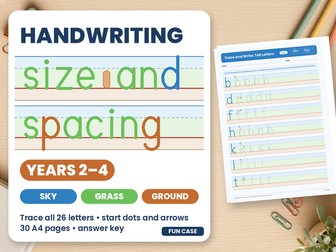
Help pupils size their letters and leave clear spaces between words, using one simple idea: every letter has a place in the sky, the grass or the ground. This pack has a 30-minute scripted lesson, display pages, tracing for all 26 lower-case letters, and two-level practice pages with an answer key.
What is included (30 A4 pages):
• Teacher guide, objectives, National Curriculum handwriting links (Year 2 size and spacing; Years 3 and 4 legibility and consistency) and key vocabulary.
• Lesson at a glance and a scripted lesson (hook, teach, model, practise, wrap-up).
• Anchor poster, a letter-zones chart showing all 26 letters as tall, small or tail, and an illustrated word wall.
• Letter cards for all 26 letters, spacer sticks and space cards to cut out, with printed cutting lines.
• Sorting mat and Sort the Letters at Level A (letter pictures on large guide lines) and Level B (sort the letters in real words).
• Three trace-and-write pages (tall, small and tail letters). Every letter has a green start dot and a direction arrow.
• Copy with Spaces at Level A (trace, with finger-space markers) and Level B (copy), plus a Fix It editing page with five common errors.
• Exit tickets at two levels, self-check bookmarks, a tall-or-tail letter sort and four quick checks per page.
• Answer key, class record sheet, pupil tracker, family letter and certificate.
For whole-class handwriting lessons, handwriting groups and one-to-one support in Years 2 to 4. Letters are in a simple print style without lead-ins, so the pack sits alongside any school handwriting scheme. Print on A4 at actual size. One non-editable PDF.
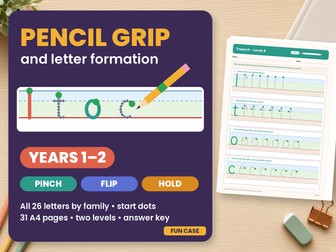
Teach young writers to sit ready to write, hold a pencil comfortably and start every letter in the right place. This pack has a 30-minute scripted lesson, display pages, tracing for all 26 lower-case letters grouped by letter family, two-level practice pages and an answer key.
What is included (31 A4 pages):
• Teacher guide, objectives, National Curriculum links (Year 1 handwriting: sitting correctly, holding a pencil, forming letters in the correct direction, letter families) and key vocabulary.
• Lesson at a glance and a scripted lesson (hook, teach, model, practise, wrap-up) with stroke words for l, t, o and c.
• Ready-to-write poster, a pinch-flip-hold pencil grip poster with grip helpers, a letter-families chart and an illustrated word wall.
• Picture cards and sorting pictures to cut out, with printed cutting lines, plus a sorting mat (Ready to write or Not ready yet).
• Warm-up patterns (lines, zigzags, waves, circles and loops) with green start dots.
• Trace It at Level A and Level B, and four trace-and-write pages: long ladder, curly caterpillar, one-armed robot and zigzag monster letters. Every letter has a green start dot and a direction arrow.
• Ready to Write at Level A (circle the picture) and Level B (sentence frames with a word bank), exit tickets at two levels, a picture sort and four quick checks per page.
• Answer key, class record sheet, family letter and certificate.
For whole-class handwriting, handwriting groups and one-to-one support in Years 1 and 2. The letters are a simple print style without lead-ins, so the pack sits alongside any school handwriting scheme. Print on A4 at actual size. One non-editable PDF.
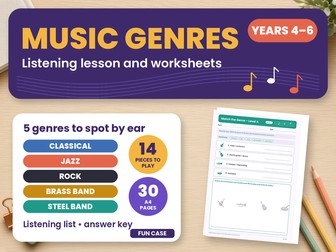
Teach pupils to recognise five music genres by ear: classical, jazz, rock, brass band and steel band. This KS2 pack gives you a 30-minute scripted listening lesson built around named pieces, so you know exactly what to play, plus two-level follow-up worksheets and a full answer key.
What is included (30 A4 pages):
• Listening list of 14 pieces, with performer or composer and what to listen for. Examples include Grieg’s In the Hall of the Mountain King, Holst’s Mars, Take Five, We Will Rock You, The Floral Dance, Colonel Bogey March and Pan in A Minor. Use BBC Ten Pieces or your school’s licensed music service. No recordings are included.
• Lesson at a glance and a scripted lesson (hook, teach, model, practise, wrap-up).
• Objectives, KS2 music curriculum links, success criteria and an 8-word vocabulary list.
• “How to listen” anchor poster, genre fac
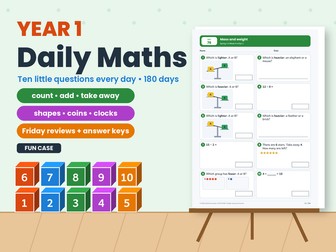
A whole year of short daily maths for Year 1, mapped statement by statement to the national curriculum in England. Each page has ten little questions in a clear, child-friendly font with big pictures: six on the focus for the week and four spiral review questions that bring back earlier learning, so counting, number bonds, adding and taking away, shape, measures, money and time stay fresh all year. Use it as a morning starter, a maths meeting, an adult-led group task or a homework sheet.
What is included (208 A4 pages):
• How to Use guide (with reading-aloud and scribing tips), Year at a Glance (six half-terms, five focus weeks and a review week each), a two-page Curriculum Coverage map listing every Year 1 statement and the days that teach it, key vocabulary and a list of handy kit to keep close by.
• 180 daily pages with ten questions each (1,800 questions in all): counting and reading numbers to 10, 20, 50 and 100, 1 more and 1 less, comparing with more, fewer and equal to, number bonds to 10, adding and subtracting within 20 including 0, and missing number problems such as 7 = ? − 9.
• Pictures to count and reason with: ten frames, number tracks, tens rods and ones, groups and arrays, socks in pairs, toy cars in a race, balance scales, glasses of water, cube towers and pencils measured in cubes.
• Counting in 2s, 5s and 10s, equal groups, sharing, doubling, halves and quarters of shapes and amounts.
• Coins and notes, numbers 1 to 20 in words, one-step word problems, days of the week and months, before and after, o’clock and half past, quicker, slower, earlier and later, first, second and third, and position and turns.
• A Friday review every week and a half-term check on Days 30, 60, 90, 120, 150 and 180.
• Answer keys for all 180 days, a class record sheet for the six checks and a pupil goal tracker.
All drawings, clocks, coins and pictures are original. One non-editable PDF.
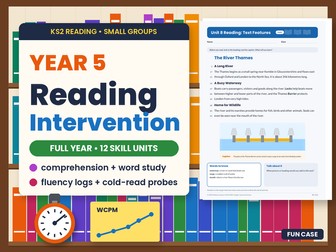
A complete, full-year reading intervention for Year 5 small groups: 12 three-week skill units (36 weeks) of comprehension, word study and fluency, with a skill screener, cold-read progress probes and full answer keys. 111 A4 pages, ready to print.
Built for groups of three to six pupils who need extra support, meeting four times a week for 20–30 minutes alongside whole-class English lessons.
What’s included
How to Use guide, a step-by-step guide to running a cold-read probe, Scope and Sequence and Curriculum Links
Skill Screener (12 items, one per unit) with a scoring and grouping grid
Group Progress Tracker and a pupil Reading Growth Graph with start, middle and end-of-year fluency benchmarks
12 units, each with 8 pages: teacher plan (day by day for three weeks), anchor chart, original teaching passage with running word counts, Words to know, Talk about it and Quick write, four multiple-choice questions plus an extended answer, graphic organiser, word study sort with a spelling tip, fluency log with a word-time helper, and a cold-read probe with a ready-made WCPM table
Answer keys with model answers for every extended question, all 12 word sorts and all probe questions
The 12 skills
Main idea and key details • Sequence of events • Character traits and feelings • Cause and effect • Context clues • Compare and contrast • Making inferences • Text features • Theme • Author’s purpose and viewpoint • Problem and solution • Summarising
Curriculum links
Every question is tagged with a KS2 English reading content domain (2a–2h), so you can see at a glance which kinds of question each pupil finds hard. Each unit is matched to a Year 5–6 comprehension statement in the national curriculum. Word study covers Year 5–6 endings (-able/-ible, -cious/-tious, -cian) and revises the Year 3–4 prefixes, suffixes and roots that many pupils in an intervention group still need.
England contexts include the Great Stink of 1858, the River Thames and the Thames Barrier, hedgehogs and migrating swallows. All passages, questions, word lists and drawings are original.
Teacher tips
Use the screener to group pupils, then teach the units in order or start with the skills your group needs most.
Time each probe on the first word of the passage; the margin word counts make scoring quick.
Shade the tracker cell green when a pupil scores 3/3 and reaches the benchmark for that time of year.
Fonts: Poppins, Lato and Andika (SIL Open Font Licence). Single-classroom licence.
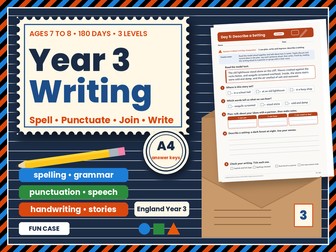
A full year of daily writing for Year 3: 180 days, one for every school day, each printed at three levels so the whole class works on the same skill together. 582 A4 pages, ready to print, written in British English and matched to the national curriculum in England (English programmes of study, years 3 and 4, and the Year 3 grammar in English appendix 2).
Every day has three pages, marked with a shape rather than a level name: circle (most support, two choices per question and sentence starters), square, and triangle (more questions, extra writing tasks and dictionary work).
The weekly rhythm
• Monday: spelling. Prefixes (dis-, mis-, in-, il-, im-, ir-, re-, sub-, inter-, super-, anti-, auto-), suffixes (-ly, -ation, -ous, -tion, -sion, -ssion, -cian), -sure and -ture, ch, -gue and -que, sc, ei, eigh and ey, homophones, plural possessive apostrophes and the Years 3 and 4 word list, with look, say, cover, write, check
• Tuesday: grammar. a or an, word families, prefixes, conjunctions (when, if, because, although), main and subordinate clauses, adverbs and prepositions for time, place and cause, the present perfect, pronouns for clarity, fronted adverbials and Year 3 grammar terms
• Wednesday: punctuation. Inverted commas for direct speech, commas after fronted adverbials, plural possession, capital letters, commas in lists, statements and questions
• Thursday: handwriting and proofreading. The four common joins, copying on handwriting guide lines, and finding and correcting spelling and punctuation mistakes
• Friday: composition. A short model text to discuss, a plan, writing and a self-check: settings, characters, plot and dialogue, information texts with headings and sub-headings, instructions, recounts and letters in paragraphs, editing and improving, diaries and opinion writing
• Week 3 Friday is a review and week 6 Friday is a half-term check with a score box. Monday of week 6 is dictation and dictionary skills (using the first 2 or 3 letters)
Also included
• A curriculum tracker that quotes every Years 3 and 4 writing statement and lists the days that teach it
• A map of the Year 3 content of English appendix 2
• A handwriting joins guide (with a note to follow your school’s scheme), a spelling word mat with the full Years 3 and 4 word list and homophones, a grammar and punctuation mat and writing checklists
• A class record, answer keys for every page (model answers for open tasks) and a Super Writer certificate
Adult-read items: the dictation sentences (Monday of week 6 in each half-term) are read aloud by an adult from the answer key. All other pages can be read by pupils, with an adult reading aloud where needed.
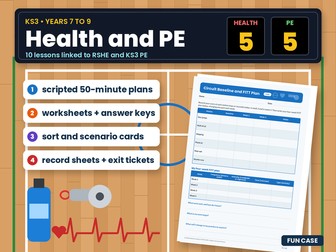
Ten complete, ready-to-teach KS3 lessons for Years 7, 8 and 9: five health education lessons mapped to the DfE RSHE statutory guidance and five practical PE lessons mapped to the KS3 national curriculum for physical education. 129 A4 pages, ready to print.
Every lesson has 12 pages, so each one works as a full 50-minute lesson with a teacher plan, pupil pages, assessment and home learning.
The ten lessons
Health: 1 Fuel Your Day: Healthy Eating • 2 Sleep and Recharge • 3 Media and Advertising Literacy • 4 Saying No: Refusal Skills • 5 Personal Hygiene and Health Protection
PE: 6 Build Your FITT Fitness Plan • 7 Heart Rate and Training Zones • 8 Ultimate Frisbee: Throw, Catch and Spirit • 9 Pickleball: Serve, Dink and Rally • 10 Invasion Games: Using Space and Tactics
Inside every lesson
• Lesson overview: objectives, the exact statutory statements taught, key words, kit, safety and sensitivity notes, and a lesson-at-a-glance timeline
• Scripted 50-minute plan with hinge questions and support and stretch ideas
• Knowledge organiser, key word fold-over cards and a cut-and-sort activity
• Worksheet A (multiple choice with an explain-your-thinking task) and Worksheet B (short answers)
• A record or planning sheet: plate planner, sleep diary, ad detective, refusal planner, hygiene routine, circuit baseline and FITT plan, heart-rate investigation, skills trackers and a match analysis sheet
• Six scenario cards for discussion, an exit ticket with self-assessment, a full answer key with model answers, and home learning with a family note
Also included
• How to use the pack, with suggested Year 7, Year 8 and Year 9 routes
• KS3 PE curriculum map and RSHE (health education) map using the statutory wording
• Ten-lesson sequence, class assessment record, and safe practice and safeguarding notes
• Certificate
Accurate, UK-specific content throughout: the Eatwell Guide, 5 A Day and the 30 g free-sugar limit, NHS sleep and handwashing advice, the UK Chief Medical Officers’ 60-minute activity guideline, the ASA and #ad rules, the under-18 sale laws for vapes and alcohol and the new smoke-free generation tobacco law, and signposting to Childline, FRANK and NHS 111. Sport rules follow UK Ultimate and Pickleball England.
Fonts: Poppins and Lato (SIL Open Font Licence). Single-classroom licence.
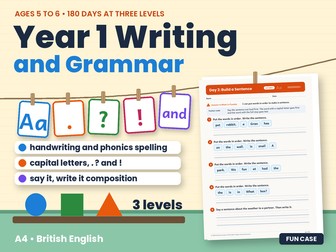
A full year of daily writing practice for Year 1: 180 days, one for every school day, each printed at three levels so the whole class practises the same skill together. 575 A4 pages, ready to print, written in British English with an easy-to-read Year 1 font.
Every day has three pages, marked with a shape rather than a level name: circle (most support, more tracing and choices to tick), square, and triangle (more independent writing and “write your own” tasks).
The weekly rhythm
Monday: handwriting (long ladder, curly caterpillar, one-armed robot and zigzag monster families, capital letters and digits 0-9)
Tuesday: sentences and grammar (building sentences, word or sentence, joining with and, singular and plural -s and -es, -ing, -ed, -er and -est, the prefix un-, compound words)
Wednesday: punctuation (capital letters, full stops, question marks, exclamation marks, capital letters for names, places, days and I)
Thursday: spelling (phonics patterns such as ff, ll, ss, zz and ck, sh, ch, th, ai and ay, ee and ea, igh, oa, oo, ar, or, er, ir, ur, ow, ou, oi, oy, split digraphs, air and ear, tch and -ve, k before e, i and y, wh and ph; tricky words, days of the week, alphabet order and dictation; phonics gap items are read aloud by an adult from the answer key)
Friday: composition (say it, write it; sequencing a story; re-read and fix), with a review in week 3 and a half-term check in week 6 of each half-term
Also included
How to use the pack, a year at a glance for all six half-terms, and ideas for adapting pages for your class
Curriculum tracker quoting every Year 1 writing statement from the national curriculum in England, with the days that teach each one
English Appendix 2 Year 1 map (vocabulary, grammar, punctuation and terminology for pupils)
Handwriting families guide, word mat (tricky words, days of the week, alphabet and spelling patterns), pupil writing checklists and a class record
Answer keys for every day with dictation scripts, and a certificate
Fonts: Poppins, Lato and Andika (SIL Open Font Licence). Single-classroom licence.
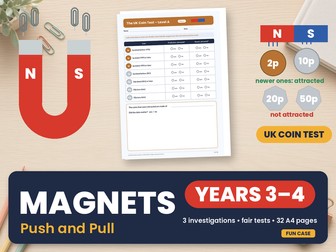
Teach the Year 3 Forces and magnets unit through hands-on enquiry. Pupils test everyday objects, investigate which UK coins a magnet picks up (and why the date matters), predict whether poles will attract or repel, and run a simple fair test to see if magnetic force works through paper.
What is included (32 A4 pages):
• Teacher guide, objectives, the Year 3 Forces and magnets National Curriculum statements, Working Scientifically links and key vocabulary.
• Lesson at a glance and a scripted lesson (hook, teach, model, practise, wrap-up).
• Safety notes, a kit list and teacher notes on UK coins, using Royal Mint facts: copper-plated steel 1p and 2p coins since 1992 and nickel-plated steel 5p and 10p coins since 2011–2012 are magnetic, while 20p and 50p coins are not.
• Magnet facts poster, poles poster, an illustrated word wall, picture cards and sorting pictures with printed cutting lines, and a sorting mat.
• Three investigations, each at Level A (picture tick tables and sentence starters) and Level B (predict with a reason, record and write a conclusion): Which Objects Are Magnetic?, The UK Coin Test, and Through Materials, a fair test with a change / observe / keep the same planner and a results table.
• Poles: Attract or Repel? at two levels, a Magnets in Real Life reading page with questions, exit tickets at two levels, a picture sort and four quick checks per page.
• Two-page answer key, class record sheet, family letter and certificate.
For Year 3 science (also useful for Year 4 revision). You will need bar magnets and everyday objects; coins are optional but make the strongest hook. Print on A4 at actual size. One non-editable PDF.
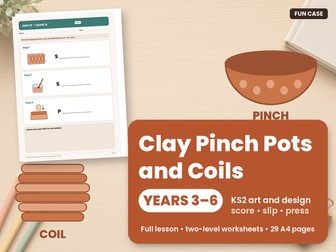
Teach clay hand-building with confidence. In one practical lesson, pupils learn that sculpture is 3-D, make a pinch pot, roll an even coil and join clay strongly with score, slip and press. Then they plan and evaluate their work in the way the KS2 art and design curriculum expects.
What is included (29 A4 pages):
• Teacher guide with objectives, the KS2 art and design National Curriculum links (sculpture with clay, sketchbooks, great artists) and guidance on choosing a level.
• Lesson at a glance (60 minutes, or two shorter sessions) and a scripted lesson: hook, teach, model, make and review.
• A safety, kit and set-up page (damp clean-up rather than sweeping, hand washing, kiln use by trained adults only, clay quantities for 30, slip recipe, slow drying) and teacher notes on clay stages, troubleshooting and adapting the lesson.
• Two step-by-step posters (Make a Pinch Pot; Coil and Join), an illustrated 12-word word wall and picture cards with printed cutting lines.
• Artist study: coil-built pots from the Jomon period in Japan, Magdalene Odundo and Grayson Perry, with discussion questions.
• Sorting mat and pictures, plus 2-D or 3-D?, Pinch Pot Steps and Join It worksheets, each at Level A (pictures and word banks) and Level B (written instructions and explanations). There is also a picture sort worksheet.
• Design My Pot sketchbook page, Evaluate My Pot self and peer review, exit tickets at two levels and four quick checks.
• Answer key, class record sheet, family letter and certificate.
You will need air-drying or kiln clay, damp sponges and simple tools. Print on A4 at actual size. One non-editable PDF.
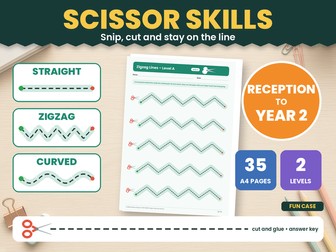
Help young children hold scissors safely and cut with control, step by step, from the first snip to a cut-and-glue picture. Every cutting page has printed paths to cut along, and the straight, zigzag and curved lines have a green start dot and a red stop dot, at two levels.
What is included (35 A4 pages):
• Teacher guide, objectives, curriculum links (EYFS Fine Motor Skills early learning goal, KS1 Design and Technology) and key vocabulary.
• Lesson at a glance and a scripted lesson (hook, teach, model, practise, wrap-up).
• Scissor rules poster, a how-to-hold-scissors poster with tips (including left-handed scissors), an illustrated word wall and an 8-step cutting skills ladder.
• Picture cards and sorting pictures to cut out, plus a sorting mat (Scissor safety or Cutting skill).
• Cutting practice: snip strips, a lion-mane fringe, and straight, zigzag and curved lines at Level A (a shaded 10 mm path to stay inside) and Level B (single dashed lines, with steps and tighter curves), plus a corners and shapes page.
• Cut and glue: cut out six pieces and build a house picture on the glue mat.
• Scissor Rules at Level A (circle the safe picture) and Level B (sentence frames with a word bank), exit tickets at two levels, a picture sort and four quick checks per page.
• Answer key, class record sheet, family letter and certificate.
For Reception and Key Stage 1 classes, fine motor groups and one-to-one support. Print on A4 at actual size, on paper for beginners. One non-editable PDF.
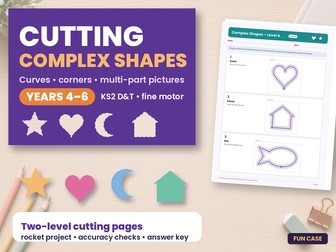
Help pupils move on from cutting lines to cutting whole shapes. In one practical lesson, pupils learn four habits – thumb up, the helper hand turns the paper, slow down at corners and rough cut first – and use them to cut smooth curves, sharp outside corners, tricky inside corners and a six-piece picture. It suits KS2 design and technology, fine motor groups and one-to-one support.
What is included (34 A4 pages):
• Teacher guide with objectives, KS2 design and technology National Curriculum links (using tools accurately; annotated sketches and pattern pieces; evaluating), a “Which level?” guide and S/D/N descriptors for the class record.
• Lesson at a glance (30 minutes) and a scripted lesson: hook, teach, model, practise and wrap-up, with safety and timing notes.
• Four Habits poster and teacher notes on outside corners, inside corners, curves and multi-part pictures, with a troubleshooting table.
• Word wall, 12 shape cards, an 8-step skills ladder, six games and activities, and advice on choosing scissors and paper.
• Sorting mat and sorting pictures (Curves or Corners) and a picture sort worksheet.
• Six cutting pages: Curves, Corners and Complex Shapes, each at Level A (8 mm shaded bands, stop dots on every corner and a rough-cut box) and Level B (single dashed lines; stay within 3 mm).
• Accuracy Check at two levels, with a printed gauge: on the line, within 3 mm or more than 3 mm.
• Rocket project: a planning sheet, six pieces to cut and a glue mat, plus a Level B Design Your Own page with a sketch grid and a planning table.
• Exit tickets at two levels, four quick checks, answer key, class record sheet, pupil goal tracker, family letter and certificate.
You will need scissors (including left-handed pairs), glue sticks and paper. Print on A4 at actual size so the 8 mm bands and 3 mm targets stay true. One non-editable PDF.


 Quick View