Father’s Day and Mother’s Day · Gift boxes and pop-up cardsQuick View
EduSori

Father’s Day and Mother’s Day · Gift boxes and pop-up cards

(0)
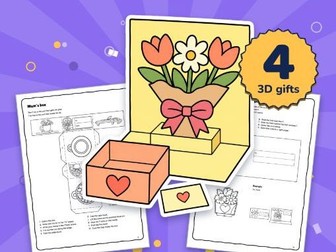
There’s a note hidden inside a box, and a figure pops up when you open the card. With these templates, each child can choose something to make, colour it in and add their own message for Dad, Mum or someone special. The pictures show how to put each gift together, and the examples help children get started with their writing. What’s in the 25-page A4 PDF 2 boxes with lids and 4 notes to fold and put inside (2 spare). 2 pop-up cards. Open them to see a rucksack for walks or a bunch of flowers pop up. 6 vouchers, 2 certificates, 4 bookmarks (2 spare) and 2 frames for a photo or drawing. 2 worksheets with sentence starters for personal messages and 2 tags (1 spare) to address a gift to whoever each child chooses. 1 guide to materials, 2 assembly guides and 2 pages of finished examples. Age and year group. Years 2 to 4 (US Grades 1 to 3), roughly ages 6 to 9. Children aged 5 can do the activities with help reading, making the inside cuts and writing. Materials and printing. Scissors, a glue stick and coloured pencils. You can print in black and white or in colour. The cover is in colour, and the inside pages are in black and white for colouring in. Print the sheets you choose on A4, single-sided and at 100%. When to use it. In the UK, Father’s Day is on the third Sunday in June and Mothering Sunday is on the fourth Sunday of Lent. Use the templates to thank someone for something or give them a keepsake at any point in the school year. Keywords · Father’s Day, Mother’s Day, gift box, pop-up card, pop-up greeting card, 3D paper cut-outs, primary school craft, gift vouchers, personal message, gift for someone special
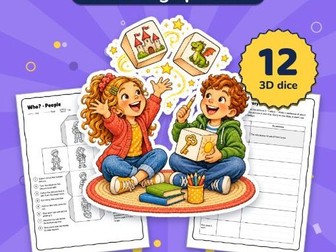
3D Story Dice: 12 Dice to Colour, Cut Out and Make, with Creative Writing SheetsQuick View
EduSori

3D Story Dice: 12 Dice to Colour, Cut Out and Make, with Creative Writing Sheets

(0)
When children say ‘I don’t know what story to tell’, give them a die to roll. Children colour, cut out and glue their own story dice, then roll them for ideas. Each die answers one story question and has six different pictures. Who? Three dice with people, animals and story folk. Where? Two dice with storylands and places near and far. With what? Two dice with mystery items and things to take on an adventure. What happens? Six problems to get the story going. How do they feel? Six feelings. What is the weather like? How do they travel? How does it end? The 72 pictures have no words, so children can tell stories in English, another language spoken in class or a language they’re learning. Younger children can tell a story with three dice (Who? Where? What happens?). Six dice give them a whole story, and all twelve can make the wildest story of all. The worksheets take children from telling a story aloud to planning its beginning, middle and ending, writing it down and checking it against eight questions. What’s included (22 A4 pages, PDF) A cover and a picture index of all 12 assembled dice. 12 cut-out dice, one per page, with glue tabs, numbered steps and a picture of the finished die. Each cube has 46 mm edges when assembled. ‘Six games with the dice’, with Three-dice story, Story chain, Story in six rolls, Change the story, Guess the picture and The wildest story. ‘My three-dice story’ for writing and drawing, and ‘My story in six rolls’ for writing one sentence per die. Each sheet starts with a worked example. ‘Words for telling stories’, with ways to start, carry on, surprise the reader, explain, say when and where, and finish. ‘Plan my story’ with a sample plan, ‘Write my story’ and ‘Check my story’ with a worked example. ‘Ideas for class and home’ for adults. The cover is in colour and the inside pages are black and white for children to colour in. You’ll need scissors, a glue stick and coloured pencils. Use thick paper (160 g/m²) or card for best results. The writing sheets have open-ended tasks without an answer key. Age and year group: Ages 5–10 (Reception to Year 5). An adult makes the dice for children aged 5. Children can tell their story aloud, draw it or dictate it.
Dinosaur fossils · Self-checking cardsQuick View
EduSori

Dinosaur fossils · Self-checking cards

(0)
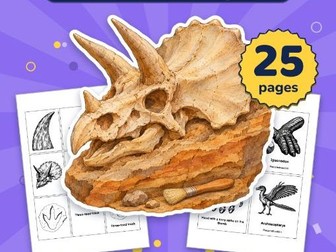
What detail helps you tell a track, a tooth or a feather impression apart? In Level A, pupils match each picture to its name, put it in one of six groups and check their choice with a control card and a fold-out key. In Level B, they look for the same detail in the fossil picture and the reconstruction of the animal. There are 48 pieces to cut out in all. Inspired by Montessori teaching, this resource helps pupils practise looking closely, sorting, measuring in centimetres and using a detail they can see to explain a choice. Pupils can work on their own, in pairs or at a classroom activity area. Allow about 8–10 minutes for the first round with three fossils, 12–18 minutes for all of Level A, 10–15 minutes for Level B and 5–10 minutes for each paper activity. Contents (25 A4 pages, PDF) P. 1. Colour cover. Pp. 2–9. Worked example, 36 Level A cards (12 pictures, 12 names and 12 control cards) and three boards for six groups. Pp. 10–13. Twelve Level B cards (six fossil pictures and six reconstructions) and a worked example. Pp. 14–19. Six activities for comparing, measuring, sequencing, observing, sorting and matching. Pp. 20–22. Three fold-out keys for checking work. Pp. 23–25. Teacher’s guide with set-up instructions, guidance and six documented cases. Recommended year group and age: Years 2–4 · ages 6–9 · Key Stages 1 and 2. Printing: You can print in black and white. The inside pages are already in black and white. Page 1 is the cover. Print pages 2 to 25. Print single-sided at 100% so the cards fit and the measuring activity keeps its scale. Author: EduSori.
Advent Pixel Mosaic for TeamsQuick View
EduSori

Advent Pixel Mosaic for Teams

(0)
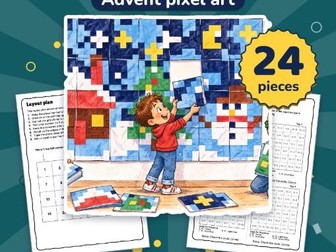
A Christmas picture for the whole class Each day, one pupil or a pair works out the calculations for a piece and colours the squares using its colour code. At the end, the class puts the pieces together using the layout plan. The Christmas scene features a little house with its lights on, a decorated fir tree, a snowman, stars and the moon. At home, take turns and put the mural together as a family. Choose a level for each pupil or family member. Level A covers addition and subtraction up to 20 for Years 2–3. Level B covers the 2 to 10 times tables and two-step calculations where pupils multiply first, then add or subtract, for Years 4–5. Both levels make the same scene. You can use pieces from both levels in one mural. PDF contents · 25 A4 pages Cover, guide, four worked examples, two colour codes and a numbered layout plan. 24 pieces, each with 6 × 6 squares and two versions of the calculations, for 48 cards in all. Each level takes up 6 sheets. Each card has its own code. A turn-taking chart, a certificate and five pages of answers in colour. The answers show the whole picture and all 24 finished pieces. You can print in colour or black and white. Print single-sided. To check the shades, view the answers on screen or print them in colour. Print the cards at actual size to make a mural measuring 48.6 × 32.4 cm. Get coloured pencils, school scissors and sticky tape ready. Keywords: December addition and subtraction, Christmas times tables, colour by answer, Advent maths calendar, winter classroom display, group arithmetic challenge, primary teacher gift.
Primary Advent Logic Calendar with Cut-Out EnvelopesQuick View
EduSori

Primary Advent Logic Calendar with Cut-Out Envelopes

(0)
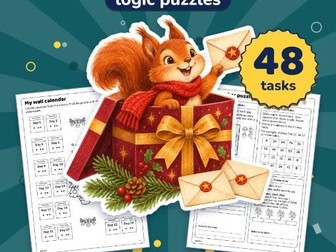
Open a door on the calendar and find the day’s puzzle. From 1 to 24 December, each date has two puzzles, so each child can choose the level that suits them. Use it as a quick morning starter in class. At home, put the calendar together and solve a puzzle with pencil and paper. Children work out how much the pictures on the scales weigh, continue patterns, work out who gets each gift or lives in each house, complete mini picture sudokus and draw paths that follow a rule. Each type has a worked example. Children write or draw their answers in the boxes. PDF contents · 25 A4 pages A wall calendar and 24 numbered envelopes on two sheets to cut out, fold and stick. 48 puzzles on 12 sheets, two per day. As a guide, ★ is for ages 6–7 and ★★ is for ages 8–10. A set-up guide, 12 worked examples, one per puzzle type and level, and a ‘How to play’ page. Puzzles illustrated with 18 hand-drawn Christmas objects. Three pages of answers. A sheet to cross off completed days, a certificate, a hints page and a working-out sheet. The inside pages are in black and white, ready for any printer. Print single-sided at actual size. To assemble the calendar, use round-ended scissors and a glue stick. For the puzzles, all you need is a pencil and a rubber. Keywords Advent activities for children Christmas maths reasoning KS1 and KS2 morning starters printable Christmas brain teasers December classroom activities Christmas picture sudoku festive puzzles for home learning
My First Week at School · Primary EAL School Vocabulary and Picture Cards for New ArrivalsQuick View
EduSori

My First Week at School · Primary EAL School Vocabulary and Picture Cards for New Arrivals

(0)
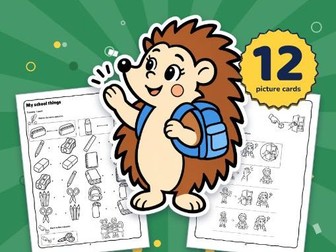
Help pupils who are new to English find their way around school, name the things in their school bag, ask for help and join in at playtime. Piko the hedgehog guides pupils through five days of English as an additional language (EAL) activities. Picture instructions and worked examples show pupils what to do. Use I point for matching, pointing and rehearsing short phrases aloud. Use I write when pupils are ready to copy words and finish short sentences with the same pictures. The two routes suit classroom use or small-group EAL support. Contents (25 A4 pages, PDF) Five pairs of pointing and writing worksheets, one for each day from Monday to Friday 12 school vocabulary picture cards, including six starred cards for the partner game Piko’s School Bag Four double-sided peg cards with dots on the back for pupils to check their answers One eight-part cut-out picture dictionary with 14 illustrated entries, including articles and plural forms where they apply Four cards for asking for help, one weekly record, three answer pages and one certificate You can print in colour or black and white. Only the cover is in colour. The interior is black and white.
Numbers to 10 and to 20 | Counting Worksheets, Peg Cards, Dominoes and ColouringQuick View
EduSori

Numbers to 10 and to 20 | Counting Worksheets, Peg Cards, Dominoes and Colouring

(0)
In Lía’s kite workshop, pupils count reels of thread, ribbon bows, kites and fabric patches. At the Numbers to 10 level, they practise counting, writing numbers, comparing groups and making 10. The Numbers to 20 level adds groups of 5 and 10, tens and ones, and addition and subtraction with pictures. Pupils put a peg below the number they choose or punch a hole in its circle with an adult’s help. Use the Answers and checks pages at the end. In dominoes, pupils match halves that show the same number. On the colouring worksheets, they write the answer in the box and look up its colour in the code. Each activity format starts with a worked example. What’s included · 25 A4 PDF pages 8 pages of guided activities on counting, comparing, partitioning numbers, addition and subtraction. The first counting worksheet (page 4) has a worked example and three rows to count. 32 self-checking peg cards on 4 cut-out sheets, 16 per level. 3 sets of dominoes with 8 tiles each, using pictures, numbers and partitioned numbers. 4 solve-and-colour worksheets, 2 per level. 2 pages of teacher guidance, 2 pages of answers and checks, 1 certificate and 1 cover. Year group and age Year 1–2 · ages 5–7. Primary school maths in England. The Numbers to 10 level can also be used in Reception. US: Kindergarten–Grade 1. Use it in class, at home or in a maths corner. The A4 PDF has a colour cover and a black-and-white interior. The codes give the colour names. You can print it in colour or in black and white.
I have… Who has? | Mental maths card game for Years 1–4Quick View
EduSori

I have… Who has? | Mental maths card game for Years 1–4

(0)
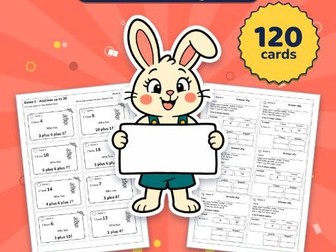
Deal a whole deck. Ask each pupil to solve the question on their card. Have them write the answer on their answer slip. Ask a pupil to read their card aloud to start the round. The pupil with the number called for reads the next card. Keep going until the group comes back to the first card. The guide shows a complete worked round and explains how to play as a class, in pairs or on your own. For solo play, use 8 answer slips for a deck of 16 or 12 for a deck of 24. Print 2 copies of the answer slip sheet. For 24 children, print 4 copies of the answer slip sheet. Each game has its own answer key to check the card chain and the answers pupils write down. What’s included 29 A4 pages in PDF format. 6 mental maths games covering addition and subtraction up to 20, addition and subtraction up to 100, the 2 to 5 and 6 to 9 times tables, and doubles and exact halves. 120 cards on 15 cut-out sheets. 3 decks of 16 cards and 3 decks of 24 cards. 6 answer slip sheets with 36 cut-out answer slips in total. 6 answer keys with questions and answers in the order they come up in the round. Games 1 and 2 from Year 1 · Game 3 from Year 2 · Game 4 in Year 3 · Game 5 in Year 4 · Game 6 in Years 3–4 Print in black and white. Only the cover is in colour. Print single-sided at actual size.
Christmas Nonograms for Primary MathsQuick View
EduSori

Christmas Nonograms for Primary Maths

(0)
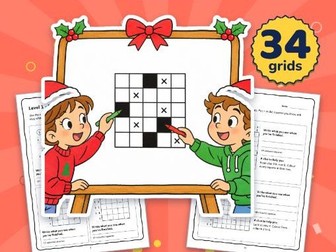
Give pupils a grid and a set of number clues. They read the clues for each row and column, colour the squares that fit and mark the squares that must stay white with a ×. Pupils use logic to find the one solution to each puzzle and reveal a hidden picture. Look out for a candy cane, an ice skate, a Christmas stocking, a toy train and a snowman. Use a sheet in the maths corner, as a quiet activity before the holidays or as a puzzle to do at home. Start with a small grid so pupils can learn to read the clues. Move up a size when they can explain why a square should be coloured or left white. All they need is a pencil and a rubber. Print in colour or black and white. The cover is in colour and all the activities inside are in black and white. What’s included 25 A4 pages with 34 puzzles and 34 hidden pictures. 16 puzzles on 5 × 5 grids, 10 on 8 × 8 grids and 8 on 10 × 10 grids. A guide for adults, practice strips to explain the clues and 3 examples worked through step by step. A page to make your own nonogram, a list to record the pictures and a printable award. 34 illustrated solutions with coloured squares, crosses and a suggested name for each picture. Each puzzle includes a square count for checking. Keywords · Advent logic puzzles · festive reasoning activities · winter picture grids · end of term brain teasers · printable number challenges · independent problem solving · grid deduction games
Telling the Time with Analogue Clocks, Year 2–3 · Self-Checking Cards, Dominoes and Mini-BookQuick View
EduSori

Telling the Time with Analogue Clocks, Year 2–3 · Self-Checking Cards, Dominoes and Mini-Book

(0)
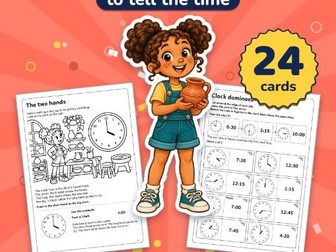
Which hour does the short hand show when it’s between two numbers? In Nara’s pottery workshop, pupils learn to tell the two clock hands apart and practise o’clock, half past, quarter past and quarter to. Use the cards in the maths area, for individual practice or at home. Each child writes the time or draws both hands, then finds the matching check card. In pairs, pupils join domino tiles by matching a clock face to its time in figures. In the mini-book, each child draws clocks for times in their own day. What’s included · 25 A4 PDF pages 1 colour cover, 2 pages for the teacher’s guide and check cards, and 1 lesson on the two clock hands. 14 practice worksheets with worked examples and 42 exercises. Level 1 · Year 2. Pages 5 to 12 and the A cards (p. 19). Read and draw o’clock and half past times. Level 2 · Year 3. Pages 13 to 18 and the B cards (p. 20). Practise quarter past and quarter to. Read times from clock hands and draw hands from times in figures. 24 cut-out self-checking cards, 12 per level, and 24 check cards. 1 set of dominoes with 16 tiles on two sheets and an answer key showing the complete loop. 1 mini-book with 8 pages on one sheet, with Nara’s five o’clock (5:00) snack as the example. 1 award certificate and the answers. Year group and age Year 2–3 · ages 6–8 (primary school in England) · US: Grades 1–2. The 25-page A4 PDF has a colour cover and a black-and-white interior. You can print it in colour or in black and white. You’ll need a pencil and scissors for the cut-out pages.
Pin-Pricking Cards for Numbers Zero to TwentyQuick View
EduSori

Pin-Pricking Cards for Numbers Zero to Twenty

(0)
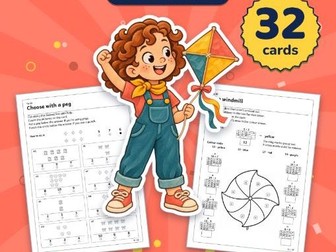
Make a number garland with 32 printable pin-pricking cards. Prick the dots on the numbers from 0 to 20. Cut out the shapes. Pass thread through the top rings. Hang the digits of each number together. The pack has 22 different shapes, one for each of the 21 numbers and one for the medal. Some numbers appear at two levels. Prick the dots with a craft pricker or join the dots with a pencil. The ‘From paper to garland’ page shows the steps and a finished example. The 3 ‘Cut-outs’ pages show what each card makes, with the matching card letter. There are 3 levels of difficulty. Level 1 has 10 outline cards with 39 to 73 dots. Level 2 has 10 cards for the numbers 0 to 9, with 55 to 80 dots. The cards add faces and, where applicable, gaps. A gap is an area inside a closed loop of dots. Leave the gaps uncut. Level 3 has 12 cards for the numbers 10 to 20 and a medal, with 59 to 116 dots. Choose level 3 from age 6 or with help. The ranges come from the vector dot counts in the PDF and include each hanging dot. You’ll need a fine-tipped craft pricker for paper, a soft mat, masking tape, round-ended school scissors and fine thread. Use a pencil to join the dots instead. At age 4, an adult handles the pricker. From age 5, an adult supervises pricking. What’s included (22 portrait A4 pages, PDF) 1 colour cover. The interior is black and white. 1 teacher’s guide and 1 demonstration page. 16 portrait activity sheets with 2 cards each. 3 ‘Cut-outs’ pages, 1 per level. Stage · Reception and Year 1 (ages 4–6; kindergarten/1st grade in the US).
3D Woodland Animals and Scenery to Cut OutQuick View
EduSori

3D Woodland Animals and Scenery to Cut Out

(0)
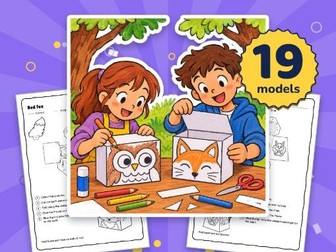
Build a paper woodland with your class. Start with the acorn to show how a flat sheet becomes a model. Let each pupil choose an animal, colour its faces and follow the marks to cut, fold and glue. Put the models together for a class display, or use a single template in a geometry workshop or for a craft activity at home. Choose from woodland wildlife such as the red squirrel, long-eared owl and great spotted woodpecker. Add scenery such as a stump with mushrooms, a log with a hollow drawn on it and a plank footbridge. Use the finished model picture to see where the separate pieces fit. Use 160 g/m² paper, colouring pencils, round-ended scissors and a glue stick. The sheets say when an adult should help. Print at actual size in colour or in black and white. All inside pages are designed for black-and-white printing. What’s included 20 A4 pages, with 1 colour cover and 1 illustrated guide on the acorn sheet. 19 templates to colour, cut out and build. 12 animals (red fox, long-eared owl, red squirrel, deer, European hedgehog, wild boar, piglet, brown bear, Iberian wolf, Iberian hare, beaver and great spotted woodpecker) and 7 pieces of scenery (acorn, stump with mushrooms, giant mushroom, two-tier fir, woodland shelter, log with a drawn hollow and plank footbridge). Cut and fold lines, plus tabs marked P. 4 to 6 steps and a finished model picture for each template. Keywords · autumn classroom craft · woodland habitat display · hands-on geometry · Iberian wildlife for children · printable cutting practice · fine motor skills activity · gift for young nature lovers
Printable Christmas Paper Crafts for Kids – Stars, Lanterns and GarlandQuick View
EduSori

Printable Christmas Paper Crafts for Kids – Stars, Lanterns and Garland

(0)
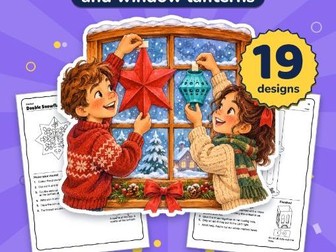
Decorate a window or Christmas tree with raised paper stars, lanterns with cut-out windows and a garland of baubles in winter hats. Each template has cutting and folding lines, tabs where needed, short instructions and a picture of the finished decoration. In class, pupils can each choose a star and compare the flat template with their finished 3D decoration. At home, link more paper rings to make the garland longer. Light shines through the lantern windows. Stand the lanterns on a table with an LED candle, or hang them empty so daylight can shine through the paper. You’ll need paper or card, coloured pencils, school scissors, glue, thread and sticky tape. An adult cuts out the holes inside the shapes and puts in the LED candle with its battery compartment closed. Print in colour or in black and white. What’s included 21 A4 pages in PDF format. 1 colour cover and 1 illustrated guide to materials and assembly. 19 black-and-white templates, one per design. 10 stars with 5, 6, 8 or 12 points, 8 lanterns with cut-out windows and 1 garland with 3 links. 41 cut-outs, two levels of assembly and a picture of the finished decoration on each template. Keywords · primary school Advent activities · handmade gifts from children · classroom window decorations · folding nets for primary maths · symmetry activities for children · make your own tree decorations · December cutting and sticking
Play Shops at the Market · 3D cut-outs and maths with eurosQuick View
EduSori

Play Shops at the Market · 3D cut-outs and maths with euros

(0)
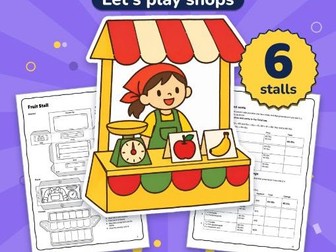
Open the fruit stall, set up the juice stall or sell pocket-sized instruments. In pairs, one person does the shopping while the other runs the stall. Then they swap roles. The cards show the prices, and children use paper money to act out paying and giving change. The practice sheets have a worked example and space to write answers. What’s in the 25-page A4 PDF Six 3D stalls to colour in and build. Fruit Stall, Stamps and Prints, Juice and Water, Buttons and Ribbons, Maps and Walks, and Pocket Music. 48 illustrated cards showing each item’s name and price, plus 48 play coins and four play notes. An illustrated assembly guide, an example purchase and a reusable shopping list. 20 challenges to answer in writing and three pages of answers. In Year 2, children add prices and practise paying the exact amount. In Year 3, they count the money paid and work out change in whole euros. In Year 4, they do calculations with euros and cents. Age and year group. Ages 6 to 9, Years 2 to 4 (US Grades 1 to 3). We recommend one stall per pair. With several stalls, each seller keeps coins to give as change. Children may need help from an adult with the small cuts. Materials. Scissors, a glue stick and coloured pencils. Print in black and white or in colour. The cover is in colour and the inside pages are designed in black and white. Print on A4 at 100%. Use thick paper for the cut-outs. Use throughout the year. For any term, in the maths corner, as pair work or for play at home. Keywords · Market, financial education, euros and cents, change, paying the exact amount, play coins and notes, adding prices, playing shops, papercraft, 3D cut-outs.
3D Insects to Colour, Cut Out and BuildQuick View
EduSori

3D Insects to Colour, Cut Out and Build

(0)
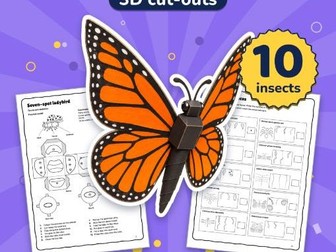
Build a paper ladybird, bee or monarch butterfly. Find out where the legs, antennae and wings attach. Each insect has two sheets with pieces to colour, glue marks and drawings that show how to put it together. The activities then ask pupils to count the pieces, write the names of the body parts and recognise the stages in the monarch butterfly’s life cycle. Created by EduSori. What’s in the 25-page A4 PDF 20 sheets for building 10 insects. Seven-spot ladybird, honey bee, monarch butterfly, black garden ant, damselfly, housefly, house cricket, stick insect, earwig and lacewing. An illustrated assembly guide and classroom notes. 3 written activities, each with a worked example, plus an answer key. Age and year group. Ages 6 to 10, Years 2 to 5 (US Grades 1 to 4). For Years 2 and 3, it’s best to start with the ant and help pupils cut and glue the small pieces. The monarch butterfly’s life cycle extends the work for Years 4 and 5. Materials. Scissors, a glue stick and coloured pencils. You can print in black and white or in colour. Print on A4 at 100%. The sheets inside are in black and white. Use throughout the year. For classroom projects on insects in spring and for studying living things throughout the school year. Keywords · insects, 3D cut-outs, spring crafts, insect anatomy, wings, antennae, butterfly life cycle, monarch butterfly, natural science, primary education
Alphabet Pin-Pricking Cards and Worksheets for Reception and Year 1Quick View
EduSori

Alphabet Pin-Pricking Cards and Worksheets for Reception and Year 1

(0)
Prick, colour, cut and hang the alphabet. Each printable card pairs a capital letter with a picture to colour and its written name. Use the cut-out letters to make a classroom alphabet garland together. 25 A4 pages with 26 capital letter cards from A to Z, arranged two per sheet, and a separate reward star with a space for the child’s name. Three levels with 22–50 dots per card for A–J, 40–61 for K–R and 46–67 for S–Z and the star. Includes an adult guide, six illustrated steps and three pages showing the finished letters. On page 19, cut off the reward star along the dashed line and fill in nine missing capital letters across three rows. The answers are at the foot of the page. An animal matching worksheet with one worked example and seven matches to complete, plus an answer sheet. A vocabulary page with ten letter groups and three magic e pairs, garland instructions and a certificate. For Reception and Year 1 (ages 4–6). Print single-sided at 100%. The cover is in colour and the 24 inside pages are in black and white. For four-year-olds, use a pencil to join the dots and leave the craft pricker to the adult. From age five, stay beside the child as they prick and cut.
Egypt in 3D · Ancient Egyptian Cut-outsQuick View
EduSori

Egypt in 3D · Ancient Egyptian Cut-outs

(0)
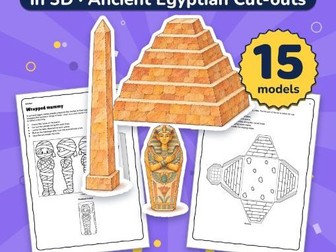
Set up a small museum of ancient Egypt in your classroom. Each model comes with a short passage about a real object or building. Pupils colour the faces of their piece, cut out the template and build it. The Step Pyramid of Saqqara, the sarcophagus with a lid and the senet board help pupils compare why different objects were built, kept or used. What’s in the 25-page A4 PDF 15 models to colour and build. A teacher’s guide and a practice cube to try the first fold. Fifteen short reading passages, a table of twelve hieroglyphs, five words to decode and five comprehension questions with space to write. Answers to both writing activities. Age and year group. Ages 8 to 11. Years 4 to 6 (US Grades 3 to 5). Designed for Year 5. In Year 4, start with the mummy or the stela. In Year 6, use it for revision or as a heritage project. Materials. Scissors, glue and pencils. Light card works well for the pieces. Print on A4 at actual size. You can print the PDF in black and white or in colour. The cover is in colour and the inside pages are set up in black and white. When to use it. Use it at any point in the school year when you are teaching ancient history or preparing a classroom exhibition. Keywords · ancient Egypt, 3D cut-outs, Saqqara step pyramid, mummy, sarcophagus, canopic jars, Abu Simbel, hieroglyphs, senet, reading comprehension
Times Tables Pixel ArtQuick View
EduSori

Times Tables Pixel Art

(0)
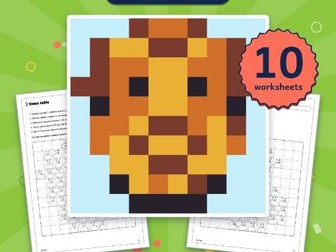
Multiply the top 2 numbers in each calculation. Add the bottom number to the product. Write each square’s answer in its box. Colour every square with no calculation light blue. Use the colour key to finish the picture once you’ve worked out all the answers. Each worksheet begins with a worked example. What’s included 27 portrait A4 PDF pages for Years 4–5 (ages 8–10). 10 worksheets with 10 × 10 squares each and 606 calculations in total, with 46–70 per worksheet. 1 worksheet for each times table from 2 to 10, plus a mixed worksheet with 70 calculations, 7 of which have 9 as a factor. 10 cut-out colour keys on 2 pages. 17 practice questions: 4 on groups, 4 on factors, 5 on division and 4 word problems. The cover and all 10 worksheet solutions are in colour. The guide, worksheets, colour keys and practice questions with their answers are in black and white. You can print in colour or in black and white. Calculations per worksheet · In order from the 2 to the 10 times table, followed by the mixed worksheet: 70, 52, 60, 70, 46, 64, 64, 52, 58 and 70.
From Seed to Plant: Bean Germination Cards, Sequences & Observation Diary | Years 1–3 ScienceQuick View
EduSori

From Seed to Plant: Bean Germination Cards, Sequences & Observation Diary | Years 1–3 Science

(0)
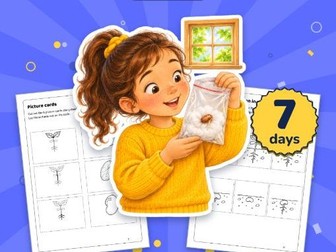
Split open a soaked bean with an adult’s help and look at the embryo inside. In the science corner, pupils match the pictures with their names, use the check cards to check each pair and put the germination panels in order. For the experiment, each pair places one bean next to damp cotton wool in one bag and another next to dry cotton wool in the other. Before they start, pupils draw their prediction. For seven days, they tick and draw what they see. From age 7, pupils can also measure the root of each bean and compare the two bags on a graph. Print the activities in black and white. The cover is in colour. 1 square = 1 cm. Print at 100% without scaling to fit the page. What’s included 25 pages in total, including the cover. ‘Inside a seed’ (p. 4), with a picture of a split bean and an example of how to use the cards. 6 concepts in 18 cards: 6 picture cards, 6 name cards and 6 check cards. ‘Glue or write the names’ (p. 8), to identify the parts of the bean and the seedling. 2 cut-out sequences of 6 panels each and 3 ‘Which fits?’ rows to find the missing picture. 1 experiment with two bags, a prediction sheet and a day 0 record. 7 observation diary pages, a final graph, a certificate, a 2-page teacher’s guide and 1 page of answers. Materials per pair 2 whole dried beans from the same packet, 2 identical clear bags, cotton wool, water at room temperature, a teaspoon, a marker pen, a ruler, a pencil, round-ended scissors and glue. Set aside another bean and a plastic cup for the demonstration. Activities by age At age 5, pupils look at the split bean (p. 4), match the cards (pp. 5–7), put the bag sequence in order (pp. 9–10) and circle the missing panel (p. 13). With adult support, they record their prediction and starting point (pp. 14–15) and complete the diary using drawings and tick boxes (pp. 16–22). At ages 7–8, add labelling the bean and seedling (p. 8), putting the soil sequence in order (pp. 11–12), measuring the root in the diary (pp. 16–22) and completing the graph (p. 23). Year group and age Years 1–3 · ages 5–8. Primary school Science in England. Equivalent to Kindergarten–Grade 2 in the US. Format 25-page A4 PDF. Colour cover and black-and-white interior. Author EduSori
Science Reading Comprehension for Years 6–7 | Non-fiction Texts with Activities and AnswersQuick View
EduSori

Science Reading Comprehension for Years 6–7 | Non-fiction Texts with Activities and Answers

(0)
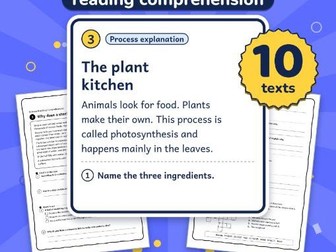
Why is the sky blue? How can a steel ship float? What happens when you soak an egg in vinegar? These ten short texts give pupils something to think about and a reason to go back to the page. Topics also include photosynthesis, food chains, helpful and harmful microbes, the time sunlight takes to reach Earth, Mars, renewable energy and the life of Spanish scientist Margarita Salas. The egg experiment can be tried at home with an adult’s help. ​ Pupils meet seven text types over the course of the pack: an explanation, a process explanation, instructions with an explanation, an information text, a fact file with accompanying text, a comparison and a biography. Scientific facts were checked against openly available sources, with approximate figures used where values vary or are uncertain. ​ Each text takes up two pages and comes with eight activities. Symbols identify the five activity types so pupils can see whether they’re finding a detail, using clues to work something out, learning a scientific word, giving a reasoned opinion or tackling a challenge. Challenges include true or false, a word bank, sorting what plants need and make during photosynthesis, ordering an experiment and a food chain, grouping microbes, matching, a Mars crossword, sorting facts from opinions and putting events from a scientist’s life in order. ​ Use one text at a time for reading lessons, English or science support, homework or home learning at any point in the school year. Print on A4, single-sided, at 100% so pupils can keep the text beside the questions. The black-and-white interior is designed for reading and writing, with no illustrations and a black border on each page. ​ What’s included (27 A4 pages, PDF) ​ A colour cover. A one-page guide for adults with suggestions for using the pack and an explanation of what each question type practises. A one-page ‘My reading’ sheet with tick boxes and star ratings. 10 texts with activities across 20 pages, two pages per text. A one-page reading certificate. Three pages of answers covering every activity, including model written answers, example opinions and the completed crossword. ​ What makes it useful ​ Every text gives pupils practice in finding details, making inferences and giving reasons for an opinion. Pupils write more often than they tick boxes, and some questions ask them to back up their answers with evidence from the text. The guide suggests asking pupils which clue they used. The texts focus on understanding scientific ideas through reading, and the answer pages support quick marking and discussion. ​ Skills covered ​ Locating information, making inferences, explaining cause and effect, applying what pupils have read to new situations, summarising, identifying the main idea, distinguishing fact from opinion and building scientific vocabulary.
The Puzzle Club: Reasoning Challenges for Years 3–7Quick View
EduSori

The Puzzle Club: Reasoning Challenges for Years 3–7

(0)
Can your pupils spot the word that changes a question, work out who’s telling the truth and crack a four-digit padlock code? In this printable workbook, children earn bronze, silver and gold membership cards by solving riddles and puzzles. Most answers come from a bit of logic, a calculation or a fresh idea. ​ The three levels are flexible. Start where the challenge suits your pupils. ​ Bronze (Years 3–4) covers three-clue riddles, odd-one-out tasks with two possible answers, number sequences and trick questions. Silver (Years 4–6) adds tricky calculations, truth and lies, ordering people and objects from clues, stories that seem impossible, ages and families, and putting ideas in order. Gold (Years 6–7) takes on truth and lies with four people, ordering five people or objects, harder stories, and measuring and weighing challenges with two jugs, sand timers and eight balls. It ends with the four-stage padlock puzzle. ​ Four puzzle-solving techniques and two worked examples help children get started. Riddle clues go from hardest to easiest, and numbered emergency clues for the impossible stories can be read one at a time. Five English riddles include rhyme and letter play. Children can also use a worked example to write their own riddle and try it on someone else. ​ The last two pages give numbered solutions and explain the reasoning. Tasks with several valid answers include examples, and any answer that meets all the conditions counts. The one-page guide shows adults how to give a clue without giving away the answer. ​ Print single-sided on A4 at 100%. The interior is set up for black-and-white printing. You’ll need a pencil, rubber and paper for sketches or working, plus scissors for the cards. ​ What’s included (25 A4 pages, PDF) ​ Colour cover. Guide for adults (1 page). Four puzzle-solving techniques and two worked puzzles (1 page). Bronze membership card and puzzles (5 pages). Silver membership card and puzzles (6 pages). Gold membership card and puzzles, including the final challenge (5 pages). Five English riddles, a write-your-own-riddle activity and 12 cut-out one-minute puzzle cards (3 pages). Gold membership diploma (1 page). Numbered solutions with explanations (2 pages). ​ What makes it useful ​ Work through a level a week or set one puzzle a day. Use the sheets in class, at break, while waiting, for summer homework or for a family game. The pocket-sized cards also work on journeys. Children practise reading comprehension and reasoning together. ​ Skills practised ​ Reading carefully and rereading, making inferences from clues, ruling out possibilities, ordering people and objects, reasoning about truth and lies, finding sequence rules, spotting words that change a problem, tackling tricky calculations, planning step by step, explaining an answer and writing an original riddle.