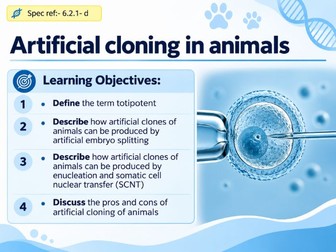
OCR 6.2.1 Artificial Cloning in AnimalsQuick View
ETyson91

OCR 6.2.1 Artificial Cloning in Animals

(0)
This OCR A Level Biology 6.2.1 lesson covers Artificial Cloning in Animals, addressing all the specification points. Students explore how artificial clones can be produced using artificial embryo twinning and somatic cell nuclear transfer (SCNT), including the process of enucleation. The lesson also examines the arguments for and against artificial animal cloning and develops students’ ability to evaluate its uses in agriculture and medicine, including issues surrounding the longevity and health of cloned animals.
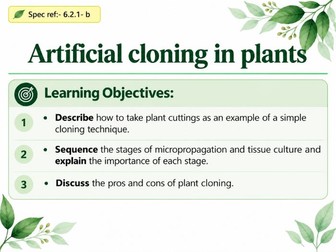
OCR 6.2.1 Artificial Plant CloningQuick View
ETyson91

OCR 6.2.1 Artificial Plant Cloning

(0)
This OCR A Level Biology 6.2.1 lesson covers Artificial Cloning in Plants, addressing all the specification points. Students explore how artificial clones are produced using micropropagation and tissue culture, including the stages involved in the process. The lesson also examines the arguments for and against artificial plant cloning and develops students’ ability to evaluate its uses in horticulture and agriculture.
Animal, plant and specialised cellsQuick View
ETyson91

Animal, plant and specialised cells

(0)
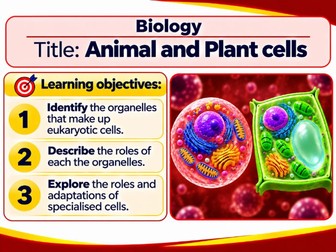
A complete, engaging GCSE Biology lesson covering animal and plant cells, cell organelles and specialised cells. This lesson helps students to: Identify the organelles found in animal, plant and prokaryotic cells. Describe the functions of different cell organelles. Compare and contrast eukaryotic and prokaryotic cells. Explore the functions and adaptations of specialised cells, including sperm cells, egg cells and ciliated epithelial cells. Understand haploid nuclei and their role in fertilisation. Resources include: Clearly presented information slides with labelled diagrams. Think–Pair–Share and retrieval activities. Comprehension tasks and structured worksheets. Exam-style fact recall and application questions. Answer slides to support self-assessment and feedback. Designed to support clear explanations, active participation and exam preparation, this resource is ideal for GCSE Biology lessons and revision.
MicroscopyQuick View
ETyson91

Microscopy

(0)
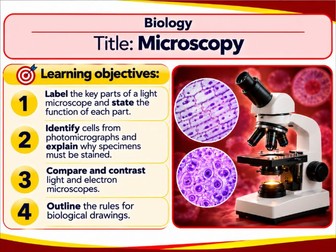
A complete, engaging GCSE Biology lesson covering light and electron microscopes, staining, photomicrographs and biological drawings. This lesson helps students to: Describe the key parts of a light microscope and explain their functions. Identify plant and animal cells from photomicrographs. Explain why specimens need to be stained before viewing. Compare and contrast light and electron microscopes, including their advantages and disadvantages. Understand electron micrographs and the concept of cell ultrastructure. Apply the rules for producing accurate biological drawings. Resources include: Clearly presented information slides with labelled diagrams and images. Microscope labelling and identification activities. Photomicrograph interpretation tasks. Think–Pair–Share and retrieval activities. Comparison tasks exploring the advantages and disadvantages of different microscopes. Biological drawing activities, including examples of good and poor drawings. Exam-style fact recall and application questions. Answer slides to support self-assessment and feedback. Designed to support clear explanations, active participation and exam preparation, this resource is ideal for GCSE Biology lessons and revision.
OCR 6.2.1 Natural Clones in plantsQuick View
ETyson91

OCR 6.2.1 Natural Clones in plants

(0)
This OCR A Level Biology 6.2.1 lesson covers Natural Clones in Plants, addressing all the specification points. Students explore examples of natural cloning and the different methods of vegetative propagation used to produce clones for horticulture. The lesson also includes a practical focus on plant cuttings, explaining how to select and dissect suitable plant material to produce cuttings as a simple cloning technique.
OCR 6.2.1 Natural Clones in AnimalsQuick View
ETyson91

OCR 6.2.1 Natural Clones in Animals

(0)
This OCR A Level Biology 6.2.1 lesson covers Natural Clones in Animals, addressing the specification points. Students explore examples of natural cloning in animal species, including identical twins formed by embryo splitting. The lesson also examines other examples of natural cloning, helping students understand how genetically identical offspring can be produced naturally.
OCR 6.2.1 Introduction to BiotechnologyQuick View
ETyson91

OCR 6.2.1 Introduction to Biotechnology

(0)
This OCR A Level Biology 6.2.1 lesson covers introducing biotechnology and the many ways microorganisms are used to produce useful products and provide important services. Students explore applications including food production, medicines, sewage treatment, composting and bioremediation, as well as emerging uses such as biofuels and vaccines. The lesson also examines the advantages of using microorganisms in biotechnology, including their rapid reproduction, simple nutritional requirements, low production costs, small space requirements and suitability for large-scale industrial production. Includes opportunities to develop understanding through discussion and application of key biological concepts.
OCR 6.2.1 Fermenters and microbial growthQuick View
ETyson91

OCR 6.2.1 Fermenters and microbial growth

(0)
This comprehensive OCR A Level Biology 6.2.1 lesson explores the design and operation of industrial fermenters and the factors that need to be controlled to maximise microbial growth and product yield. Students investigate the importance of maintaining optimum temperature, pH, oxygen availability, nutrient supply and agitation, alongside preventing contamination and removing waste products. The lesson also examines the microbial growth curve, including the lag, exponential, stationary and decline phases, and how changing conditions affect population growth and productivity. Includes labelled fermenter diagrams, knowledge-check activities and opportunities to apply understanding to industrial biotechnology.
OCR 6.2.1 Batch and continuous culturing & Primary vs Secondary metabolitesQuick View
ETyson91

OCR 6.2.1 Batch and continuous culturing & Primary vs Secondary metabolites

(0)
This OCR A Level Biology 6.2.1 lesson covers batch and continuous culturing in industrial biotechnology. Students compare the two fermentation methods, considering vessel conditions, nutrient availability, microbial growth phases, productivity, advantages and disadvantages. The lesson also examines the differences between primary and secondary metabolites, exploring when they are produced during the growth cycle and how this influences the choice of culturing method for commercial production. Includes annotated growth curves, application activities and exam-style questions to develop students’ understanding and ability to apply their knowledge to industrial biotechnology.
OCR 6.2.1 Aseptic techniqueQuick View
ETyson91

OCR 6.2.1 Aseptic technique

(0)
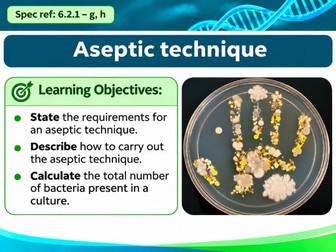
This OCR A Level Biology 6.2.1 lesson covers the aseptic technique and the practical skills involved in culturing microorganisms. Students explore how to maintain sterile conditions, prepare and inoculate agar plates, carry out serial dilutions, and calculate bacterial population sizes using colony counts. The lesson also includes investigating antibiotic effectiveness by measuring zones of inhibition, with exam-style questions and worked examples to develop students’ understanding and application of the required mathematical skills.