Recognise right angles in shapes in different orientations. - Year 5 resources level 3 objectives. I also used for level 4, but not included in these resources 3D shapes for higher ability children to find all the right angles.
A really good lesson, developed for equivalent fractions.
To be successful I need to remember to:
Which shapes have the same amount shaded in?
Write down these fractions.
Use the equals sign to show the fractions are equivalent.
Here are some Guided reading materials I have collected and developed - There is a reading rota - with pre and post reading provision - as well as independent reading activities related to AF's.
Supercharge your literacy with :- powerful verbs tube line, adverb tube line, connective tube line and homophone tube line NOW you can edit the station names and tube lines to anything yo wish.
A collection of resources to support the teaching of Comparative and superlative sentence structure. I have used this with year 5. There is an Interactive whiteboard introduction, activities for the main lesson, upper- table 1 and 2, middle - table 3 and 4, lower - table 5 and 6. There is spelling support activities and homework. I hope you find it useful, as I have.
This is part of a wider persuasive unit. This plan introduces children to persuasive campaigners. An example of this text type – charity / environmental campaigns. They often use emotive language and are trying not to sell us something, but to make us stop / change / give.
Children will investigate
1. Who is the reader trying to persuade?
2. How do they try and get your attention?
3. What is the key information?
4. How do they want the reader to feel?
5. What do they want the reader to do?
The activities will help children to look at the texts again using the five questions above.
To learn about what a moral dilemma is, understand why they are hard to solve, and consider the kinds of factors that have to be taken into account when trying to solve them.
A power point to teach children the exchange method when working out subtraction problems.
I found that children found it hard to visualize the exchange process, so i developed this as a visual aide to help chn understand the concepts behind exchanging.
Amazing Images through the eyes of the Electron Microscope.
I developed this as a 'guessing' game (with clues) using amazing Images, magnified through an Electron Microscope.
The chn really enjoyed playing it. - Just for fun, with a real science twist.
Something I developed for a Lesson Observation
Use efficient written methods to add and subtract whole numbers and decimals with up to two places.
Use understanding of place value to multiply and divide whole numbers and decimals by 10, 100, 1000 or 10 000.
Next Steps:
Refine and use efficient written methods to multiply and divide HTU × U, TU × TU, U.t × U and HTU ÷ U.
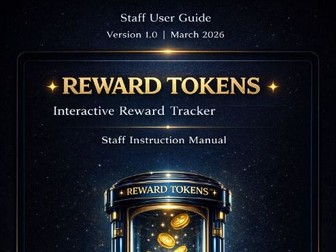
Transform behaviour for the whole class. This is a visible way to show progress with the Token Reward Tracker — a beautifully designed, fully interactive system built for all classrooms, but particularly SEND environments/classrooms, specialist provisions, and inclusive settings.
— Teachers Guide — There is a branded and unbranded version of the guide, the the tracker itself a can be personalised to your school.
— NEW 3D Printer Option — I have now provided a 3D print file, so you can actually print out the token Jar, if you wish.
— **APP ** — Unbranded only - With its eye-catching animated reward canister, live progress gauge, and customisable token styles, the tracker makes achievement concrete, motivating, and easy to understand. Every token added creates instant visual feedback, reinforcing positive behaviour, engagement, and self-regulation in real time.
— APP — Key Features
✔ Instant Visual Motivation
Tokens drop, water rises, and progress fills live — making effort tangible and meaningful.
✔ Fully Customisable Pupils & Prizes
Add, edit, and manage unlimited pupils and rewards. Personalise targets, avatars, token styles, and exchange options.
✔ Staff-Controlled & PIN Protected
Teacher Console and Admin Controls ensure secure management of data and settings.
✔ Lifetime Total Tracking
Celebrate sustained effort over time — totals never reset when targets are met.
✔ SEND-Appropriate Design
Optional Quiet Mode and Performance Mode reduce sensory load with softer visuals, smoother motion, and no sudden audio.
✔ No Internet Required
Runs entirely offline. No pupil data leaves the device.
✔ Inspection-Ready
Clear safeguarding design makes it suitable for SEND classrooms, specialist provisions, and Ofsted environments.
Purpose of the Reward Tracker
The Reward Tokens system is a visual, motivating reward tracker designed to support pupils with SEND by:
• Reinforcing positive behaviour, effort, and engagement
• Making progress visible, concrete, and meaningful
• Supporting self-regulation, motivation, and goal-setting
• Providing consistent reward practice across staff
The animated canister, tokens, and progress gauge are intentional — they provide immediate feedback without relying on verbal praise alone.
Also known as a virtual - Marble Jar Whole Class
Something I developed to help year 5 children understand percentages of amounts. It looks at the process of converting to a known fraction, calculating, and using the correct units. There are examples of level 3-5 SATs questions also. Now contains the activity trail.
I developed this to give parents information about how their child is progressing through the year.
It is an interim report that I give out termly. The first sheet is a class data sheet, where you can copy and past all class data for the reported term. The second sheet is the actual report, several fields will automatically be filled in based on the class data sheet, thus saving a lot of time.
An effective peer assessment activity that my class have used. It is something I developed to support my class in editing a piece of written work. From experience if the children are not guided through the process then chances are they will not know how to edit their work successfully. I have found this resource useful. I have used it for self assessment also.
This can be used for children to conduct their own peer or self assessment. It can be used as stand alone activity or as a resource for children to use at the end of a unit. It can be completely edited - statements can be customized to the genre you need. In this assessment pack are grids for each level, differentiated from level 1 to 5.
I have used this for several different themes. Presently it takes the form of country names, it can be changed into anything you like....., animals, cartoon characters, etc. I just thought I would share this group names resource - countries themed, totally editable - mix of small and large labels, suitable for 5 tables, groups.
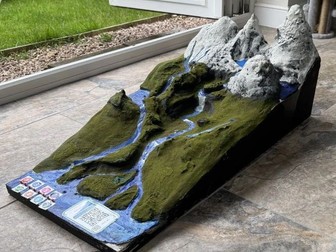
3D printable river system. The SLT file can be printed on many 3D printers. Personally I have printed it on a Sovol Printer. It takes approx 8 hours to print. Once printed you can paint it, add LED lights etc, to make it more interactive.
When designing a 3D-printed river model, remember that rivers increase in size and volume as they flow from their source to their mouth.
LED light points
Source - near the top of the model - mountain and glacier.
Waterfall - near the second drop in the river system.
Tributary - to the right of the model
Lake - right side of the model
Flood Plan - center of the model
Delta - near the front, raised piece of land
Mouth - near the front center
Ocean - near the front left of the model.
They always flow downhill due to gravity, taking the path of least resistance. This causes rivers to meander (bend and curve) around obstacles like rocks and hills. The river’s flowing water erodes the land, forming features such as waterfalls, valleys, and gorges. Further downstream, as the river slows down, it deposits sediment, creating features like oxbow lakes and deltas. These elements can be modeled in 3D to show how rivers shape the landscape over time.
This is guidance for pupils to use when conducting self and peer assessment. In this case we use purple pen, It can be adapted to any colour. This is a fantastic resource, but I cannot take credit for making it. Credit must go to @miss_edugogy, however I have edited it to suit our schools marking scheme and my class, I hope you find it useful.
National Curriculum attainment target
Complete a simple symmetric figure with respect to a specific line of symmetry
Lesson objective
• Complete simple symmetric figures with respect to a
specific line of symmetry
Pupils need to:
• identify shapes with more than one line of symmetry
• reflect a 2-D shape in one line of symmetry
Vocabulary
symmetrical, line of symmetry, distance, irregular