Here’s a TES-ready description:
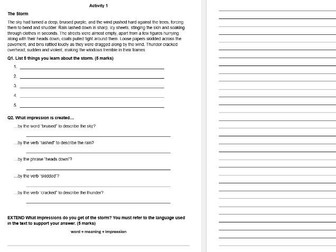
A focused Eduqas GCSE English Language Component 1 resource designed to develop students’ confidence with retrieval, word-level language analysis and 5-mark impressions questions.
The resource contains five short, accessible fiction extracts based on familiar settings:
A storm
An abandoned house
A busy street
A forest at night
A train station
Each activity includes:
A 5-mark retrieval question
Five targeted word-level impressions questions
A full 5-mark impressions question
A clear word → meaning → impression writing structure
Detailed answer checks
Full model responses using all five quotations
The activities gradually support students in moving from identifying simple impressions to explaining how individual words create an overall impression of a setting.
Suitable for intervention, revision, homework, cover lessons or independent practice. Particularly useful for lower-attaining students who need a clear and repetitive approach to Eduqas Component 1 reading questions.
A stand alone creative writing lesson suitable for KS3.
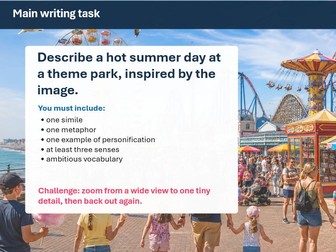
Summer Creative Writing Cover Lesson – Theme Park Description
A fully resourced, summer-themed creative writing lesson suitable for KS3 English, designed to work effectively as a cover lesson or an engaging end-of-term activity.
Students begin with an eight-question retrieval quiz identifying similes, metaphors and personification. They then explore a vibrant seaside theme park image, which can be gradually revealed in six sections. For each section, students discuss what they notice and create an imaginative descriptive sentence with a partner.
The main task asks students to describe a hot summer’s day at a busy theme park, using the image for inspiration.
The lesson finishes with structured peer or self-assessment and an opportunity for students to improve their writing.
The PowerPoint includes:
An eight-question retrieval starter
A gradual image-reveal activity
A high-quality theme park writing stimulus
Planning prompts and sentence support
An extended creative writing task
Peer and self-assessment criteria
This is a straightforward, engaging lesson that can be delivered by a non-specialist cover teacher with minimal preparation.
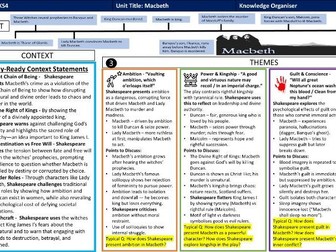
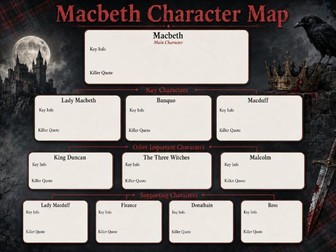
Macbeth knowledge organiser featuring:
Essay ready context statements
Themes with a focus on Shakespeare’s intention
practice questions
Character information
top 15 quotations
motif & symbolism
vocabulary
4 pages, made on power point
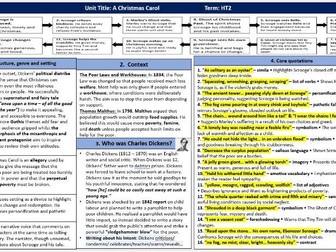
A comprehensive and student-friendly knowledge organiser for Charles Dickens’ A Christmas Carol , designed to support teaching, homework, retrieval practice and GCSE revision.
This detailed resource brings together the essential knowledge students need to write confident, analytical responses about the novella. It is particularly suitable for Year 10 and Year 11 students studying A Christmas Carol for GCSE English Literature.
The resource includes:
Key contextual information, including the Poor Laws, workhouses, Thomas Malthus and Dickens’ experiences of poverty and child labour
Clear explanations of genre, allegory, setting and the role of the intrusive narrator
16 carefully selected core quotations with identified methods and concise analysis
Detailed character profiles for Scrooge, Marley, the three spirits, Fred, the Cratchits, Fezziwig, Belle, and Ignorance and Want
Explanations of Dickens’ intentions and the social messages presented through each character
A bank of powerful literary terminology, including allegory, antithesis, symbolism, pathetic fallacy, asyndeton and polysyndeton
Ambitious vocabulary such as misanthropic, malevolent, benevolent, Malthusian, atonement and epiphany
Definitions, synonyms and different word forms to help students use sophisticated vocabulary accurately in their writing
The organiser encourages students to connect quotations, methods, context and Dickens’ intentions rather than learning isolated facts. It can be used as a classroom reference sheet, revision booklet, homework resource, retrieval tool or scaffold for essay writing.
The resource is supplied as an editable PowerPoint, allowing teachers to adapt the content to suit their own classes and curriculum.
A comprehensive and student-friendly knowledge organiser for J.B. Priestley’s An Inspector Calls, designed to support classroom teaching, homework, retrieval practice and GCSE revision.
This detailed resource brings together the essential knowledge students need to write confident, analytical responses about the play. It is particularly suitable for Year 10 and Year 11 students studying An Inspector Calls for GCSE English Literature.
The resource includes:
A clear act-by-act plot summary
Key contextual information, including socialism, capitalism, class inequality, gender expectations and the contrast between 1912 and 1945
Detailed coverage of major themes, including responsibility, social class, power, patriarchy and generational conflict
Character profiles for Inspector Goole, Eva Smith, Mr and Mrs Birling, Sheila, Eric, Gerald and Edna
Topic sentences and explanations of Priestley’s purpose for each character
20 carefully selected core quotations from across the play
Explanations of form and structure, including dramatic irony, lighting, cliff-hangers, the morality play and the purgatorial narrative
Detailed analysis of key symbols, including the telephone, engagement ring, lighting, Titanic and Inspector’s notebook
Ambitious literary and contextual vocabulary with definitions and model sentences
The organiser encourages students to connect quotations, methods, context and Priestley’s intentions rather than learning isolated facts. It can be used as a classroom reference sheet, revision booklet, homework resource, retrieval tool or scaffold for essay writing.
The resource is supplied as an editable PowerPoint, allowing teachers to adapt the content to suit their own classes and curriculum.
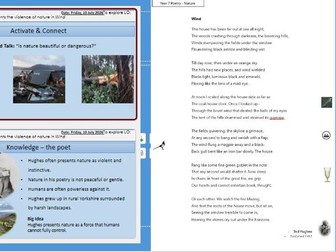
A complete and carefully sequenced KS3 poetry scheme designed for Year 7 students. The unit develops confidence in reading, discussing and writing about poetry, while introducing students to key poetic methods, analytical writing and comparison.
The scheme also provides an early foundation for the AQA Power and Conflict poetry anthology. Through accessible KS3 poems, students encounter ideas that they will revisit at GCSE, including the power of nature, conflict, patriotism, identity, migration, prejudice and protest. They also begin to develop the close-analysis and comparison skills required for future anthology study, without directly repeating the GCSE poems.
The scheme is organised around three connected themes:
childhood and identity
the power of nature
war, patriotism and protest
Students begin with Blake’s The Lamb and The Tyger, exploring innocence, power and mystery, before considering migration, memory and belonging in Carol Ann Duffy’s Originally. These poems introduce ideas about identity, place and memory that connect with later study of poems such as The Émigrée.
Students then study contrasting presentations of nature in The Sea, Wind and Island Man. This section prepares students to explore how poets present nature as powerful, unpredictable and capable of affecting human experience—ideas that link closely to the nature poems within the AQA Power and Conflict anthology.
The final section introduces different perspectives on war through The Soldier, Dulce et Decorum Est, Suicide in the Trenches and The Right Word. Students explore patriotism, propaganda, conflict, prejudice and the power of labels. These poems provide a strong conceptual foundation for later study of war and conflict poetry, including contrasting attitudes towards conflict and its impact on individuals.
Across the unit, students progress from initial comprehension and discussion to precise language analysis, comparison and increasingly independent analytical writing. Creative writing and persuasive speaking tasks allow students to apply poetic and rhetorical techniques in their own work.
The scheme includes:
clearly sequenced lessons and learning objectives
retrieval practice and vocabulary activities
first-reading and comprehension tasks
language, imagery and structure analysis
model paragraphs and scaffolded writing frames
comparison activities
creative writing opportunities
persuasive speech writing and oracy
support for lower-attaining students
challenge for higher-attaining students
self-assessment, peer feedback and redrafting
a final analytical essay on The Right Word
The unit provides a strong foundation for later KS3 and GCSE poetry study, particularly the AQA Power and Conflict anthology, while also developing transferable skills in close reading, interpretation, comparison and extended analytical writing.
An AQA Language paper 1 mini mock featuring an extract from Skellig and model answers.
Resource includes:
1 word document which features the mini mock and questions
1 power point with model answers and planning in the notes.
Enhance your students analytical skills with this comprehensive mini mock, featuring challenging yet accessible questions designed to improve retrieval, language analysis, structural understanding, and evaluation. Perfect for exam preparation or classroom discussion, this resource ensures engaging, high-quality responses with full mark model answers to support both teaching and learning!


 Quick View