An Inspector Calls: Character AnalysisQuick View
becky_fox22

An Inspector Calls: Character Analysis

7 Resources
All of the resources in this bundle support students to analyse the significance of characters in the play. A wide variety of activities are included which promote thoughtful discussions and encourage academic rigour in the classroom.
An Inspector Calls: Mr BirlingQuick View
becky_fox22

An Inspector Calls: Mr Birling

(0)
These lessons aim to introduce students to Mr Birling’s characteriation in the play and consider him through the theme of capitalism. The final slides aim to support students to write analytically about the character and provide them with opportunities for explicit vocabulary teaching, collaborative planning, live modelling and worked back examples.
An Inspector Calls: SheilaQuick View
becky_fox22

An Inspector Calls: Sheila

(0)
These lessons aim to introduce students to Sheila Birling’s character development in the play. The activities require students to engage with her characterisation, important quotations and big ideas in the play. Students are then expected to apply this knowledge to an exam style question.
An Inspector Calls: Gerald CroftQuick View
becky_fox22

An Inspector Calls: Gerald Croft

(0)
The first lesson looks at exploitation through the character of Gerald Croft. Students will first be introduced to the concepts of exploitation and misogyny. They will then analyse how Gerald’s actions towards Eva are exploitative in the play. The second lesson asks students to consider Gerald Croft’s attitude towards responsibility and consider important motifs and quotations in relation to this. Students will finally complete a creative task to consolidate their understanding of his overall characterisation.
An Inspector Calls: Eric BirlingQuick View
becky_fox22

An Inspector Calls: Eric Birling

(0)
This lesson explores how Priestley creates antipathy for Eric Birling due to his actions towards Eva Smith in the play. It also prompts students to consider the motivation for the character’s irresponsible and immoral actions. The lesson creates opportunities for students to discuss interpretations, work collaboratively on language analysis and assess the effectiveness of model analytical writing.
An Inspector Calls: Cyclical StructureQuick View
becky_fox22

An Inspector Calls: Cyclical Structure

(0)
This lesson looks at the importance of the play’s structure. It asks students to assess how Priestley mirrors the beginning and end of the play, interpret the significance of the final twist and consider their own feelings about the play’s ending. Students are also given quotes from two contrasting critical views and are asked to evaluate how their own opinion aligns with them.
An Inspector Calls: Inspector GooleQuick View
becky_fox22

An Inspector Calls: Inspector Goole

(0)
This lesson looks at the theme of socialism through the character of the Inspector. The lesson aims to support students in analysing how Priestley explores his socialist agenda through the character.
An Inspector Calls: Eva SmithQuick View
becky_fox22

An Inspector Calls: Eva Smith

(0)
This lesson explores ideas about social inequality through the character, Eva Smith. There are opportunities for explicit vocabulary teaching, analysis of important motifs and a discussion activity which is later applied to a piece of formal writing.
Lord of the Flies Revision WorkshopQuick View
becky_fox22

Lord of the Flies Revision Workshop

(0)
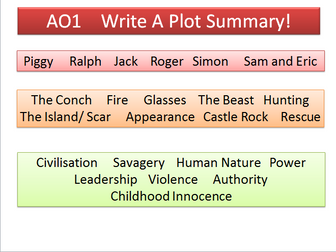
The lesson should be used to help students revise key ideas within the novel and gives students example essay questions. The powerpoint could be used over two lessons.
Act 1 Scene 2 and 3 MacbethQuick View
becky_fox22

Act 1 Scene 2 and 3 Macbeth

(0)
The lesson looks at how Macbeth and Banquo are presented in the opening and their juxtaposing reactions to the prophecy. The lesson aims to stretch and challenge more able students and continues from the first lesson on tragedy.