An assembly to mark world music day, with copyright free images and audio clips, focusing on the positive effects of music on children’s wellbeing and mental health.
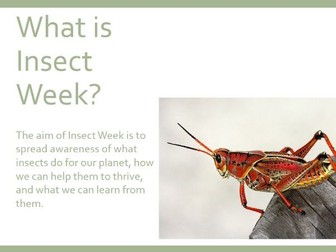
An assembly for Insect Week (24th to 30th June), featuring an explanation of the initiative, guidance on what to do at home, and two short interactive quizzes.
A selection of 20 exercises in developing close reading skills, each one based on a short extract from a piece of fiction (exercises 1-10) or non-fiction (exercises 11-20), with questions for each extract. Also included are:
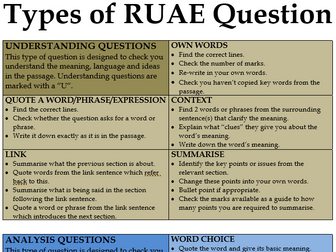
a summary of the diferent types of close reading / RUAE questions and what they require the reader to do (directly linked to the National 5 question types)
a summary of common punctuation and what it is used for in a text.
a summary of figures of speech, with definitions and examples.
Ideal for use as a classroom resource, or as a homework booklet or revision resource.
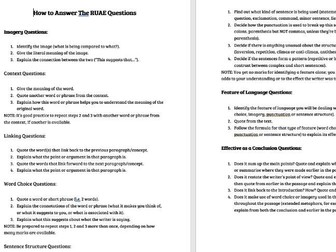
A3 poster or writing mat (two sheets) with specific explainers and guidance for each of the different RUAE questions in a Nat5 or Higher English RUAE assessment. Each explainer includes exact guidance on how to answer the question types to maximise marks. A very valuabel resource for an English classroom.
A resource comprising:
a text about Chinese New Year
vocabulary classification activity
hints about decoding new vocabulary
word / definition matching
a true or false reading comprehension (with differentiation opportunities)
creative activity based around the Chinese Zodiac
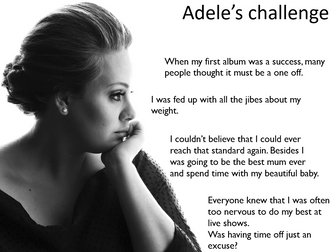
Assembly on adapting a growth mindset for whole school delivery. Features three real-life stories of overcoming closed mindsets (Adele, Thomas Edison and Malala), as well as practical tips for thinking more positively.
A handout naming, picturing and describing the English punctuation marks, and explaining their uses in simple terms. Also, a simple guide to upper case and lower case letters, and when to use capital letters.
A Reading for Understanding, Analysis and Evaluation (RUAE), or close reading, exercise on an extract from Bill Bryson’s “Notes from a Small Island”, with questions modelled around the National 5 RUAE questions and a full marking scheme.
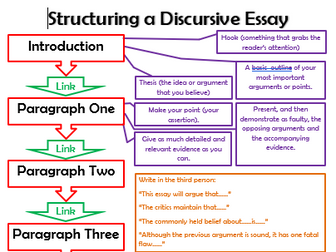
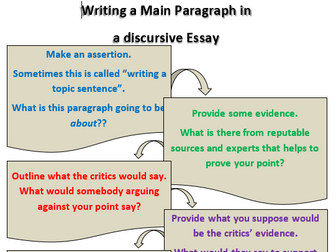
A3 poster designed to walk pupils, step by step, through the process of writing a main body paragraph for a discursive essay. Particularly useful for Nat5 and Higher English folio work.
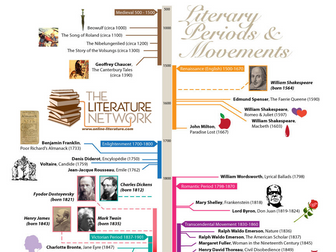
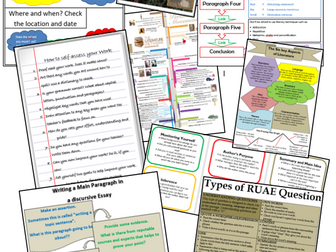
A selection of nine, ready to print, colour posters for use in an English classroom. Subjects covered include: checking sources, close reading skills, laying out / embedding quotations, literary movements, types of reading questions, carrying out effective self-assessment, soldier poets of WW1 and structuring a discursive essay. Some of these could also be used very effectively as writing mats for table use during writing classes.
A standalone KS3 English Lesson designed to introduce and develop the basic skills of finding evidence and points from a text. Includes fully developed lesson plan, PowerPoint presentation, three worksheets and sheet of extracts from The Hobbit. Learning activities include group, paired and individual tasks, and are differentiated. Also provided are opportunities for stretch and challenge, through the extension.
A set of guidelines on what to anticipate, look for and notice when reading a literary passage for information, or in a time-pressured exam environment.
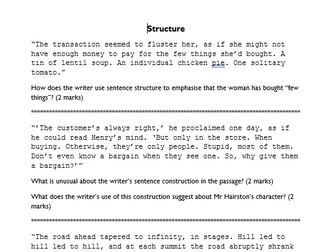
A worksheet containing 8 exercises designed to develop pupils’ understanding of how writers use structure to convey their messages or ideas. This is often a tricky aspect of English for many pupils, and this worksheet is designed to challenge pupils to identify more than simply “repetition” or “a list”, and look at deeper meanings and more sophisticated uses of structure. Can be used for individual or paired / group work.