Transverse and Longitudinal WavesQuick View
gracious51

Transverse and Longitudinal Waves

(7)
Introduction to waves for KS3 students. Lesson includes key definitions for the components of a wave, labelling wave components, comparing transverse and longitudinal waves, a brief introduction to the ripple tank and a comprehension task on frequency and amplitude (W/S) I think it would be really unfair of me to charge for my resources because there's no such thing as a perfect ready-to-go resource. So use and adapt, as I do, to many of your excellent resources :) Please review :) I would be grateful for any feedback. Thanks!
Displacement Reaction Practical KS3Quick View
gracious51

Displacement Reaction Practical KS3

(6)
This lesson briefly introduces displacement of metals, includes word equations and a short practical on the displacement of a range of metals. The final segment of the lesson focuses on the practical write up - perfect for high ability students as it has minimal guidance. Despite this, my lower ability sets are able to do this easily as they are used to writing up investigations, so it may work well for you too.
Neutralisation Practical KS3Quick View
gracious51

Neutralisation Practical KS3

(4)
Year 7 lesson focused on neutralisation reactions. It is a very short practical where the students have an acid, an alkali and universal indicator. They have to add a certain amount of acid and drop in the alkali until they reach a neutral solution. The students then have to write up their investigation from start to finish. The write up has minimal support so is good for a high ability class or a lower ability class who are well trained in how to write up lab practicals.
P6.6 Reflection and Refraction of Waves NEW AQA 2016 Trilogy SpecificationQuick View
gracious51

P6.6 Reflection and Refraction of Waves NEW AQA 2016 Trilogy Specification

(5)
Lesson includes reflection and refraction and exam style questions using students prior knowledge from this topic of longitudinal, transverse waves and CRO. I think it would be really unfair of me to charge for my resources because there's no such thing as a perfect ready-to-go resource. So use and adapt, as I do, to many of your excellent resources :) Please review, comments on any errors would be really appreciated and I'll get them fixed asap :)
Electronic StructureQuick View
gracious51

Electronic Structure

(0)
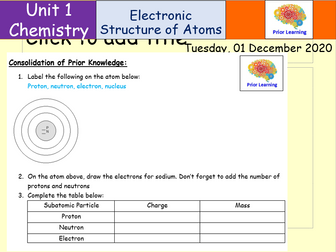
BTEC Applied Science Unit 1 Chemistry Lesson on Electronic Structure Includes energy levels, notation of electrons and sub-orbitals. Includes practice on filling sub orbitals of a range of elements and writing the notation of each
The Effect of Concentration on Reaction Rate Theory LessonQuick View
gracious51

The Effect of Concentration on Reaction Rate Theory Lesson

(0)
Lesson includes an starter task which uses Rosenshines princples of consolidating prior learning students then look at concentration as a factor that affects reaction rate. students critique the method for the RP and are then introduced to the term ‘precision’
Required Practical -  Concentration on Reaction RateQuick View
gracious51

Required Practical - Concentration on Reaction Rate

(0)
This lesson allows students to complete the required practical on the effect of concentrationon reaction rate. The students can either complete the practical in class, or alternatively be provided with modelled results that they can interpret. There is an additional task whereby students explore precision in common experimental equipment
Effect of Catalysts on Reaction RateQuick View
gracious51

Effect of Catalysts on Reaction Rate

(0)
This lessons allows students to explore the effect of adding a catalyst to a reaction. students will observe the graph to show how the addition of a catalyst will alter the activation. Students then apply their knowledge of catalysts to an exam question