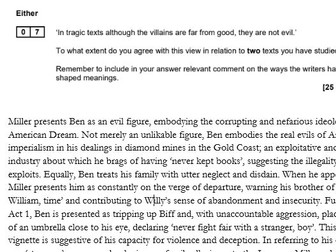
Modelled response to an AQA A Level English Literature Spec B Paper 1 Section C Tragedy question:
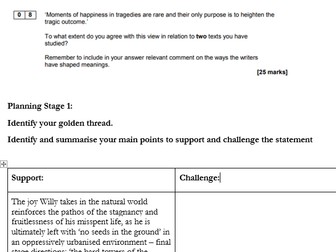
‘Moments of happiness in tragedies are rare and their only purpose is to heighten the tragic outcome’
To what extent do you agree with this view in relation to two texts you have studied?
Breaks down the essay planning and composition process, includes indicative topic sentences and A* model paragraph.
Based on Keats’ anthology and Miller’s Death of a Salesman
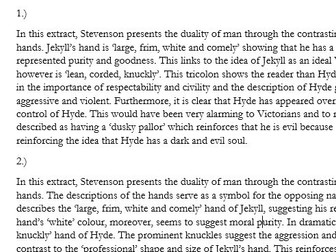
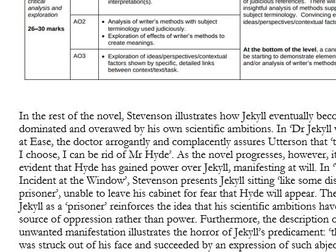
An AQA GCSE English Literature question on Jekyll & Hyde with Grade 9 Model Answer.
Extract-based question.
Can be used in a variety of ways as a teaching and revision resource:
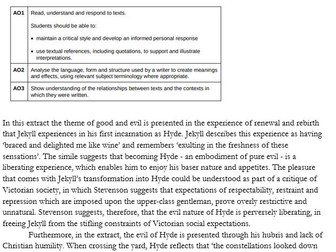
Students to identify how and where each of the assessment criteria are addressed in the Grade 9 response
Students to identify and describe how the Grade 9 response constitutes ‘convincing, critical’ analysis
Students to complete an additional paragraph(s), maintaining the same standard of prose as the Grade 9 response
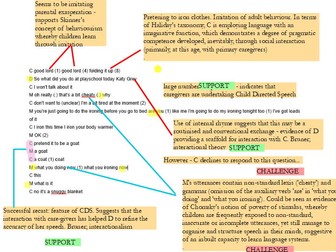
AQA English Language A Level Paper 1 Section B Child Language Development
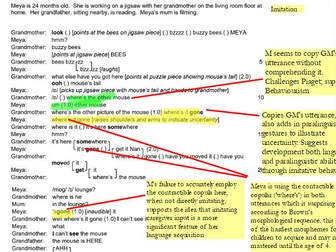
Modelled analysis for tackling this challenging component of the English language A Level. Includes an annotated transcript, linking features of child and adult speech to key theories of child language acquisition.
Scaffolds the process of structuring responses and breaking down the question, and includes high level guidance.
A really valuable resource for teachers and students of child language development.
A Level Language A Level Paper 2 Section B
Outstanding resource which models how to respond to Questions 3 and 4 of AQA A Level Language A Level Paper 2 Section B. Includes an exam-style practice paper along with A* model responses to both questions. Invaluable materials for helping English A Level students attain top grades in the exam.
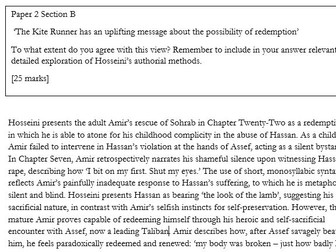
An A* model response to the following question (AQA English Literature A Level Spec B, Social & Political Protest Writing):
‘The Kite Runner has an uplifting message about the possibility of redemption’
To what extent do you agree with this view? Remember to include in your answer relevant detailed exploration of Hosseini’s authorial methods.
[25 marks]
Also includes a C Grade response for the purposes of comparison and analysis.
Can be used in a variety of ways as a teaching and revision resource:
Students to identify how and where each of the assessment criteria are addressed in the A* response
Students to identify and describe how the A* response constitutes ‘perceptive and assured’ analysis
Students to identify the limitations of the C grade response and provide feedback on how the response could be improved, using the excerpted mark scheme
Students to complete an additional paragraph(s), maintaining the same standard of prose as the A* response
Detailed pre-exam revision lessons for AQA A Level Literature Aspects of Tragedy paper (Spec B).
Set texts: Poetry of John Keats and Death of A Salesman
Includes rigorous revision of texts alongside practice essay questions and modelled exam reponses.
An invaluable resource of A Level Literature students ahead of exam season.
A scaffolded response to the GCSE English Literature AQA Love and Relationships Poetry Anthology question:
Compare the presentation of familial relationships in ‘Mother, Any Distance’ and ‘Walking Away’
Includes step-by-step guide to answering the exam question and model paragraphs at Grade 9
Flipchart presentation and PDF included
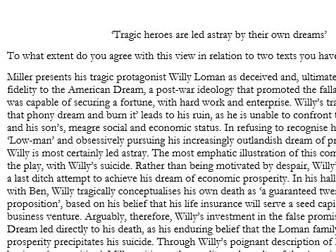
An A* model response to the following question (AQA English Literature A Level Spec B, Tragedy):
‘Tragic heroes are led astray by their own dreams’
To what extent do you agree with this view in relation to two texts you have studied?
The texts analysed are Miller’s Death of A Salesman and the poetry of John Keats
Also includes a B and D Grade response for the purposes of comparison and analysis.
Can be used in a variety of ways as a teaching and revision resource:
Students to identify how and where each of the assessment criteria are addressed in the A* response
Students to identify and describe how the A* response constitutes ‘perceptive and assured’ analysis
Students to identify the limitations of the D and B grade responses and provide feedback on how the response could be improved, using the excerpted mark scheme
Students to complete an additional paragraph(s), maintaining the same standard of prose as the A* response
AQA English Language A Level Paper 1 Section B Child Language Development
Modelled analysis for tackling this challenging component of the English language A Level. Includes an annotated transcript, linking features of child and adult speech to key theories of child language acquisition.
Scaffolds the process of structuring responses and breaking down the question, and includes model A* paragraphs.
A really valuable resource for teachers and students of child language development.
AQA English Language A Level Paper 2 Section A Language Change
A very high quality sequence of lessons covering the core content for teaching language change as part of A Level English language. Has been developed and refined over the years to assist my students in securing outstanding results. Includes a range of learning activities and resources.
The unit of learning covers the following content in an accessible, engaging and rigorous manner:
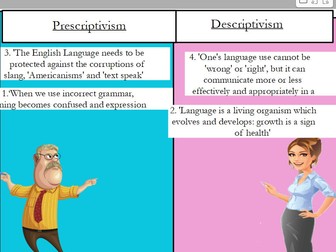
Prescriptivism and Descriptivism
Lexical and Semantic Change: loss and gain, causes, contextual factors, processes
Archaic and Obsolete Words
Language Reform
Top Down Language Change: Political Correctness, Prescriptivist Institutions, Hate Speech Laws, Euphemism Treadmill
Bottom Up/Grass Roots Language Change: Semantic Reclamation
Linguistic Determinism vs Linguistic Reflectionism
Models of Language Change:
Random Fluctuation Theory, The Substratum Theory, Functional Theory, The S-Curve, The Wave Model
Attitudes towards Language Change: Jean Aitchinson, Donald Mackinnon, Lesley Milroy
AQA English Language A Level Paper 2 Section A Language Change
An outstanding resource modelling a response to the following evaluative essay question on language change:
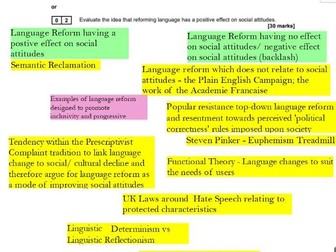
Evaluate the idea that reforming language has a positive effect on social attitudes (30 marks)
Scaffolds the process and planning and composition and includes extensive model paragraphs. Has been developed and refined over the years to assist my students in securing outstanding results in A Level English Language.
Guided practice paper for AQA English Language GCSE Paper 1 Section A Question 3, analysing structure.
Includes a range of practice papers taken from The Hunger Games, The Lovely Bones and The Fault is in Our Stars, to ensure students are interested and engaged as they learn how to tackle this challenging aspect of the AQA English Language GCSE paper: analysiing the effect of structure.
Presentation contains scaffolded techniques and modelled responses.
Includes flipchart, PDF and word document.
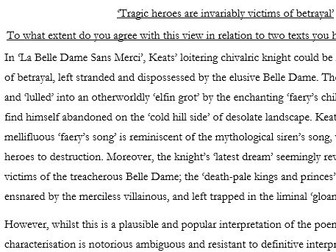
An A* model response to the following question (AQA English Literature A Level Spec B, Tragedy):
‘Tragic heroes are invariably victims of betrayal’ To what extent do you agree with this view in relation to two texts you have studied? (25 marks)
Also includes a C Grade response for the purposes of comparison and analysis.
The texts analysed are Miller’s Death of a Salesman and the poetry of John Keats
Can be used in a variety of ways as a teaching and revision resource:
Students to identify how and where each of the assessment criteria are addressed in the A* response
Students to identify and describe how the A* response constitutes ‘perceptive and assured’ analysis
Students to identify the limitations of the C grade response and provide feedback on how the response could be improved, using the excerpted mark scheme
Students to complete an additional paragraph(s), maintaining the same standard of prose as the A* response
AQA English Language A Level Paper 2 Section A Language Change
An outstanding resource modelling a response to the following evaluative essay question on language change:
Evaluate the idea that the English Language has been decaying over time and continues to do so (30 marks)
Scaffolds the process and planning and composition and includes extensive model paragraphs. Has been developed and refined over the years to assist my students in securing outstanding results in A Level English Language.
A Level Language A Level Paper 2 Section B
Outstanding resource which models how to respond to Questions 3 and 4 of AQA A Level Language A Level Paper 2 Section B. Includes model paragraphs for both questions using real past papers. Invaluable materials for helping English A Level students attain top grades in the exam.
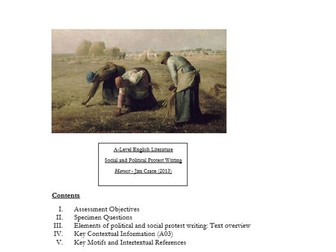
An outstanding revision booklet for A Level English Literature students and teachers alike. Aimed at those studying Harvest as a set text for AQA English Literature Spec B, aspects of Social and Political Protest Writing.
Collates key information regarding all the exam assessment objectives in relation to the text, including a highly detailed analysis of the novel’s key quotations, motifs and intertextual references.
An invaluable resource to support A Level students with independent study and exam preparation.
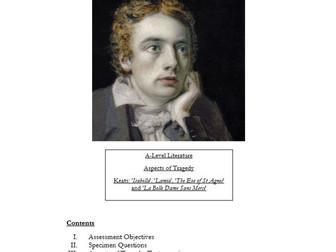
An excellent revision booklet aimed at English Literature A Level students and teachers, especially those studying Keats’ poetry as an Aspects of Tragedy (AQA Spec B) set text.
Includes a wealth of relevant contextual and analytical content, including very detailed annotations of the following poems in their entirety: ‘Lamia’, ‘Isabella or The Pot of Basil’, ‘La Belle Dame Sans Merci’, ‘The Eve of St. Agnes’.
An invaluable resource to support A Level students with independent study and examination preparation.
An invaluable resource for teachers and students alike.
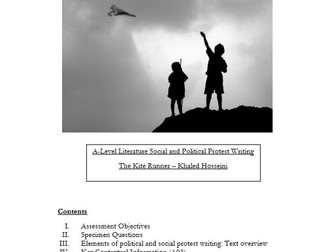
Collates key information relating to this AQA English A Level set text, including contextual information and detailed analysis of key quotations, motifs and intertextual references. Fantastic resource to support A Level literature students with independent study and revision.
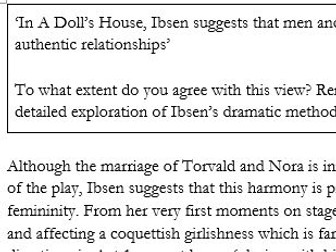
Ibsen’s A Doll’s House A Level Essay A* Model Response 1
An A* model response to the following question (AQA English Literature A Level Spec B, Social & Political Protest Writing):
‘In A Doll’s House, Ibsen suggests that men and women are incapable of harmonious and authentic relationships’ To what extent do you agree with this view? Remember to include in your answer relevant detailed exploration of Ibsen’s dramatic methods. [25 marks]
Can be used in a variety of ways as a teaching and revision resource:
Students to identify how and where each of the assessment criteria are addressed in the response
Students to identify and describe how the response constitutes ‘perceptive and assured’ analysis
Students to complete an additional paragraph(s), maintaining the same standard of academic prose
An AQA GCSE English Literature question on Jekyll & Hyde with Grade 9 Model Answer.
Extract-based question.
Also includes a 6 Grade response for the purposes of comparison and analysis.
Can be used in a variety of ways as a teaching and revision resource:
Students to identify how and where each of the assessment criteria are addressed in the Grade 9 response
Students to identify and describe how the Grade 9 response constitutes ‘convincing, critical’ analysis
Students to identify the limitations of the 6 grade response and provide feedback on how the response could be improved, using the excerpted mark scheme
Students to complete an additional paragraph(s), maintaining the same standard of prose as the Grade 9 response
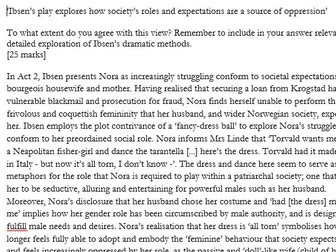
An A* model response to the following question (AQA English Literature A Level Spec B, Social & Political Protest Writing):
‘Ibsen’s play explores how society’s roles and expectations are a source of oppression’. To what extent do you agree with this view? Remember to include in your answer relevant detailed exploration of Ibsen’s dramatic methods.[25 marks]
Also includes a C Grade response for the purposes of comparison and analysis.
Can be used in a variety of ways as a teaching and revision resource:
Students to identify how and where each of the assessment criteria are addressed in the A* response
Students to identify and describe how the A* response constitutes ‘perceptive and assured’ analysis
Students to identify the limitations of the C grade response and provide feedback on how the response could be improved, using the excerpted mark scheme
Students to complete an additional paragraph(s), maintaining the same standard of prose as the A* response