British Science Week 2025 Key Stage 3 LessonQuick View
MissGraceScience

British Science Week 2025 Key Stage 3 Lesson

(0)
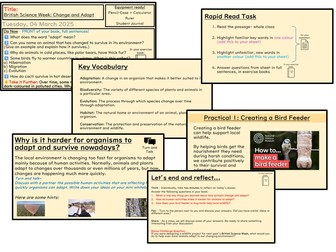
A fully planned lesson for British Science Week 2025 on the theme of ‘Change and adapt’. The lesson is separated into the following: 1) Do now activity- 5 questions, with answers, relating to the theme 2) Homework- taken from Twinkl on he life of Charles Darwin. I have listed how to find this on Twinkl on the relevant powerpoint slide. 3) Introduction to adaptations- the classic song, then a card sort activity which can be resourced from the BSW 2025 website (I have added a copy of this to the bundle- hopefully Tes doesn’t remove for copyright). I have listed how to find this online on the relevant powerpoint slide. 4) Reading activity- taken from Twinkl and designed for British Science Week 2025. I have listed how to find this on Twinkl on the relevant powerpoint slide. UPDATE: I HAVE MADE AND ATTACHED A FREE VERSION IF YOU DO NOT HAVE A TWINKL ACCOUNT. 5) A choice of two practical activities- making bird feeders and making bug hotels. Relevant method sheets have been made by myself and provided in this bundle. 6) Reflection plenary The lesson also features a clear printing (reprographics) and requisition list, as well as links to careers. Unfortunately for copyright reasons I cannot directly link the Twinkl resources but you can access these with a Twinkl membership. Hopefully this will save you some time for BSW 2025!
British Science Week 2025 Lesson (NO PRACTICAL)Quick View
MissGraceScience

British Science Week 2025 Lesson (NO PRACTICAL)

(0)
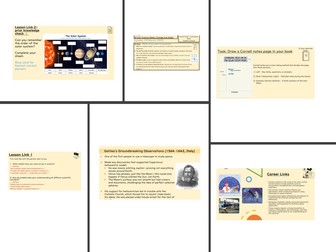
How have scientific models changed and adapted over time? This engaging Key Stage 3 lesson explores the fascinating history of the Solar System Model, from ancient beliefs to modern science. Perfect for British Science Week 2025, this non-practical lesson is ideal for teachers without lab access or those seeking a structured, interactive theory-based session. What’s Inside? Do Now Activity – Kick-start learning with five thought-provoking questions Interactive Lesson Links – Recap the role of scientific models and the modern heliocentric Solar System. Cornell Notes Timeline – Students track key astronomers’ discoveries with a mix of teacher-led discussion and short, engaging videos. Think-Pair-Share – Spark lively debates on the most revolutionary astronomers. Creative Poster Task – In groups, students design Science Fair-style posters showcasing different Solar System models. Science Fair Presentations – Half the class presents, while the other half critiques and asks questions before swapping roles. Plenary Reflection – Wrap up with a final reflection task to reinforce learning. No additional resources needed. The lesson is fully planned, and while one of the lesson link activities is from Twinkl (which I cannot link due to copyright), many alternatives are available elsewhere e.g. Tes. I hope this is useful and will save you time for BSW 2025!
VESNU Calculations display/book print outQuick View
MissGraceScience

VESNU Calculations display/book print out

(0)
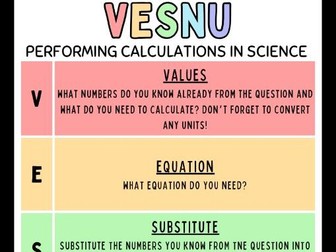
A clear print out suitable for a classroom display or to be stuck into a pupil’s exercise book. A method useful for calculations in GCSE science, but can easily be embedded from KS3. The VESNU method for calculations is an improvement on the much-used FIFA but ensures that pupils always remember to convert units, include units in answers and rearrange. V (Values) – Identify and list all the given values from the problem statement. E (Equation) – Write down the relevant formula or equation needed to solve the problem. S (Substitute) – Substitute / swap in the given values into the equation, then rearrange if necessary to solve for the unknown variable. N (Numerical Answer) – Perform the calculations to obtain the numerical answer. U (Units) – Ensure the final answer includes the correct units. Example: Finding Time Problem: A car is moving at a speed of 20 m/s and covers a distance of 100 meters. How long does it take? V (Values) • Distance (d) = 100 m • Speed (s) = 20 m/s • Time (t) = ? E (Equation) Speed = Distance / Time S (Substitute) Substituting the values: 20 = 100 / t Rearranging to solve for t: t = 100 / 20 N (Numerical Answer) t = 5 U (Units) t = 5 s