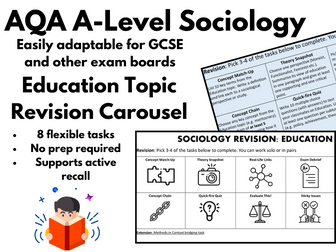
This flexible, low-prep revision carousel is perfect for consolidating learning at the end of the Education topic in AQA A-Level Sociology (though it can easily be adapted for GCSE or other exam boards).
Designed for maximum versatility, this task grid encourages active recall, higher-order thinking, and independent learning. Students choose from a range of 8 tasks covering theory, key concepts, debate, and exam application. Tasks are varied and accessible, making this ideal for:
Independent revision lessons
Homework or flipped learning
Engaging cover work with no printing needed
Small group or paired discussion tasks
End-of-topic review and retrieval practice
Each task encourages depth and critical thinking, with built-in stretch and challenge. The grid format also allows differentiation by choice - students can pick the tasks that best suit their confidence level or interests.
Also included is an optional extension task to help bridge into the next topic (Methods in Context), encouraging students to think like sociologists by applying methods to education-based issues.
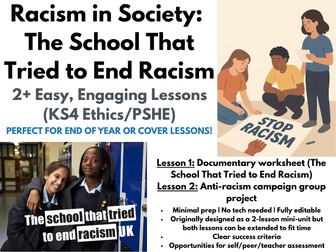
Two engaging, low-prep lessons on racism in society – ideal for KS4 Ethics, Citizenship, or PSHE
This flexible mini-unit includes two thoughtfully designed lessons that explore racism in an age-appropriate, accessible way. It’s perfect for end-of-year teaching, cover lessons, or as a ready-to-use resource to support meaningful discussion and creative thinking with minimal teacher prep required.
What’s included:
1 editable PowerPoint – covers both lessons with clear instructions, visual prompts, optional discussion questions, support/inspiration for students, and success criteria
1 editable worksheet to accompany Episode 1 of the Channel 4 documentary The School That Tried to End Racism
1 editable planning worksheet for the group campaign task –* includes guiding questions and built-in scaffolding*
Lesson 1: Documentary and Discussion
Students watch The School That Tried to End Racism (Episode 1), currently free to stream for Amazon Prime subscribers. Some clips may also be available on YouTube or through educational platforms. The included worksheet supports comprehension, personal reflection, and purposeful discussion.
You can easily extend this lesson depending on how many episodes you choose to show (or assign different episodes to different groups).
Lesson 2: Anti-Racism Campaign Project
Students work in small groups to design their own anti-racism campaign (poster, slogan, and short speech/script). The task encourages creativity, empathy, and practical solutions to challenge racism in school or the wider community.
The campaign task works brilliantly as a standalone lesson, but also makes a great follow-up to the documentary.
It can easily be extended into 2–3 lessons by allowing more time for students to create high-quality resources and using the built-in success criteria for self, peer, or teacher assessment.
Optional extension ideas:
Group presentations
Carousel/market-stall activity to view and give feedback on each group’s campaign
Display final posters in class or around the school
Who is it for?
KS4 (ages 14–16) – suitable for Ethics, PSHE, Citizenship, or tutor sessions
Designed with challenging or mixed-ability classes in mind – minimal tech, no computer room needed, and easy to manage
Whether you want to make the most of your final weeks with a class or introduce a deeper look at racism through real-life context and student voice, this resource gives you everything you need.
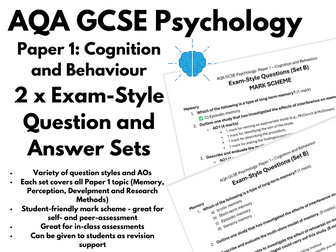
Two sets of exam-style questions AND answer sheets / mark schemes, covering all Paper 1 topics of the AQA GCSE Psychology spec.
Each set contains a selection of MCQs, short answer questions and extended response (9 markers) for each section of Paper 1 (Memory, Perception, Development and Research Methods). Assesses knowledge and understanding, application and evaluation, and includes a ‘design a study’ style question.
Mark schemes are student-friendly to support peer- and self-marking, containing breakdowns of how marks are awarded and example responses.
Can be used as in-class assessments, or given to students as a revision resource.


 Quick View