It’s a reading aloud, dictation and translation task.
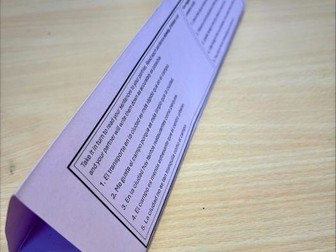
Print out (preferably on card) and fold like a toblerone.
Students work in pair, taking it in turn to read aloud while the partner write down what they hear.
Then, they do the translation task together and check their answers.
I print out the answers to the translation and place it inside the Toblerone.
You can see a free sample here:
and here for Spanish:
https://www.tes.com/teaching-resource/-13409208
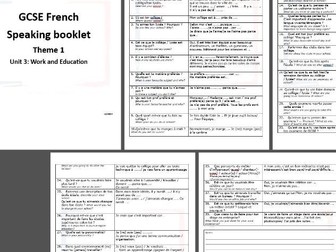
A comprehensive booklet with:
Information and tips about the speaking exams
Infographics on how to ask questions in French and how to describe photos using the PALM methods
2 Foundation and 2 Higher role-plays for each Units,
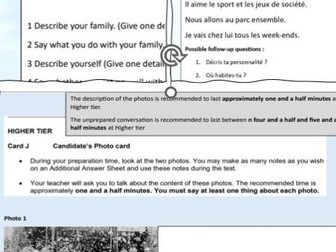
2 Foundations and 2 higher reading aloud tasks with possible follow-up questions
Photocards to describe with space to make notes
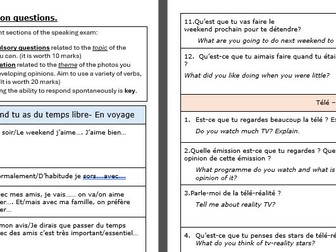
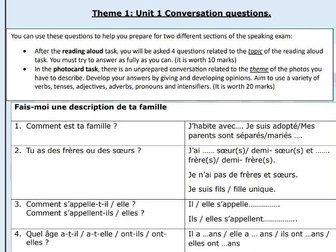
Banks of questions with starter phrases to answer.
We follow AQA and Kerboodle.
la santé, healthy living, healthy eating.
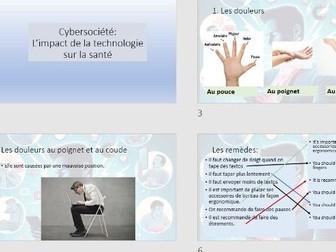
A presentation with vocab revision and key sentences and a worksheet with a matching activity. The questions and answers which match are written in the same font.
It is based on the text from AQA French Higher, p18
An activity that I have designed with my top set yr11 in mind to discuss advantages and disadvantages of various jobs. It is using an authentic document in the form of a survey.
I made this for my yr8 class, it fits in with Studio 2.
They had to cut up the section on page 2 and find the correct order of the conversation.
I then asked them to practice the conversation in pairs, changing the sections highlighted.
They had to practice their conversations in a certain style. I asked them for suggestions and they came up with 'in the style of Match of the day', 'a game show', 'A musical', ' A soap opera' and several more. They had great fun.
A booklet which covers Unit 3 of the new specifications.
The conversation questions have some suggestions on how to start answers but not full answers.
There is space to add questions or notes.
The questions can be used to revise/practice for the the follow-up questions after the reading aloud task and after the photo card task.
We use the UOP textbook.
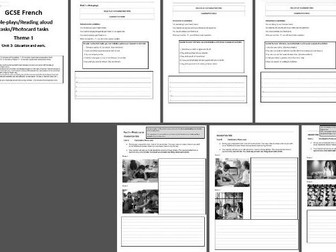
A booklet to practice role-plays, reading aloud and photo card tasks on Unit 3 of Theme 1.
I have adapted the tasks from the sample published on AQA so that they cover the topics of work and education.
There is space for students to note down their answers.
There are 2 Foundation RP + 2 Higher RP, 2 Foundation Reading aloud tasks with possible follow-up questions, 2 higher Reading aloud with possible follow-up questions, 2 Foundation Photo card tasks and 2 Higher Photo card tasks.
A booklet to practice role-plays, reading aloud and photo card tasks on Unit 1 of Theme 1.
I have adapted the tasks from the sample published on AQA so that they cover the topics of Unit 1 (Ma personalité, Mon futur moi, Les familles de nos jours and Mes amis, c’est ma vie).
There is space for students to note down their answers.
There are 2 Foundation RP + 2 Higher RP, 2 Foundation Reading aloud tasks with possible follow-up questions, 2 higher Reading aloud with possible follow-up questions, 2 Foundation Photo card tasks and 2 Higher Photo card tasks.
Used for A-level French.
It covers sound, camera movements, use of black and white and reference to American blockbusters in La Haine, Métisse,L’ordre et la Morale, Les Rivières Pourpres and also 2 of his short films.
I prepared this for my year 8 but it could be used for other year groups.
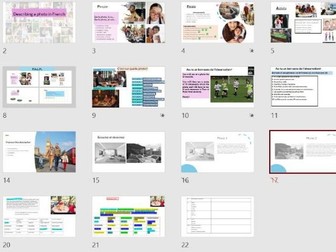
I have used the PALMw acronym (People, action,location, mood, What else) and I have created various activities to help students to practice describing a photo.
Activities included are:
Identify the photo from reading sentences
Drawing on a background from listening.
Looking at a photo for 15 seconds and then deciding which statements are true or false.
Looking at a photo with 4 short sentences and improving the sentences
Translation
Mini-whiteboards will be useful for some activities.
A booklet which covers Unit 1 of the new specifications.
The conversation questions have some suggestions on how to start answers but not full answers.
There is space to add questions or notes.
The questions can be used to revise/practice for the the follow-up questions after the reading aloud task and after the photo card task.
We use the UOP textbook.
A lesson to practice the near Future in the context of a visit to Paris.
Fits with Dynamo 1.
It starts with presenting the main sites and memorising their spellings.
Slide 24 was designed when we were teaching remotely in lock down.
Slide 25 is the listening from Dynamo 1 p114
The second part focuses on the near future.There’s a sentence builder using je vais + visiter/aller/acheter, some pronunciation practice, a battleship, some bad translation, some sentence to re-write into the correct order.
Then we move onto expressing opinions, there’s a jigsaw translation and a delayed copying task.
The final task is a paragraph to write.
Suitable for GCSE students.
Students work In groups of three where one person is referee and the other 2 play against one another. Person A goes first and starts translating section number 1, if person A translates correctly, they move onto number 2 and so on. When a mistake is made player B has a go, starting from the top. Whenever a player resumes their turn, they start from the beginning.
The referee has the answers and will guide the 2 players and decide whose turn is next.
I have included a French to English version and an English to French one.
Some speaking mat/sentence builders to fit with Studio 2 Rouge and help students produce more complex sentences.
I have used them to practice conversations, guess the secret sentences, to play trapdoor, to do simulteneous translations and some dictations.
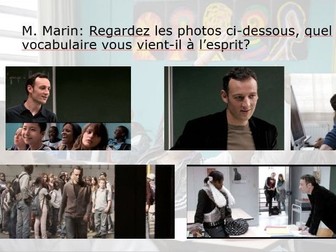
A ppt to study the character of M. Marin which contains some background information and then some activities based on scenes extracts.
As the videos are from Youtube, there is always the possibility that they have beed deleted, however, the scene chosen can be found on youtube or from your version of the film.
A powerpoint to introduce family relationships and reasons for getting on/not getting on with various family members.
It first focuses on “Tu t’endends bien avec…?” and Oui, je m’entends bien/Non, je ne m’entends pas.
Then it introduces various reasons using reflexive verbs. Il m’aide/me comprends/m’écoute etc etc with some pictures for students to try and work out the meanings.
I then introduce a sentence builder and we work on pronunciation by marking the silent letters (I can’t remember whether I designed this SB or used/modified someone else’s so if it’s yours, please let me know and I’ll credit you - Thank you) This is followed by a mind-reader activity, a sentence stealer and a delayed copying - Many thaks to DR Conti).
The full sentence builder is there for extansion or future work)