GCSE PE - EDEXCEL
Lesson 1 - Introduction to the course
Expectations
Exercise books expectations
Homework expectations
Assessment folders info
Course overview
Text book info
Health and well being intro
GCSE PE: Lesson 13: The respiratory system
Presentation and resources for:
Structure and function of the respiratory system
Mechanics of breathing
Constituents of air
Gaseous exchange
A level PE; Scientific principles: 2.2: Fitness testing
2.2 Fitness testing
Benefits of fitness testing
Laboratory tests
Field tests Vs Laboratory tests
Validity, reliability and protocols.
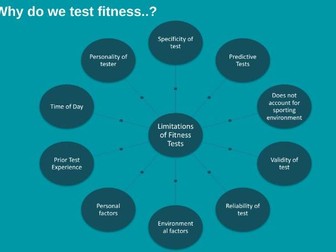
Why we fitness test
Limitations to fitness testing
Anaerobic fitness tests
Aerobic fitness tests
Advantages and disadvantages of all
A level PE: Scientific principles 2.2 Thresholds and measuring intensity.
Presentation slides for the Component 1 - Scientific Principles
2.2: Preparation and training: Thresholds and measuring intensity
The presentation includes:
The energy continuum
Functional thresholds
Measuring intensity:
1 rep max
Work-rest ratios
Target Heart rate
Karvonen formula
Rate of perceived exertion
Borg Scale
Vo2 max
Power meters
Blood lactate
GPS
Background of the presentation may need changing as it was originally a Google Slide.
Presentation slides for the Component 1 - Scientific Principles
2.2: Preparation and training - Components of fitness
The presentation includes:
Agility
Anaerobic capacity
Balance
Co-ordination
Flexibility
Power
Reaction time
Speed
Strength (Static, dynamic, elastic)
Aerobic endurance (sub-maximal and maximal)
Vo2 max
Exercise economy
Localised muscular endurance
Determinants of sporting performance - running
Background of the presentation may need changing as it was originally a Google Slide.
GCSE Physical education lesson 2: Physical, social and emotional health.
2 presentation bundle
Definitions - Fitness, health and well-being
Benefits of physical health
Benefits of social health
Benefits of emotional health
Past paper question
Fit but not healthy
Presentation slides for the Component 1 - Scientific Principles
1.3: Neuromuscular system.
The presentation includes:
Structure of the Central Nervous System
Muscle Fibre types
Muscle fibre distribution (+ Essay question)
Anatomy/structure of the neuromuscular system
Physiology of muscular contraction
Five stages of muscular contraction
Huxley’s sliding filament theory
The role of ATP withing muscular contraction
All or none law
Muscle fibre recruitment patters
Responses to exercise on the neuromuscular system
Adaptations to exercise on the neuromuscular system
Past paper questions on the topics with mark schemes throughout to check for understanding and practice application of knowledge.
Background of the presentation may need changing as it was originally a Google Slide.
Presentation slides for the Component 1 - Scientific Principles
1.2: Cardiovascular system
The presentation includes:
How The cardiovascular and respiratory systems work together
The heart as a double loop circuit
Starlings law
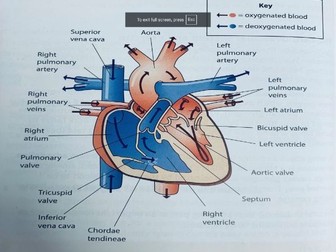
Structure of the heart
Roles and functions of the elements of the CV system
Constituents of blood
Blood vessels
Layers of the heart
The cardiac impulse
The cardiac cycle
Cardiovascular volumes
The Cardiac Control Centre
Heart rate + the effect of exercise
Cardiac drift
Responses and adaptations of exercise on the CV system
Unhealthy lifestyles
Past paper questions on the topics with mark schemes throughout to check for understanding and practice application of knowledge.
Background of the presentation may need changing as it was originally a Google Slide.
GCSE PE: Lesson 9: Joints and movement.
Plus additional worksheet
Identify the 4 classifications of bones.
Explain the function of each classification of bones.
Classification of each bones .
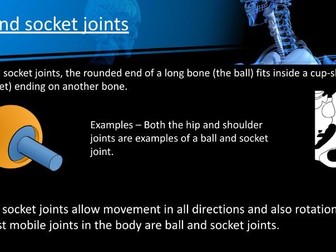
Identify the 7 joints in the body.
Identify the 4 classifications of joints.
Identify and explain the movement available at a joint.
GCSE PE: Lesson 10: Muscles, muscle types and movement
This resources will enable students to:
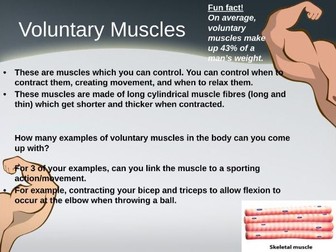
Identify 3 types of muscles in the body.
Explain the 3 types of muscle in the body.
Identify and label the muscles in the body.
Identify the function of muscles in the body.
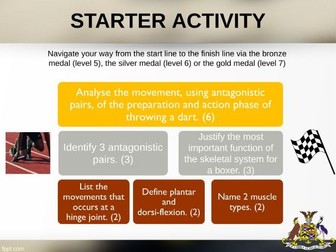
Define antagonistic pairs, and identify examples in the body.
Includes worksheets and homework task
Presentation slides for the Component 1 - Scientific Principles
2.2: Preparation and training - Methods of training
The presentation includes:
Weight training
Resistance training
Assisted training
Plyometric training
SAQ training
Functional stability
Flexibility - Stretching:
Static, ballistic, dynamic, proprioceptive neuromuscular facilitation
Continuous training
Cross training
Fartlek training
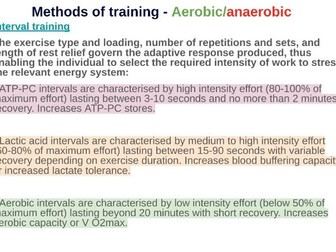
Interval training
Circuit training
(Optional group task slide)
Past paper questions on the topics with mark schemes throughout to check for understanding and practice application of knowledge.
Background of the presentation may need changing as it was originally a Google Slide.
GCSE PE: Lesson 11: Muscle fibre types
This resource will enable students to:
To identify the 3 muscle fibre types.
To Explain the characteristics of the 3 muscle fibres
To evaluate the importance of the 3 muscle fibres for sport.
Multiple files included.
GCSE PE: Lesson 8 Structure and function of the skeletal system
TWO presentations.
Functions of the skeletal system
Protection of vital organs
Muscle attachment
Joints for movement
Storing calcium and phosphorus
Red and white blood cell production
Structure of the skeletal system
Names and locations of bones
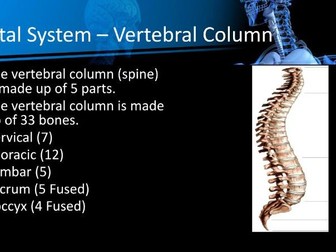
Vertebral column
GCSE Physical education
2 lesson presentation bundle
Lesson 4: Sedentary lifestyle
Link to prior learning starter activity
Definition of a sedentary lifestyle
Impact on health of a sedentary lifestyle
Exam questions
Lesson 5: Diet
Balanced diet
Macronutrients
Carbohydrates + Carbo-loading
Fats
Protein + timing of consumption
Micronutrients
Vitamins
Minerals
Fibre
Water
Additional diet worksheet and homework task
Presentation slides for the Component 1 - Scientific Principles
2.2: Preparation and training - Principles of training & periodisation
The presentation includes:
Principles of training:
Specificity
Individual needs
Over training
Reversability
Progressive overload:
Frequency
Intensity
Time
Type
Wider reading task
Periodisation
Tapering and peaking
Background of the presentation may need changing as it was originally a Google Slide.
Presentation slides for the Component 1 - Scientific Principles
2.2: Preparation and training - Performance in different conditions
The presentation includes:
Performance at altitude
Altitude wider reading task
Performance in hot conditions
Performance in humid conditions
Performance in cold conditions
Background of the presentation may need changing as it was originally a Google Slide.
Presentation slides for the Component 1 - Scientific Principles
1.4: Energy systems and fatigue
The presentation includes:
Forms of energy
Energy transfer in the body
Energy sources
ATP
ATP re-synthesis
The ATP-PC system
The lactic acid system
The aerobic system
Beta Oxidation
The energy continuum
Fatigue
EPOC
Fast component of recovery
Slow component of recovery
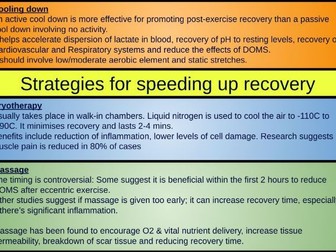
Strategies to aid recovery
The importance of a warm up
Priming exercise
Past paper questions on the topics with mark schemes throughout to check for understanding and practice application of knowledge.
Background of the presentation may need changing as it was originally a Google Slide.


 Quick View