AQA A Level Psychology Research Methods Lessons – NEW SPEC (7182)/Teaching from 2025Quick View
kirstyclark99

AQA A Level Psychology Research Methods Lessons – NEW SPEC (7182)/Teaching from 2025

(0)
High-quality, engaging lessons designed specifically for the AQA A Level Psychology (new specification), focusing on the Research Methods content. These lessons are ideal for teachers, tutors, or students seeking clear explanations, strong exam preparation, and structured skill development. Topics covered include: • Experimental method. Types of experiment, laboratory and field experiments; natural and quasi-experiments. • Observational techniques. Types of observation: naturalistic and controlled observation; covert and overt observation; participant and non-participant observation. • Self-report techniques. Questionnaires; interviews, structured and unstructured. • Correlations. Analysis of the relationship between co-variables. The difference between correlations and experiments. • Content analysis. • Case studies. • Aims: stating aims, the difference between aims and hypotheses. • Hypotheses: directional and non-directional. Lesson features: Starter questions to activate prior knowledge Clear explanations with teacher modelling Worked examples and guided calculations Deliberate practice and retrieval activities Scaffolded exam questions aligned to AQA assessment objectives Regular checks for understanding Data interpretation and statistical practice Plenaries to consolidate learning and exam technique These lessons are exam-focused, clearly structured, and accessible, supporting students in developing strong research methods knowledge alongside the mathematical, analytical and AO3 evaluation skills required for success in AQA A Level Psychology.
AQA A Level Psychology Clinical Psychology Lessons – NEW SPEC (7182)/Teaching from 2025Quick View
kirstyclark99

AQA A Level Psychology Clinical Psychology Lessons – NEW SPEC (7182)/Teaching from 2025

(0)
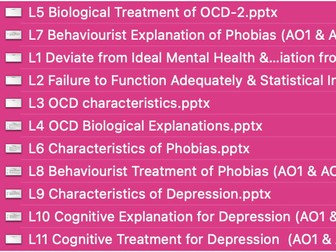
High-quality, engaging lessons designed specifically for the AQA A Level Psychology (new specification), focusing on the Clinical Psychology content. These lessons are ideal for teachers, tutors, or students seeking clear explanations, strong exam preparation, and structured skill development. Topics covered include: Definitions in the Field of Mental Health Definitions of abnormality, including deviation from social norms, failure to function adequately, statistical infrequency and deviation from ideal mental health Strengths and limitations of each definition Phobias Characteristics of phobias Behavioural, emotional and cognitive characteristics The behavioural approach to explaining phobias Classical and operant conditioning The two-process model Treatments for phobias, including systematic desensitisation and flooding Evaluation of behavioural explanations and treatments Depression Characteristics of depression Behavioural, emotional and cognitive characteristics The cognitive approach to explaining depression Beck’s cognitive theory Ellis’s ABC model Cognitive Behavioural Therapy (CBT) Evaluation of cognitive explanations and treatments Obsessive-Compulsive Disorder (OCD) Characteristics of OCD Behavioural, emotional and cognitive characteristics The biological approach to explaining OCD Genetic explanations Neurotransmitter explanations, including the role of serotonin Neural explanations and brain structures Drug therapy as a treatment for OCD Evaluation of biological explanations and treatments Lesson features: Starter questions to activate prior knowledge Clear explanations with teacher modelling Deliberate practice and retrieval activities Scaffolded exam questions aligned to AQA assessment objectives Regular checks for understanding Application of theories and research to exam-style scenarios AO1 knowledge, AO2 application and AO3 evaluation practice Plenaries to consolidate learning and exam technique These lessons are exam-focused, clearly structured, and accessible, supporting students in developing strong clinical psychology knowledge alongside the AO3 evaluation skills required for success in AQA A Level Psychology.
AQA A Level Psychology Attachment Lessons & Workbook – NEW SPEC (7182)/Teaching from 2025Quick View
kirstyclark99

AQA A Level Psychology Attachment Lessons & Workbook – NEW SPEC (7182)/Teaching from 2025

(0)
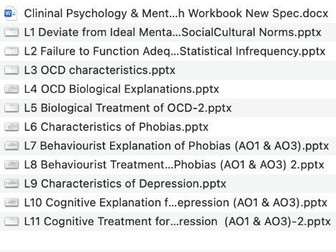
High-quality, engaging lessons designed specifically for the AQA A Level Psychology (new specification), focusing on the Attachment content. These lessons are ideal for teachers, tutors, or students seeking clear explanations, strong exam preparation, and structured skill development. Topics covered include: Explanations of Attachment Learning theory as an explanation of attachment Classical and operant conditioning Bowlby’s monotropic theory The concept of monotropy and the critical period Internal working models Evaluation of learning theory and Bowlby’s theory Types of Attachment Ainsworth’s Strange Situation Secure, insecure-avoidant and insecure-resistant attachment Cultural variations in attachment Cross-cultural research into attachment Evaluation of research into attachment types and cultural differences Maternal Deprivation Bowlby’s theory of maternal deprivation The effects of prolonged separation from an attachment figure Bowlby’s 44 thieves study Critical evaluation of the maternal deprivation hypothesis Effects of Institutionalisation The effects of institutionalisation on children’s development Romanian orphan studies, including Rutter’s research The concept of privation The importance of early intervention and the effects of early experience Influence of Early Attachment The influence of childhood attachment on later relationships The continuity hypothesis Internal working models and adult relationships Research into the relationship between early attachment and later relationships Evaluation of the influence of early attachment on later development Lesson features: Starter questions to activate prior knowledge Clear explanations with teacher modelling Deliberate practice and retrieval activities Scaffolded exam questions aligned to AQA assessment objectives Regular checks for understanding Application of theories and research to exam-style scenarios AO1 knowledge, AO2 application and AO3 evaluation practice Research-methods and study-analysis activities Plenaries to consolidate learning and exam technique These lessons are exam-focused, clearly structured, and accessible, supporting students in developing strong attachment knowledge alongside the AO1, AO2 and AO3 skills required for success in AQA A Level Psychology. Also included is a comprehensive workbook that coincides with the lessons, providing students with structured activities, retrieval practice, exam-style questions and opportunities to consolidate their learning throughout the topic.
AQA A Level Psychology Clinical Psychology Lessons & Workbook – NEW SPEC (7182)/Teaching from 2025Quick View
kirstyclark99

AQA A Level Psychology Clinical Psychology Lessons & Workbook – NEW SPEC (7182)/Teaching from 2025

(0)
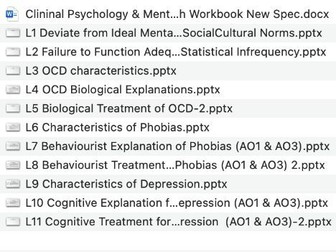
High-quality, engaging lessons designed specifically for the AQA A Level Psychology (new specification), focusing on the Clinical Psychology content. These lessons are ideal for teachers, tutors, or students seeking clear explanations, strong exam preparation, and structured skill development. Topics covered include: • Definitions in the Field of Mental Health o Definitions of abnormality, including deviation from social norms, failure to function adequately, statistical infrequency and deviation from ideal mental health o Strengths and limitations of each definition • Phobias o Characteristics of phobias o Behavioural, emotional and cognitive characteristics o The behavioural approach to explaining phobias o Classical and operant conditioning o The two-process model o Treatments for phobias, including systematic desensitisation and flooding o Evaluation of behavioural explanations and treatments • Depression o Characteristics of depression o Behavioural, emotional and cognitive characteristics o The cognitive approach to explaining depression o Beck’s cognitive theory o Ellis’s ABC model o Cognitive Behavioural Therapy (CBT) o Evaluation of cognitive explanations and treatments • Obsessive-Compulsive Disorder (OCD) o Characteristics of OCD o Behavioural, emotional and cognitive characteristics o The biological approach to explaining OCD o Genetic explanations o Neurotransmitter explanations, including the role of serotonin o Neural explanations and brain structures o Drug therapy as a treatment for OCD o Evaluation of biological explanations and treatments Lesson features: • Starter questions to activate prior knowledge • Clear explanations with teacher modelling • Deliberate practice and retrieval activities • Scaffolded exam questions aligned to AQA assessment objectives • Regular checks for understanding • Application of theories and research to exam-style scenarios • AO1 knowledge, AO2 application and AO3 evaluation practice • Plenaries to consolidate learning and exam technique These lessons are exam-focused, clearly structured, and accessible, supporting students in developing strong clinical psychology knowledge alongside the AO3 evaluation skills required for success in AQA A Level Psychology. Also included is a workbook which coincides with the lessons.
AQA A Level Psychology Attachment Lessons – NEW SPEC (7182)/Teaching from 2025Quick View
kirstyclark99

AQA A Level Psychology Attachment Lessons – NEW SPEC (7182)/Teaching from 2025

(0)
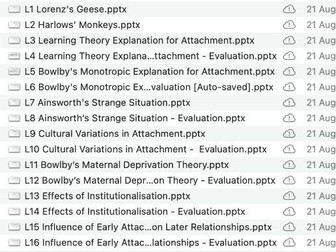
High-quality, engaging lessons designed specifically for the AQA A Level Psychology (new specification), focusing on the Attachment content. These lessons are ideal for teachers, tutors, or students seeking clear explanations, strong exam preparation, and structured skill development. Topics covered include: Animal Studies of Attachment • Lorenz’s research into imprinting in goslings • The concept of imprinting and the critical period • Harlow’s research into attachment in rhesus monkeys • Contact comfort and the importance of caregiver-infant interaction • The role of food versus comfort in attachment • Evaluation of Lorenz and Harlow’s studies • Ethical issues and the use of animal research • The contribution of animal studies to explanations of human attachment Explanations of Attachment Learning theory as an explanation of attachment Classical and operant conditioning Bowlby’s monotropic theory The concept of monotropy and the critical period Internal working models Evaluation of learning theory and Bowlby’s theory Types of Attachment Ainsworth’s Strange Situation Secure, insecure-avoidant and insecure-resistant attachment Cultural variations in attachment Cross-cultural research into attachment Evaluation of research into attachment types and cultural differences Maternal Deprivation Bowlby’s theory of maternal deprivation The effects of prolonged separation from an attachment figure Bowlby’s 44 thieves study Critical evaluation of the maternal deprivation hypothesis Effects of Institutionalisation The effects of institutionalisation on children’s development Romanian orphan studies, including Rutter’s research The concept of privation The importance of early intervention and the effects of early experience Influence of Early Attachment The influence of childhood attachment on later relationships The continuity hypothesis Internal working models and adult relationships Research into the relationship between early attachment and later relationships Evaluation of the influence of early attachment on later development Lesson features: Starter questions to activate prior knowledge Clear explanations with teacher modelling Deliberate practice and retrieval activities Scaffolded exam questions aligned to AQA assessment objectives Regular checks for understanding Application of theories and research to exam-style scenarios AO1 knowledge, AO2 application and AO3 evaluation practice Research-methods and study-analysis activities Plenaries to consolidate learning and exam technique These lessons are exam-focused, clearly structured, and accessible, supporting students in developing strong attachment knowledge alongside the AO1, AO2 and AO3 skills required for success in AQA A Level Psychology.
AQA A Level Psychology Relationships Lessons & Workbook – NEW SPEC (7182)/Teaching from 2025Quick View
kirstyclark99

AQA A Level Psychology Relationships Lessons & Workbook – NEW SPEC (7182)/Teaching from 2025

(0)
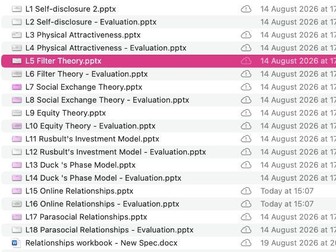
High-quality, engaging lessons designed specifically for the AQA A Level Psychology (new specification), focusing on the Relationships content. These lessons are ideal for teachers, tutors, or students seeking clear explanations, strong exam preparation, and structured skill development. Topics covered include: • The Formation of Romantic Relationships o The role of self-disclosure in relationship formation o The importance of physical attractiveness o The matching hypothesis o The filter theory of relationship formation o Evaluation of explanations for the formation of romantic relationships • Theories of Romantic Relationships o The social exchange theory o Costs, rewards and comparison levels o The concept of profit within relationships o Comparison with the equity theory o The role of fairness and equity in relationships o Evaluation of social exchange and equity theories • Duck’s Phase Model of Relationship Breakdown o The four phases of relationship breakdown o Intrapsychic, dyadic, social and grave-dressing phases o How relationships progress through the stages of breakdown o Evaluation of Duck’s model • Online and Parasocial Relationships o Online relationships and their differences from face-to-face relationships o The formation and maintenance of parasocial relationships o The role of media in the development of one-sided relationships o Evaluation of online and parasocial relationships Lesson features: • Starter questions to activate prior knowledge • Clear explanations with teacher modelling • Deliberate practice and retrieval activities • Detailed coverage of key theories and research studies • Scaffolded exam questions aligned to AQA assessment objectives • Regular checks for understanding • Application of theories and research to exam-style scenarios • AO1 knowledge, AO2 application and AO3 evaluation practice • Opportunities to compare and evaluate competing explanations • Research-study analysis and evaluation activities • Plenaries to consolidate learning and exam technique These lessons are exam-focused, clearly structured, and accessible, supporting students in developing strong Relationships knowledge alongside the AO1, AO2 and AO3 skills required for success in AQA A Level Psychology. Also included is a comprehensive workbook that coincides with the lessons, providing students with structured activities, retrieval practice, key study tasks, exam-style questions and opportunities to consolidate their learning throughout the topic.
Attachment Content Booklet – AQA A Level Psychology NEW SPECQuick View
kirstyclark99

Attachment Content Booklet – AQA A Level Psychology NEW SPEC

(0)
This Attachment content booklet has been carefully designed to align with the AQA A Level Psychology specification (new specification), providing students with clear, coherent and exam-focused content that directly supports success in knowledge, application and extended-response questions. The booklet has been developed using a range of trusted AQA-aligned resources to ensure accurate and comprehensive coverage of the Attachment topic, while presenting key theories, research and concepts in a student-friendly and accessible format. Key features include: Full coverage of the Attachment topic in line with the AQA A Level Psychology specification Clear, structured explanations to support AO1 knowledge and understanding Evaluation written using the PEEL structure (Point, Evidence, Explain, Link), modelling high-quality AO3 responses Explicit links between key theories, research studies and psychological concepts to support effective application and evaluation Clear coverage of animal studies, learning theory, Bowlby’s monotropic theory, the role of the father, the Strange Situation, cultural variations in attachment, Bowlby’s theory of maternal deprivation, Romanian orphan studies and the effects of institutionalisation Coverage of key research studies and their relevance to the development of psychological explanations of attachment A clear, logical layout to aid understanding, revision and independent learning Exam-focused guidance to help students develop precise, well-developed evaluation points Opportunities to develop understanding of methodology, research findings and application to exam-style questions Ideal for: Supporting students with Attachment exam and extended-response questions Independent revision and consolidation of key theories, research and studies Classroom teaching, interventions and homework Developing students’ ability to apply psychological theories and research to unfamiliar scenarios Strengthening students’ ability to evaluate theories, studies and explanations Teachers and tutors looking for a reliable, exam-ready Attachment resource This booklet helps students develop confidence, precision and clarity in their Attachment responses, enabling them to make effective links between theories, research evidence and the wider AQA Psychology specification. It is an excellent resource for developing the knowledge, application and evaluation skills required to meet the demands of AQA A Level Psychology assessments.
AQA A Level Psychology Issues & Debates Lessons & Workbook – NEW SPEC (7182)/Teaching from 2025Quick View
kirstyclark99

AQA A Level Psychology Issues & Debates Lessons & Workbook – NEW SPEC (7182)/Teaching from 2025

(0)
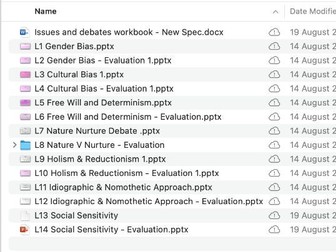
High-quality, engaging lessons designed specifically for the AQA A Level Psychology (new specification), focusing on the Issues & Debates topic. These lessons are ideal for teachers, tutors, or students seeking clear explanations, strong exam preparation, and structured skill development. Topics covered include: Gender Bias Alpha and beta bias The impact of gender bias on psychological research and theory Examples of gender bias within psychology Cultural Bias Ethnocentrism Cultural relativism Examples of cultural bias in psychological research The impact of cultural bias on psychological theories and findings Free Will and Determinism The free will–determinism debate Hard determinism, soft determinism and biological/environmental determinism Implications of determinism for responsibility and behaviour The Nature–Nurture Debate The relative contributions of heredity and environment to behaviour Interactionist approaches Examples of nature–nurture explanations across psychology Holism and Reductionism Holistic and reductionist explanations of behaviour Biological, environmental and psychological reductionism The strengths and limitations of different levels of explanation Idiographic and Nomothetic Approaches Understanding individual cases versus establishing general laws Methods associated with idiographic and nomothetic approaches Strengths and limitations of each approach Social Sensitivity Social sensitivity in psychological research The impact of psychological research on individuals, groups and wider society Socially sensitive research and its potential consequences Lesson features: Starter questions to activate prior knowledge Clear explanations with teacher modelling Deliberate practice and retrieval activities Scaffolded exam questions aligned to AQA assessment objectives Explicit development of AO1, AO2 and AO3 skills Opportunities to apply issues and debates to different areas of psychology Regular checks for understanding Model answers and evaluation opportunities Plenaries to consolidate learning and exam technique Exam-focused activities designed to develop precise, well-developed evaluation points These lessons are exam-focused, clearly structured and accessible, supporting students in developing strong subject knowledge alongside the application and evaluation skills required for success in AQA A Level Psychology. Also included is a comprehensive workbook that coincides with the lessons, allowing students to follow the content, complete activities, consolidate their learning and practise exam-style questions alongside each lesson.
AQA A Level Psychology Issues & Debates Lessons – NEW SPEC (7182)/Teaching from 2025Quick View
kirstyclark99

AQA A Level Psychology Issues & Debates Lessons – NEW SPEC (7182)/Teaching from 2025

(0)
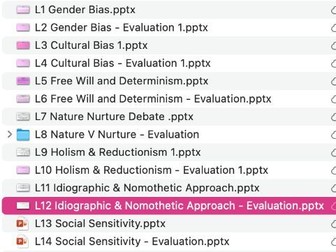
High-quality, engaging lessons designed specifically for the AQA A Level Psychology (new specification), focusing on the Issues & Debates topic. These lessons are ideal for teachers, tutors, or students seeking clear explanations, strong exam preparation, and structured skill development. Topics covered include: Gender Bias Alpha and beta bias The impact of gender bias on psychological research and theory Examples of gender bias within psychology Cultural Bias Ethnocentrism Cultural relativism Examples of cultural bias in psychological research The impact of cultural bias on psychological theories and findings Free Will and Determinism The free will–determinism debate Hard determinism, soft determinism and biological/environmental determinism Implications of determinism for responsibility and behaviour The Nature–Nurture Debate The relative contributions of heredity and environment to behaviour Interactionist approaches Examples of nature–nurture explanations across psychology Holism and Reductionism Holistic and reductionist explanations of behaviour Biological, environmental and psychological reductionism The strengths and limitations of different levels of explanation Idiographic and Nomothetic Approaches Understanding individual cases versus establishing general laws Methods associated with idiographic and nomothetic approaches Strengths and limitations of each approach Social Sensitivity Social sensitivity in psychological research The impact of psychological research on individuals, groups and wider society Socially sensitive research and its potential consequences Lesson features: Starter questions to activate prior knowledge Clear explanations with teacher modelling Deliberate practice and retrieval activities Scaffolded exam questions aligned to AQA assessment objectives Explicit development of AO1, AO2 and AO3 skills Opportunities to apply issues and debates to different areas of psychology Regular checks for understanding Model answers and evaluation opportunities Plenaries to consolidate learning and exam technique Exam-focused activities designed to develop precise, well-developed evaluation points These lessons are exam-focused, clearly structured and accessible, supporting students in developing strong subject knowledge alongside the application and evaluation skills required for success in AQA A Level Psychology.
Relationships Content Booklet - AQA A Level Psychology NEW SPECQuick View
kirstyclark99

Relationships Content Booklet - AQA A Level Psychology NEW SPEC

(0)
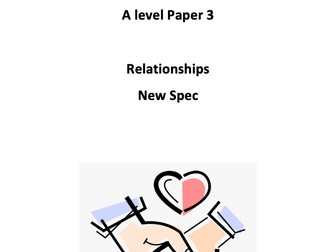
This Relationships content booklet has been carefully designed for the AQA A Level Psychology specification, providing students with clear, coherent and exam-focused content that directly supports success in exam and extended-response questions. The booklet has been developed using a range of trusted AQA-aligned resources to ensure accurate and comprehensive coverage of the specification, while presenting key theories, research and evaluation in a student-friendly and accessible format. Key features include: • Full coverage of the Relationships topic in line with the AQA A Level Psychology specification • Clear, structured explanations to support AO1 knowledge and understanding • Evaluation written using the PEEL structure (Point, Evidence, Explain, Link), modelling high-quality AO3 responses • Explicit links between key theories, research studies and the wider topic, supporting effective application and evaluation • Clear coverage of factors affecting attraction, the matching hypothesis, filter theory, social exchange theory, equity theory, investment model, relationship breakdown online relationships and parasocial relationships. • Coverage of relevant research studies and supporting evidence, helping students develop accurate and detailed knowledge • Clear explanations of key concepts, assumptions and processes within each explanation of relationships • A clear, logical layout to aid understanding, revision and independent learning • Exam-focused guidance to help students develop precise, well-developed evaluation points and apply research effectively Ideal for: • Supporting students with extended writing and Relationships exam questions • Independent revision and consolidation of key theories, research and explanations • Classroom teaching, interventions and homework • Developing students’ ability to apply, analyse and evaluate psychological theories and research • Teachers and tutors looking for a reliable, exam-ready Relationships resource This booklet helps students develop confidence, precision and clarity in their Relationships responses, enabling them to demonstrate strong knowledge and make effective links between psychological theories, research and evidence. It is an excellent resource for developing the knowledge, application and evaluation skills needed to meet the demands of AQA A Level Psychology assessments.
Issues & Debates Content Booklet - AQA A Level Psychology NEW SPECQuick View
kirstyclark99

Issues & Debates Content Booklet - AQA A Level Psychology NEW SPEC

(0)
This Issues and Debates content booklet has been carefully designed for the AQA A Level Psychology specification to provide students with clear, coherent, and exam-focused content that directly supports success in exam and essay questions. The booklet has been developed using a range of trusted AQA-aligned resources to ensure accurate and comprehensive coverage of the specification, while presenting key debates and complex psychological issues in a student-friendly and accessible format. Key features include: • Full coverage of the Issues and Debates topic in line with the AQA A Level Psychology specification • Clear, structured explanations to support AO1 knowledge and understanding • Evaluation written using the PEEL structure (Point, Evidence, Explain, Link), modelling high-quality AO3 responses • Explicit links between key debates, psychological approaches and exam/essay questions, supporting effective application and evaluation • Clear coverage of gender bias, cultural bias, social sensitivity, free will and determinism, the nature–nurture debate, holism and reductionism and idiographic and nomothetic approaches • A clear, logical layout to aid understanding, revision and independent learning • Exam-focused guidance to help students develop precise, well-developed evaluation points Ideal for: • Supporting students with extended writing and Issues and Debates essay questions • Independent revision and consolidation of key debates and issues • Classroom teaching, interventions and homework • Developing students’ ability to apply debates across different areas of psychology • Teachers and tutors looking for a reliable, exam-ready Issues and Debates resource This booklet helps students develop confidence, precision and clarity in their Issues and Debates responses, enabling them to make effective links between debates and the wider AQA Psychology specification. It is an excellent resource for developing the knowledge, application and evaluation skills needed to meet the demands of AQA A Level Psychology assessments.
Clinical Psychology & Mental Health Content Booklet - AQA A Level Psychology NEW SPECQuick View
kirstyclark99

Clinical Psychology & Mental Health Content Booklet - AQA A Level Psychology NEW SPEC

(0)
This Clinical Psychology and Mental Health content booklet has been carefully designed for the AQA A Level Psychology specification, providing students with clear, coherent and exam-focused content that directly supports success in exam and extended-response questions. The booklet has been developed using a range of trusted AQA-aligned resources to ensure accurate and comprehensive coverage of the specification, while presenting key explanations, research and evaluation in a student-friendly and accessible format. Key features include: • Full coverage of the Clinical Psychology and Mental Health topic in line with the AQA A Level Psychology specification • Clear, structured explanations to support AO1 knowledge and understanding • Evaluation written using the PEEL structure (Point, Evidence, Explain, Link), modelling high-quality AO3 responses • Explicit links between psychological explanations, treatments and research studies, supporting effective application and evaluation • Clear coverage of definitions in the field of mental health, the characteristics of OCD, phobias and depression, the biological explanation and treatments for OCD, the behaviourist explanation and treatments for phobias, and the cognitive explanation and treatments for depression • Coverage of relevant research studies and supporting evidence, helping students develop accurate and detailed knowledge • Clear explanations of key concepts, assumptions and processes within each explanation and treatment • A clear, logical layout to aid understanding, revision and independent learning • Exam-focused guidance to help students develop precise, well-developed evaluation points and apply research effectively Ideal for: • Supporting students with extended writing and Clinical Psychology and Mental Health exam questions • Independent revision and consolidation of key explanations, research and treatments • Classroom teaching, interventions and homework • Developing students’ ability to apply, analyse and evaluate psychological explanations and research • Teachers and tutors looking for a reliable, exam-ready Clinical Psychology and Mental Health resource This booklet helps students develop confidence, precision and clarity in their Clinical Psychology and Mental Health responses, enabling them to demonstrate strong knowledge and make effective links between psychological explanations, research, diagnosis and treatments. It is an excellent resource for developing the knowledge, application and evaluation skills needed to meet the demands of AQA A Level Psychology assessments.
GCSE AQA Sociology Families & Households Content BookletQuick View
kirstyclark99

GCSE AQA Sociology Families & Households Content Booklet

(0)
Support your students’ learning with this clear and comprehensive content booklet for the Families and Households topic. Designed specifically for AQA GCSE Sociology, it provides: Concise, Accessible Notes – Covers all key concepts, theories, and studies, making complex ideas easy to understand. Structured for Learning – Organised logically to support both teaching and independent study. Exam-Focused – Highlights essential knowledge for exam success and helps students consolidate learning. Perfect for classroom use, revision, or independent study, this booklet is an invaluable tool for helping students master the Families and Households unit and boost their confidence in exams.
AQA A Level Psychology NEW SPEC - Biopsychology Past Paper Question BookletQuick View
kirstyclark99

AQA A Level Psychology NEW SPEC - Biopsychology Past Paper Question Booklet

(0)
This booklet is a carefully curated collection of exam-style questions for the Biopsychology topic, designed to help students develop secure knowledge, strong application skills, and confident exam technique in line with the AQA A Level Psychology specification. The questions cover all key areas of Biopsychology, including: Divisions of the nervous system (central and peripheral: somatic and autonomic) Neurons and synaptic transmission, including neurotransmitters, excitation and inhibition The endocrine system, glands and hormones The fight or flight response, including the role of adrenaline Ways of studying the brain, including fMRI, EEGs, ERPs and post-mortem examinations Localisation of function and hemispheric lateralisation, including Broca’s and Wernicke’s areas and split-brain research Plasticity and functional recovery of the brain after trauma The booklets include a wide range of AO1, AO2 and AO3 exam questions, allowing students to: Practise precise use of biopsychological terminology Apply knowledge to unfamiliar contexts Develop effective evaluation and comparison skills Ideal for: Retrieval practice and independent revision Homework, interventions, and exam preparation Teachers and tutors seeking ready-made assessment resources These booklets support deliberate practice and exam readiness, helping students become familiar with AQA exam-style questioning while strengthening understanding and confidence in Biopsychology.
Biopsychology Content Booklet - AQA A Level Psychology NEW SPECQuick View
kirstyclark99

Biopsychology Content Booklet - AQA A Level Psychology NEW SPEC

(0)
This Biopsychology content booklet has been carefully designed for the AQA A Level Psychology (new specification) to provide students with clear, coherent and exam-focused content that directly supports success in exam and essay questions. The booklet has been developed through collaboration across multiple AQA-approved textbooks, ensuring accurate and comprehensive coverage of the specification while presenting complex biological concepts in a student-friendly and accessible format. Key features include: Full coverage of the Biopsychology topic in line with the new AQA specification Clear, structured explanations to support AO1 knowledge and understanding Evaluation written using the PEEL structure (Point, Evidence, Explain, Link), modelling high-quality AO3 responses Explicit links between content and exam/essay questions, supporting effective application and evaluation A clear, logical layout to aid understanding, revision, and independent learning Ideal for: Supporting students with extended writing and essay structure Independent revision and consolidation of complex biological content Classroom teaching, interventions, and homework Teachers and tutors looking for a reliable, exam-ready Biopsychology resource This booklet helps students develop confidence, precision and clarity in their Biopsychology responses, making it an excellent resource for meeting the demands of AQA A Level Psychology assessments.
Approaches Content Booklet - AQA A Level Psychology NEW SPECQuick View
kirstyclark99

Approaches Content Booklet - AQA A Level Psychology NEW SPEC

(0)
This Approaches content booklet has been carefully designed for the AQA A Level Psychology (new specification) and provides students with clear, coherent and exam-focused content to support success in both short-answer and essay questions. The booklet has been created through collaboration across multiple AQA-approved textbooks, ensuring accurate coverage of the specification while presenting the material in a student-friendly and accessible format. Content is concise yet detailed, helping students understand key theories, concepts, and studies without becoming overwhelmed. Key features include: Full coverage of the Approaches topic in line with the new AQA specification Clearly structured explanations to support AO1 knowledge Evaluation written using the PEEL structure (Point, Evidence, Explain, Link), modelling high-level AO3 responses Explicit links to exam and essay questions, supporting effective application and evaluation Clear, logical layout to improve comprehension and independent study Ideal for: Supporting students with essay writing and exam technique Independent revision and content consolidation Classroom teaching, interventions, and homework Teachers and tutors seeking a reliable, exam-ready resource This booklet helps students develop confidence, clarity and coherence in their responses, making it an excellent resource for mastering the Approaches topic and meeting the demands of AQA A Level Psychology assessments.
Research Methods Content Booklet - AQA A Level Psychology NEW SPECQuick View
kirstyclark99

Research Methods Content Booklet - AQA A Level Psychology NEW SPEC

(0)
This Research Methods content booklet has been carefully designed for the AQA A Level Psychology (new specification) to provide students with clear, coherent, and exam-focused content that directly supports success in exam and essay questions. The booklet has been developed through collaboration across multiple AQA-approved textbooks, ensuring accurate and comprehensive coverage of the specification while presenting complex research concepts in a student-friendly and accessible format. Key features include: Full coverage of the Research Methods topic in line with the new AQA specification Clear, structured explanations to support AO1 knowledge and understanding Evaluation written using the PEEL structure (Point, Evidence, Explain, Link), modelling high-quality AO3 responses Explicit links between content and exam/essay questions, supporting effective application and evaluation A clear, logical layout to aid understanding, revision, and independent learning Ideal for: Supporting students with extended writing and essay structure Independent revision and consolidation of complex research methods concepts Classroom teaching, interventions, and homework Teachers and tutors looking for a reliable, exam-ready Research Methods resource This booklet helps students develop confidence, precision, and clarity in their Research Methods responses, making it an excellent resource for meeting the demands of AQA A Level Psychology assessments.
Collection of AQA A Level Psychology Retrieval/Starter Questions with AnswersQuick View
kirstyclark99

Collection of AQA A Level Psychology Retrieval/Starter Questions with Answers

(0)
This AQA A Level Psychology Retrieval & Starter Questions resource is the perfect tool to help students revise, consolidate, and recall key knowledge across the specification, including the optional topics Relationships, Forensics, and Schizophrenia. Packed with high-quality, exam-focused questions and answers, this resource is designed to strengthen students’ understanding, boost memory retention, and build confidence in tackling both short-answer and extended exam questions. Key features include: Extensive collection of retrieval and starter questions covering core and optional topics Clear, concise answers for self-assessment and independent study Focus on exam-relevant content to support AO1 knowledge and AO3 evaluation Flexible use in class, as homework, or for individual revision Perfect for quick retrieval practice, low-stakes quizzes, and lesson starters Ideal for: Boosting recall and reinforcing understanding across the AQA A Level Psychology specification Supporting students preparing for the compulsory topics and Relationships, Forensics, and Schizophrenia topics Teachers seeking ready-to-use starter activities, quizzes, or independent study materials This resource ensures students engage with, practise, and retain essential psychology knowledge, making revision more effective and exam-ready.
AQA A Level Sociology Families and Households Quizzing SheetsQuick View
kirstyclark99

AQA A Level Sociology Families and Households Quizzing Sheets

(0)
This document is designed to support students revise the families and households topic. It is carefully structured around each section of the AQA Sociology specification, making it easier for students to identify what they need to know and how they will be assessed. The document lists the key concepts with definitions, the main sociologists with links to a concept and evaluation. Topics Covered: Gender roles, domestic labour and power relationships within the family in contemporary society Changing patterns of marriage, cohabitation, separation, divorce, childbearing and the life course Functions of the family and household: Overview of key sociological perspectives—Functionalism, the New Right, Marxism, Feminism, and Postmodernism, including the personal life perspective —and their views on the the relationship of the family to the social structure and social change. Demographic trends in the United Kingdom since 1900 The nature of childhood, and changes in the status of children This resource is fully aligned with the AQA specification and teaching guide, and it incorporates sources from AQA’s recommended contemporary reading list to ensure relevance and academic rigour. Of the students who used this booklet, 86% achieved grades A–B, with a 100% overall pass rate.
AQA A Level Sociology Education Quizzing SheetsQuick View
kirstyclark99

AQA A Level Sociology Education Quizzing Sheets

(0)
This document is designed to support students revise the education topic. It is carefully structured around each section of the AQA Sociology specification, making it easier for students to identify what they need to know and how they will be assessed. The document lists the key concepts with definitions, the main sociologists with links to a concept and evaluation. Topics Covered: Differential Educational Achievement: Analysis of how social class, gender, and ethnicity influence educational outcomes, with evaluation of key explanations. Internal Factors in Education: Examination of school-based relationships and processes, linked to social class, gender, and ethnicity, including evaluative content. Functions of the Education System: Overview of key sociological perspectives—Functionalism, the New Right, Marxism, Feminism, and Postmodernism—and their views on the role of education. Educational Policy and Globalisation: Evaluation of policies relating to selection, marketisation, privatisation, and efforts to promote equality. Includes analysis of globalisation’s impact on educational policy and practice. This resource is fully aligned with the AQA specification and teaching guide, and it incorporates sources from AQA’s recommended contemporary reading list to ensure relevance and academic rigour. Of the students who used this booklet, 86% achieved grades A–B, with a 100% overall pass rate.
AQA A Level Psychology Approaches Lessons & Workbook - NEW SPEC (7182)/Teaching from 2025Quick View
kirstyclark99

AQA A Level Psychology Approaches Lessons & Workbook - NEW SPEC (7182)/Teaching from 2025

(0)
High-quality, engaging lessons designed specifically for the AQA A Level Psychology (new specification), covering all core approaches in psychology. These lessons are ideal for teachers, tutors, or students seeking clear explanations, strong exam focus, and structured skill development. Topics covered include: Learning Approaches Behaviourist approach: classical conditioning (Pavlov), operant conditioning, types of reinforcement, and Skinner’s research Social Learning Theory: imitation, identification, vicarious reinforcement, mediational processes, and Bandura’s research Cognitive Approach Internal mental processes, schemas, and the use of models to explain and infer mental processes Biological Approach Genetic basis of behaviour (genotype, phenotype, evolution) Influence of biological structures, neurochemistry, and cognitive neuroscience Psychodynamic Approach The unconscious, structure of personality (Id, Ego, Superego) Defence mechanisms (repression, denial, displacement) and psychosexual stages Humanistic Psychology Free will, self-actualisation, Maslow’s hierarchy of needs, congruence, and conditions of worth Comparison of Approaches Clear, structured comparisons to support AO3 evaluation skills Lesson features: Starter questions to activate prior knowledge Clear explanations and teacher modelling Deliberate practice and retrieval activities Scaffolded exam questions aligned to AQA assessment objectives Regular checks for understanding Plenaries to consolidate learning and exam technique These lessons are exam-focused, well-structured, and student-friendly, supporting both content mastery and strong evaluation skills needed for success at A Level. Also included is a workbook which coincides with the lessons.