 Quick View
Teacher Exposed! How well do you know your Teacher? Editable Classroom Game Show
Teacher Exposed! How Well Do You Know Your Teacher?
Editable Classroom Game Show
How well do your students really know you? Teacher Exposed turns the teacher into the star of a lively whole-class game. Students work in teams to predict the teacher’s answers, habits, preferences, and classroom quirks. After every prediction, the teacher reveals the prepared answer and can share a short story or detail.
The humor is warm, playful, and school appropriate. The questions create recognition, laughter, and classroom connection without asking for private or uncomfortable information.
Use the game for Teacher’s Day, Teacher Appreciation Week, back to school, the end of the year, advisory, homeroom, class parties, or community-building lessons.
The PowerPoint is designed specifically for classroom projection. Students see only the game instructions, questions, answer choices, and reveals. All preparation, editing, scoring, and troubleshooting information is kept in a separate Teacher Guide PDF.
What is included:
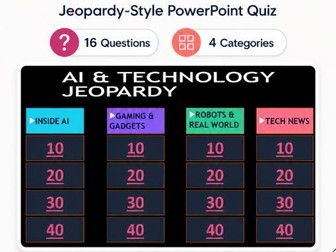
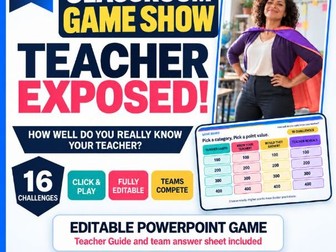
One fully editable 35-slide PowerPoint game (One clickable 4 x 4 game board with 16 sixteen question slides, editable teacher reveal slides
One six-page Teacher Guide PDF
One printable Student Team Answer Sheet PDF
Teacher answer-planning pages and a final projection checklist
How the game works
A team selects a category and point value from the clickable board.
Every team discusses the prompt and agrees on one prediction.
Teams keep their answers secret until they are called.
The teacher selects REVEAL and shares the prepared answer.
The exact answer or closest prediction earns the points.
The BOARD button returns the class to the main game board.
Editable features
Category titles, point values, questions, answer choices, teacher answers, story lines, colors, and photos can all be changed. The included photos may also be replaced with the teacher’s own school-appropriate images.
Recommended for upper elementary, middle school, and high school. Teachers can edit any prompt to match student age, school culture, or class context.