This is a worksheet that I produced for an observation. There are 4 sections with 8 questions in each section. Each section is harder than the previous and answer boxes (all jumbled up) are on the right so that students can self-check. Answers are also provided. This is a sheet that I will always use when I teach this topic.
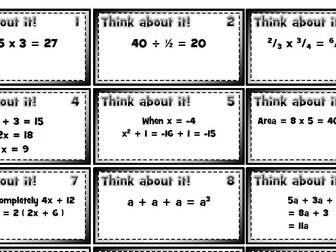
There are 24 cards each containing a question and an answer. 22 of them are incorrect and bare based on common misconceptions. Can students spot the correct two answers and correct the other 22. Promotes some good discussions.
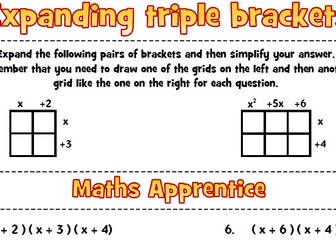
This is a worksheet with (easier) expanding triple brackets which is the 'Maths Apprentice' section and then the 'Maths Gangsta' section containing questions that have a coefficient of x which is greater than 2. Answers are also provided. A chance for students to practise the new GCSE topic.
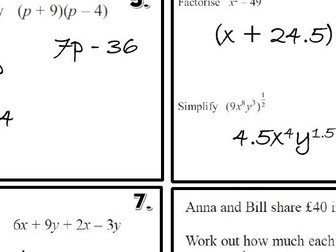
I have made this to provide a spin on the revision process leading up to the GCSEs. I have created 24 exam-style questions and have provided some 'working out' and an answer. All of the answers are incorrect by means of a common misconception. The task for the pupils is to spot the mistake and correct it. I have tried this with multiple classes and they find it fun and useful and many of them fail to spot the misconceptions thereby promoting some insightful discussions too.
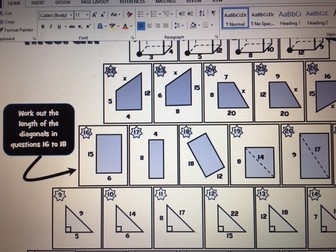
This worksheet starts at the bottom with easy questions (working out the hypotenuse), then to ones in which you work out one of the smaller sides. You then move up the sheet, working out diagonals of rectangles and lengths in which additional lines need to be drawn in order to create the triangle. A random answer grid is also here so that students can self-check as they go along.
The worksheet has 24 questions, divided into three sections, getting progressively harder. There are boxes which contain the answers that are randomly scattered so that students can self-check. I have been making my own resources for 15 years now and take pride in making sure they are beautifully presented. I will only upload resources that I use myself on a regular basis.
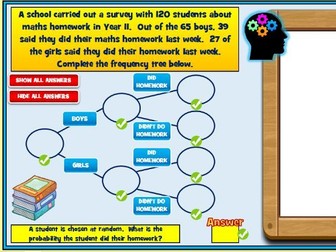
I’ve been using Excel for 20 years now and it is amazing what you can create in it. As with all of my files, content and presentation are always exceptional. This is a file to deliver the topic of frequency trees. You access the questions using the tabs at the bottom of the screen. There are three different trees to fill in and the answers are revealed by clicking on the ticks buttons. Each one ends with a probability question relating to the tree. There is a further tab which contains 4 questions in which students need to create and complete their own tree before answering a probability question relating to the tree. As before, all answers can be revealed at a click of the button. I would use this to teach the topic from scratch or as part of intervention when getting the students ready for their mocks or real GCSEs. I have produced over 30 of these files so if you find this useful, please have a look at others in the series.
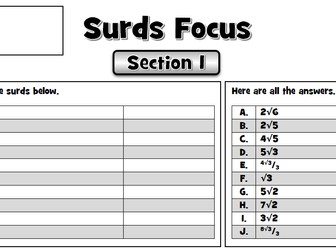
This activity contains 3 sections which involve simplifying surds. The answers are provided in random order on the right so students can self-check. Good practice on a challenging topic.
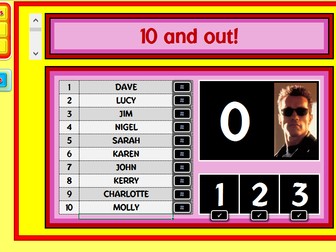
Many students have played a similar game before which they may call 'elevenses'. You choose 10 students, they then take it in turns to say 1, 2 or 3. Their number is added on to the total and once it gets to 9, the next person is out as whoever takes it up to 10 is out. This activity is ideal for the last 5 minutes of the lesson to ensure the students remain mentally focused as well as leaving the lesson on a high.
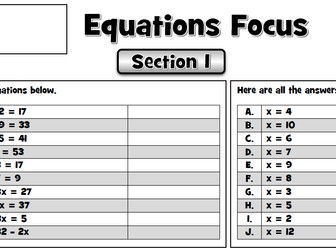
This activity contains 10 sections, each containing 10 equations for the students to solve. the answers are provided (scrambled up) and have a letter attached to them which makes marking them very easy (answers are provided). It starts with two-step equations, then equations with unknowns on both sides then those with brackets and it moves onto solving quadratics by factorising and simultaneous equations.
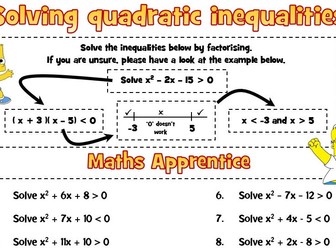
I have made this to teach my Year 11 groups as this has filtered down to the Higher tier. It contains 10 questions in which the coefficient of the x^2 is 1 and then 10 questions in which the coefficient is greater than 1. The answers are provided and this serves as excellent practice to get them ready for the new content to the GCSE.
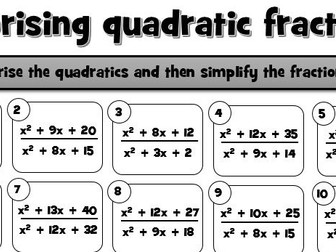
This activity contains thirty algebraic fractions in which students have to factorise the top and bottom into double brackets and then cancel some out to leave the simplified answer. This is one of the harder topics on the higher paper and serves as good practice for factorising quadratics as well as a means of pushing the most able. There is a scrambled answer grid so that students can check as they go so that they can be independent.
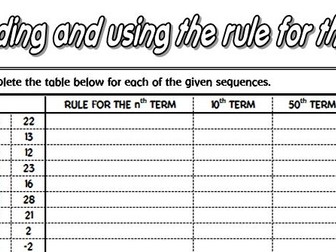
This is a worksheet that I made to extend the learning on this topic. Students start off by working out the rule for the nth term and then use the rule to work out the 10th, 50th and 100th term. In the next sections they are given the rule and have to work out the sequences and then have bits of information given and have to work out the rest. I have also found that groups like this activity and it stretches even the more able.
We all know that there is loads of ratio in the GCSE so I made this worksheet to have some intense practice on ratio. The first couple of sections contain standard ratio questions so that students can refresh their knowledge on the topic. Answers are contained in the boxes on the right so that students can self-check as they go along. The second side contains lots of exam questions in which the students will need to apply their knowledge in an exam context. Enjoy!
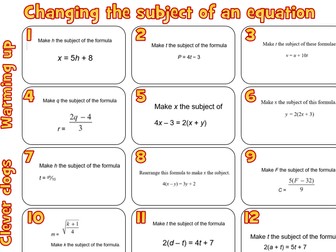
This activity contains 24 questions in which the students have to rearrange the formula in order to change the subject of the equation. They start off on the easier, two-step equations and then move onto the harder ones. This will provide support for those on the foundation tier but will certainly challenge even the most able on the higher tier.
I made this resource for Year 11 to focus on area and perimeter of compound shapes. The first few sections contains triangles and rectangles and then it moves on to compound shapes. Answer boxes (all jumbled up) contain all of the answers so that students can self-check, freeing up the teacher to support students who are struggling. The second side contains exam questions so that students can apply their knowledge and understanding in an exam question context. Enjoy!
I made this resource to use with my Year 11 classes to revise Pythagoras and trigonometry. There are 18 questions on each with answer boxes (jumbled up) on the right side of the sheet enabling students to self-check as they go along (frees the teacher up to support those that are struggling and encourages independence to the others (rather than racing around marking the same question 30 times). I’ve used it with a few classes and it worked well every time. The last six questions on each topic are concealed Pythagoras and trigonometry questions that sometimes appear in the GCSE just to prepare the students. Enjoy!
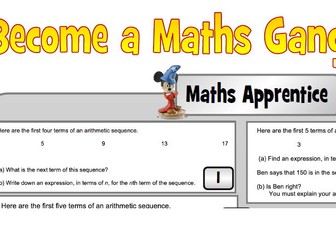
I've called this 'Become a Maths Gangsta' because the students get pulled into this activity containing four boxes of sequences questions with each box containing harder questions. Start off as a Maths Apprentice, then move onto 'Maths Expert', before becoming a 'Maths Jedi' and then a 'Maths Gangsta'. The students love it and it covers all aspects of the sequences topics from the nth term of a linear sequence all the way to lovely quadratic sequences. Answers are also provided!
As with any school, the focus is making sure students make expected progress and, at foundation level, push to get grade 4's and 5's. I have put together this 31 page booklet of 31 topics which they will need to know at foundation level. I plan to use this in revision sessions and also for the students to take home to do some independent revision and I have spent about 20 hours putting this together. I have produced similar booklets in the past and the students always find them useful. Each page has lots for exam questions on many of the key topics ranging from simplifying expressions and compound area to Pythagoras and trigonometry. I have been teaching for over 15 years now and I spend hours producing resources that I use myself on a daily basis.
This is another key topic for the GCSE students. I made this to help them to focus on equations so the first side contains many equations which are to be solved algebraically. Answer boxes are provided on the right (all jumbled up) so that students can self-check, freeing the teacher to support those that find it difficult. The second side contains exam questions in which students have to create and then solve equations based on information given or shapes containing sides or angles expressed with algebra. Enjoy!
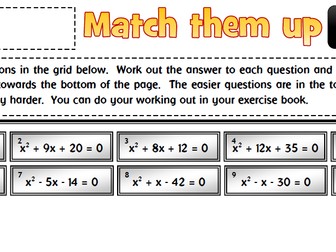
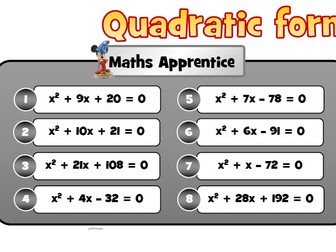
This is an activity which I made for my Year 10 and 11 groups. There are 30 questions at the top and 30 answers at the bottom. The students have to factorise and solve the 30 quadratics at the top and then match each one to the corresponding answer at the bottom of the page. The structure of the sheet allows the students to self-mark and also allows the teacher to swiftly check for correct and incorrect answers when circulating in the classroom.


 Quick View