Use this activity sheet with a clip of the ‘America’ song from Westside Story. Students classify parts of the song as push factors, pull factors or results of the migration, while enjoying the music!
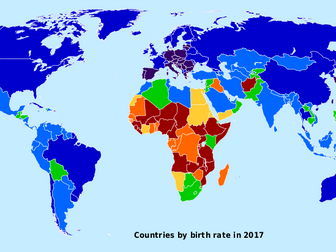
This can be used as a task within a lesson about population growth.
It is a series of factors for students to classify as mostly affecting either birth rate or death rate, then they can use them to create a spider diagram of the factors, adding an up or down arrow to show whether it would increase or decrease the birth rate or the death rate, also explaining why.
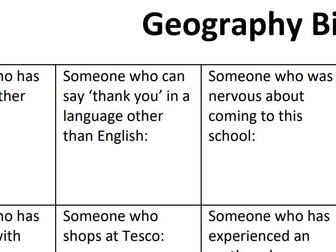
Aimed at new Year 7 classes - students go around the room and speak to their peers, writing names into the boxes. Works really well with some teacher led feedback at the end, asking further questions around the bingo requirements.
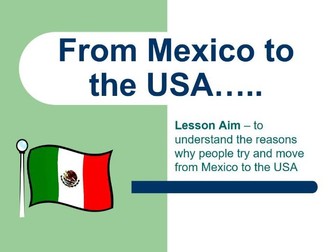
This is a full lesson that uses a conference style debate to encourage students to look at differing viewpoints about the controversial issue of migration from Mexico to the USA, thinking about it from the perspective of a range iof different stakeholders.
The Powerpoint presentation starts with a series of key pictures of ways in which migrants try to cross the border to remind the students of the lengths the migrants will go to, and then the conference groups are introduced and the conference explained.
There is also a set of role cards to help the students put their conference speeches together and a helpsheet with some key facts they could incorporate.
I have used this successfully with Year 9, but it would probably work for any year group in Key Stage 3.
A complete lesson aimed at Year 9 introducing migration as a concept. There is a matching task to learn key terms and definitions, a push/pull factors activity and a task using the ‘America’ song from Westside Story to identify push and pull factors from the perspective of the Puerto Rican migrants to New York. It concludes with a homework task asking students to interview a real-life migrant!
This full lesson uses the well known ‘Enrique’ card sorting task to build a story of why Mexicans continue to take huge risks to cross the border into America. It has a starter, a differentiated follow up task and a plenary.
This is a complete lesson on tropical rainforest plant adaptations geared towards Key Stage 3 that includes a Powerpoint presentation and a tasksheet for an ‘off the peg’ approach.
The lesson invites the students to recap some of the climatic conditions in the rainforest to set the scene for the adaptations that have developed. Students then use a cut and stick activity to identify the adaptations and describe and explain them - there are big images of all of them in the slideshow which you can use to go over the correct answers or to provide stimulus for the task, whichever you prefer.
Then there is a follow-up activity looking at the rainforest nutrient cycle and comparing it to the broken nutrient cycle after the forest has been cleared.
This is a complete lesson comprising a Powerpoint presentation and a worksheet that introduces the tundra biome, looking at where it is located, its main characteristics and its climate, using a climate graph to help develop graph skills.
This is a lesson aimed at Key Stage 3 which introduces conditions in the tropical rainforest and covers the main vegetation layers. Everything you need is included to go ahead and teach it ‘off the peg’.
The lesson starts with a rainforest picture and rainforest sounds - you could close your blinds and turn the lights off to make it a bit more like the forest floor! Students get straight into a short piece of creative writing describing what they can see, hear, smell etc - there is a structure sheet to help them if needed and you might want to come up with a few sentences of your own to get them started.
A few students could feed back and read theirs out.
Then there is a slide comparing rainforest conditions with conditions in the classroom - ideally you need an environment meter for this so you can measure temp and humidity in the room.
After that, layers. There are three differentiated tasks - two wordfill sheets (one harder than the other) and a more open notes sheet for your highest ability. This higher ability task requires a resource sheet - I used a double page from Waugh’s ‘Integrated Approach’ textbook, of which I have included a picture.
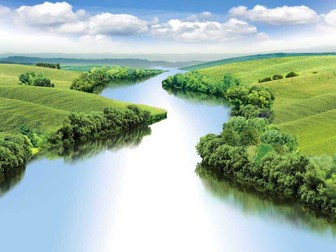
This little game tests students on their recall of river processes and their definitions.
Print out the sheet on card or laminate it, then cut out as separate ROWS - each student has a row containing a term and a definition. A student jumps up and reads out their term, and the student with the correct definition jumps up and reads that out - if they are correct, the read out their term and on it goes until you get back to the start.
It can also be played the other way, starting with the definitions and looking for the correct terms.
For a class of 30ish students, print out two copies and add an element of competition…


 Quick View