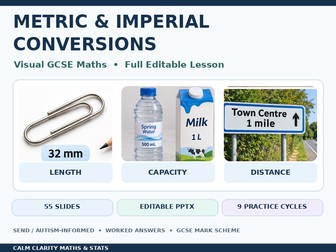
Metric & Imperial Conversions | Full Editable SEND GCSE LessonQuick View
gkinyanjui

Metric & Imperial Conversions | Full Editable SEND GCSE Lesson

(0)
Metric and imperial conversions GCSE lesson: 55 editable visual slides, SEND-informed teaching, graduated practice, worked answers and 5 GCSE questions. About the resource Teach measurement conversions confidently, beginning with familiar everyday objects and progressing to GCSE area, volume, capacity and multistep reasoning. The PowerPoint uses spacious layouts, predictable teaching stages, careful colour meaning and illustrative photo-style images. Designed with learners who benefit from visual structure in mind, including some autistic and SEND learners. No single design suits every learner. What is covered Metric length: mm, cm, m and km, with direct multiplication and division. Metric mass and capacity: g, kg, mL and litres. Imperial length: inches, feet, yards and miles. Imperial mass and UK capacity: ounces, pounds, stones, UK pints and gallons. Converting between systems using supplied factors: inches/cm, miles/km, kg/lb, UK pints/L and mph/km/h. Squared units: perimeter versus area; cm² and m². Cubed units: cm³, m³, millilitres and litres; cuboid capacity. Identifying and correcting common conversion mistakes. Lesson structure and included files One 55-slide editable PowerPoint (PPTX). First-slide learning objectives and expected outcomes, gentle photo-based starter with checking, four-stage lesson roadmap, and NINE teaching cycles: The Idea → Worked Example → Your Turn → Check. Every Your Turn includes START, BUILD and STRETCH tasks, with the full worked answers on the immediately following slide. There are 27 graduated practice questions in total. Five original GCSE-style assessment questions (21 marks) with five separate detailed, teacher-created marking slides. At the very end are THREE large, editable reference tables covering metric, imperial and between-system conversions. Speaker notes support teachers throughout. How to teach Suitable for KS3 recap, KS4/GCSE Foundation and selected Higher bridging or intervention. Use as two teaching sessions or select sections for targeted catch-up, revision and cover. Pause or print the summary tables. Teachers can change the order, working pace and accessibility settings. British curriculum terminology is used; international equivalents are included where helpful (metre/meter, litre/liter, maths/mathematics). UK pints and gallons are clearly identified because US liquid units differ. Conversion factors between metric and imperial are supplied in the example questions, as in GCSE exams. File included: one editable 55-slide PPTX. No separate worksheets or officially reproduced past-paper questions.
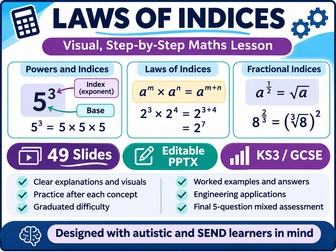
Laws of Indices | Autism-Friendly PowerPoint | KS3–KS4Quick View
gkinyanjui

Laws of Indices | Autism-Friendly PowerPoint | KS3–KS4

(0)
Laws of Indices PowerPoint: 32 visual slides designed with autistic and SEND learners in mind, with worked examples and short KS3/GCSE maths tasks. Use it for structured explanations and carefully paced practice. About this resource Teach the laws of indices through small, manageable steps rather than dense algebra. This editable PowerPoint uses repeated-factor diagrams, uncluttered slides and consistent visual cues to help pupils see what powers mean and choose the correct rule. It has been designed with learners who benefit from predictable structure and visual support in mind, including some autistic and SEND learners. What’s covered What powers, bases and indices mean, with repeated multiplication. Using the power key on a calculator. The zero and power-of-one rules. Multiplying powers with the same base: add the indices. Dividing powers with the same base: subtract the indices. Powers of powers: multiply the indices. Negative indices as reciprocals. Fractional indices, including square roots, cube roots and powers such as 8 to the power of 2/3. Applying rules in engineering-themed examples. Inside the 32 slides Clear lesson goals and introductory examples. Factor diagrams and visual explanations before formal rules. Worked numerical and algebraic examples. Short ‘Your turn’ checks, with answers or worked checking slides. One-page visual summary of the main index laws. Engineering-themed machine-wear and alarm-time calculations. Exit check plus two optional engineering recap slides. How to use it Present the slides in order for supported whole-class teaching, or select individual sections for a recap, intervention, small group or revision session. Pause at the ‘Your turn’ prompts for verbal answers, mini-whiteboards or written working. Use the recap slide to support memory and the exit check to identify which rules need revisiting. Who it’s for Useful for KS3 learners meeting index notation, GCSE/KS4 pupils revisiting index laws, and post-16 learners who need a step-by-step refresher. Teachers can adjust the pace and level of support to suit their group. Fractional and negative indices can be taught separately if needed. File supplied One editable Microsoft PowerPoint (.pptx), 32 slides. This download does not include a separate worksheet, assessment pack or SCORM activity.
Solving Linear Equations | KS3 GCSE | Visual SEND Lesson PowerPoint| EditableQuick View
gkinyanjui

Solving Linear Equations | KS3 GCSE | Visual SEND Lesson PowerPoint| Editable

(0)
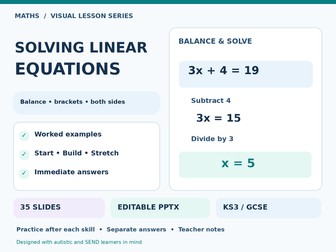
Solving Linear Equations PowerPoint: 35 editable KS3/GCSE maths slides with step-by-step examples, graduated practice and answers for visual SEND support. Full lesson About this resource This structured algebra teaching presentation builds confidence in solving linear equations in one variable. Pupils first understand equality and the balance method, then practise inverse operations before moving towards brackets, negative answers and unknowns on both sides. It uses consistent See → Try → Check stages, spacious layouts and calm visual cues. Topics and skills Meaning of an equation and keeping both sides balanced One-step and two-step equations using inverse operations Negative solutions and careful checking by substitution Expanding brackets before solving Collecting variables when unknowns appear on both sides Mixed equations, fractional solutions and a simple engineering context A Spot the Mistake explanation to address a common misconception What’s included 35 editable PowerPoint slides (.pptx) with teacher notes 9 graduated Start / Build / Stretch practice sets, with separate answer slides Clearly modelled step-by-step calculations and a one-page rule recap A five-question summative check followed by an answer slide Flexible teacher-led pacing: no compulsory timers or distracting transitions Who it’s for and how to use it Designed for KS3 (ages 11–14), GCSE Foundation learning and older pupils who need a structured recap. Useful for whole-class modelling, mini-whiteboard checking, small-group intervention, catch-up and revision; select a few sections per session if appropriate. The clear layout is designed with some autistic and SEND learners in mind, without assuming one format suits everyone. International classroom use The same algebra skills appear in programmes describing one-variable equations, inverse operations and Algebra 1 foundations. Suitable for adaptation by teachers outside the UK; it is not mapped or endorsed to a particular US, IB or Cambridge specification.
Straight-Line Graphs: Coordinates & Plotting | Full Editable SEND-Friendly Lesson with ObjectivesQuick View
gkinyanjui

Straight-Line Graphs: Coordinates & Plotting | Full Editable SEND-Friendly Lesson with Objectives

(0)
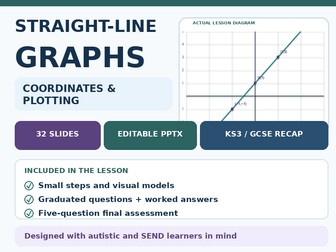
Straight-Line Graphs PowerPoint: 32 editable KS3 maths slides teaching coordinates, tables of values and plotting, with graduated practice and answers. About this resource Build confidence in straight-line graphs through a predictable, small-step sequence suitable for KS3 and GCSE Foundation recap. Students learn to read coordinates in all four quadrants, complete linear tables of values, plot accurate points and draw a straight line from an equation. Short visual explanations, a gentle starter and immediate worked answers help pupils check each skill before moving on. Skills covered x- and y-axes, the origin and ordered pairs (x,y) Positive and negative coordinates, quadrants I–IV Substituting x-values into a linear expression Completing tables of values and recording ordered pairs Plotting and joining points to draw a straight-line graph Reading y for a given x and finding a simple x-value An applied production-time model with units A clearly labelled Spot the Mistake activity What is included 32 editable PowerPoint slides (.pptx) Lesson objectives, expected outcomes and soft retrieval starter Original editable graph diagrams and clear worked examples 6 skill-focused START / BUILD / STRETCH sets plus a starter, each immediately followed by a CHECK slide Teacher speaker notes and a visual recap Exactly five mixed end-of-lesson questions with worked answers on the following two slides Who it suits Designed with some autistic and SEND learners in mind: consistent blue explanation, lilac practice and mint check stages, uncluttered slides, no automatic timers and optional oral, mini-whiteboard or written responses. Suitable for KS3, supported GCSE revision and intervention. Teach over one or more sessions as appropriate. International terms Also relevant for teachers seeking coordinate plane, graphing linear equations, ordered pairs and slope foundations. Not mapped to a particular US, IB or IGCSE specification. File supplied: one editable PPTX only. No separate worksheets or online activitie
Gradient & Slope | Full Editable SEND Maths Lesson GCSEQuick View
gkinyanjui

Gradient & Slope | Full Editable SEND Maths Lesson GCSE

(0)
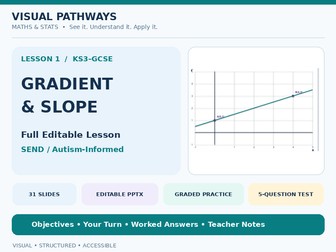
Gradient & Slope lesson: 31 editable KS3/GCSE maths slides with objectives, visual examples, graduated questions, worked answers and SEND-informed pacing. About this resource Full editable PowerPoint lesson from Visual Pathways Maths & Stats. Positive, negative and fractional gradients. The lesson advances through carefully modelled examples and genuine graduated START / BUILD / STRETCH questions, with matching worked answers on the next slide. Predictable layouts, muted blue/lilac/mint panels and untimed practice are designed with some autistic and SEND learners in mind; pupils’ individual preferences and needs should still guide adaptation. Topics and skills Reading positive, negative and zero gradients Using gradient = change in y ÷ change in x Finding gradient between two points, including negatives and fractions Comparing steepness and correcting misconceptions about the sign What is included 31 editable PowerPoint slides (.pptx) with presenter/teacher notes Lesson title, objectives, expected outcomes and soft starter Graduated Your Turn tasks with immediate Check/answer slides Exactly five original GCSE exam-style summative questions, followed by worked marking schemes Calm editable graphs, formula text and worked algebra where applicable How to teach and who it suits KS3 to GCSE Foundation / revision. Use whole-class modelling, mini-whiteboards, intervention, revision or quiet independent attempts. The format is teacher-paced with no required timers. Spread the teaching over two sessions where additional processing time is useful. International classroom language UK gradient = US slope; straight-line graphs = graphing linear equations. Adaptable to secondary mathematics internationally, but not mapped to or endorsed by Common Core, IB, Cambridge or any named exam board. Files supplied: one PowerPoint. No separate worksheets, exam-board paper reproductions, digital graphing app or SCORM activity.
Engineering Algebra:Autism-Friendly QuestionsQuick View
gkinyanjui

Engineering Algebra:Autism-Friendly Questions

(0)
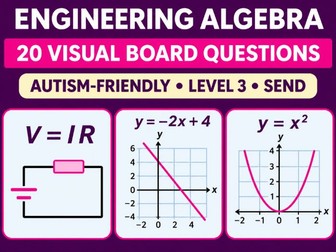
Autism-Friendly Engineering Algebra Editable PowerPoint | 20 Visual Board Questions | Level 3 Maths | SEND A 20-slide, editable Engineering Algebra PowerPoint for Level 3 Engineering Maths, Access to HE, Further Education (FE), post-16 and SEND-inclusive classrooms. Designed with one question per slide, large fonts, short instructions, clear diagrams and generous blank whiteboard space to make challenging algebra easier to access without lowering the mathematics. Autism-Friendly and Visual Design Predictable layout: One focused question at a time. Large, high-contrast text: Easy to see on classroom screens. Minimal reading: Short prompts supported by circuits, graphs and illustrations. Space to show working: Ideal for interactive whiteboard demonstrations, teacher modelling and student explanations. Progressive challenge: From rearranging formulae to Level 3 engineering applications. These structured features may also benefit learners with SEND, literacy or processing difficulties. Individual accessibility preferences will vary. Maths Topics Covered Algebra and Equations: Transposing formulae, Ohm’s law, resistance, electrical power and energy. Indices and Logarithms: Index laws, exponential growth and decay, capacitor discharge. Straight-Line Graphs: Plotting coordinates, gradients, intercepts, positive and negative values. Simultaneous Equations: Substitution, elimination and graphical solutions. Quadratic Equations: Factorisation, quadratic formula and graphs. Real-World Engineering Questions Explore electrical circuits, resistor networks, machine positioning, production rates, temperature sensor calibration, capacitor discharge and water-pump flow rates. The final four questions are practical engineering applications, helping learners connect abstract mathematics to real situations. How to Use Project one question, allow thinking time, then use the large blank working area for step-by-step solutions. Ideal for interactive whiteboard practice, retrieval practice, guided teaching, differentiated instruction, maths revision, formative assessment and classroom questioning. Graph questions include coordinate grids for plotting. What’s Included? 20 fully editable PowerPoint slides — one question per slide, with large mathematical notation, clear visual support and generous working space. Designed for Level 3 Engineering Mathematics, Access to Higher Education and vocational maths. Selected questions can also support GCSE Higher Maths revision. Clear visuals. Less text. Full mathematical challenge. An inclusive, autism-friendly maths teaching resource supporting confidence, participation and independent problem-solving.