KS3 Soft Sculpture Art LessonQuick View
Jasonwilliamsillustration

KS3 Soft Sculpture Art Lesson

(0)
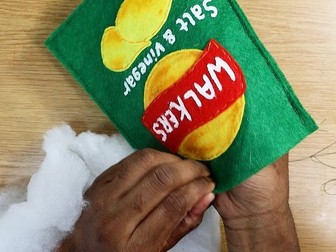
Inspire your students with this engaging, hands-on textile art lesson based on the work of contemporary artist Lucy Sparrow! Perfect for KS3 (Year 7) Art & Design, this fully resourced lesson introduces students to soft sculpture, combining creativity with practical textile skills. What’s Included Fully planned PowerPoint lesson (no videos required) Clear learning objectives and step-by-step visual instructions Printable templates for crisp packet designs Plenary quiz to assess understanding Student choice of crisp flavours for personalisation Skills & Curriculum Links Pattern cutting, stitching, and embellishment techniques Exploring the work of a contemporary British artist Transforming everyday objects into 3D textile art Encouraging creativity, independence, and craft-based skills Ideal For: Key Stage 3 Art (Year 7 focus) Introducing soft sculpture or textiles units One-off art days or enrichment activities Cover lessons (clear and scaffolded for non-specialists) “A brilliant, accessible project that gets students excited about sewing while linking art to everyday culture. Always a hit in my classroom!”
How Can Art Empower Self-Expression? – Articulated Puppet-Making Lesson (KS3)Quick View
Jasonwilliamsillustration

How Can Art Empower Self-Expression? – Articulated Puppet-Making Lesson (KS3)

(0)
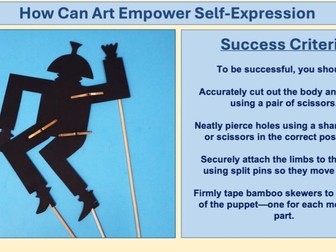
Overview: In this hands-on lesson, students explore how art can be a powerful tool for self-expression by creating their own articulated paper puppets. This engaging activity allows students to express identity, emotion, or personal interests through visual storytelling and creative construction. Learning Objective: To understand how art can empower self-expression through the creation of moveable puppets. Success Criteria: Accurately cut out the body and limbs using scissors Neatly pierce holes in correct positions using a pencil or scissors Securely attach limbs to the body with split pins to allow movement Firmly tape bamboo skewers to the back—one for each moveable part Skills Developed: Fine motor and cutting skills Understanding of articulation and mechanics in design Visual communication and personal expression Safe tool use and 3D construction techniques Ideal For: KS3 Art, Design Technology, or Drama cross-curricular links Identity, self-portraiture, or PSHE-themed art projects Students of all abilities, including EAL and SEN learners
Hilma af Klint-Inspired Abstract Forms Art Lesson (KS3)Quick View
Jasonwilliamsillustration

Hilma af Klint-Inspired Abstract Forms Art Lesson (KS3)

(0)
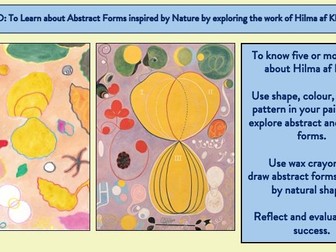
Overview: This engaging and creative lesson introduces students to the pioneering abstract artist Hilma af Klint and encourages them to explore abstract forms inspired by nature through drawing and painting. The lesson links art history with practical skills, developing students’ confidence with shape, colour, line, and pattern. Learning Objective: To learn about abstract forms inspired by nature by exploring the work of Hilma af Klint. Lesson Includes: Clear learning objective and differentiated outcomes Research and recall five key facts about Hilma af Klint Drawing activity using wax crayons to develop abstract forms from natural shapes Painting task using shape, colour, line, and pattern to create a final piece Reflective self-evaluation prompt to assess learning and creative success Visual prompts to support all stages of the lesson Ideal For: KS3 Art students A project on Abstract Art, Women Artists, or Art and Nature Cover lessons or art history/art skills integration
Designing a Creature Sculpture – Inspired by Sophie WoodrowQuick View
Jasonwilliamsillustration

Designing a Creature Sculpture – Inspired by Sophie Woodrow

(0)
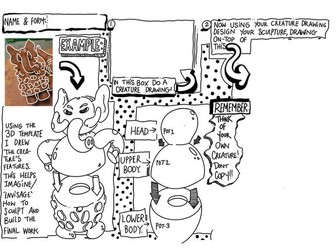
This worksheet helps students design a sculpture they will make later, inspired by the work of ceramic artist Sophie Woodrow. Using a 3D template, students draw their creature ideas, exploring unusual features and imaginative forms. This activity encourages creative thinking, visualisation, and planning ahead for their final ceramic sculpture. Sophie Woodrow’s ceramic sculptures are deeply expressive, often described as “psychological portraits” that explore the boundaries between the human form and the natural world. Her recent works, such as Group of Three Figures (2022), Sol and Theia (2022), and Ghost (2022), showcase her distinctive style using porcelain to create richly textured, evocative pieces. Each sculpture begins with a small porcelain thumb pot, which she coils and pinches upward, then incises, imprints, and models to create a richly textured surface. The figures are finished with eyes—two black holes that reveal the dark space inside—inviting viewers to contemplate the relationship between inner and outward realities. Woodrow explains, “I think of bodies as permeable and unstable, as impressions and sensations flow around and through us.” She is particularly interested in the impression that landscape leaves on us and the contested boundaries between the landscape of the earth and the landscape of our imagination. sophiewoodrow.co.uk Her work has been exhibited in various galleries and is part of collections at institutions like Aberystwyth University Ceramic Collections and the National Museum Cardiff. sophiewoodrow.co.uk For more information on her work, you can visit her official website: https://sophiewoodrow.co.uk/work/