

 Quick View
Renaissance Medicine: Lesson 1: What was the Renaissance?
Explore the transformative period of the Renaissance with the PowerPoint resource “Lesson 1: What Was the Renaissance?” This resource provides a comprehensive overview of the cultural, scientific, and medical advancements that marked this era.
This resource includes:
A clear definition of the Renaissance (1500-1800) as a period of “rebirth,” highlighting renewed interest in Greek and Roman ideas and innovations in science, technology, medicine, literature, and art.
Activities to examine the causes of the Renaissance, including economic prosperity, the invention of the printing press, and advancements in exploration and weaponry.
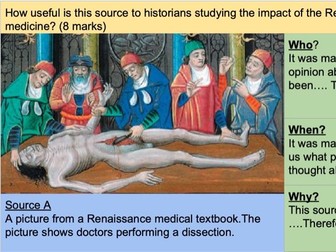
Insights into the impact of the Renaissance on medicine, including the scientific method, the challenge to Galen’s ideas, and improvements in anatomy and surgery through practices like dissection.
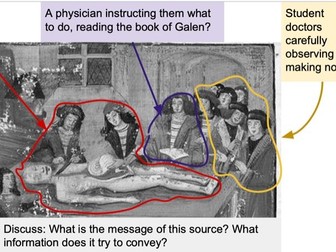
Tasks encouraging critical thinking, such as comparing the Renaissance with ancient and medieval periods, summarizing key developments, and analyzing a historical source of a dissection from a Renaissance textbook.
Essay challenges such as assessing the greatest development of the Renaissance and debating its influence on scientific progress.
Designed for GCSE or equivalent specifications, this .pptx file is compatible with PowerPoint, offering educators and students a dynamic way to analyze the Renaissance’s role in shaping modern medicine and science. Perfect for fostering historical understanding and analytical skills.
 Quick View
Renaissance Medicine: Lesson 7/ 8: How did hospitals change in the 18th century?
Explore the evolution of hospitals during the 18th century with the PowerPoint resource “Lesson 7/8: How Did Hospitals Change in the 18th Century?” This resource examines advancements in hospital care, the training of doctors, and the conditions of medical facilities during this transformative period.
This resource includes:
An overview of the transition from medieval hospitality-based care to more professional and organized medical facilities, highlighting the growth of new hospitals and their impact on public health.
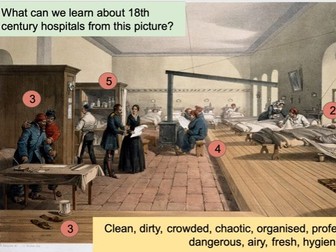
Activities to analyze hospital conditions, including unhygienic practices such as bed sharing, lack of cleanliness, and the spread of diseases, contrasted with the relatively low death rates and successful patient discharges.
A study of reformers like John Howard, who criticized poor hygiene and ventilation in hospitals, providing a balanced view of 18th-century hospital conditions.
A portrait analysis of John Hunter, exploring his contributions to anatomy and the impression he left on medical progress through his studies, specimens, and medical texts.
Critical thinking tasks comparing the study of anatomy in the 16th and 18th centuries, focusing on figures like Vesalius and Hunter, and their use of the scientific method to challenge traditional ideas.
Designed for GCSE or equivalent specifications, this .pptx file is compatible with PowerPoint, offering educators and students an engaging way to understand the significant changes in hospital care during the 18th century. Ideal for fostering historical inquiry and evaluative skills.
 Quick View
Renaissance Medicine: Lesson 5: What treatments were available for people in the Enlightenment
Explore the evolution of medical treatments during the Renaissance and Enlightenment period with the PowerPoint resource “Lesson 5: What Treatments Were Available for People in the Enlightenment?” This resource examines the continuity and change in treatments and their effectiveness.
This resource includes:
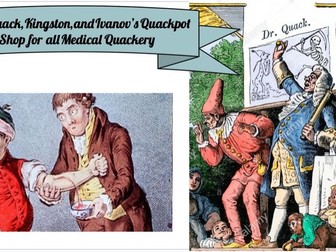
A discussion of traditional treatments, such as bleeding, purging, and herbal remedies, alongside new ideas introduced during the Enlightenment, including the use of quinine and experimental approaches.
Activities analyzing the three major challenges faced by doctors—pain, infection, and bleeding—and how Renaissance solutions compared to medieval practices.
Interactive tasks like creating spider diagrams and evaluating remedies used during the period, such as opium, tobacco, and the bezoar stone.
Insights into the contributions of key individuals, such as Thomas Sydenham (the “English Hippocrates”), and his innovative approach to disease treatment, emphasizing observation and experimentation.
Source analysis, including Lady Johanna St John’s remedies, to assess the overlap of natural and supernatural treatments.
A critical examination of whether Enlightenment treatments significantly improved on earlier methods, encouraging students to use evidence to argue their conclusions.
Designed for GCSE or equivalent specifications, this .pptx file is compatible with PowerPoint, offering educators and students an engaging way to explore the transition from medieval to Enlightenment medicine. Perfect for fostering analytical and evaluative skills.
 Quick View
Health and the People: Lesson 7: What was public health like in medieval towns?
Examine the living conditions and public health challenges of medieval towns with the PowerPoint resource “Lesson 7: What Was Public Health Like in Medieval Towns?” This engaging resource is ideal for history students exploring urban health and hygiene during the Middle Ages.
This resource includes:
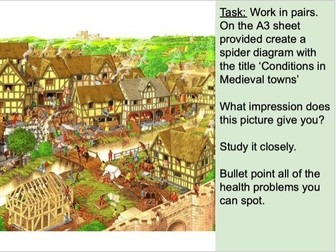
A detailed description of medieval urban living conditions, including waste disposal, overcrowding, and water contamination.
Comparisons between Roman and medieval public health measures, focusing on innovations like aqueducts and public baths versus the lack of sanitation in medieval towns.
Activities such as creating tables, spider diagrams, and analyzing primary and secondary sources to evaluate the state of medieval public health.
Insights into efforts to improve public health, such as paving streets, building aqueducts, and establishing laws against waste disposal in rivers and streets.
Critical thinking challenges encouraging students to assess the impact of poor public health on disease spread and societal conditions.
Designed for GCSE or equivalent specifications, this .pptx file is compatible with PowerPoint and provides an interactive way for educators and students to analyze medieval urban public health. Perfect for fostering historical inquiry and evaluation skills.
 Quick View
Health and the People: Lesson 5/6: How good was medieval surgery?
Explore the challenges, innovations, and limitations of surgery in the Middle Ages with the PowerPoint resource “Lesson 5/6: How Good Was Medieval Surgery?” This resource provides a detailed look into medieval surgical practices and their impact on medical progress.
This resource includes:
Insights into who performed surgeries in Western Europe and the Islamic Empire, with comparisons of their techniques and tools.
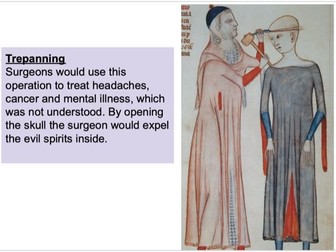
Explanations of common surgical methods like trepanning, cauterization, and bloodletting, highlighting the problems surgeons faced, such as pain, infection, and bleeding.
Activities such as group discussions, primary source analysis, and role-playing games where students act as medieval doctors and patients.
A case study on John Ardenne, a pioneering English surgeon, focusing on his battlefield innovations, pain-relieving ointment, and contributions to surgical knowledge.
Critical thinking challenges, including creating spider diagrams and evaluating the short- and long-term significance of Ardenne’s work.
Designed for GCSE or equivalent specifications, this .pptx file is compatible with PowerPoint and offers a dynamic way to understand medieval surgery’s strengths and limitations. Perfect for classroom engagement and historical analysis.
undefined
 Quick View
Health and the People: Lesson 4: How did Islam affect medieval medicine?
Delve into the influence of Islam on medieval medicine with the PowerPoint resource “Lesson 4: How Did Islam Affect Medieval Medicine?” This resource is perfect for history or medical history students exploring the contributions of Islamic culture to medical progress.
This resource includes:
A detailed examination of Islamic medical ideas, advancements, and their long-term impact on European medicine.
Insights into the role of religion, including how the Five Pillars of Islam influenced healthcare practices and charitable hospital development.
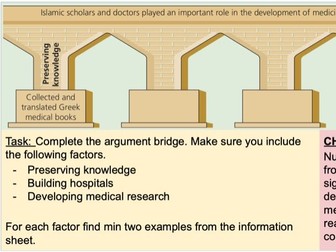
Activities such as flashcard creation, comparing Islamic and Christian medicine, and using argument bridges to analyze key factors like preserving knowledge and building hospitals.
Source analysis tasks, including evaluating historical accounts like those of Muslim doctor Usama ibn Munqidh, to assess differences in medical practices and their religious influences.
Challenges encouraging critical thinking, such as ranking factors in Islamic medical progress and explaining the significance of knowledge transmission to Europe.
Designed for GCSE or equivalent specifications, this .pptx file is compatible with PowerPoint and offers an engaging way for educators and students to explore the pivotal role of Islamic medicine in the Middle Ages.
 Quick View
Health and the People: Lesson 2: What did a medieval doctor know?
Explore the world of medieval medicine with the PowerPoint resource “Lesson 2: What Did a Medieval Doctor Know?” This comprehensive presentation is ideal for GCSE history or medical history students delving into the practices, training, and societal roles of doctors in the Middle Ages.
This resource includes:
Insights into the knowledge medieval doctors relied on, including natural and supernatural ideas, the Hippocratic and Galenic traditions, and the theory of the four humours.
A focus on the training physicians received and their societal positions.
Engaging tasks, such as analyzing primary sources, constructing a “stairway of power” to understand the feudal hierarchy and healthcare accessibility.
Detailed comparisons of different types of medieval medical practitioners (physicians, barber-surgeons, wise women) and their training, treatments, and accessibility.
Critical thinking challenges to evaluate medieval medicine and analyze historical sources.
Designed for GCSE or equivalent specifications, this .pptx file is fully
compatible with PowerPoint software, providing a rich and interactive educational experience. Perfect for classroom use and revision.
 Quick View
Renaissance Medicine: Lesson 3: How important were Pare’s discoveries?
Examine the revolutionary contributions of Ambroise Paré to surgery and medicine with the PowerPoint resource “Lesson 3: How Important Were Paré’s Discoveries?” This resource provides an in-depth look at Paré’s innovative methods and their impact on medical progress.
This resource includes:
A biographical exploration of Paré’s journey from barber surgeon to military surgeon and his groundbreaking work during the 16th century.
Activities using the mnemonic “LLLL”: Lotion, Limbs, Ligatures, and
Legacy, summarizing Paré’s key achievements in wound treatment, amputation techniques, and his challenge to traditional methods like cauterization.
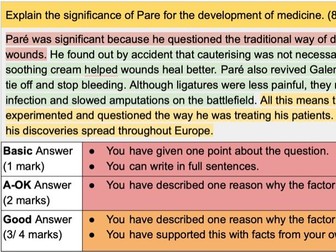
A recreation of Paré’s famous experiment replacing cauterization with a soothing lotion made of rose oil, egg yolk, and turpentine, alongside discussions of its impact on infection prevention.
An analysis of Paré’s revival of ligatures to stop bleeding, their benefits and drawbacks, and how this innovation contributed to elevating the status of surgeons.
Tasks encouraging critical thinking, such as evaluating Paré’s short- and long-term significance, analyzing his limitations, and crafting an 8-mark essay on his contributions.
Designed for GCSE or equivalent specifications, this .pptx file is compatible with PowerPoint, offering educators and students a dynamic and interactive way to understand Paré’s legacy. Perfect for fostering historical understanding and analytical skills.
 Quick View
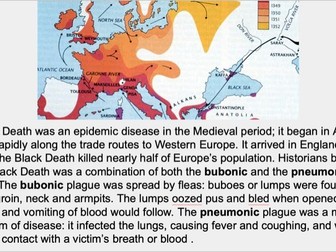
Health and the People: Lesson 9: What did people think caused the Black Death?
Dive into the devastating impact of the Black Death with the PowerPoint resource “Lesson 9: What Did People Think Caused the Black Death?” This resource provides an in-depth exploration of the plague’s symptoms, spread, and the medieval explanations for its origins.
This resource includes:
A detailed description of the Black Death, covering the time period (1348 in England), types of plague (bubonic and pneumonic), symptoms, and methods of transmission.
Insights into medieval beliefs about the causes of the plague, such as divine punishment, miasma (bad air), astrology, the Four Humours theory, and superstitions.
Activities encouraging students to analyze historical explanations, evaluate their reliability, and link them to broader themes like Christian medicine and the influence of ancient thinkers like Galen and Hippocrates.
Tasks to develop critical thinking, such as filling in knowledge organizers, skimming sources for evidence, and ranking source reliability based on provenance.
Discussions about the rapid spread due to overcrowded towns, poor hygiene, and inadequate waste disposal, as well as the psychological impact of the epidemic.
Designed for GCSE or equivalent specifications, this .pptx file is compatible with PowerPoint, offering a rich educational experience to analyze one of history’s most catastrophic pandemics. Ideal for engaging students in historical inquiry and evaluation.
 Quick View
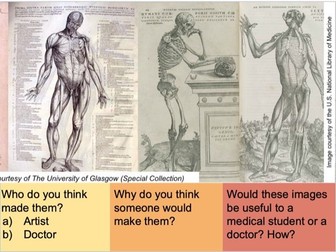
Renaissance Medicine: Lesson 2: What was the impact of Vesalius on medical progress?
Explore the revolutionary contributions of Andreas Vesalius to anatomy and medical progress with the PowerPoint resource “Lesson 2: What Was the Impact of Vesalius on Medical Progress?” This resource delves into the challenges Vesalius faced, his groundbreaking methods, and his legacy.
This resource includes:
An overview of Vesalius’ work challenging Galen’s ideas, such as disproving the belief that the human liver had five lobes or that the lower jaw was made up of two bones.
Activities highlighting Vesalius’ contributions using the mnemonic “ABCD”: Anatomy, Book (his publication De humani corporis fabrica), Challenging Galen, and Dissection.
Tasks for students to recreate Vesalius’ experiments and analyze his drawings to understand his methodology and its significance.
A comparison of medieval and Renaissance anatomy, focusing on changes in attitudes toward dissection and the gradual shift from Galen’s authority to experimental methods.
Discussions of Vesalius’ short-term and long-term impacts, including improved knowledge of anatomy, shifts in medical training, and the limitations of his work in advancing treatments and understanding diseases.
Designed for GCSE or equivalent specifications, this .pptx file is compatible with PowerPoint, offering educators and students a dynamic and engaging way to examine Vesalius’ role in transforming medical science. Perfect for fostering historical inquiry and critical analysis.
 Quick View
Renaissance Medicine: Lesson 6: How did doctors deal with the Great Plague of 1665?
Examine the responses to the devastating Great Plague of 1665 with the PowerPoint resource “Lesson 6: How Did Doctors Deal with the Great Plague of 1665?” This resource explores the causes, treatments, and societal impacts of the plague, as well as the effectiveness of 17th-century medical knowledge.
This resource includes:
A detailed analysis of contemporary beliefs about the plague’s causes, such as divine punishment, miasma, and astrological influences, alongside modern understandings of its true cause (fleas on rats).
Activities to compare the Great Plague with the Black Death of 1350, analyzing similarities and differences in causes, treatments, and impacts.
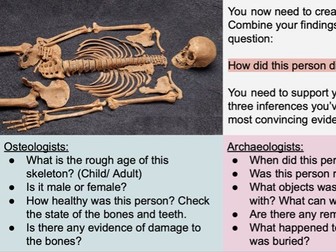
Engaging tasks like a mock archaeological investigation of plague victims to infer details about their lives and deaths, supporting critical thinking.
A review of ineffective remedies, including bloodletting, charms, and miasma-based treatments, and an exploration of government attempts to prevent its spread, such as quarantines, mass burials, and killing animals believed to carry the plague.
Source analysis exercises, including evaluating illustrations and bills of mortality to assess their usefulness in understanding the plague’s impact.
Discussions on the broader consequences of the plague, such as the death of 100,000 Londoners (a quarter of the population), and the failure of most measures due to limited medical knowledge.
Designed for GCSE or equivalent specifications, this .pptx file is compatible with PowerPoint, providing an engaging and interactive approach to understanding the Great Plague. Perfect for fostering analytical and evaluative skills.
 Quick View
Renaissance Medicine: Lesson 10/11: Synoptic Review - Renaissance Medicine
Consolidate and evaluate key concepts of Renaissance medicine with the PowerPoint resource “Lesson 10/11: Synoptic Review - Renaissance Medicine.” This resource prepares students to critically analyze medical advancements and their broader historical context.
This resource includes:
A detailed review of major figures, including Vesalius, Paré, Harvey, and Jenner, focusing on their contributions to anatomy, surgery, the circulatory system, and vaccination.
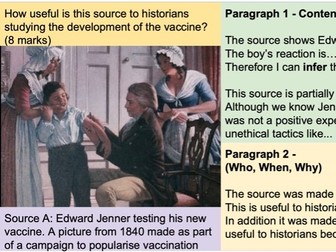
Source analysis tasks, such as evaluating illustrations of Jenner’s vaccination experiments, to assess their content, provenance, and usefulness for historical understanding.
Comparative activities, including analyzing similarities between the Black Death (14th century) and the Great Plague (17th century), and comparing hospitals in medieval and Renaissance periods in terms of organization, treatments, and funding.
Essay-writing guidance for 20-mark questions, exploring themes like the role of individuals in medical progress versus other factors such as science, technology, and government involvement.
Discussions on the long-term impacts of Renaissance discoveries, encouraging students to evaluate how these advancements influenced modern medical practices.
Designed for GCSE or equivalent specifications, this .pptx file is compatible with PowerPoint, offering educators and students an engaging and structured way to synthesize and assess the significance of Renaissance medicine. Perfect for fostering critical thinking and essay-writing skills.
 Quick View
Renaissance Medicine: Lesson 9: How did Edward Jenner help defeat smallpox?
Explore the revolutionary work of Edward Jenner with the PowerPoint resource “Lesson 9: How Did Edward Jenner Help Defeat Smallpox?” This resource examines Jenner’s pioneering discovery of the smallpox vaccine, its impact, and the challenges he faced.
This resource includes:
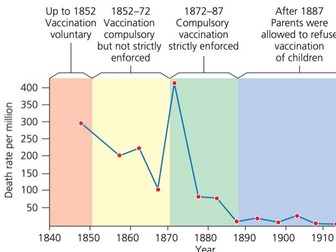
A detailed overview of smallpox, including its symptoms, mortality rates, and previous prevention methods like variolation, which carried significant risks.
Jenner’s breakthrough discovery in 1796, using cowpox to create the first vaccine, and his experiments on James Phipps and others to prove its effectiveness.
Activities to analyze the ethical dilemmas of Jenner’s methods and the opposition he faced, such as skepticism from the Royal Society, resistance from variolation practitioners, and public fears about vaccination.
Timeline tasks to trace the success of Jenner’s vaccine, from its initial reception to government funding and the eventual eradication of smallpox declared by the WHO in 1980.
Discussions on the short- and long-term significance of Jenner’s work, highlighting how it laid the foundation for modern immunology and preventive medicine.
Engaging tasks such as creating definitions, evaluating Jenner’s impact, and playing “Jenner Jeopardy” to reinforce key concepts.
Designed for GCSE or equivalent specifications, this .pptx file is compatible with PowerPoint, providing an engaging and interactive way for students to explore Jenner’s role in defeating smallpox and shaping modern medicine. Perfect for fostering historical understanding and critical thinking.
 Quick View
Health and the People: Lesson 3: How did Christianity affect medieval medicine?
Unpack the profound influence of Christianity on medieval medicine with the PowerPoint resource “Lesson 3: How Did Christianity Affect Medieval Medicine?” This educational tool is designed for history or medical history learners exploring the relationship between religion and healthcare in the Middle Ages.
This resource includes:
An analysis of Christian beliefs about illness and healing, emphasizing care over cure and the role of prayer, miracles, and relics.
Insight into how the Christian Church established hospitals and influenced medical training through preserved ancient knowledge.
Tasks like spider diagrams and card sorts to categorize positive and negative impacts of Christianity on medicine, exploring themes such as education, hospitals, and preservation of knowledge.
Critical thinking challenges, including primary source analysis and inference tasks about medieval ideas and Church-driven limitations on medical progress.
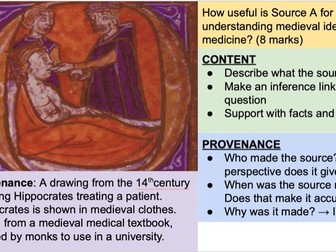
A case study of a 14th-century depiction of Hippocrates, exploring its content and provenance to assess reliability.
This .pptx file is perfect for GCSE or equivalent specifications, offering educators and students an engaging way to examine the interplay between religion and medical history. Compatible with PowerPoint software for seamless use.
 Quick View
Health and the People: Lesson 1: What did medieval people believe about illness?
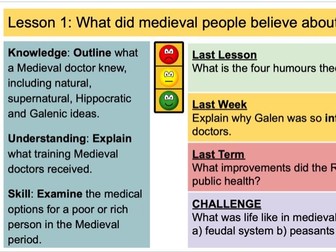
Discover the fascinating beliefs and practices of medieval medicine with this engaging PowerPoint resource: “Lesson 1: What Did Medieval People Believe About Illness?” Perfect for history or medical history students, it covers key topics such as natural and supernatural ideas, Hippocratic and Galenic influences, and the four humours theory.
This resource includes:
A detailed exploration of medieval medical knowledge and training.
Practical tasks for students, such as creating timelines and filling knowledge organizers.
Keywords and their definitions for easy comprehension.
Interactive activities like diagnosing “patients” using medieval techniques such as urinoscopy.
Challenges that encourage critical thinking and comparisons with ancient medical practices.
Ideal for educators following GCSE or similar specifications, this PowerPoint resource provides both content and activities to enhance understanding. File type: .pptx, compatible with PowerPoint software for easy access and presentation.
 Quick View
Renaissance Medicine: Lesson 4: What was Harvey’s contribution to medical progress?
Explore the groundbreaking discoveries of William Harvey with the PowerPoint resource “Lesson 4: What Was Harvey’s Contribution to Medical Progress?” This resource examines Harvey’s methods, challenges, and the short- and long-term impacts of his work on blood circulation and the heart.
This resource includes:
An overview of Galen’s ideas about blood and how Harvey challenged them through experimentation, observation, and dissection.
Activities such as recreating Harvey’s experiments to demonstrate how the heart functions as a pump, comparing it to a fire pump, and analyzing the role of valves in blood circulation.
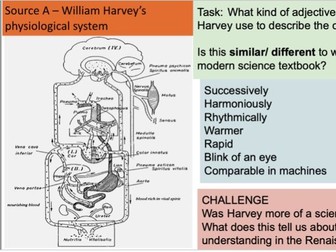
Tasks for analyzing the language Harvey used to describe the circulatory system, comparing it to modern scientific descriptions, and debating whether Harvey was more of a scientist or a writer.
Discussions on Harvey’s significance, addressing how his discoveries gradually influenced medical training and understanding despite initial resistance.
Critical thinking challenges, such as evaluating whether Harvey’s work can be considered a scientific revolution and crafting an 8-mark essay on his contributions and limitations.
Designed for GCSE or equivalent specifications, this .pptx file is compatible with PowerPoint and provides educators and students with an engaging way to explore Harvey’s pivotal role in advancing medical knowledge. Ideal for developing historical understanding and analytical skills.
 Quick View
Health and the People: Lesson 11/12: Synoptic Review - Medieval Medicine
Summarize and review the key concepts of medieval medicine with the PowerPoint resource “Lesson 11/12: Synoptic Review - Medieval Medicine.” This resource is ideal for consolidating knowledge and preparing students for essays and exams.
This resource includes:
A comprehensive review of medieval medicine, covering ideas about illness, anatomy, treatments, surgery, public health, and key individuals.
Activities to enhance retention, such as creating a knowledge organizer, defining core terms, and selecting powerful knowledge for each category.
Structured essay-writing guidance, including tips for crafting a well-argued response with the “Burger” (PEE), “Cheese,” and “Secret Sauce” method, and completing 16-mark essay questions.
An exploration of key themes, including the impact of religion on medical progress, and comparisons between ancient and medieval medicine.
Source analysis tasks to evaluate the usefulness of historical materials for understanding medieval medicine and its societal impacts.
Designed for GCSE or equivalent specifications, this .pptx file is compatible with PowerPoint, providing educators with a valuable tool for revision and students with a clear pathway to exam success. Perfect for reinforcing historical knowledge and critical thinking skills.
 Quick View
Health and the People: Lesson 8: What was public health like in monasteries?
Explore the superior public health conditions of medieval monasteries with the PowerPoint resource “Lesson 8: What Was Public Health Like in Monasteries?” This resource is perfect for history students examining the contrast between urban and monastic health practices during the Middle Ages.
This resource includes:
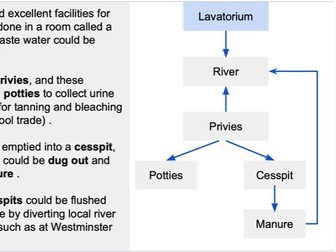
Insights into the daily routines of monks, emphasizing cleanliness as a religious and health practice, with features like lavatoriums, privies, and sophisticated water systems.
Explanations of how monasteries used rivers for water supply, filtration systems for purity, and innovative drainage to maintain sanitation.
Comparisons between the public health facilities of monasteries and medieval towns, focusing on waste management, water access, and attitudes toward hygiene.
Activities such as creating diagrams, summarizing key points in revision crib sheets, and analyzing the impact of monastic cleanliness on health.
Critical thinking tasks, including an 8-mark essay question comparing towns and monasteries and explaining the broader significance of monastic public health practices.
Designed for GCSE or equivalent specifications, this .pptx file is compatible with PowerPoint, providing educators and students with an engaging way to analyze the unique public health advancements of monasteries. Ideal for fostering analytical and evaluative skills.
 Quick View
Health and the People: Lesson 10: What was the impact of the Black Death?
Investigate the profound effects of the Black Death on medieval society with the PowerPoint resource “Lesson 10: What Was the Impact of the Black Death?” This resource offers a comprehensive analysis of the social, economic, and cultural consequences of the plague.
This resource includes:
An exploration of the devastating impact of the Black Death, including the loss of one-third of the population, economic disruption, and societal changes.
Activities for categorizing and evaluating the positive and negative consequences of the plague, such as shifts in labor dynamics, changes in land use, and the psychological toll.
Tasks analyzing medieval prevention and treatment efforts, distinguishing effective measures from ineffective ones, and linking them to medieval medical beliefs and practices.
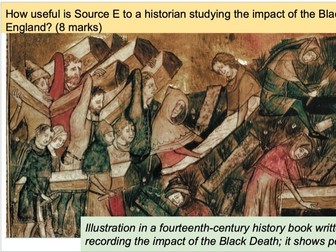
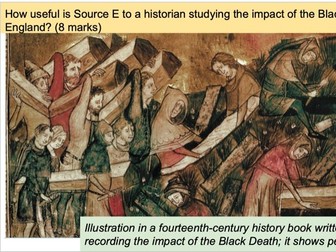
Source analysis tasks, such as evaluating a 14th-century illustration of people carrying coffins, to infer the scale and societal reactions to the plague.
Critical thinking challenges, including assessing the usefulness and limitations of historical sources for understanding the plague’s impact.
Designed for GCSE or equivalent specifications, this .pptx file is compatible with PowerPoint, providing educators and students with an engaging and thought-provoking way to explore the long-term implications of one of history’s deadliest pandemics. Ideal for fostering analytical and evaluative skills.
 Quick View