Imperial and metric weight in context of Numeracy style tasksQuick View
meurigfa

Imperial and metric weight in context of Numeracy style tasks

(0)
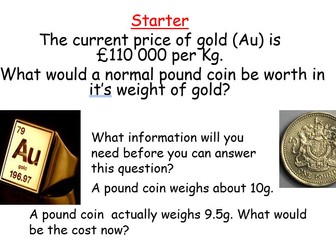
A lesson using metric and imperial weights in context. Slides cam be printed of the tasks and modified as required. Cross curricular with chemical symbols of metals too. Final task allows pupils to take charge of their own strategy. Powerpoint also has answers on the slides. Lesson Objectives All of us will use our metric conversions of weight in the context of a real problem. Most of us will use our imperial conversion for pounds and kg. Some of us will work out how much in weight we could buy of each metal with £500.
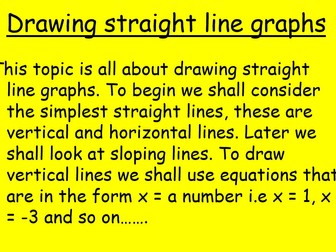
Drawing straight lines y=mx+cQuick View
meurigfa

Drawing straight lines y=mx+c

(0)
Very detailed powerpoint showing how to plot and draw straight lines in the class room. Once y=mx +c has been established there is a selection of worksheets to practise drawing straight lines without plotting co-ordinates. Answers included. Also an additional power point to get the pupils to stand and show lines with their arms . For example movement from x=2 to x=-6. Good fun if music running in the background.
Problem solving activity using speed, distance and timeQuick View
meurigfa

Problem solving activity using speed, distance and time

(0)
You have been given 20 pieces of information telling you about four friends who are making their way to Welshpool. Harry, Iwan, Ross and Rhys all use different methods of transport to get to Welshpool and all take a different amount of time. Use the 20 pieces of information you have been given and work out the answer to the following question……. How long does it take Rhys to get ready? (the time between him waking up and setting off) Devise the best strategy in order for you to solve the problem. Reinforce your knowledge of using the relationship between speed, distance and time. This task can be edited to match a local place to you
Averages problem solvingQuick View
meurigfa

Averages problem solving

(0)
Power point to use averages to find numbers that work in a puzzle. Based on the types of questions expected to be done at Gcse. This task is aimed at lower school or low ability and assumes averages already practised. I have also included a few exam questions on a pdf to use as an extension task.
GCSE MATHS  REVISION WJEC MATHS EXAM PAPER QUESTIONS ORDERED IN TOPICSQuick View
meurigfa

GCSE MATHS REVISION WJEC MATHS EXAM PAPER QUESTIONS ORDERED IN TOPICS

(0)
I have put together a booklet using all the most recent wjec maths exam papers, grouping all the questions from the same topics together.It is a huge document and it can be used for targeting the topics to tackle first. Pages in selected ranges could be printed off .It is the same as working on exam papers but concentrating on certain topics
Don't be mean about averages- Averages Problem solvingQuick View
meurigfa

Don't be mean about averages- Averages Problem solving

(0)
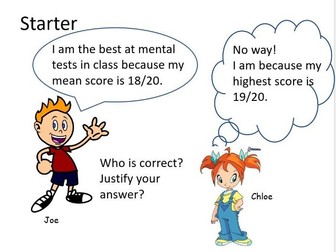
Differentiated problem solving activity on the different averages. Three levels of difficultly Red, Amber and Green. Powerpoint with worksheets and answers. This is in line with the types of questions now asked at GCSE, but could easily be used with KS3. The students have to find the numbers that work given the values for certain averages. This is a good activity to consolidate understanding of the different averages.