This booklet contains each of the 12 practicals required by the AQA A Level Chemistry syllabus.
Each practical is split into the following sections:
• An outline of the equipment used
• Suggested methods
• Diagrams showing the equipment set up
• Past paper exam questions covering the practicals
• Mark schemes for the questions
• Examiners notes on the questions
Organic synthesis revision game!
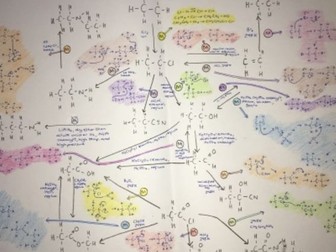
In teams pupils are to attempt to fill in the organic synthesis mind map for the whole of the AQA chemistry A level course, starting with ethane at the top.
Where there is an “M” this requires them to write a mechanism. Otherwise just add the reagents and conditions to the arrow.
Once done, they do a 10 question quiz on the topic of organic synthesis which is on the last slide. They are given a starting material and asked for reactions to make other organic substances, including mechanisms where required.
PPT first slide = map to be printed off A3. Second slide = answers in colour to be printed off. Third slide = quiz.
This is lessons 7 - 9 of 9 lessons as part of the 4.10 section of the new specification.
Lesson 1 - Properties and uses of materials
Lesson 2 - Polymers and metals
Lesson 3 - Corrosion
Lesson 4 - Natural resources
Lesson 5 - Life cycle assessment and recycling
Lesson 6 - Potable water
Lesson 7 - Waste water treatment
Lesson 8 - Haber process
Lesson 9 - NPK Fertilisers
This booklet contains each of the 6 practicals required by the AQA AS Level Chemistry syllabus.
Each practical is split into the following sections:
• An outline of the equipment used
• Suggested methods
• Diagrams showing the equipment set up
• Past paper exam questions covering the practicals
• Mark schemes for the questions
• Examiners notes on the questions
used to give students an idea of what A level chemistry entails. includes:
expectations
example mini lessons
overall sum up
(I also asked a year12 student to attend the lesson to answer questions at the end)
Scheme of work for the new topic Using The Earth's resources and Obtaining Potable Water, and Life Cycle Assessments and Recycling, as part of the Using Resources unit.
Specification references 4.10.1 and 4.10.2.
Includes powerpoint presentations and activities including those for required practical 8.
This booklet contains each of the 6 practicals required by the AQA AS Level Chemistry syllabus.
Each practical is split into the following sections:
• An outline of the equipment used
• Suggested methods
• Diagrams showing the equipment set up
• Past paper exam questions covering the practicals
• Mark schemes for the questions
• Examiners notes on the questions
I used this to break up revision with year 12 and 13 - they get into teams of no more than 4 people, then choose a team name and pick a “double up round” where they will receive double points for answers.
Once done they will swap papers and mark each others, I gave out sweets as prizes. The questions are picked from exam papers so it tests their ability to use key terms and show working for calculations. The rounds are as follows:
Round 1 – slide 2 (equilibria) 2 marks
Round 2 – slide 4 (amount of substance) 3 marks
Round 3 – slide 6 (nomenclature and isomerism) 2 marks
Round 4 – slide 8 (shapes and bonding) 4 marks
Round 5 – slide 10 (shapes and bonding) 2 marks
Round 6 – slide 12 (periodicity) 3 marks
Round 7 – slide 14 (periodicity) 4 marks
Round 8 – slide 16 (chemical analysis and practical skills) 12 marks
Round 9 – slide 18 (kinetics) 1 mark
Round 10 – slide 20 (redox) 1 mark
Round 11 – slide 22 (equilibria) 1 mark
I enlarge these to A3 and then pupils fill them in for revision, to use with exam type questions before end of unit tests.
The topics are as follows:
Rocks, microbes and disease, inheritance and selection, speeding up, plants, acids and alkalis, electricity, magnets, heating and cooling.
This is a worksheet to go with the film Home Alone with questions on the following topics (all at key stage 3 science level):
Organisms – cells and movement (4 questions)
Matter – particles and separating mixtures (5 questions)
Forces – speed and gravity (4 questions)
An assessment for each part of the new AQA Chemistry specification 8462 (for use from 2016), with a marking grid to use for self/peer assessment.
Simple, easy to follow, to be used with pupils in lessons, resulting in pupils being given a level on the new 1 - 9 scale.
There is a free one on here to try before you buy :-)
https://www.tes.com/teaching-resource/chemistry-leveling-resource-1-9-atoms-elements-and-compounds-with-marking-grid-11229188
Lessons 1 -3 of 9 lessons as part of the 4.10 section of the new specification (other lessons also available)
Lesson 1 - Properties and uses of materials
Lesson 2 - Polymers and metals
Lesson 3 - Corrosion
Lesson 4 - Natural resources
Lesson 5 - Life cycle assessment and recycling
Lesson 6 - Potable water
Lesson 7 - Waste water treatment
Lesson 8 - Haber process
Lesson 9 - NPK Fertilisers
Lessons 4 - 6 of 9 lessons as part of the 4.10 section of the new specification.
Lesson 1 - Properties and uses of materials
Lesson 2 - Polymers and metals
Lesson 3 - Corrosion
Lesson 4 - Natural resources
Lesson 5 - Life cycle assessment and recycling
Lesson 6 - Potable water
Lesson 7 - Waste water treatment
Lesson 8 - Haber process
Lesson 9 - NPK Fertilisers
I used this to break up revision with year 12 and 13 - they get into teams of no more than 4 people, then choose a team name and pick a “double up round” where they will receive double points for answers.
Once done they will swap papers and mark each others, I gave out sweets as prizes. The questions are picked from exam papers so it tests their ability to use key terms and show working for calculations. The rounds are as follows:
Round 1 – read out (atomic structure) 4 marks
Round 2 – slide 2 (amount of substance) 6 marks
Round 3 – slide 3 (practical skills) 6 marks
Round 4 – slide 4 (bonding) 5 marks
Round 5 – read out (group 7 and redox) 3 marks
Round 6 – slide 5 (group 2) 1 mark
Round 7 – slide 6 (energetics) 3 marks
Round 8 – slide 8 (haloalkanes) 1 mark
Round 9 – slide 9 (organic analysis) 1 mark
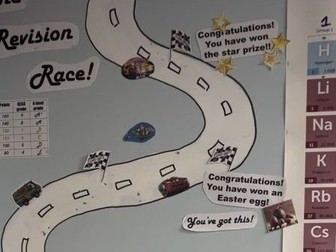
This includes all the materials you need to make the race along with a revision plan for students to use as their revision at home.
How to use this revision race:
Each student’s name is put on the board at the START line (if they don’t like their name being up there you could give each student a number confidentially).
Every lesson at the start, a timer is put on the board. The timer allows one minute per mark so for example a 10 minute quiz will be 10 minutes long.
As the students enter they are given the quiz, with the remaining time on the board. So any students entering late get less time.
Once done the quizzes are passed to someone else to mark.
Once marked the scores are called out and added to an excel spreadsheet.
The names are then moved up the race track by the teacher to the score they got (this can be handicapped so that scores are changed based on grade predictions. For example someone who scores 10 out 10 but has a predicted grade of a 9, would only receive a score of 8. This makes it more of an even race. But the final reveal of scores, I then take the handicap off so that it matches their likely grade in the GCSE exams).
If anyone is absent and wants to do the race at another time, I let them come back at break or lunch. It amazed me how many did this!
Prizes given at the end
(MORE DETAILS IN THE INSTRUCTIONS IN THE RESOURCE)
Included in this resources:
The flags to make the race track
A photo showing the track painted on the wall
A Powerpoint slide ready to put names in (a few have been left in so you can see how it works, but I have just changed names for initials)
Excel spreadsheet ready made for you to enter students names and scores, with handicap formula (the numbers have been left in from last year so you can see how it works)
AQA quizzes for A level and GCSE chemistry
EdExcel quizzes for A level chemistry
Instructions on how to use the race included
Star prize certificate template
Revision plan for students to use at home - matching the quizzes done in lessons