IGCSE ESL 0991 Exam-style Essay QuestionQuick View
shonamcintosh

IGCSE ESL 0991 Exam-style Essay Question

(0)
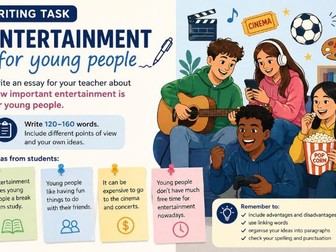
Cambridge ESL writing task worksheet for secondary students: essay on entertainment for young people, vocabulary support and exam-style guidance. This ready-to-use A4 guide is designed for Cambridge IGCSE ESL preparing for extended writing tasks. The resource focuses on the topic of entertainment for young people and guides learners through the full writing process. Students are provided with: a clear, exam-style essay question idea prompts based on typical student responses This resource supports: development of balanced arguments use of linking devices and paragraphing It is ideal for: exam preparation lessons timed writing practice homework tasks intervention or mixed-ability classes The worksheet can be used as a standalone lesson or alongside vocabulary mats and model answers to further develop student confidence and performance in Cambridge-style writing assessments.
Cambridge IGCSE 0991 Speaking Part 1 & 2Quick View
shonamcintosh

Cambridge IGCSE 0991 Speaking Part 1 & 2

(0)
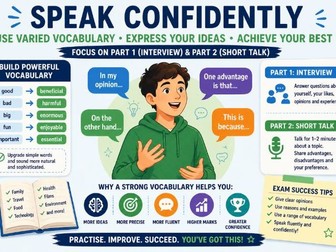
Cambridge IGCSE 0991 ESL Speaking Revision Guide – vocabulary, idioms, Part 1 & 2 practice, exam tips and speaking tasks for final exam preparation. This revision guide is designed to support students in the final days before the Cambridge IGCSE English as a Second Language (0991) Speaking exam. It focuses specifically on improving vocabulary range, developing more sophisticated responses, and building confidence across Part 1 (Interview) and Part 2 (Short Talk). The resource includes: Topic-based vocabulary banks covering common speaking themes (e.g. family, travel, food, technology, health) Upgrading vocabulary tasks to move students beyond basic words like good and fun Useful opinion phrases and structures to extend answers effectively Idioms with clear meanings to add natural, higher-level expression Practice Part 1 questions for fluency development Part 2 planning tasks (advantages, disadvantages, preferences) Space for students to personalise vocabulary with their own examples This guide can be used as: A final revision lesson (approx. 50 minutes) A student-led independent study booklet A speaking warm-up resource in the days before the exam A targeted intervention tool for improving vocabulary (Assessment Objective: Vocabulary & Development) Ideal for Grade 9–10 ESL learners preparing for Cambridge 0991, particularly those aiming to move from mid to top bands by increasing lexical range and precision. Clear, practical, and exam-focused, this resource helps students turn simple answers into well-developed, confident responses.
Grade 8 Cambridge Checkpoint exam-style writing - FictionQuick View
shonamcintosh

Grade 8 Cambridge Checkpoint exam-style writing - Fiction

(0)
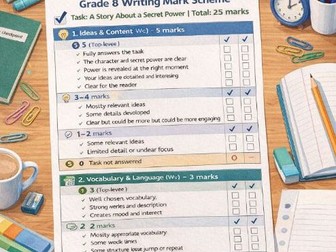
This Grade 8 narrative writing resource supports students in writing a story about a secret power, fully aligned to the Cambridge Checkpoint Lower Secondary writing criteria. The pack includes a student-friendly, one-page mark scheme presented as a clear table, making assessment objectives easy for students to understand and apply. Each section breaks down expectations for content, vocabulary, structure, grammar, and spelling, helping students self-assess their work before submission. The language has been carefully simplified without losing accuracy, making it ideal for mixed-ability and EAL learners. This resource works well as a pre-writing checklist, exam preparation handout, or self- and peer-assessment tool. Teachers can use it to explicitly teach success criteria, support independent learning, and reinforce what high-quality narrative writing looks like at Grade 8 level. Perfect for Cambridge Checkpoint, Lower Secondary English, and narrative writing lessons, this ready-to-use resource saves marking time while helping students take ownership of their progress.
Cambridge Checkpoint Exam-Style Writing Task Stage 7Quick View
shonamcintosh

Cambridge Checkpoint Exam-Style Writing Task Stage 7

(0)
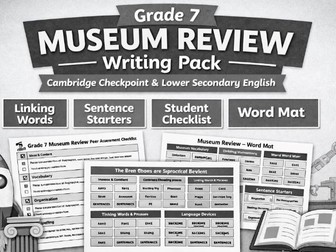
This Grade 7 museum review writing pack is a clear, student-friendly resource designed to support Cambridge Checkpoint and lower-secondary English writing lessons. The resource includes a peer-assessment checklist, and a printable word mat with vocabulary presented in an easy-to-use table and a model answer. Ideal for exam preparation, peer assessment, self-assessment, and scaffolded writing, this resource supports students in writing clear reviews with accurate language. It is especially suitable for mixed-ability and EAL learners, offering visual support and accessible success criteria. Perfect for Grade 7 English, Cambridge Checkpoint, and lower secondary writing lessons, this ready-to-use pack saves planning time while helping students understand exactly how to achieve high marks.
Macbeth guide by scenesQuick View
shonamcintosh

Macbeth guide by scenes

(0)
The attached document, “Macbeth Guide by Scenes”, is a scene-by-scene summary of Macbeth by William Shakespeare. It offers concise explanations of the key events, character developments, and thematic elements in each scene across all five acts of the play. It includes: Thematic prompts (e.g., greed, ambition, fear, evil, fate) with brief explanations linking them to Macbeth’s actions. Revision Aid: Helps students quickly recap the plot and main developments of each scene. Thematic Analysis: Encourages students to link events and actions to broader themes such as ambition and fate.
Star Wars DIRT DocumentQuick View
shonamcintosh

Star Wars DIRT Document

(0)
Star Wars Dirt Doc is a reflection and improvement (DIRT: Dedicated Improvement and Reflection Time) activity designed for students to evaluate and redraft a section of their own writing, themed around Star Wars. A PowerPoint slide guiding students through a self-assessment and improvement task. Students are instructed to: Choose a paragraph from their previous work. Use teacher feedback and self-reflection to redraft it with attention to structure, vocabulary, grammar, spelling, and/or content. Explain the changes they’ve made and what they’ve learned. Useful for: Self-reflection: Helps students think critically about their writing and take ownership of their learning. Promotes active revision: reinforces the importance of redrafting and refining work using feedback. Improves technical accuracy and creativity: Focuses on language mechanics as well as content enhancement.