VIPERS Reading Comprehension – Cloud Tea MonkeysQuick View
meganbeard2004

VIPERS Reading Comprehension – Cloud Tea Monkeys

(0)
This comprehensive VIPERS reading resource is based on The Cloud Tea Monkeys by Mal Peet and Elspeth Graham. It provides structured comprehension questions organised by VIPERS domains to support high-quality guided reading sessions. The resource is clearly divided into sections following the sequence of the text: Vocabulary (Pages 1–6) – Focus on word meaning in context (e.g. plantation, merchant, precious, debt) Retrieval (Pages 7–12) – Key fact-finding questions linked to plot events Inference (Pages 13–18) – Exploring character feelings, motivation and evidence Prediction (Pages 19–23) – Using clues to anticipate outcomes Explanation (Pages 24–27) – Authorial intent and reasoning Sequence (Page 28–End) – Ordering events, identifying the main problem and summarising Each section includes: Carefully scaffolded comprehension questions Key vocabulary prompts Clear links to VIPERS reading skills Repeated sets for flexible printing, group work or carousel activities This resource is ideal for: KS2 guided reading Whole-class reading Targeted intervention groups Homework or comprehension extension tasks It supports pupils in developing deeper comprehension skills while engaging with a rich, culturally diverse text. The structured layout makes it easy to assess understanding across all VIPERS strands. Perfect for teachers looking for ready-to-use, skill-focused comprehension linked directly to the text.
Adjective Word MatQuick View
meganbeard2004

Adjective Word Mat

(0)
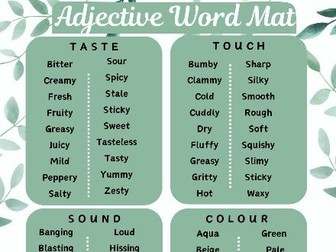
Support and enhance your pupils’ descriptive writing with this beautifully designed Adjective Word Mat. Organised into clear categories, this resource helps children generate ambitious vocabulary linked to the five senses and key descriptive themes. The word mat includes adjectives grouped under: Taste (e.g. bitter, zesty, juicy, spicy) Touch (e.g. silky, rough, clammy, squishy) Sound (e.g. crackling, thundering, tranquil, screeching) Colour (e.g. aqua, rusty, bright, dull) Size (e.g. gigantic, miniature, immense, petite) Time (e.g. ancient, rapid, brief, futuristic) Perfect for: Narrative writing Setting descriptions Poetry Character descriptions Sensory writing tasks Vocabulary building activities Working walls or writing displays Ideal for: KS1 (supported writing) Lower and Upper KS2 EAL learners Intervention groups focusing on vocabulary development What’s Included: 1 high-quality printable adjective word mat (PDF or image format) Clear, child-friendly layout Calm, nature-themed design suitable for classroom display or table mats This resource encourages children to move beyond simple adjectives and develop richer, more precise vocabulary in their writing.
Key Stage 2 Maths ToolkitQuick View
meganbeard2004

Key Stage 2 Maths Toolkit

(0)
This KS2 Maths Toolkit is a comprehensive collection of visual models, grids and structured supports designed to strengthen children’s conceptual understanding of number and calculation across Key Stage Two. It supports pupils in making the transition from concrete and pictorial representations to more abstract mathematical thinking, in line with the mastery approach. The toolkit provides teachers with a consistent set of representations that can be used across year groups to develop fluency, reasoning and problem-solving. It is particularly effective for supporting visual learners, children with SEND, and those who benefit from structured layout and clear mathematical models. The toolkit includes: A times table grid to support multiplication and division recall and pattern spotting. A fraction wall to explore equivalence, comparison and fraction relationships. A number line to 100 to support counting, estimation and understanding of number magnitude. Part–part–whole and part–part–part–whole models to represent additive relationships and support reasoning and missing number problems. A place value chart and a decimal place value chart to develop understanding of digit value and number size. Column method grids for addition, subtraction and multiplication to support accurate formal written calculations. A bar model to represent relationships in word problems, comparisons, ratios and fractions. Squared working space to support accurate layout, place value alignment and calculation. This toolkit encourages consistency of representation across the school, supports mathematical talk and reasoning, and helps children build a deep and connected understanding of number. It can be used flexibly as part of whole-class teaching, small group intervention or independent practice, making it a valuable addition to any KS2 classroom.
Maths Toolkit Key Stage 1Quick View
meganbeard2004

Maths Toolkit Key Stage 1

(0)
This Key Stage 1 Maths Toolkit is a clear, child-friendly set of visual models designed to support pupils’ understanding of number, calculation and mathematical structure. It brings together the key representations used in mastery and CPA approaches, helping children move from concrete to pictorial and then to abstract thinking. The toolkit is ideal for use in lessons, intervention groups, working walls, or pupil maths books, and supports children in explaining their thinking as well as finding correct answers. What’s included The toolkit includes the following visual models: Ten frame – for counting, subitising, number bonds and early addition/subtraction Number line to 20 – for sequencing, counting forwards/backwards and simple calculations Blank number line – for modelling jumps, differences and calculation strategies Part–part–whole model – for understanding number bonds and the relationship between parts and a whole Part–part–part–whole model – for combining three parts and supporting early multi-step thinking Blank bar model – for representing problems and relationships visually Place value charts: Tens and ones Hundreds, tens and ones Squared working out space – for neat, structured recording of calculations Why this toolkit is useful? Supports the mastery approach to maths Encourages children to visualise number and structure Helps pupils explain their reasoning, not just give answers Particularly supportive for SEND learners, EAL pupils and children needing visual scaffolds Promotes consistency across lessons and year groups Suggested uses As a desk mat or reference sheet for pupils On a working wall to model strategies In maths books as a toolkit page children can refer back to In small-group or intervention work Age range Designed for Key Stage 1 (Years 1 and 2).