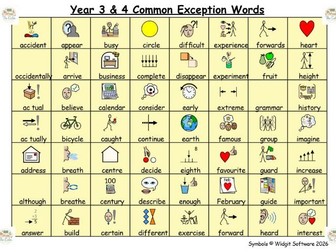
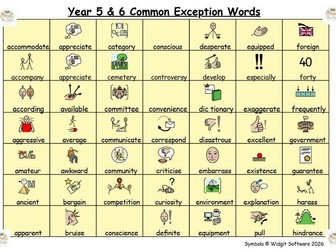
A bundle of all the Primary common exception words with images to support SEND children. Save your time and effort by downloading these and laminating them for you classroom.
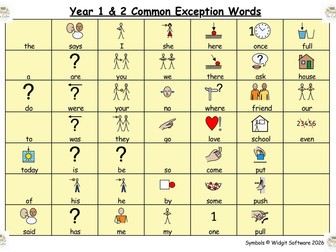
A clear, dyslexia‑friendly set of Year 1 and Year 2 Common Exception Words presented in a calm, uncluttered layout.
This printable resource includes all statutory CEWs from the KS1 curriculum, organised into easy‑to‑read tables that support early readers, SEND learners, and pupils who benefit from reduced visual load.
What’s included:
Full set of Year 1 Common Exception Words
Full set of Year 2 Common Exception Words
Words grouped into simple table formats for quick reference
Clean, accessible layout suitable for dyslexic learners
Ideal for classroom displays, table mats, intervention groups, spelling practice and home learning
Why it’s SEND‑friendly:
Calm, low‑clutter design
Consistent spacing to reduce visual overwhelm
Clear font choices to support readability
Easy for pupils to track, scan and locate words independently
Perfect for:
KS1 classrooms
Phonics and spelling interventions
SEND support
Dyslexia‑friendly literacy provision
TA‑led small groups
Homework packs and parent support
Format:
PDF — ready to print and use immediately.
KS2 Science: Climate Change & Sustainability Unit (Year 5) — Science Week Ready
A complete, ready-to-teach Year 5 science unit exploring climate change, sustainability and pollution, perfect for Science Week or as a half-term topic. This engaging 25-slide presentation takes pupils through three fully-resourced lessons, each with vocabulary, discussion prompts, retrieval-practice “Brain Boosters” and hands-on activities.
What’s included:
Lesson 1 – Climate Change: Introduces key vocabulary (atmosphere, greenhouse gases, weather patterns), a true/false weather-vs-climate vote, a concept-cartoon discussion and a practical experiment.
Lesson 2 – A Significant Scientist (James Lovelock): A child-friendly biography of the “Science Rebel,” his Electron Capture Detector, the discovery of CFCs, the ban that saved the Ozone Layer and the Gaia hypothesis — with a paired “I read black, you read purple” reading activity and an interview-question task.
Lesson 3 – Water Pollution: Causes of water pollution, oil spills, a full oil-spill clean-up experiment with equipment list and reflection, plus a “what can WE do?” call to action on reducing plastic, saving energy and using your voice.
 Quick View

 Quick View
 Quick View
 Quick View
 Quick View