A Married State by Katherine Philips | Cambridge IGCSE 0475 Poetry Lesson | 2028Quick View
NickyMal

A Married State by Katherine Philips | Cambridge IGCSE 0475 Poetry Lesson | 2028

(0)
Teach Katherine Philips’s A Married State with this illustrated, editable PowerPoint for Cambridge IGCSE Literature in English (0475), Paper 1 Poetry, for the 2028 exams. The lesson takes students from a first reading to a 25-mark practice response on how Philips makes the speaker’s advice about marriage persuasive. Guided close reading helps students analyse precise words, rhyme, direct address and satire, then weigh alternative interpretations before developing their own argument. What’s included The complete poem in one continuous stanza, with line numbers and a glossary alongside it Guided analysis of five sections of the poem, with prompts that link each section to the essay question A model paragraph, a three-paragraph essay plan, an independent writing task and a full sample essay A self-assessment checklist and Cambridge’s official specimen mark scheme A question bank of official specimen questions
Of Mice and Men | Edexcel IGCSE Revision | 5 Past-Paper Questions and AO1/AO4 GuidanceQuick View
NickyMal

Of Mice and Men | Edexcel IGCSE Revision | 5 Past-Paper Questions and AO1/AO4 Guidance

(0)
An editable, 12-slide PowerPoint for revising Of Mice and Men for Pearson Edexcel International GCSE English Literature Paper 1 (4ET1/01). The resource uses five dated, 40-mark past-paper questions from 2021 to 2024, covering memories, money, happiness, respect and life on the ranch. Students spend the session planning answers, writing developed paragraphs and improving their own work. What’s included Four short essay-planning and timed paragraph-writing tasks A paragraph rewrite activity that asks students to strengthen their use of evidence and context One 45-minute full essay task A separate indicative-content slide after each question, with AO1 ideas for textual evidence and interpretation and AO4 ideas for connecting context to specific moments in the novel Display the question slide for independent writing, then reveal the indicative content for feedback and redrafting. Use the tasks across revision lessons, in one-to-one tuition or as independent practice.
Frankenstein: KS3 Comprehension & PEA Writing, PowerPoint & WorksheetQuick View
NickyMal

Frankenstein: KS3 Comprehension & PEA Writing, PowerPoint & Worksheet

(0)
Develop KS3 pupils’ comprehension and analytical writing through the dramatic creation scene from Mary Shelley’s Frankenstein. This PowerPoint and accompanying Word worksheet guide pupils through Victor Frankenstein’s feelings, ambition and disappointment, helping them build clear Point, Evidence, Analysis paragraphs. Pupils practise selecting short quotations, exploring language choices and explaining what these reveal about character. Included: Teaching PowerPoint with a visual starter and contextual introduction. Chapter 5 extract with a vocabulary glossary. Clear guidance on structuring PEA paragraphs. Five character-focused questions, with supporting prompts in the slides. Exploration of word choice, rhetorical questions, repetition, exclamation and contrast. Analytical sentence starters and a response checklist. Accompanying Word worksheet containing the extract, glossary and questions. Suitable for KS3 English lessons on Frankenstein, Gothic fiction, characterisation and analytical writing. Use for whole-class teaching, small-group support or guided independent practice. Files supplied: PowerPoint (.pptx) and Word (.docx).
Jekyll and Hyde: Mystery in Chapter 4 | Current Eduqas GCSE | Lesson & Exam PracticeQuick View
NickyMal

Jekyll and Hyde: Mystery in Chapter 4 | Current Eduqas GCSE | Lesson & Exam Practice

(0)
A scaffolded, 25-slide PowerPoint lesson designed around current Eduqas GCSE English Literature requirements for Component 2, Section B. Focusing on The Carew Murder Case, this lesson explores how Stevenson creates mystery when Utterson recognises the broken cane. Students practise analysing the extract before selecting another mysterious moment from Chapters 1–4 to answer the same exam question. Short, manageable tasks support students who need help developing analytical responses, while ambitious vocabulary encourages more precise expression. The resource includes: Lesson objectives and a chronological starter, with answers immediately afterwards. A Chapter 4 extract focusing on the police-station scene. An original Eduqas-style 40-mark question. Explicit guidance explaining why students should refer to other parts of the novel. Terminology practice and vocabulary including apprehension, implication, enigma and withholding. Separate model paragraphs on the extract and elsewhere in the novel. Sentence starters, independent writing and homework. AO1, AO2 and AO3 guidance, simplified mark-band descriptors and links to the official Eduqas mark scheme. Fully editable, with black text throughout. Suitable for supported GCSE teaching, small-group intervention or individual tuition.
Macbeth: Banquo Character Analysis | Edexcel IGCSE January 2023 Past Paper Question | 30-Mark EssayQuick View
NickyMal

Macbeth: Banquo Character Analysis | Edexcel IGCSE January 2023 Past Paper Question | 30-Mark Essay

(0)
Macbeth – Banquo Character Analysis | Edexcel International GCSE English Literature A 16-slide PowerPoint lesson exploring Shakespeare’s presentation of Banquo as a morally good character, structured around the January 2023 Edexcel International GCSE English Literature Paper 2R, Question 14: “Banquo is a brave and good man.” How is Banquo presented as a morally good character in Macbeth? The lesson encourages students to move beyond describing Banquo as simply good or loyal and develop a more nuanced interpretation of his character. It considers his bravery, resistance to temptation, suspicions about Macbeth, and dramatic significance. The lesson includes: A discussion starter exploring Banquo’s morality and self-restraint. Close language analysis of selected quotations, including “Lesser than Macbeth, and greater” and “Merciful powers”. Opportunities to explore alternative interpretations of Banquo’s actions, particularly his suspicion and silence. Analysis of Banquo’s ghost and its dramatic significance. Contextual connections to Jacobean Christianity, James I and Shakespeare’s adaptation of Holinshed. A short model analytical paragraph to annotate. A 12-minute independent paragraph-writing task. A suggested structure for a full 30-mark essay and an AO1, AO2 and AO4 self-assessment checklist. Suitable for: Edexcel International GCSE English Literature students studying Macbeth, particularly those developing more detailed language analysis, supported alternative interpretations and relevant contextual discussion.
Tony Kytes, the Arch-Deceiver – Thomas Hardy | Cambridge IGCSE Literature 0475Quick View
NickyMal

Tony Kytes, the Arch-Deceiver – Thomas Hardy | Cambridge IGCSE Literature 0475

(0)
A detailed PowerPoint lesson with an accompanying extracts document exploring Thomas Hardy’s Tony Kytes, the Arch-Deceiver, included in Stories of Ourselves, Volume 3 for Cambridge IGCSE Literature in English (0475), examinations from 2028. The lesson focuses on Hardy’s presentation of Tony as both a comic and morally questionable character. Students explore how his flattery, dishonesty and increasingly elaborate excuses create humour while exposing the consequences of his behaviour for Milly, Unity and Hannah. The resource includes: An introduction to the story, its narrative framing and the relationships between the main characters. Brief contextual discussion of courtship, marriage, reputation and storytelling. Guided close reading of eight sections from the wagon scene, with analytical questions. Exploration of dialogue, narrative voice, repetition, pacing and dramatic irony. Discussion of how Hardy makes Tony’s deception both amusing and uncomfortable. Analysis of the ending and competing interpretations of Tony’s character. A model analytical paragraph and a guided paragraph-writing task. A 25-mark essay-planning activity with marking guidance and extension questions. A separate Word document containing the extracts, follow-up questions and writing prompts. Learning focus: Developing precise quotation analysis, exploring the effects of Hardy’s narrative methods, and constructing balanced literary interpretations supported by textual evidence. Suitable for: Cambridge IGCSE Literature in English (0475) students studying Stories of Ourselves, Volume 3, or teachers introducing Hardy’s short fiction.
Shakespeare Sonnet 18 | Cambridge IGCSE Literature 0475 | All 4 AOs & 2028 Specimen QuestionQuick View
NickyMal

Shakespeare Sonnet 18 | Cambridge IGCSE Literature 0475 | All 4 AOs & 2028 Specimen Question

(0)
Sonnet 18 – William Shakespeare | Cambridge IGCSE Literature in English (0475) A PowerPoint lesson exploring Shakespeare’s Sonnet 18, with a focus on developing analytical writing and understanding how all four Cambridge IGCSE Literature assessment objectives work together. The lesson is structured around an official Cambridge specimen-paper question for examinations from 2028 (0475/01/SP/28, Question 2): “How does the speaker strikingly compare his lover to summer in Sonnet 18?” (25 marks) Students explore how Shakespeare moves from the temporary beauty of summer to the promise of preservation through poetry, considering the effects of language, form and structure. The lesson includes: A starter exploring why summer is both an attractive and imperfect comparison. Guided reading of the poem’s developing argument. Close analysis of “summer’s lease” and “thy eternal summer shall not fade”. Exploration of the volta, three quatrains and final couplet. A three-point essay plan focused on beauty and its preservation. Guided analytical paragraph writing. A model analytical paragraph with explanations of how it demonstrates AO1, AO2, AO3 and AO4. An activity showing how one piece of analysis can address several assessment objectives. An exit ticket and quotation-based homework task. The presentation also includes brief guidance on the differences between the 2026–2027 closed-text and 2028–2030 open-text examination arrangements. Suitable for: Cambridge IGCSE Literature in English (0475) students studying Songs of Ourselves, particularly those preparing for examinations from 2028 or developing their analytical essay-writing skills. Format: Editable PowerPoint presentation.
Macbeth – Ambition | Edexcel International GCSE English Literature | June 2022 Past Paper LessonQuick View
NickyMal

Macbeth – Ambition | Edexcel International GCSE English Literature | June 2022 Past Paper Lesson

(0)
Macbeth: Ambition and Its Consequences – Edexcel International GCSE English Literature An analytical PowerPoint lesson exploring how Shakespeare presents ambition and its consequences in Macbeth, structured around the June 2022 Pearson Edexcel International GCSE English Literature (4ET1/02), Question 14: “Explore the theme of ambition in the play.” (30 marks) The lesson is designed to help students strengthen their literary analysis, particularly by integrating relevant context into their interpretations and considering alternative readings supported by textual evidence. The lesson includes: An opening discussion comparing the ambitions of Macbeth, Banquo and Malcolm. Guided analysis of Macbeth’s Act 1, Scene 7 soliloquy, including the imagery of angels, damnation and “vaulting ambition”. Exploration of Lady Macbeth’s presentation of ambition through cruelty, morality and expectations of masculinity. Close analysis of Macbeth’s insecurity after becoming king, including the imagery of the “fruitless crown” and “barren sceptre”. Activities developing alternative interpretations and more purposeful contextual connections. Discussion of Banquo as a contrast to Macbeth’s destructive ambition. A model analytical paragraph demonstrating integrated context and competing interpretations. A four-paragraph essay-planning task and independent analytical writing activity. Review questions and a full 30-mark essay homework task. Key skills: AO1 argument and textual evidence, AO2 analysis of language, form and structure, and AO4 contextual understanding. Suitable for: Students studying Macbeth for Edexcel International GCSE English Literature, particularly those working to develop more perceptive and sustained analytical responses. Format: Editable PowerPoint presentation.
An Inspector Calls – Gerald Croft | Cambridge IGCSE Literature 0475 (2028) | Character Analysis LessQuick View
NickyMal

An Inspector Calls – Gerald Croft | Cambridge IGCSE Literature 0475 (2028) | Character Analysis Less

(0)
An Inspector Calls – Gerald Croft: How Far Do We Sympathise with Him? A focused PowerPoint lesson for Cambridge IGCSE Literature in English (0475), examinations from 2028, exploring how J. B. Priestley presents Gerald Croft and encourages audiences to question their sympathy for him. Students develop a balanced interpretation of Gerald by closely analysing his language, his relationship with Daisy Renton and his attempt to restore his engagement to Sheila. The lesson includes: An introductory discussion about sympathy for Gerald. Close analysis of his description of Daisy as “young and fresh and charming”. Exploration of Gerald’s admission that his feelings for Daisy were not equal to hers. Two contrasting interpretations of Gerald’s honesty and behaviour. Guided analytical writing on language and implications. Analysis of the ring exchange in Act Three and its dramatic significance. An independent analytical paragraph-writing task. AO1–AO4 review questions and a short homework task connecting interpretations across the play. Key skills: Selecting precise textual references, exploring implications, analysing dialogue and dramatic choices, and developing an informed personal response. Suitable for: Cambridge IGCSE Literature in English students studying An Inspector Calls, particularly those developing character analysis and analytical paragraph writing. Format: Editable PowerPoint presentation.
A Pair of Silk Stockings by Kate Chopin | Cambridge IGCSE Literature 0475 | Exams from 2028Quick View
NickyMal

A Pair of Silk Stockings by Kate Chopin | Cambridge IGCSE Literature 0475 | Exams from 2028

(0)
A lesson on Kate Chopin’s A Pair of Silk Stockings, from Stories of Ourselves, Volume 3, for Cambridge IGCSE Literature in English 0475, examinations from 2028. The resource develops close analysis of language, narrative viewpoint and structure, exploring sympathy, temptation, responsibility and personal freedom. Guided activities lead students towards a supported whole-story argument. Includes: Story overview and teaching explanations Guided close-reading questions and alternative interpretations A model analytical paragraph and essay planning support Three original exam-style questions with suggested marking guidance Summaries of the 2028 assessment objectives and marking bands A printable extract and questions in PDF and editable Word formats Suitable for introducing the story, developing analytical writing or revision.
Cambridge IGCSE English Language Paper 1 0500 New Spec 2027–2029 Full Paper: River RestorationQuick View
NickyMal

Cambridge IGCSE English Language Paper 1 0500 New Spec 2027–2029 Full Paper: River Restoration

(0)
Give students a full Paper 1 reading practice with this original, 80-mark resource. It follows the structure and mark allocations of Cambridge’s specimen paper for examinations from 2027. The paper includes three original texts exploring river restoration and flood management, examining the relationship between environmental protection, engineering and local communities. Four questions cover comprehension, summary, writer’s attitude, language analysis and an extended response in role. A separate, professionally formatted mark scheme provides indicative answers and detailed marking guidance for each question, including distinct reading and writing criteria for the final task. The resource includes clearly presented reading extracts with line numbers, structured questions and space for written responses. Both the question paper and mark scheme are supplied as editable Word documents, ready to print or adapt for lessons, homework, revision or a timed mock examination.
Cambridge IGCSE First Language English 0500: Complete Paper 1 Practice Paper and Mark Scheme (2027)Quick View
NickyMal

Cambridge IGCSE First Language English 0500: Complete Paper 1 Practice Paper and Mark Scheme (2027)

(0)
There is currently only one published sample paper for this series. Give students a full Paper 1 reading practice with this original, 80-mark resource. It follows the structure and mark allocations of Cambridge’s specimen paper for examinations from 2027. The paper includes three original texts about exploration and discovery and four questions covering comprehension, summary, writer’s attitude, language analysis and an extended response in role. A separate printable mark scheme provides indicative answers and guidance for each question, including distinct reading and writing criteria for the final task. The paper and mark scheme are supplied as editable Word documents, ready to print or adapt for lessons, homework or a timed mock.
Cambridge IGCSE Literature in English (2028 onwards) | An Inspector Calls | Close Analysis AO1–AO4Quick View
NickyMal

Cambridge IGCSE Literature in English (2028 onwards) | An Inspector Calls | Close Analysis AO1–AO4

(0)
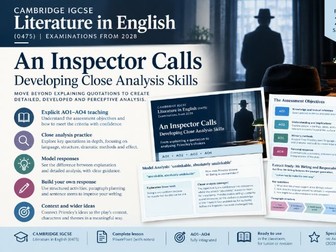
Specification: Cambridge IGCSE Literature in English (0475), examinations from 2028. An Inspector Calls is listed as a Drama set text for Paper 2 in the 2028 syllabus. Help students move beyond explaining quotations to producing detailed, developed and perceptive literary analysis with this classroom-ready PowerPoint lesson on J. B. Priestley’s An Inspector Calls. Designed for Cambridge IGCSE Literature in English, this resource focuses on close analysis, personal interpretation and the assessment objectives AO1–AO4. Students explore how Priestley uses language, dramatic methods and structure to communicate ideas about responsibility, social class and authority. What’s included Clear explanations of the four assessment objectives and how they contribute to a stronger response. A dedicated AO4 section showing the difference between a relevant, developed and perceptive personal interpretation. A model analysis of Birling’s claim that the Titanic is “unsinkable, absolutely unsinkable”. Guided close-analysis activities on Birling’s attitudes to responsibility and the Inspector’s final warning. Questions exploring language, pronouns, imagery, dramatic delivery, structure and audience response. A paragraph-building framework with sentence stems to support students’ written analysis. Independent practice using Eric’s criticism of his father. A self-assessment checklist and plenary task to help students identify their next steps. Learning objectives Students will learn to: Select precise textual evidence and sustain a clear response to a question. Explore the implications of a quotation rather than simply paraphrasing it. Analyse how Priestley’s language and dramatic choices create meaning and effects. Develop a personal interpretation that moves beyond obvious character descriptions. Connect detailed analysis to the play’s wider ideas and context where relevant.
Edexcel IGCSE English Literature: Top Band Comparative Anthology Poetry: Conceptual Essay PlanningQuick View
NickyMal

Edexcel IGCSE English Literature: Top Band Comparative Anthology Poetry: Conceptual Essay Planning

(0)
Help students develop thoughtful, sustained comparisons with this 17-slide PowerPoint for Edexcel International GCSE English Literature anthology poetry. Designed for students aiming for the top band, this lesson moves beyond identifying shared themes towards building a conceptual argument: exploring how poets’ ideas connect, where their perspectives differ and why those differences matter. This lesson was created because I found my students were struggling with how to construct the ‘perceptive’ comparisons for the top band of the mark scheme. The resource includes: • Clear references to AO2 and AO3, with guidance on applying the assessment criteria to essay planning. • A structured approach to developing an argument across four distinct stages. • Four comparative planning challenges, each followed by a teacher model plan. • Examples showing how to integrate language, form and structure into the comparison. • A final independent planning task and an exit ticket to check progression. The poem pairings explore fear and vulnerability in Prayer Before Birth and Hide and Seek; power and control in My Last Duchess and The Tyger; identity and belonging in Search for My Tongue and Half-caste; and memory in Piano and Poem at Thirty-Nine. Suitable for use after studying the poems, this resource supports focused revision, classroom teaching and small-group tuition. It encourages students to select precise evidence, develop perceptive comparisons and make every paragraph contribute to an increasingly assured judgement.
Of Mice and Men: Slim Edexcel IGCSE Top Band Essay WritingQuick View
NickyMal

Of Mice and Men: Slim Edexcel IGCSE Top Band Essay Writing

(0)
Help students develop a thoughtful, sustained argument about Slim’s importance in Of Mice and Men. Designed for Pearson Edexcel International GCSE English Literature, this 22-slide lesson focuses on AO1 and AO4 through the November 2020 past exam question. Students explore Slim’s earned authority, his compassion and the complexity of his practical judgements. Clear teaching explanations and guided activities show how to move from describing character traits to developing a convincing interpretation supported by accurate evidence and purposeful contextual links. The resource includes retrieval activities, comparisons with Curley, evidence and interpretation tasks, model openings and paragraphs, essay planning, independent writing and peer review. Separate answer slides and teacher notes support classroom delivery, with references to the official mark scheme. Suitable for Years 10 and 11 after studying the novel, particularly students working towards the top band. The editable PowerPoint can be taught as an extended lesson or divided across two sessions.
Cambridge IGCSE English Language Paper 1 0500 New Spec 2027–2029: Weather Forecasting Full PaperQuick View
NickyMal

Cambridge IGCSE English Language Paper 1 0500 New Spec 2027–2029: Weather Forecasting Full Paper

(0)
There is currently only one published sample paper for this series. Give students a further full Paper 1 reading practice with this original, 80-mark resource. It follows the structure and mark allocations of Cambridge’s specimen paper for examinations from 2027. The paper includes three original texts about weather forecasting, technology and human judgement and four questions covering comprehension, summary, writer’s attitude, language analysis and an extended response in role. A separate printable mark scheme provides indicative answers and guidance for each question, including distinct reading and writing criteria for the final task. The paper and mark scheme are supplied as editable Word documents, ready to print or adapt for lessons, homework or a timed mock.
Cambridge IGCSE English Language Paper 1 0500 new spec 2027-2029 Full PaperQuick View
NickyMal

Cambridge IGCSE English Language Paper 1 0500 new spec 2027-2029 Full Paper

(0)
Cambridge IGCSE First Language English 0500: Complete Paper 1 Practice Paper and Mark Scheme (2027 Format) There is currently only one published sample paper for this series. Give students a full Paper 1 reading practice with this original, 80-mark resource. It follows the structure and mark allocations of Cambridge’s specimen paper for examinations from 2027. The paper includes three original texts about lighthouses and four questions covering comprehension, summary, writer’s attitude, language analysis and an extended response in role. A separate printable mark scheme provides indicative answers and guidance for each question, including distinct reading and writing criteria for the final task. The paper and mark scheme are supplied as editable Word documents, ready to print or adapt for lessons, homework or a timed mock.
An Inspector Calls | Cambridge IGCSE Literature 0475 / 0992 | 2028 Essay Planning LessonQuick View
NickyMal

An Inspector Calls | Cambridge IGCSE Literature 0475 / 0992 | 2028 Essay Planning Lesson

(0)
A complete 17-slide An Inspector Calls lesson for Cambridge IGCSE Literature in English 0475/02 and 0992/02, designed for examinations from 2028. Students learn to plan a progressive response to the 25-mark Paper 2 drama question, then write one or two analytical paragraphs. The lesson includes learning targets, exam context, the 2028 specimen level descriptions, a starter, a four-paragraph plan, an optional fifth paragraph, conclusion guidance, a model paragraph and independent writing. Two original practice questions give students a choice of focus: Sheila’s changing attitude to responsibility or the Inspector’s powerful presence. The remaining essay is set as homework. The displayed mark scheme extract comes from Cambridge’s 0992/02 specimen material.
Advanced Creative Writing for 11+ Entrance ExamsQuick View
NickyMal

Advanced Creative Writing for 11+ Entrance Exams

(0)
Help pupils move beyond familiar descriptive techniques and make deliberate choices in their creative writing. This 15-slide PowerPoint is designed for selective 11+ English preparation, either in a taught lesson or as guided practice at home. The lesson shows pupils how to plan purposeful paragraphs, connect ideas through repeated details, control viewpoint and pace, withhold information, and choose precise language. A worked opening demonstrates these choices before pupils apply them in an independent writing task. The PowerPoint includes: A worked creative writing opening Guidance on linking paragraphs and developing an idea Advanced techniques for viewpoint, pacing and withholding information An independent writing task A final editing checklist Suitable for tutors, teachers and parents supporting pupils preparing for competitive independent school English entrance exams. Created by The English Entrance Press. This is an independently produced teaching resource and is not affiliated with any school.
Sevenoaks 11 plus English Paper: The Jungle BookQuick View
NickyMal

Sevenoaks 11 plus English Paper: The Jungle Book

(0)
Sevenoaks School 11+ English Practice Paper: The Jungle Book Give your child focused practice for the Sevenoaks School 11+ English assessment with a complete, independently written reading and creative writing paper. The paper follows the single passage approach of Sevenoaks School’s published Year 7 papers. Section A offers 15 marks of questions that develop close reading, inference and analysis. Section B offers 15 marks for a creative writing response. It includes space to plan and write, plus separate indicative answers and writing guidance, making it useful for a timed mock followed by careful review. Included: one printable practice paper and a separate answers and guidance PDF. This paper is designed for pupils preparing for Sevenoaks School 11+ English. It can also support strong readers preparing for selective independent school entrance exams.
Jekyll and Hyde Chapter 5: The Incident of the Letter | Current Eduqas GCSE LessonQuick View
NickyMal

Jekyll and Hyde Chapter 5: The Incident of the Letter | Current Eduqas GCSE Lesson

(0)
n editable 22-slide PowerPoint lesson aligned with the current Eduqas GCSE English Literature requirements for Component 2, Section B (19th-century prose). A brief chapter summary sets up the handwriting scene in The Incident of the Letter. Pupils explore what Guest notices about the two documents and why Utterson suspects Jekyll. They then choose another moment from the novel to answer the same question about how Stevenson creates suspicion. The lesson includes: A Chapter 4 retrieval starter and comprehension questions, with answers on the following slides. The Chapter 5 handwriting extract and vocabulary practice covering discrepancy, inference, complicity and withholding. An original 40-mark Eduqas-style question, with clear guidance on using the extract and evidence from elsewhere in the novel. Two model paragraphs, sentence starters, independent writing and homework on the missing messenger. Pupil-friendly AO1, AO2 and AO3 guidance and simplified mark-band descriptors.