

Build your own atoms!
Print onto thin card, provide split pins (one per atom), glue, scissors and coloured pens / pencils. Students make models of the first 5 elements - great fun for lower ability groups and reinforces the names, charges and relative positions of each subatomic particle.
 Quick View
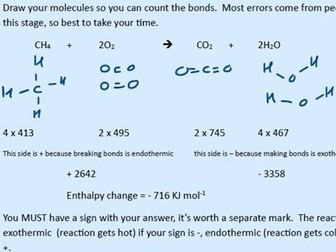
Bond enthalpy calculations KS4 chemistry
A complete worksheet with notes, worked example, then questions and worked answers for bond enthalpy calculations. Suitable for GCSE / IGCSE students.
More complete bundles of worked methods, questions and answers are available covering:
Calculating relative formula mass and number of moles
Calculating empirical formulae
Calculating masses (reactions involving solids only)
Calculating with gases (reactions involving only gases, or gases and solids)
Calculating with masses, gases and concentrations
Calculating waters of crystalisation
Bond enthalpy calculations
Calculating enthalpy change from experiments, Q = mcΔT
Calculating which material is in excess
 Quick View
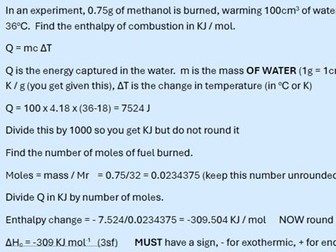
Calculating enthalpy changes Q = mc(delta)T
This is a complete set of brief notes, then a worked example, questions and answers for enthalpy change calculations suitable for IGCSE / GCSE students.
There is a more complete bundle available covering:
Calculating relative formula mass and number of moles
Calculating empirical formulae
Calculating masses (reactions involving solids only)
Calculating with gases (reactions involving only gases, or gases and solids)
Calculating with masses, gases and concentrations
Calculating waters of crystalisation
Bond enthalpy calculations
Calculating enthalpy change from experiments, Q = mcΔT
Calculating which material is in excess
 Quick View
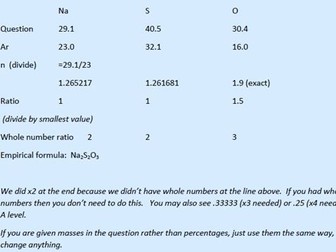
KS4 Chemistry calculations question bundle
This is a** complete set of calculations notes, questions and worked answers** for IGCSE / GCSE chemistry, or for students crossing into year 1 of A level chemistry. It is suitable for any of the exam boards.
Material covered:
Calculating relative formula mass and number of moles
Calculating empirical formulae
Calculating masses (reactions involving solids only)
Calculating with gases (reactions involving only gases, or gases and solids)
Calculating with masses, gases and concentrations
Calculating waters of crystalisation
Bond enthalpy calculations
Calculating enthalpy change from experiments, Q = mcΔT
Calculating which material is in excess
Each sheet contains a full, logical worked method plus notes of common errors to be avoided, then questions in exam style but not taken from papers - leaving the exam papers for the student to attempt unseen another day. Answers are either on the sheet, or on a separate sheet also provided.
If you do not want to purchase this as a bundle, the resources will also be posted separately.
 Quick View
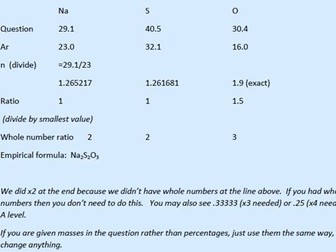
KS4 chemistry calculations empirical, finding the amount of a substance
Complete notes, worked examples, questions and worked answers for KS4 chemistry, suitable for any board at GCSE / IGCSE and for those transitioning to A level.
This bundle includes:
Calculating empirical formulae
Calculating masses (reactions involving solids only)
Calculating with gases (reactions involving only gases, or gases and solids)
Calculating with masses, gases and concentrations
Each worksheet has a full method, then questions and answers either at the end, or on a separate sheet. There is a more complete bundle also available which includes finding the waters of crystallisation, bond enthalpy calculations, finding the enthalpy change of a reaction, finding which material is in excess in a reaction.
undefined
 Quick View
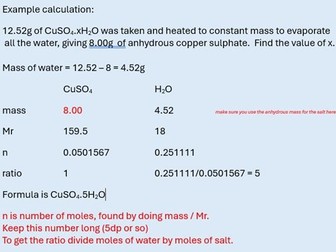
Waters of crystalisation practice
This is a complete set of notes, worked example, then questions and answers for calculating the number of waters of crystallisation in a hydrated salt. It is suitable for IGCSE / GCSE and A level chemistry.
 Quick View
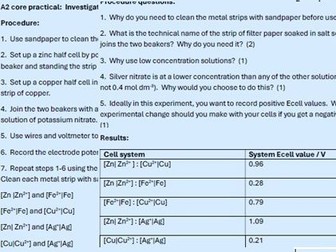
AS and A2 Chemistry practical resources
A full set of detailed notes comprising the most common practical experiments covered at AS and A level chemistry, based around OCR A and Edexcel International boards, but applicable across most exam boards.
Each document contains a description and notes on the experiment, followed by exam style questions on each experiment. Where needed, a set of representative results has been given for the student to work from.
These are ideal for any student who cannot do the practical element of the A level and should give you the practice in answering questions based on the core practicals.
AS:
Investigating the rates of hydrolysis of some haloalkanes
Analysis of some inorganic and organic unknowns (chemical tests)
Chlorination of 2-methyl propan-2-ol with concentrated HCl
Determination of the enthalpy change of a reaction using Hess’ Law
Finding the concentration of a solution of hydrochloric acid
Measurement of the molar volume of a gas
Oxidation of propan-1-ol to produce propanal and propanoic acid
A2:
Preparation of a transition metal complex
Using titration to follow the rate of iodine propanone reaction
Finding the Ka value for a weak acid
Investigating electrochemical cells
Preparation of aspirin
Finding the activation energy of a reaction
Redox titrations with iron and potassium manganate
The effects of DDT pesticide on bird populations
KS3 year 9 worksheet on the effects of DDT. Short passage to read, questions to answer and a bar chart to draw showing how the DDT builds up across the trophic levels. Some will find the bar chart difficult, but it works OK if you stress its the shape you are after, not necessarily accurate plotting.
Investigation into the morphic forms of chocolate
This powerpoint has been created using information from the PracticalChemistry website (which is excellent). You need to preprepare some chocolate by melting it and recooling it in the kitchen. The melting point, taste and texture of this chocolate are then compared to a fresh batch of the same. I used buttons as it was the simplest to regulate the amount used by the class. Water for melting the chocolate needs to be at no more than 42 deg C or it melts too fast to see the changes. Great fun, really enjoyed the experiment and although we could not necessarily determine melting point accurately enough to determine the morphic phase, we could at least see more than one morphic phase in the chocolate.
Assemble your own lunar Lander
3 files for print out to build your own lunar lander (LEM) as used in the first lunar landings. Best printed onto thin card. Assembly requires some fine motor skills, but KS3 main stream should manage it on their own. My Mum’s Brownies (KS2) managed it in pairs, sometimes with a little help. Copyright is to my Dad who designed it, but is happy to allow all users of TES and their classes to use this resource.
Excel file with Q numbers and descriptions vs evidence
basic excel file with Q numbers and descriptions vs evidence. A useful log for your Q evidence for doing PGCE and GTP. Easy enough to make, but saves you typing it out
Flick book for death of stars
Simple to make flick book for death of stars showing both red giant and red supergiant pathways. Good for lowish ability or a rainy Monday afternoon. Should help learn troublesome keywords