Véritables expressions idiomatiques pour le IB DP French BQuick View
smaigne

Véritables expressions idiomatiques pour le IB DP French B

(0)
I HAVE JUST UPDATED THIS DOCUMENT AND I AM NOW PROVIDING THE WORD VERSION INSTEAD OF THE PDF. In the Criterion A (Langue) for the Writing Component of Paper 1 of French B IBDP, most of us teachers have not understood what the IB means by “expressions idiomatiques”. See below what the site InThinking says about the matter but if you read the rapports pédagogiques (subject reports), you will see that the examiners complain about this issue and recommend that we educators teach real “expressions idiomatiques”. I have compiled here hundreds of them in this 10-page document (font 10). Please let me know if there is any issue. I will welcome your feedback. Merci. Les expressions idiomatiques sont parfois mal interprétées par les enseignants. Dans leur section Vos questions, nos réponses, le site InThinking dit aussi: Qu’entend-on par « expressions idiomatiques » (critère A, langue) ? « Des expressions idiomatiques sont utilisées » ne veut pas dire que les candidats doivent employer des proverbes (« À bon chat, bon rat » ; « L’habit ne fait pas le moine ») ou des expressions toutes faites (« mettre la main à la pâte » ; « tomber dans les pommes ») qu’ils arrivent rarement à intégrer de manière naturelle à la tâche prescrite. Les rapports pédagogiques déconseillent fortement cette approche : « Éviter les expressions idiomatiques mal maîtrisées (« sans trompette, ni tambour » (sic), etc.) car elles sonnent généralement faux et impressionnent rarement l’examinateur. » (Rapport pédagogique, mai 2018). Il s’agit plutôt d’employer des expressions idiomatiques comme « relever un défi », « dresser un bilan » ou « faire obstacle », qui contribuent à la précision de la langue. https://thinkib.net/frenchb/page/37670/vos-questions-nos-reponses
Writing an informal email French B IBDP conventions and useful vocabulary and phrasesQuick View
smaigne

Writing an informal email French B IBDP conventions and useful vocabulary and phrases

(0)
This is a handout to help students understand the conceptual understanding of an informal email (courriel amical / personnel) for the Paper 1 Writing component of the IBDP. The hand-out is 13-page long and contains the essential and optional conventions of the informal email as well as very useful vocabulary, phrases and sentences, including common slang and “emôticones” to use (moderately) in an informal text such as the journal intime. This will save time to educators who wish to teach that type of text. I have a similar document for the blog and the diary entry, another type of text prescribed by the IB. The vocabulary comes with an English translation for students. Please let me know if there is any issue.
Writing a diary entry French B IBDP conventions and useful vocabulary and phrasesQuick View
smaigne

Writing a diary entry French B IBDP conventions and useful vocabulary and phrases

(0)
This is a handout to help students understand the conceptual understanding of a diary entry for the Paper 1 Writing component of the IBDP. The hand out is 10-page long and contains the essential and optional conventions of the diary as well as very useful vocabulary, phrases and sentences, including common slang and “emôticones” to use (moderately) in an informal text such as the journal intime. This will save time to educators who wish to teach that type of text. I have a similar document for the blog, another type of text prescribed by the IB. The vocabulary comes with an English translation for students. Please let me know if there is any issue.
Writing a blog entry French B IBDP conventions and useful vocabulary and phrasesQuick View
smaigne

Writing a blog entry French B IBDP conventions and useful vocabulary and phrases

(0)
This is a handout to help students understand the conceptual understanding of a blog entry for the Paper 1 Writing component of the IBDP. The hand-out is 10-page long and contains the essential and optional conventions of the blog as well as very useful vocabulary, phrases and sentences, including complex structures with the subjunctive or the imperative, common slang and “emôticones” to use (moderately) in an informal text such as the blog (if the audience are teenagers). This will save time to educators who wish to teach that type of text. I have a similar document for the diary, another type of text prescribed by the IB. The vocabulary comes with an English translation for students. Please let me know if there is any issue.
El tiempo (weather) en 5 tiempos gramaticales (tenses): frases útilesQuick View
smaigne

El tiempo (weather) en 5 tiempos gramaticales (tenses): frases útiles

(0)
Phrases and sentences to describe the weather in 5 tenses: the imperfect (hacía calor), the preterite (hizo calor), the simple present (hace calor), the near future (va a hacer calor) and the remote/simple future (hará calor). Useful handout to stick in ex-books and encourage students to insert weather phrases and sentences in written and spoken work.
Improve your writing in Spanish Mat/HandoutQuick View
smaigne

Improve your writing in Spanish Mat/Handout

(0)
This is an A4 two-page document of a compilation of useful phrases and sentence starters to improve writing but also speaking skills. There is no English translation and this might be more targeted at the top band of Higher Tier GCSE and A-level. Teachers will have to either ask pupils to work on translations and equivalents at home, or do it in class with pupils, before the latter can use the mat/hand-out independently. It can be copied double sided and laminated as a mat or simply copied on one single sided A4 (two pages on one) and stuck in books. Any constructive feedback will be welcomed as I always wish to improve my resources.
GCSE Spanish Writing: How to write an email or article using Usted versus TúQuick View
smaigne

GCSE Spanish Writing: How to write an email or article using Usted versus Tú

(0)
In the Writing paper of Spanish GCSE, pupils will be required to write in formal register/style using the Usted form. They might need to write to a single person using Usted (Vd.) or to a group of people using Ustedes (Vds.) while writing a simple formal email, an online report or an online magazine article addressed to a teacher before an exchange, to a future employer or to unknown readers. In some cases, they will also need to convince the reader(s). This pack contains resources to teach the Usted form for the new Spanish GCSE writing exam (also useful for the speaking exam role-plays). It contains: a double A4 handout (that could be double sided for a mat or simply reduced to one A4 and stuck in books) on sentence starters to write a formal email/report/article using the Usted and Ustedes forms, with English translations. It contains also phrases to end the email/report/article as well as phrases to convince the reader(s). PDF doc. a double A4 handout (that could be double sided for a mat or simply reduced to one A4 and stuck in books) on sentence starters to write an informal email/report/article using the tú and vosotros forms, with English translations. It contains also phrases to end the email/report/article as well as phrases to convince the reader(s). PDF doc. a PPT to teach the Usted form in the context of a higher tier task of the Edexcel writing exam paper. To teach how to understand the instructions of a writing task when written in the Usted form. Normal PPT format for you to amend as you wish. The accompanying worksheet to this PPT. Word format for you to amend as you wish. Any constructive feedback will be welcomed as I always wish to improve my resources.
KS3 Spanish-speaking country research project handoutQuick View
smaigne

KS3 Spanish-speaking country research project handout

(0)
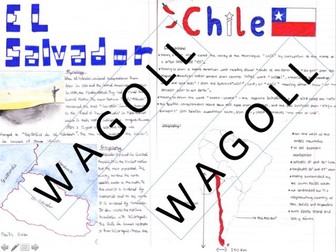
The new national curriculum emphasizes the need to teach the cultures of the Spanish-speaking countries. In order to meet this requirement as well as to motivate pupils into the learning of these amazing cultures, we ask our pupils at KS3 to pick un país de habla española (or a city/comunidad if there are more pupils than countries in a class) and research about it. However we set criteria in order to ensure quality. We also show previous years’ work as WAGOLLs so pupils know what they actually can do. We like it to be done in the exercise books and to be handwritten to make sure this will be their work. Here you will find two documents, the hand-out we give to pupils and the one we keep with the pupils’ names to know which pupil will be doing which country. *What a good one looks like