IGCSE Physics: Pitch & Loudness | Edexcel Modular | Unit 5 | L12Quick View
groggsy

IGCSE Physics: Pitch & Loudness | Edexcel Modular | Unit 5 | L12

(0)
IGCSE Physics: Pitch & Loudness | Edexcel Modular | Unit 5 | L12 This lesson covers spec points 5.26P, 5.27P, 5.28P and 5.29P — how an oscilloscope displays sound, and how pitch relates to frequency and loudness relates to amplitude. PowerPoint includes: • Retrieval starter reviewing period and frequency from oscilloscope traces • Direct Instruction (I Do) — pitch linked to frequency; loudness linked to amplitude; oscilloscope trace visualisations for all four combinations (high/low pitch × loud/quiet) • Guided Practice (We Do) — three case studies: whisper vs bass drum trace identification; wave pattern MCQ; volume vs speed misconception check • Independent Practice (You Do) — oscilloscope frequency measurement description; shouting vs talking trace change; guitar string pitch physics • Digital audio context discussion (gain and pitch manipulation) • Real-world application: string instruments (length, tension, mass) • Review and Reflect unit summary exit ticket — final lesson of Unit 5 Activity Sheet includes: • 2×2 grid of four labelled oscilloscope traces (A–D) for Q4 comparison task • Side-by-side example wave and blank grid for Q8 sketching task • 10 exam-style questions plus stretch covering pitch, loudness, oscilloscope method, and calculations • Stretch question requires frequency calculation and comparison of both pitch and loudness • Full mark scheme for teacher use
IGCSE Physics: Waves — Complete Unit Resource Pack | Edexcel Modular | Unit 5 | 12 LessonsQuick View
groggsy

IGCSE Physics: Waves — Complete Unit Resource Pack | Edexcel Modular | Unit 5 | 12 Lessons

(0)
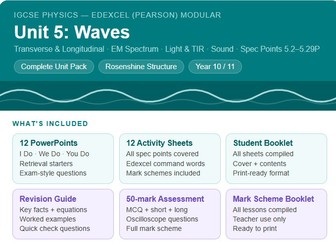
IGCSE Physics: Waves — Complete Unit Resource Pack | Edexcel Modular | Unit 5 | 12 Lessons This is the complete resource pack for Unit 5: Waves, covering all spec points 5.2–5.29P of the Edexcel IGCSE Physics (Modular) specification. Everything you need to teach, practise and assess the full Waves unit is included. What’s included (40+ files): 12 PowerPoints — each following the DES Lesson Cycle: Smart Start (retrieval starter, 4 questions with answers) Direct Instruction (I Do — worked examples, formula triangles) Guided Practice (We Do — 3 scaffolded problems) Independent Practice (You Do — Edexcel exam-style questions) Review and Reflect (traffic light exit ticket) 12 Activity Sheets / Practical Booklets — including: L1 — Types of Waves & Wave Properties L2 — The Wave Equation & Frequency-Period Relationship L3 — Oscilloscope Readings & Calculations (includes 4 labelled oscilloscope traces) L4 — The Doppler Effect L5 — The Electromagnetic Spectrum (includes full EM spectrum completion table) L6 — Properties of Light & Reflection (includes reflection results table) L7 — Core Practical: Investigating Refraction (full practical booklet with method, results, analysis and conclusion) L8 — Refraction Calculations — Snell’s Law L9 — Critical Angle & Total Internal Reflection L10 — Sound Waves & Hearing Range L11 — Core Practical: Speed of Sound in Air (full practical booklet with method, results, analysis and conclusion) L12 — Pitch & Loudness Compiled booklets: Student Activity Booklet — all 12 activity sheets in one document Mark Scheme Booklet — all 12 mark schemes compiled for teacher use Assessment: 50-mark end-of-unit assessment (10 MCQ + 7 structured questions) Full mark scheme included Revision materials: Revision Guide — all spec points 5.2–5.29P with key facts, equations, worked examples, examiner tips and quick check questions with answers Spec Checklist — RAG self-assessment covering all 29 spec points across 4 topic sections Spec points covered: 5.2–5.9 Wave properties, wave equation, Doppler Effect 5.10–5.13 Electromagnetic spectrum (uses and dangers) 5.14–5.22 Light waves, reflection, refraction, TIR, optical fibres (includes core practicals 5.17P and 5.19P) 5.23–5.29P Sound waves, hearing range, speed of sound (5.25P), oscilloscope investigation (5.27P), pitch and loudness All resources are: Aligned to the Edexcel IGCSE Physics (Modular) specification Written using Edexcel command words throughout Pitched to stretch top-end students with scaffolding for all Free from off-spec content — all spec point references checked Individual lessons from this unit are available separately.
IGCSE Physics: Sound Waves & Hearing Range | Edexcel Modular | Unit 5 | L10Quick View
groggsy

IGCSE Physics: Sound Waves & Hearing Range | Edexcel Modular | Unit 5 | L10

(0)
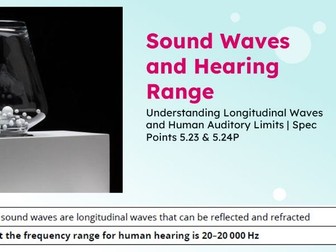
IGCSE Physics: Sound Waves & Hearing Range | Edexcel Modular | Unit 5 | L10 This lesson covers spec points 5.23 and 5.24P — sound as a longitudinal wave, transmission through media, and the human hearing range of 20–20,000 Hz. PowerPoint includes: • Retrieval starter comparing light and sound wave properties • Direct Instruction (I Do) — sound as longitudinal wave; compressions and rarefactions explained; speed in solids/liquids/gases; human hearing range stated • Guided Practice (We Do) — frequency classification task (audible/ultrasound); wave properties calculation; dog whistle application question • Independent Practice (You Do) — sound propagation description task; steel vs air speed analysis; ultrasound frequency conversion; media ranking task • Real-world context: QatarEnergy pipeline ultrasound crack detection • Misconception check: do sound waves carry matter? (true/false with reasoning reveal) • Review and Reflect traffic light Activity Sheet includes: • 11 exam-style questions plus stretch — spec-accurate (no infrasound) • Q5 tests boundary cases (15 Hz, 15,000 Hz, 25,000 Hz) • Q10 uses the Qatar hospital ultrasound context from the lesson • Stretch question covers reflection and refraction of sound (5.23) • Full mark scheme for teacher use
IGCSE Physics: The Electromagnetic Spectrum | Edexcel Modular | Unit 5 | L5Quick View
groggsy

IGCSE Physics: The Electromagnetic Spectrum | Edexcel Modular | Unit 5 | L5

(0)
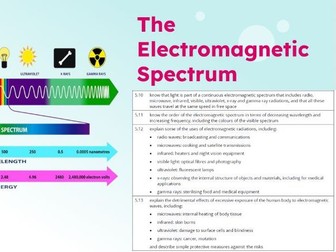
IGCSE Physics: The Electromagnetic Spectrum | Edexcel Modular | Unit 5 | L5 This lesson covers spec points 5.10, 5.11, 5.12 and 5.13 — common properties of all EM waves, the full spectrum order, and the uses and dangers of each band. PowerPoint includes: • Retrieval starter — list the visible spectrum in order • Direct Instruction (I Do) — common properties of all EM waves; full spectrum order with frequency/wavelength trends; detailed uses and dangers per band • Guided Practice (We Do) — three problems: identify EM wave from use case; hazard matching MCQ; fill-in-the-blanks on properties • Independent Practice (You Do) — compare UV and infrared dangers; two-property question; X-ray vs UV imaging question; ionising risk comparison • Order check activity (4 waves, longest to shortest wavelength) • Review and Reflect traffic light on spectrum order and uses Activity Sheet includes: • Task 1 — full EM spectrum completion table (dangers, uses, frequency/wavelength direction arrows) matching the lesson’s reference table • Task 2 — 8 exam-style questions plus stretch • Questions covering uses, dangers, ionising radiation, X-ray imaging, infrared applications • Stretch question evaluates a student claim about UV vs X-ray danger • Full mark scheme including completed table for teacher use
IGCSE Physics: The Doppler Effect | Edexcel Modular | Unit 5 | L4Quick View
groggsy

IGCSE Physics: The Doppler Effect | Edexcel Modular | Unit 5 | L4

(0)
IGCSE Physics: The Doppler Effect | Edexcel Modular | Unit 5 | L4 This lesson covers spec point 5.8 — explaining the change in observed frequency and wavelength when a source moves relative to an observer (the Doppler Effect). Entirely qualitative — no calculations required at IGCSE. PowerPoint includes: • Retrieval starter reviewing wave speed and frequency • Direct Instruction (I Do) — Doppler Effect defined; wavefront compression and stretching explained; stationary vs moving source comparison • Guided Practice (We Do) — three real-world scenarios: approaching train, stationary source, departing train • Independent Practice (You Do) — buzzer on a string exam question; wavefront sketch activity; racing car sequencing task • Misconception check: does wave speed change? (true/false with reasoning reveal) • Real-world discussion: mobile phone frequency bands • Review and Reflect exit ticket on observed wavelength Activity Sheet includes: • 10 questions plus stretch — entirely qualitative, matching spec requirements • Questions covering approaching, receding, stationary and relative motion scenarios • Q8 includes a wavefront sketch task • Q10 targets the relative motion misconception (observer moving with source) • Stretch question uses racing car sequencing activity from the lesson • Full mark scheme for teacher use
IGCSE Physics: Properties of Light & Reflection | Edexcel Modular | Unit 5 | L6Quick View
groggsy

IGCSE Physics: Properties of Light & Reflection | Edexcel Modular | Unit 5 | L6

(0)
IGCSE Physics: Properties of Light & Reflection | Edexcel Modular | Unit 5 | L6 This lesson covers spec points 5.9, 5.14, 5.15 and 5.16 — light as a transverse wave, the law of reflection, ray diagram construction, and specular vs diffuse reflection. PowerPoint includes: • Retrieval starter reviewing EM spectrum and wave types • Direct Instruction (I Do) — law of reflection stated; key terms defined; step-by-step ray diagram construction method • Guided Practice (We Do) — three ray diagram problems: basic angle, misleading surface angle, virtual image location • Independent Practice (You Do) — law of reflection question; angle calculation; specular vs diffuse explanation; periscope construction task • Misconception check: does diffuse reflection obey the law of reflection? (true/false with reasoning reveal) • Summary word-fill on image properties in a plane mirror • Review and Reflect traffic light on ray diagram accuracy Activity Sheet includes: • Results table for reflection practical (i = 10°–50°, two trials, mean, i = r? check) • 10 exam-style questions plus stretch covering law of reflection, angle calculations, specular/diffuse, and periscope • Q6 and Q10 include blank drawing spaces for ray diagram construction • Stretch question addresses the diffuse reflection misconception • Full mark scheme for teacher use
IGCSE Physics: Core Practical — Investigating Refraction | Edexcel Modular | Unit 5 | L7Quick View
groggsy

IGCSE Physics: Core Practical — Investigating Refraction | Edexcel Modular | Unit 5 | L7

(0)
IGCSE Physics: Core Practical — Investigating Refraction | Edexcel Modular | Unit 5 | L7 This lesson covers spec points 5.17P and 5.19P — investigating the refraction of light using a glass block and determining the refractive index. Structured as a full core practical lesson. PowerPoint includes: • Retrieval starter reviewing reflection and light properties • Safety and equipment briefing for ray box use • Direct Instruction (I Do) — full practical procedure demonstrated step by step; correct angle measurement explained; common pitfalls highlighted • Guided Practice (We Do) — collective data collection at three angles; data comparison with partner • Independent Practice (You Do) — ray diagram construction from measured results; error and improvement analysis • Expected results for i = 10°, 30° and 60° provided for reference • Review and Reflect traffic light on practical confidence Practical Activity Booklet includes: • Section 1 — Aim and equipment (with writing space) • Section 2 — 5-step method (numbered writing lines) • Section 3 — Results table (i = 10°–60°, two trials, mean, i > r? check, comment) • Section 4 — Ray diagram drawing space using i = 40° result • Section 5 — Analysis questions with writing lines • Section 6 — Conclusion comparing student results to accepted value n ≈ 1.5 • Full mark scheme for teacher use
IGCSE Physics: Refraction Calculations — Snell's Law | Edexcel Modular | Unit 5 | L8Quick View
groggsy

IGCSE Physics: Refraction Calculations — Snell's Law | Edexcel Modular | Unit 5 | L8

(0)
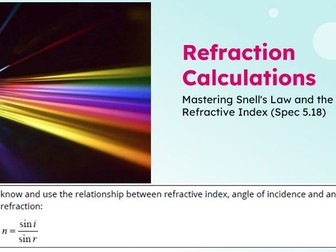
IGCSE Physics: Refraction Calculations — Snell’s Law | Edexcel Modular | Unit 5 | L8 This lesson covers spec point 5.18 — knowing and using n = sin i ÷ sin r to calculate refractive index, angle of incidence and angle of refraction. PowerPoint includes: • Retrieval starter reviewing practical data from L7 • Direct Instruction (I Do) — Snell’s Law introduced; formula triangle shown; two fully worked examples (finding n and finding r using inverse sine) • Guided Practice (We Do) — three scaffolded problems: finding n, finding r, and finding i (reverse rearrangement) • Independent Practice (You Do) — Edexcel-style questions including semicircular block, optical fibre, and i = 0° edge case • Refractive index concept check MCQ (n = 2.0 meaning) • Misconception check: can n be less than 1.0? (true/false with reasoning reveal) • Review and Reflect traffic light on calculator sin⁻¹ usage Activity Sheet includes: • Formulae box showing n = sin i ÷ sin r (base formula only, no rearrangements) • 11 exam-style questions of increasing difficulty • Questions covering finding n, finding r, finding i, unit conversion, and conceptual understanding • Stretch question addresses glass-to-water scenario (correctly flagged as beyond IGCSE) • Full mark scheme with full working for teacher use
IGCSE Physics: Critical Angle & Total Internal Reflection | Edexcel Modular | Unit 5 | L9Quick View
groggsy

IGCSE Physics: Critical Angle & Total Internal Reflection | Edexcel Modular | Unit 5 | L9

(0)
IGCSE Physics: Critical Angle & Total Internal Reflection | Edexcel Modular | Unit 5 | L9 This lesson covers spec points 5.20, 5.21 and 5.22 — defining and calculating critical angle, the conditions for TIR, and applications in optical fibres and prisms. PowerPoint includes: • Retrieval starter reviewing Snell’s Law and refraction • Direct Instruction (I Do) — critical angle defined; TIR conditions stated; sin c = 1/n introduced with worked example for glass (n = 1.5) • Guided Practice (We Do) — three critical angle calculations (water, diamond, and working backwards from c) • Independent Practice (You Do) — predicting ray paths at i = 30°, 42° and 55°; endoscope discussion; optical fibre and prism applications • TIR misconception check: can TIR occur going from air into water? (true/false with reasoning reveal) • Terminology matching activity • Review and Reflect exit ticket on dual TIR conditions Activity Sheet includes: • Formulae box showing sin c = 1/n • 11 exam-style questions plus stretch covering critical angle calculation, TIR conditions, optical fibres, prisms, endoscopes • Q8 includes a blank drawing space for the prism periscope ray diagram • Prism periscope answer diagram provided separately for teacher use • Stretch question involves core/cladding refractive index scenario • Full mark scheme for teacher use
IGCSE Physics: Types of Waves & Wave Properties | Edexcel Modular | Unit 5 | L1Quick View
groggsy

IGCSE Physics: Types of Waves & Wave Properties | Edexcel Modular | Unit 5 | L1

(0)
IGCSE Physics: Types of Waves & Wave Properties | Edexcel Modular | Unit 5 | L1 This lesson covers spec points 5.2, 5.3 and 5.4 — the difference between transverse and longitudinal waves, definitions of amplitude, wavefront, frequency, wavelength and period, and how waves transfer energy without transferring matter. PowerPoint includes: • Retrieval starter reviewing energy transfer and vibrations • Direct Instruction (I Do) — transverse vs longitudinal defined with diagrams; all five wave properties labelled • Guided Practice (We Do) — three visual-based scaffolding problems including wave annotation and longitudinal wave sequencing • Independent Practice (You Do) — Edexcel exam-style questions on wave types, definitions and energy transfer • Misconception check: amplitude vs pitch (true/false with reasoning reveal) • Review and Reflect exit ticket with traffic light self-assessment Activity Sheet includes: • 11 exam-style questions using Edexcel command words • Embedded transverse wave diagram for Q10 labelling task • Questions covering definitions, particle motion, compressions/rarefactions, and energy transfer • Stretch question comparing transverse and longitudinal particle motion with examples • Full mark scheme for teacher use
IGCSE Physics: The Wave Equation & Frequency-Period Relationship | Edexcel Modular | Unit 5 | L2Quick View
groggsy

IGCSE Physics: The Wave Equation & Frequency-Period Relationship | Edexcel Modular | Unit 5 | L2

(0)
IGCSE Physics: The Wave Equation & Frequency-Period Relationship | Edexcel Modular | Unit 5 | L2 This lesson covers spec points 5.5 and 5.6 — using v = fλ and f = 1/T, including unit conversions between Hz, kHz and MHz. PowerPoint includes: • Retrieval starter reviewing wave properties from L1 • Direct Instruction (I Do) — v = fλ and T = 1/f introduced with formula triangles; unit conversions for kHz and MHz; two fully worked examples • Guided Practice (We Do) — three scaffolded calculations: finding speed, finding frequency, and linking period to speed • Independent Practice (You Do) — multi-step exam-style calculations including MHz and period conversion problems • Logical steps ordering activity for unit conversion problems • Review and Reflect exit ticket on frequency-period mastery Activity Sheet includes: • Formulae box showing v = fλ and T = 1/f (base formulae only) • 11 exam-style questions of increasing difficulty • Questions covering Hz/kHz/MHz conversion, finding speed/frequency/wavelength, and multi-step problems • Stretch question involving ms unit conversion and wave type identification • Full mark scheme with full working for teacher use
IGCSE Physics: Core Practical — Speed of Sound in Air | Edexcel Modular | Unit 5 | L11Quick View
groggsy

IGCSE Physics: Core Practical — Speed of Sound in Air | Edexcel Modular | Unit 5 | L11

(0)
IGCSE Physics: Core Practical — Speed of Sound in Air | Edexcel Modular | Unit 5 | L11 This lesson covers spec point 5.25P — investigating the speed of sound in air using the echo method. Structured as a full core practical lesson. PowerPoint includes: • Retrieval starter reviewing wave speed equation and sound properties • Direct Instruction (I Do) — three methods explained (two-person timing, echo method, oscilloscope); reaction time error analysis; echo calculation worked example • Guided Practice (We Do) — three calculation problems including echo time and oscilloscope microphone separation • Independent Practice (You Do) — experimental design question; data analysis with anomaly identification; expected outcomes reference • Control variables discussion (temperature, humidity, wind) • Real-world application: thunder and lightning distance estimation • Review and Reflect traffic light on echo formula and anomaly identification Practical Activity Booklet includes: • Section 1 — Aim and equipment (with writing space) • Section 2 — 5-step method (numbered writing lines) • Section 3 — Results table (5 trials, total distance, speed, anomaly column, mean row) • Section 4 — Analysis questions with writing lines (anomaly, mean, error analysis) • Section 5 — Conclusion with scaffolded prompt comparing to accepted value 330–340 m/s • Full mark scheme for teacher use
IGCSE Physics: Density of Regular Objects | Edexcel Modular | Unit 4 | L1Quick View
groggsy

IGCSE Physics: Density of Regular Objects | Edexcel Modular | Unit 4 | L1

(0)
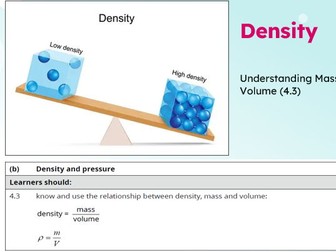
This lesson covers spec point 4.3 — knowing and using ρ = m/V to calculate density, mass and volume of regular objects. PowerPoint includes: Retrieval starter with questions reviewing prior knowledge and answers revealed Direct Instruction (I Do) — clear explanation of density with worked examples and formula triangle Guided Practice (We Do) — scaffolded problems worked through together Independent Practice (You Do) — exam-style questions of increasing difficulty Review and Reflect exit ticket with traffic light self-assessment Activity Sheet includes: 10 exam-style questions using Edexcel command words, ranging from recall to extended writing Stretch question for higher ability students Full mark scheme for teacher use This lesson is part of the complete Unit 4 resource pack, available separately at a discounted bundle price.
IGCSE Physics: Density Core Practical | Edexcel Modular | Unit 4 | L2Quick View
groggsy

IGCSE Physics: Density Core Practical | Edexcel Modular | Unit 4 | L2

(0)
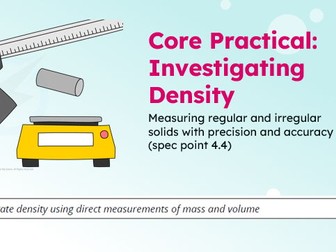
This lesson covers spec point 4.4 — investigating the density of regular and irregular objects using direct measurement and the Eureka can method. PowerPoint includes: Retrieval starter reviewing density calculations from Lesson 1 Direct Instruction (I Do) — step-by-step method for both regular and irregular objects Guided Practice (We Do) — class demonstration with prediction and discussion Independent Practice (You Do) — students carry out the practical in pairs Review and Reflect — sources of error and evaluation discussion Activity Sheet includes: Results tables for regular and irregular objects Reference table of common material densities Part C analysis questions for regular objects Part D analysis questions for the Eureka can method Stretch comparison question Full mark scheme for teacher use This lesson is part of the complete Unit 4 resource pack, available separately at a discounted bundle price.
IGCSE Physics: Pressure on Solids | Edexcel Modular | Unit 4 | L3Quick View
groggsy

IGCSE Physics: Pressure on Solids | Edexcel Modular | Unit 4 | L3

(0)
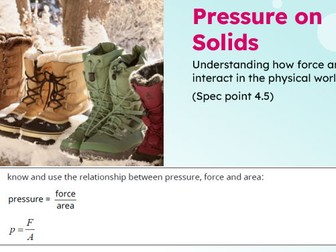
This lesson covers spec point 4.5 — knowing and using p = F/A to calculate pressure, force and area, and explaining real-world pressure scenarios. PowerPoint includes: Retrieval starter reviewing density and units from previous lessons Direct Instruction (I Do) — pressure equation introduced with real-world examples including knives, snowshoes and caterpillar tracks Guided Practice (We Do) — three worked problems with scaffolding and formula triangle Independent Practice (You Do) — exam-style questions of increasing difficulty True/False misconception check with reasoning reveal Review and Reflect exit ticket Activity Sheet includes: 9 exam-style questions using Edexcel command words Questions covering calculation, explanation and application to real-world contexts Stretch question linking pressure in solids to fluid pressure Full mark scheme for teacher use This lesson is part of the complete Unit 4 resource pack, available separately at a discounted bundle price.
IGCSE Physics: Particle Theory & Changes of State | Edexcel Modular | Unit 4 | L5Quick View
groggsy

IGCSE Physics: Particle Theory & Changes of State | Edexcel Modular | Unit 4 | L5

(0)
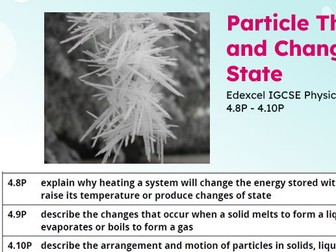
This lesson covers spec points 4.8P, 4.9P and 4.10P — describing particle arrangement and motion in solids, liquids and gases, and explaining heating curves in terms of kinetic and potential energy. PowerPoint includes: Retrieval starter reviewing changes of state and particle theory from prior learning Direct Instruction (I Do) — particle models for all three states, energy changes during heating explained clearly Guided Practice (We Do) — heating curve analysis worked through as a class Independent Practice (You Do) — exam-style questions including heating curve interpretation Misconception check on particle size during expansion Review and Reflect exit ticket Activity Sheet includes: 6 exam-style questions using Edexcel command words Embedded heating curve diagram (water, ice to steam) with labelled sections A→E for students to interpret Completion table linking graph sections to particle behaviour and energy changes Stretch question on kinetic and potential energy during boiling Full mark scheme for teacher use This lesson is part of the complete Unit 4 resource pack, available separately at a discounted bundle price.
IGCSE Physics: Change of State Core Practical | Edexcel Modular | Unit 4 | L6 & 7Quick View
groggsy

IGCSE Physics: Change of State Core Practical | Edexcel Modular | Unit 4 | L6 & 7

(0)
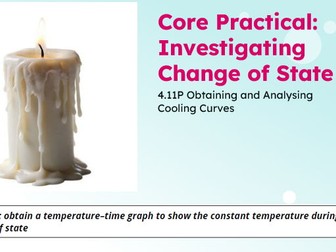
This two-lesson resource covers spec point 4.11P — obtaining a temperature-time graph to show constant temperature during a change of state, and identifying the freezing point of stearic acid. PowerPoint includes: Retrieval starter reviewing particle theory and energy changes from Lesson 5 Direct Instruction (I Do) — aim, method and safety explained clearly with equipment diagram Guided Practice (We Do) — class synchronisation of first readings, prediction of plateau position Lesson 1 Independent Practice — students carry out the cooling experiment in pairs, recording every 30 seconds Lesson 2 Independent Practice — students plot their cooling curve, circle the plateau and evaluate their results Sources of error analysis and command word matching activity Review and Reflect exit ticket Activity Sheet includes: Lesson 1 data collection table (0–900 seconds, pre-filled time column) Lesson 2 blank cooling curve graph grid (ready to plot) 6 analysis questions covering graph interpretation, particle explanation, sources of error and evaluation Stretch prediction question Full mark scheme for teacher use This lesson is part of the complete Unit 4 resource pack, available separately at a discounted bundle price.
IGCSE Physics: Specific Heat Capacity | Edexcel Modular | Unit 4 | L8Quick View
groggsy

IGCSE Physics: Specific Heat Capacity | Edexcel Modular | Unit 4 | L8

(0)
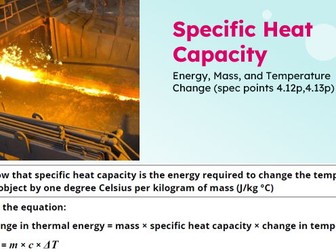
This lesson covers spec points 4.12P and 4.13P — defining specific heat capacity, and using ΔQ = mcΔT to calculate energy, mass, specific heat capacity and temperature change. PowerPoint includes: Retrieval starter reviewing change of state and energy from previous lessons Direct Instruction (I Do) — SHC defined, equation introduced with two fully worked examples including rearranging for mass Guided Practice (We Do) — three scaffolded problems of increasing difficulty Independent Practice (You Do) — four exam-style questions including a mystery metal identification problem High/low SHC misconception check with true/false reasoning reveal Real-world application — Qatar beach sand vs sea context question Review and Reflect exit ticket Activity Sheet includes: SHC reference table (water, sand, aluminium, copper, iron, lead) 8 exam-style questions using Edexcel command words Questions covering calculation, rearrangement, explanation and real-world application Stretch question using the Qatar beach/sand context Full mark scheme for teacher use This lesson is part of the complete Unit 4 resource pack, available separately at a discounted bundle price.
IGCSE Physics: Specific Heat Capacity Practical | Edexcel Modular | Unit 4 | L9Quick View
groggsy

IGCSE Physics: Specific Heat Capacity Practical | Edexcel Modular | Unit 4 | L9

(0)
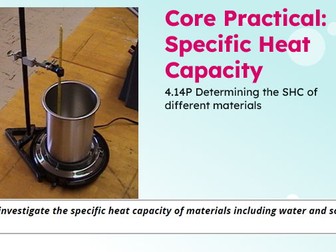
This two-lesson resource covers spec point 4.14P — investigating the specific heat capacity of aluminium using an immersion heater and joulemeter, calculating c from experimental results, and evaluating the method. PowerPoint includes: Retrieval starter requiring students to state and rearrange ΔQ = mcΔT Direct Instruction (I Do) — apparatus explained including role of oil, insulation and joulemeter Guided Practice (We Do) — assembly checklist, zeroing procedure and prediction of error direction Lesson 1 Independent Practice — students carry out the experiment, recording mass, temperatures and energy Lesson 2 Independent Practice — students calculate c, compare to accepted value of 900 J/kg°C and evaluate Temperature lag concept explained with graph Sources of error analysis and terminology matching activity Review and Reflect exit ticket Activity Sheet includes — Option 1 (Structured Practical Sheet): Aim and equipment section for students to complete Method section — 5 numbered steps for students to write in their own words Results table with 3 trials, anomaly identification and mean calculation Calculation scaffold: c = ΔQ ÷ (m × ΔT) = ___ ÷ (___ × ___) with comparison to accepted value Analysis questions covering why c is too high, role of oil, temperature lag and sources of error Conclusion section with structured writing guidance Full mark scheme for teacher use Activity Sheet includes — Option 2 (Extended Analysis Sheet): Lesson 1 data collection table Calculation scaffold box: c = ΔQ ÷ (m × ΔT) = ___ ÷ (___ × ___) with comparison to accepted value Lesson 1 analysis questions covering calculation, oil in holes, insulation and systematic error Lesson 2 data analysis questions including temperature lag and larger block misconception Stretch question on effect of block size on calculated c Full mark scheme for teacher use Both activity sheets are included in this resource. Option 1 is ideal for lower ability or less experienced students. Option 2 suits students who are confident with the method and ready to focus on deeper analysis. This lesson is part of the complete Unit 4 resource pack, available separately at a discounted bundle price.
IGCSE Physics: Solids, Liquids and Gases — Complete Unit Resource Pack | Edexcel Modular | Unit 4 |Quick View
groggsy

IGCSE Physics: Solids, Liquids and Gases — Complete Unit Resource Pack | Edexcel Modular | Unit 4 |

(0)
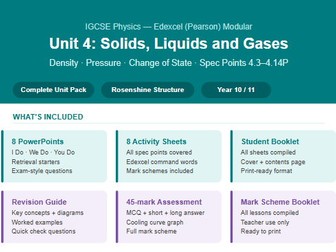
IGCSE Physics — Unit 4: Solids, Liquids and Gases | Complete Unit Resource Pack | Edexcel (Pearson) Modular This is a fully complete, exam-ready resource pack for Unit 4 of the Pearson Edexcel International GCSE Physics (Modular) specification, covering spec points 4.3–4.14P. Every resource has been built specifically for the modular specification and is ready to use from day one. What’s included: 8 PowerPoint Lesson Decks — each lesson is structured using the Rosenshine Principles of Instruction, with a clear I Do, We Do, You Do framework embedded throughout. Every lesson opens with a retrieval starter to activate prior knowledge and address misconceptions before new content is introduced. New material is introduced in small steps with clear worked examples (I Do), followed by scaffolded guided practice (We Do), building to independent exam-style practice (You Do). Lessons close with a review and reflect phase to consolidate learning. 8 Student Activity Sheets — one per lesson, covering all spec points including all three core practicals (4.4, 4.11P, 4.14P). Questions use Edexcel command words throughout and are pitched at the full range of ability, including stretch questions. Each sheet includes a full mark scheme. Student Activity Booklet — all 8 activity sheets compiled into a single print-ready booklet with cover page and contents. Ideal for exercise book replacement or folder inserts. Mark Scheme Booklet — all mark schemes compiled separately for teacher use. Revision Guide — a visually rich student revision booklet covering all 8 topics. Each topic includes a concise summary, key equations, a fully worked example and quick check questions. Includes diagrams for particle arrangements, pressure, heating curves and more. Answers included at the back. End of Unit Assessment — a 45-mark, 50-minute exam-style paper covering the full unit. Includes 5 multiple choice questions, short answer and extended writing questions, a cooling curve graph interpretation question, and answer lines throughout. A full mark scheme is included. Topics covered: Density of regular and irregular objects (4.3 & 4.4) Pressure on solids (4.5) Pressure in fluids (4.6 & 4.7) Particle theory and changes of state (4.8P–4.10P) Core practical: investigating change of state / stearic acid cooling curve (4.11P) Specific heat capacity (4.12P & 4.13P) Core practical: specific heat capacity of aluminium (4.14P) Designed for: Pearson Edexcel International GCSE Physics (Modular) — 4XPH1, Unit 1. Suitable for Year 10 or Year 11 depending on your scheme of work. Specification compliance: All resources are checked against the modular specification. No off-spec content (e.g. no percentage error questions). Practical skills are assessed through written questions in line with the examination approach. Can be used for the linear course too.
IGCSE Physics: Oscilloscope Readings & Calculations | Edexcel Modular | Unit 5 | L3Quick View
groggsy

IGCSE Physics: Oscilloscope Readings & Calculations | Edexcel Modular | Unit 5 | L3

(0)
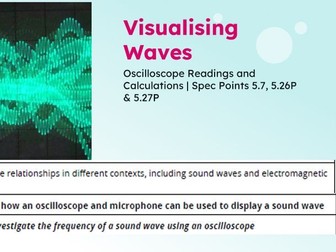
IGCSE Physics: Oscilloscope Readings & Calculations | Edexcel Modular | Unit 5 | L3 This lesson covers spec points 5.7, 5.26P and 5.27P — using wave equations in context, reading oscilloscope traces, and investigating frequency using an oscilloscope and microphone. PowerPoint includes: • Retrieval starter reviewing wave equations and frequency • Direct Instruction (I Do) — oscilloscope components, time-base settings, step-by-step period calculation from grid squares; worked example converting period to frequency • Guided Practice (We Do) — three trace analysis problems from simple to high complexity • Independent Practice (You Do) — exam-style period and frequency calculations; drawing predicted traces on grids • Virtual oscilloscope link (Academo.org) for interactive exploration • Conceptual check: does wave speed affect the trace? (true/false with reasoning reveal) • Review and Reflect traffic light exit ticket Activity Sheet includes: • Formulae box including T = n × t alongside v = fλ and T = 1/f • Four labelled oscilloscope traces (A–D) for analysis in Q4 • Blank oscilloscope grid for drawing task in Q8 • 10 questions plus stretch; covers trace reading, frequency calculation, µs/ms conversions • Stretch question links oscilloscope reading to wavelength calculation via v = fλ • Full mark scheme for teacher use