



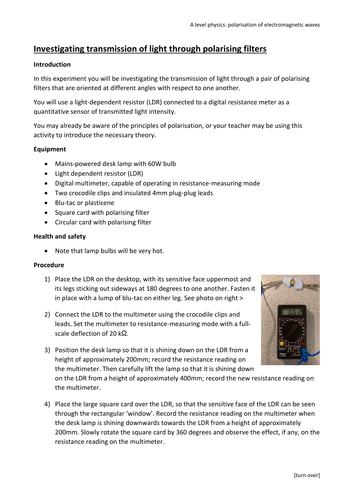
This resource is intended to help A level physics students investigate the transmission of light through polarising filters, perhaps as an introduction to the phenomenon of polarisation or maybe as a path towards Malus' law. The practical equipment required is the sort of thing that most A-level labs will already have - the 'light intensity sensor' in this case is simply an LDR connected to a multimeter set to measure resistance.
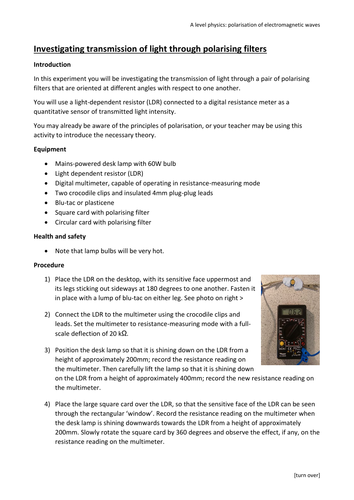
The resource includes a two-sided A4 instruction sheet for students (with photographs to help set up the equipment correctly) and a pre-prepared set of graph axes to speed up data plotting.
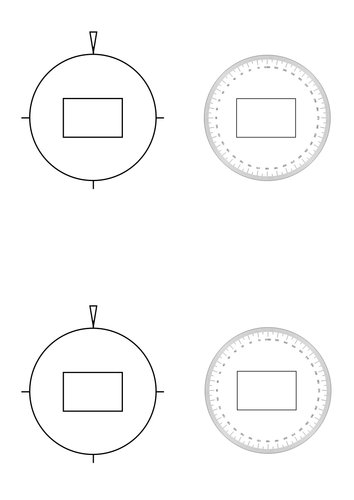
There is also a template for the two polarising filter holders with a built-in 360 degree protractor. Each template requires a small piece of linear polarising film (about the size of a 35 mm slide) to be mounted in alignment with masking tape or similar. Pieces of polarising film are available from educational suppliers and other sources. I have made up a class set of these and re-use them year after year.
The instructions are provided as a Word document, which can be amended to suit your local equipment. Desk lamps can obviously be substituted by any bright unpolarised light source (such as an LED torch, or smartphone 'flashlight') and, with a little more work, the LDR/multimeter could be replaced by a smartphone running a 'light intensity meter' app.
All three sheets (instructions, graph axes and filter templates) are also provided in PDF format.
The resource includes a two-sided A4 instruction sheet for students (with photographs to help set up the equipment correctly) and a pre-prepared set of graph axes to speed up data plotting.
There is also a template for the two polarising filter holders with a built-in 360 degree protractor. Each template requires a small piece of linear polarising film (about the size of a 35 mm slide) to be mounted in alignment with masking tape or similar. Pieces of polarising film are available from educational suppliers and other sources. I have made up a class set of these and re-use them year after year.
The instructions are provided as a Word document, which can be amended to suit your local equipment. Desk lamps can obviously be substituted by any bright unpolarised light source (such as an LED torch, or smartphone 'flashlight') and, with a little more work, the LDR/multimeter could be replaced by a smartphone running a 'light intensity meter' app.
All three sheets (instructions, graph axes and filter templates) are also provided in PDF format.
Something went wrong, please try again later.
This resource hasn't been reviewed yet
To ensure quality for our reviews, only customers who have downloaded this resource can review it
Report this resourceto let us know if it violates our terms and conditions.
Our customer service team will review your report and will be in touch.
£0.00