

 Quick View
Introduction to Projectiles
A-Level Mechanics: Introduction to Projectile Motion (20-slide PowerPoint Lesson)
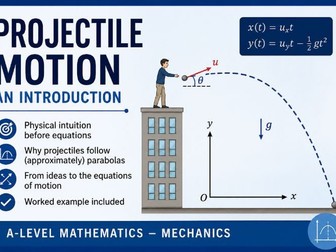
This resource is a complete introductory lesson on projectile motion for A-Level Mathematics (Mechanics).
Rather than beginning immediately with equations, the lesson develops the physical ideas behind projectile motion in a visual and intuitive way. Students are introduced to the concept through a series of thought experiments, including throwing a stone horizontally from a building and Newton’s famous Cannonball thought experiment.
The lesson explains:
• Why projectiles follow curved paths.
• The relationship between parabolas and elliptical orbits.
• Why a parabola is an excellent approximation for ordinary projectile motion.
• The assumptions used in the standard mathematical model (flat Earth, constant gravity, negligible air resistance).
• The force acting on a projectile and the resulting acceleration.
• How projectile motion can be understood as two independent motions occurring simultaneously.
• The choice of reference frame and coordinate axes.
• The vector equations of motion for projectiles.
• The four scalar equations used in A-Level Mechanics.
The PowerPoint contains clear diagrams, progressive visual explanations and a fully worked introductory example involving a projectile launched at an angle.
This lesson is particularly suitable for:
• Edexcel A-Level Mathematics (Mechanics)
• AQA A-Level Mathematics (Mechanics)
• OCR A-Level Mathematics (Mechanics)
• Further Mathematics students requiring a conceptual introduction to projectiles
The resource is designed to help students understand the underlying physics before applying the mathematical techniques, making it ideal as a first lesson on projectile motion.
Contents:
• 20 PowerPoint slides
• Learning objectives
• Visual introduction to projectile motion
• Newton’s Cannonball thought experiment
• Modelling assumptions
• Forces and acceleration
• Independent horizontal and vertical motion
• Vector and scalar equations of motion
• Worked example
Level:
A-Level Mathematics / Further Mathematics
Duration:
Approximately 45–60 minutes
Author:
Dr Miguel Navarro